The Storm Drain at Kahala Mall
Marjorie J. Walsh and Craig W. Walsh v. MMI Realty Services Inc. · Civil No. 1CCV-24-0000003 · Circuit Court of the First Circuit, State of Hawai‘i · Hon. Shirley M. Kawamura
I. The fall
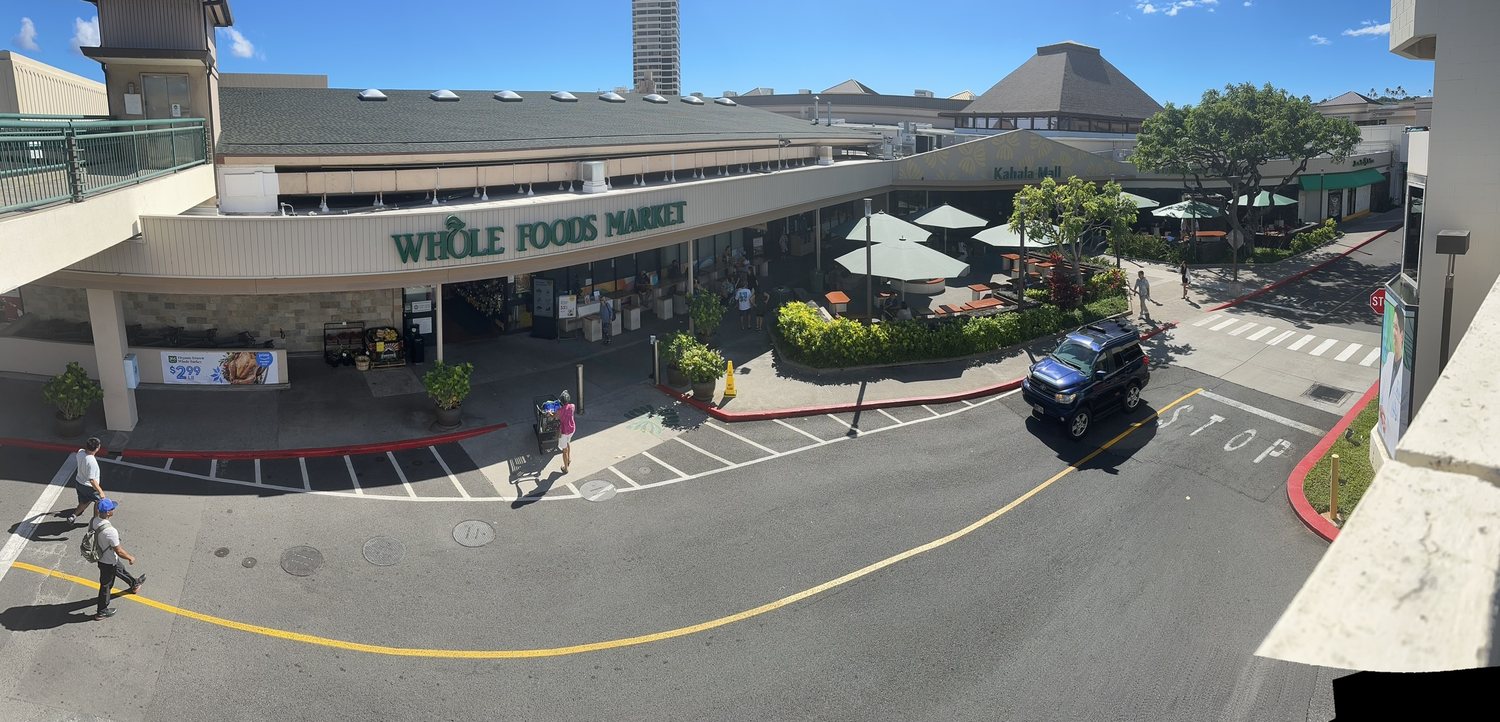
Wednesday, 16 August 2023. Craig and Marjorie Walsh had collected their mail on Halekauwila Street at three minutes past two, window-shopped at the Hilton Hawaiian Village, and had an ice cream at Lappert’s. They left the Hilton at one minute past four. Marjorie wanted milk and yoghurt, so they drove down Kalakaua Avenue and around Diamond Head to the Whole Foods at Kahala Mall, arriving at 4:28 p.m. Craig’s phone logged all of it.
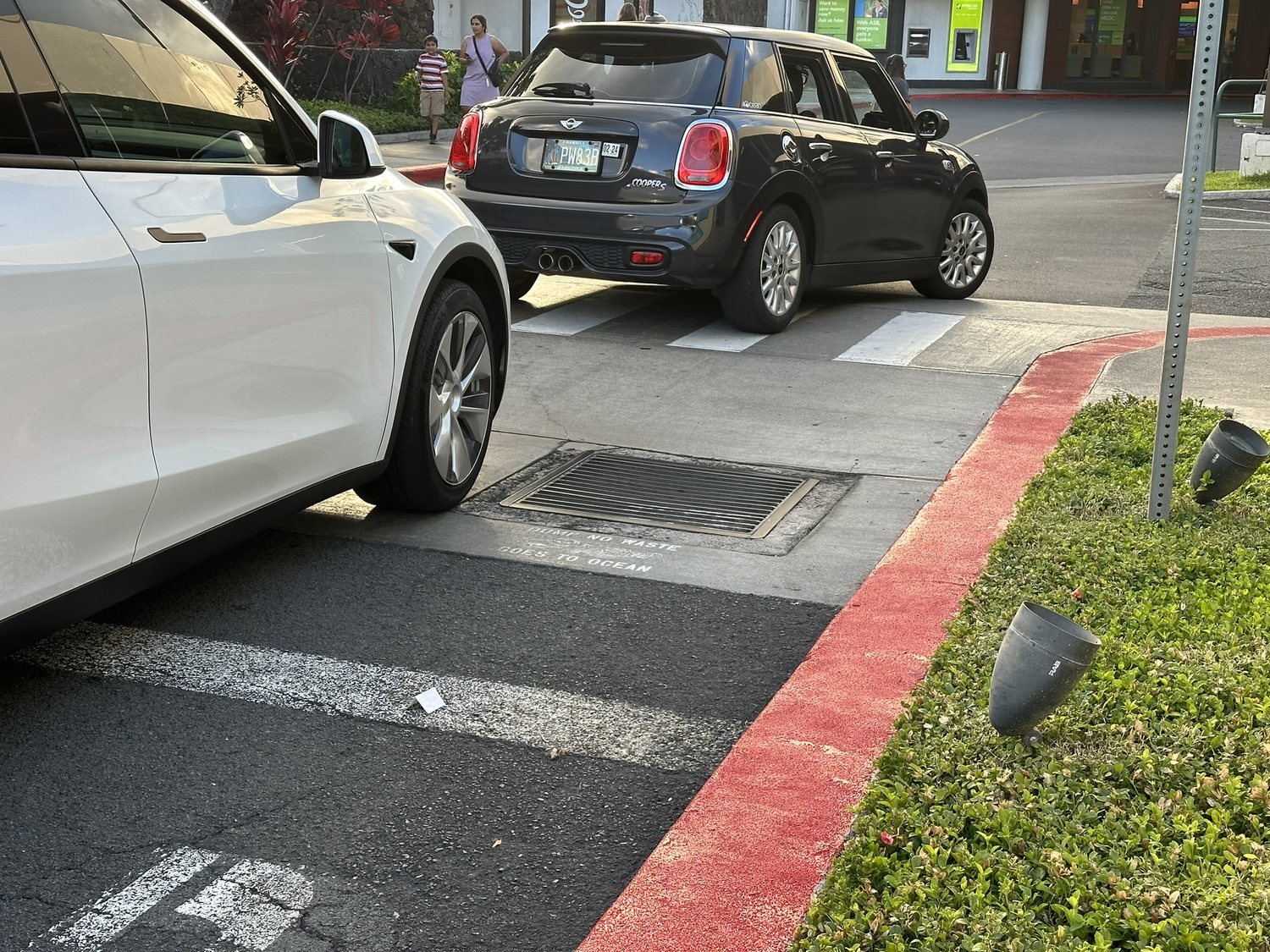
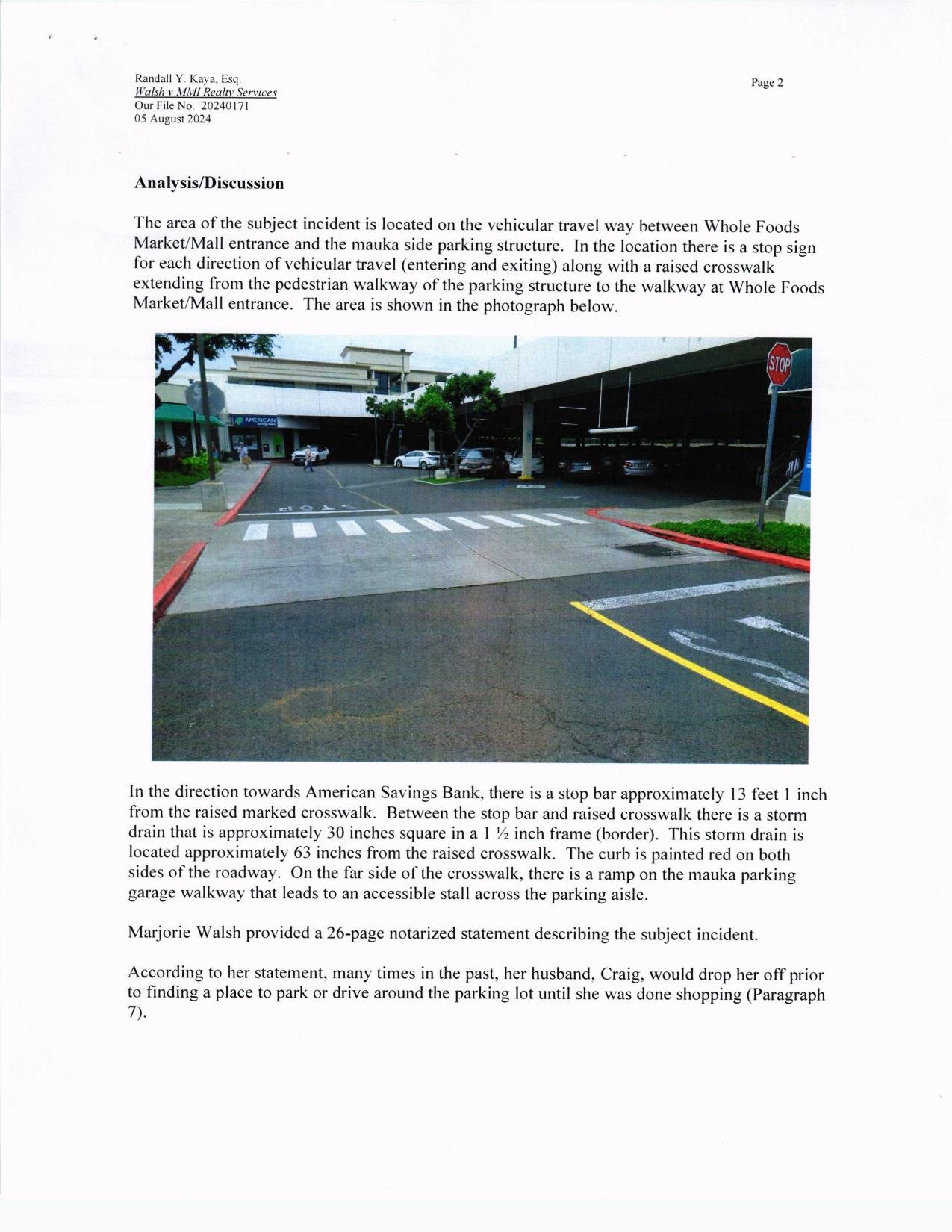
Both were seventy-four. Both held disabled parking permits — not because either used a stick, but because neither could walk far without back pain. The lot in front of Whole Foods was crowded, as usual, and there is nowhere to stop: the kerb is painted red from The Counter Custom Burgers to past the American Savings Bank, on both sides. So they did what they had done a dozen times before. Craig pulled up just short of the crosswalk, and Marjorie got out to shop while he found a space.
I stepped out of the car, closed the door, and turned to walk behind the car as is my custom. I promptly tripped on the storm grating or its decayed surround and fell. I fell towards the car and the crosswalk, with my left hand (which I used to stop my fall) going beneath the car. Craig — unaware of my fall — almost ran over my hand. Kind bystanders urgently made signals to Craig to remain stopped, which he did.
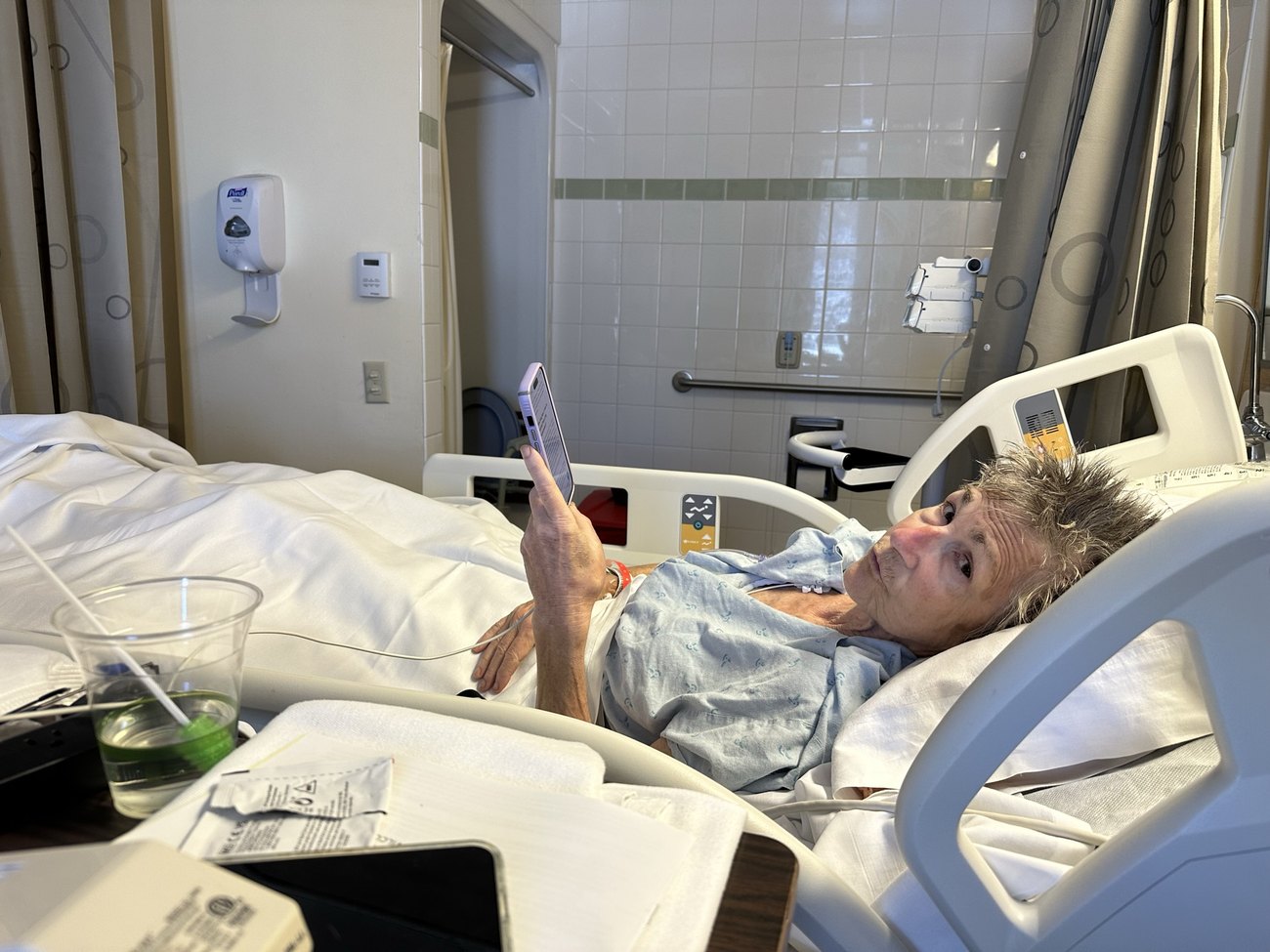
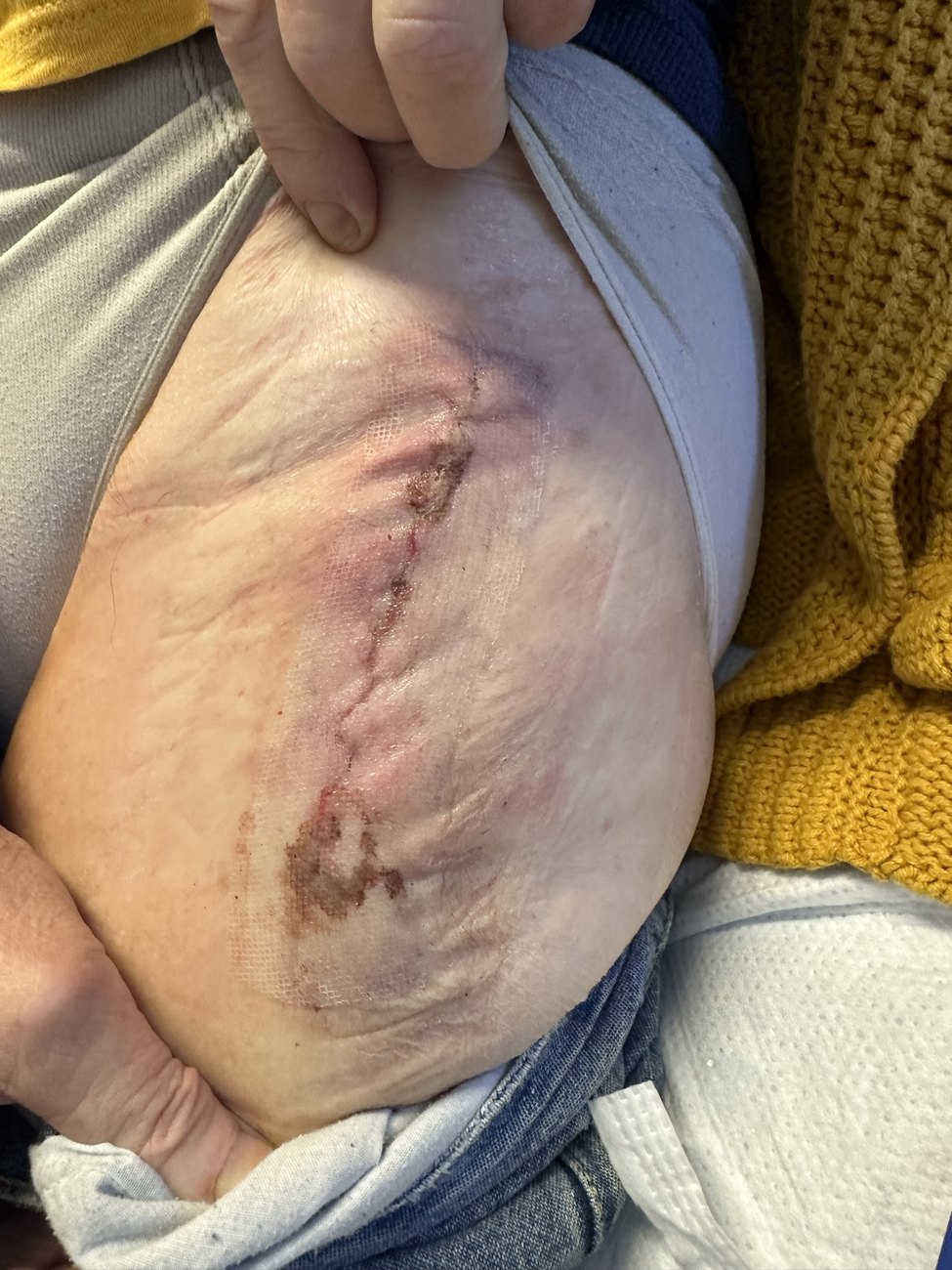
She had broken her femur. Because it broke at the head, the repair was a hip replacement she did not otherwise need. Two nights in hospital.
A mall security guard arrived, a man named Gifford H. John. He wanted a statement. Craig wrote their names, telephone numbers and email addresses on the guard’s clipboard and said his priority was getting his wife to a hospital. Nobody took the names of the bystanders who had stopped to help — although the State of Hawai‘i Guard Card training the guard held requires witness details to be collected.
They left Kahala Mall at 4:42 p.m., fourteen minutes after arriving, and reached the Straub Clinic emergency room at 4:55. Four members of the ER staff were needed to get Marjorie out of the car.
II. The drain
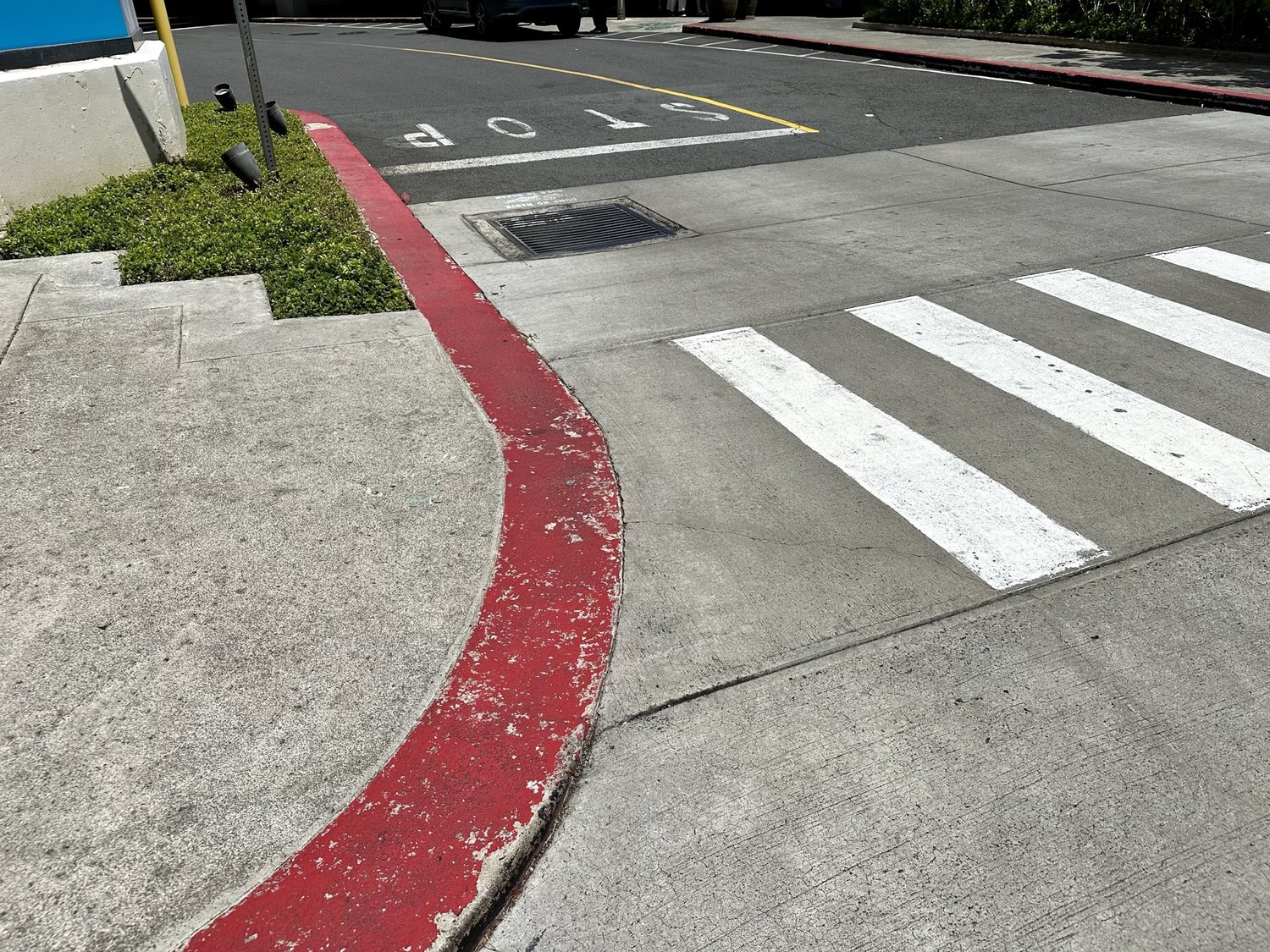
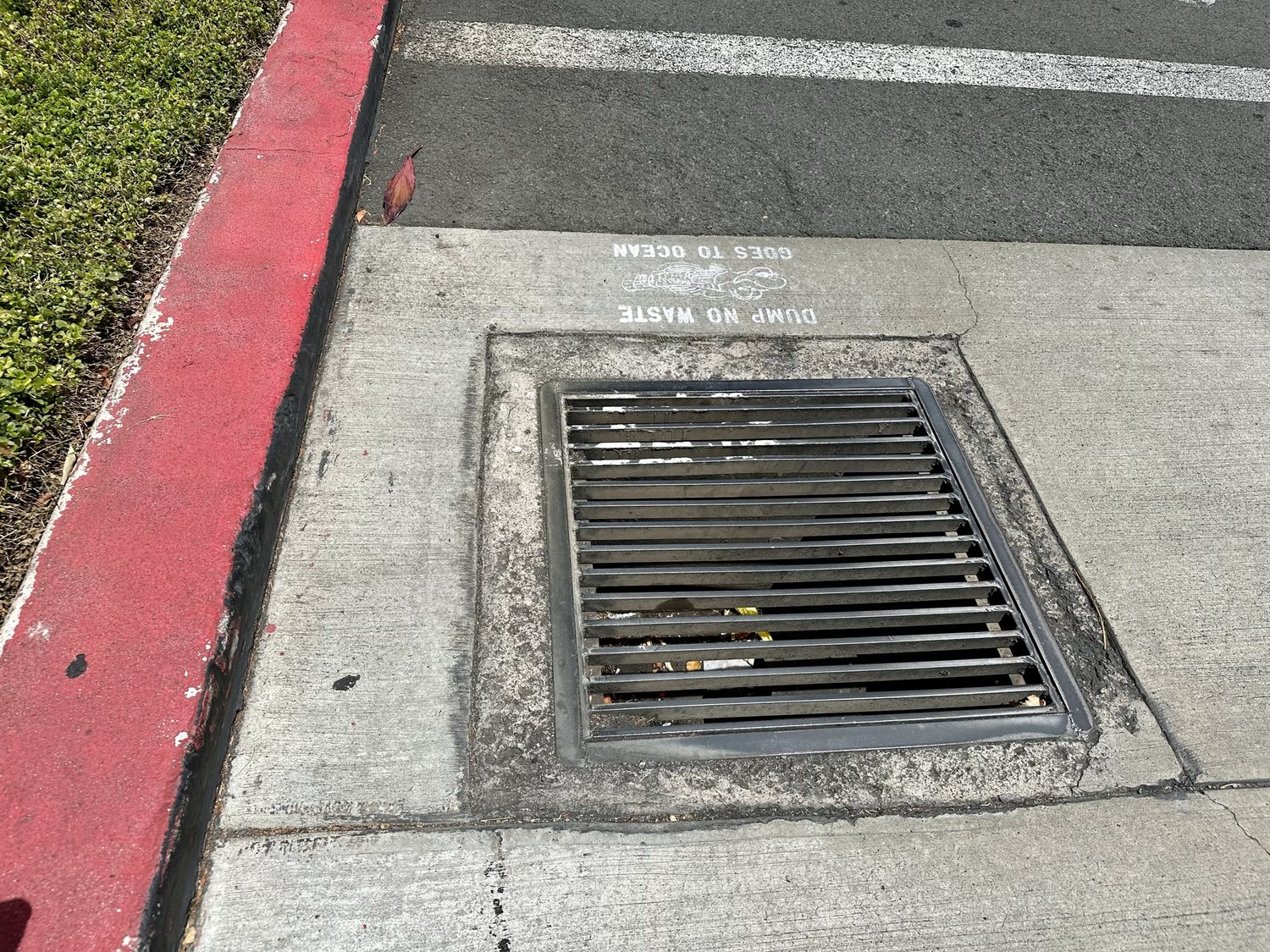
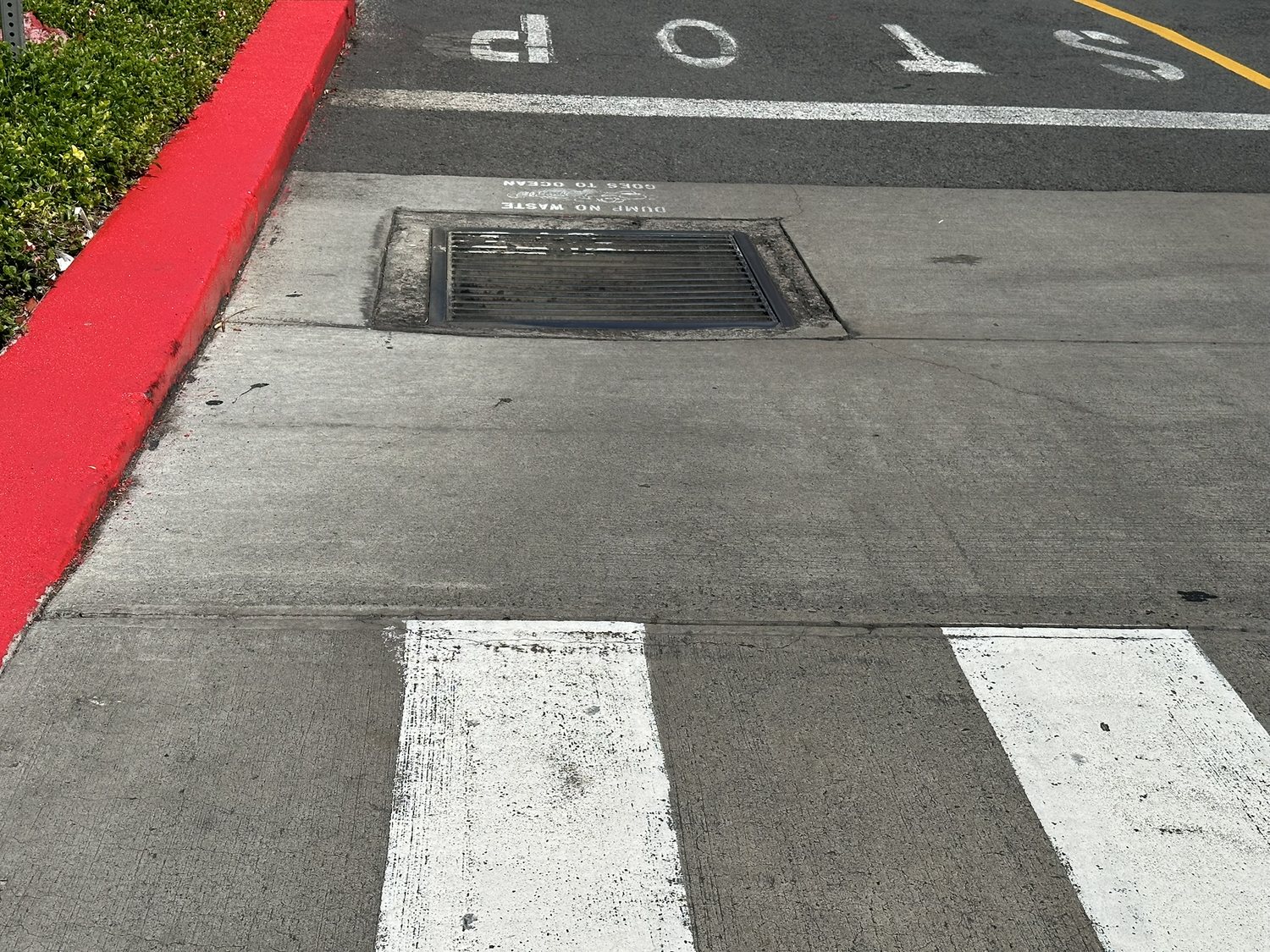
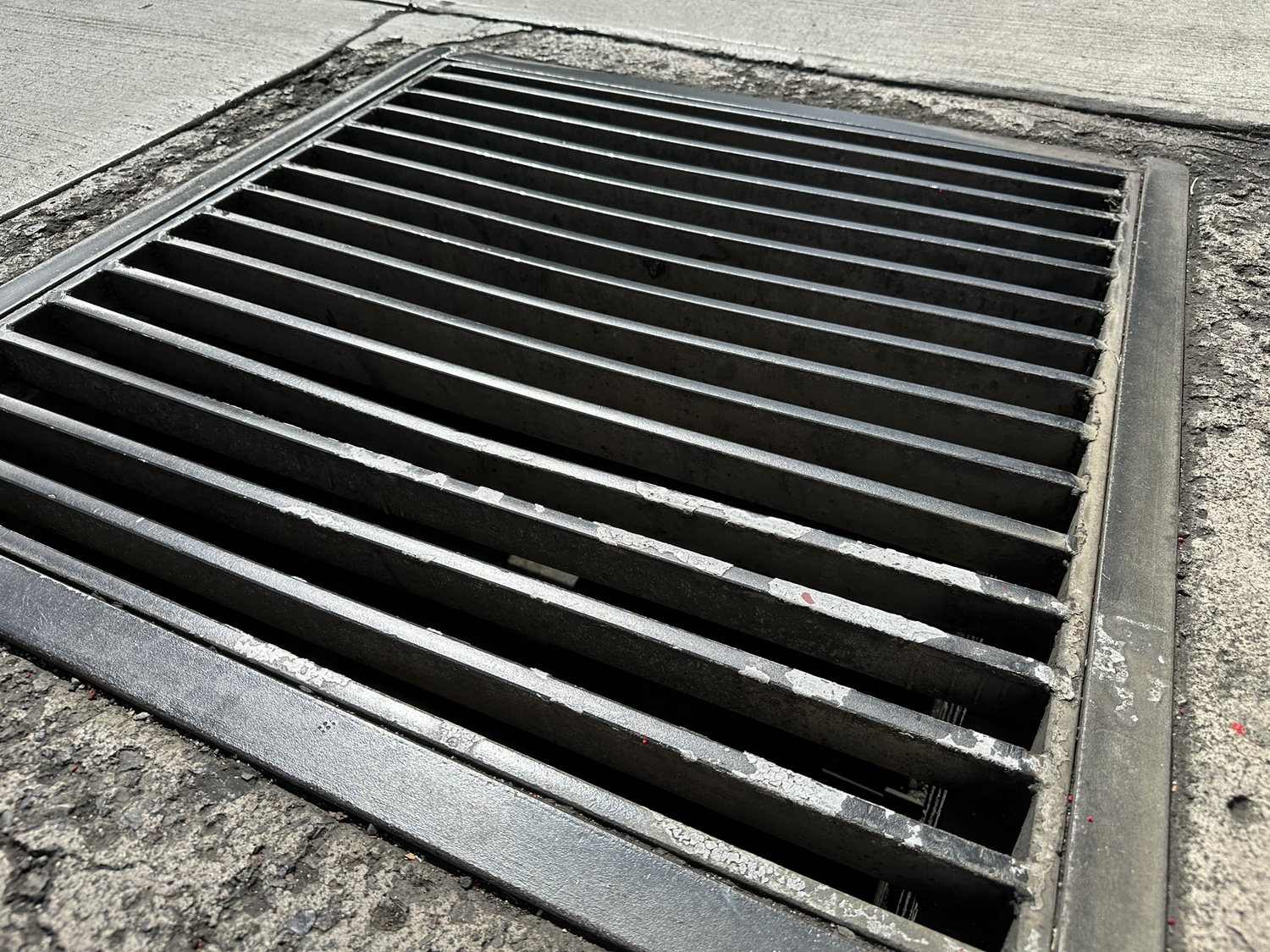
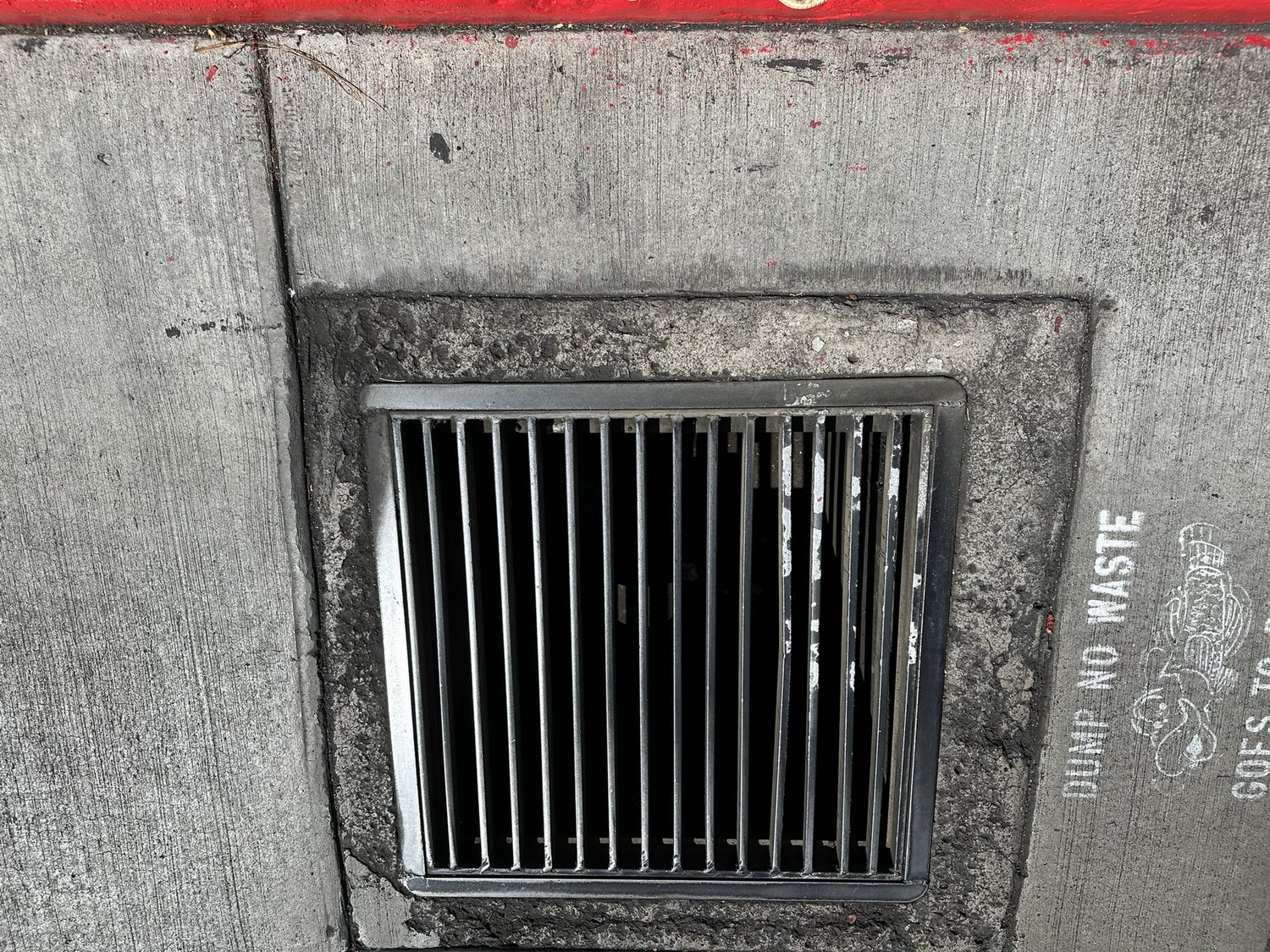
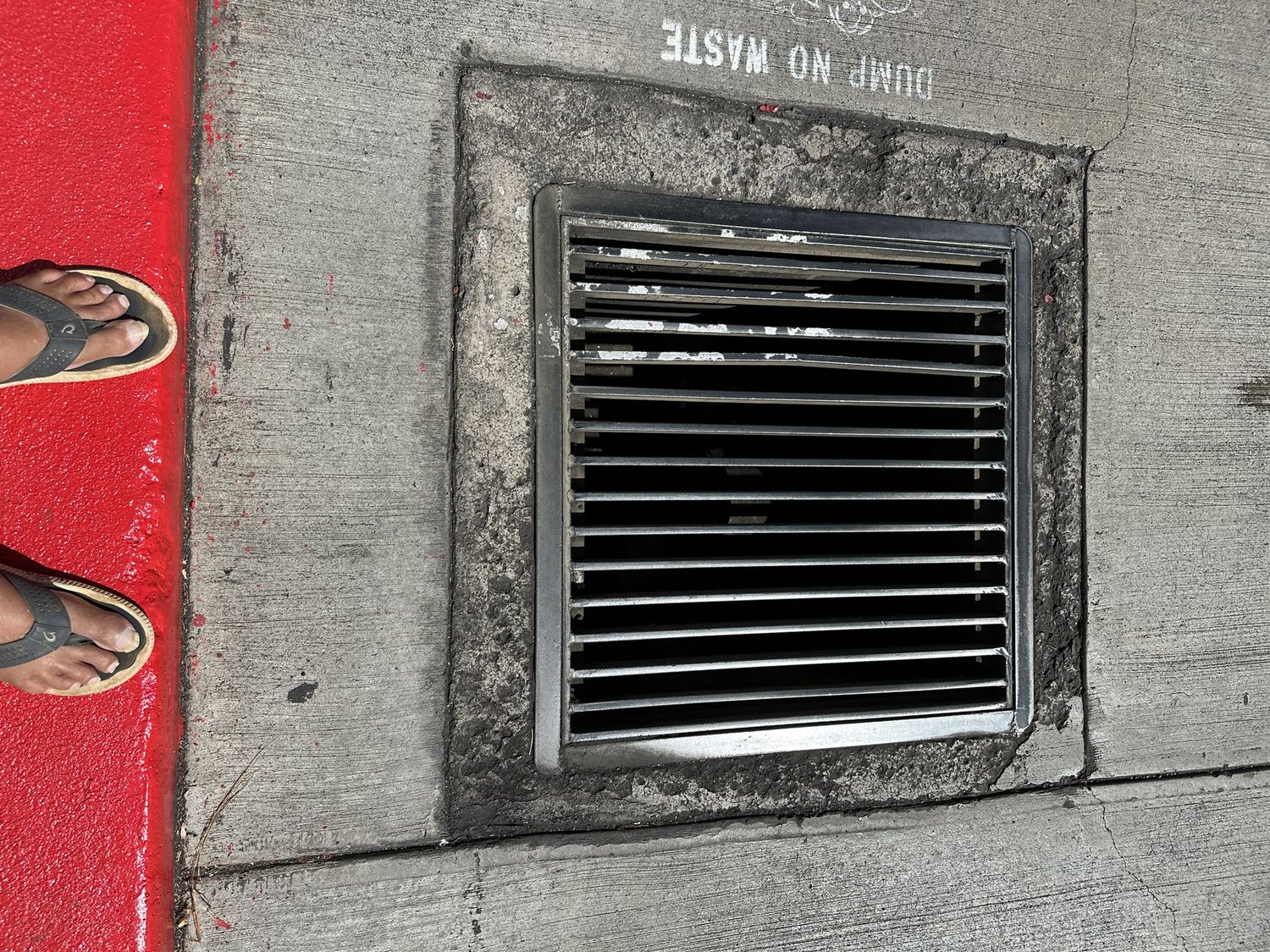
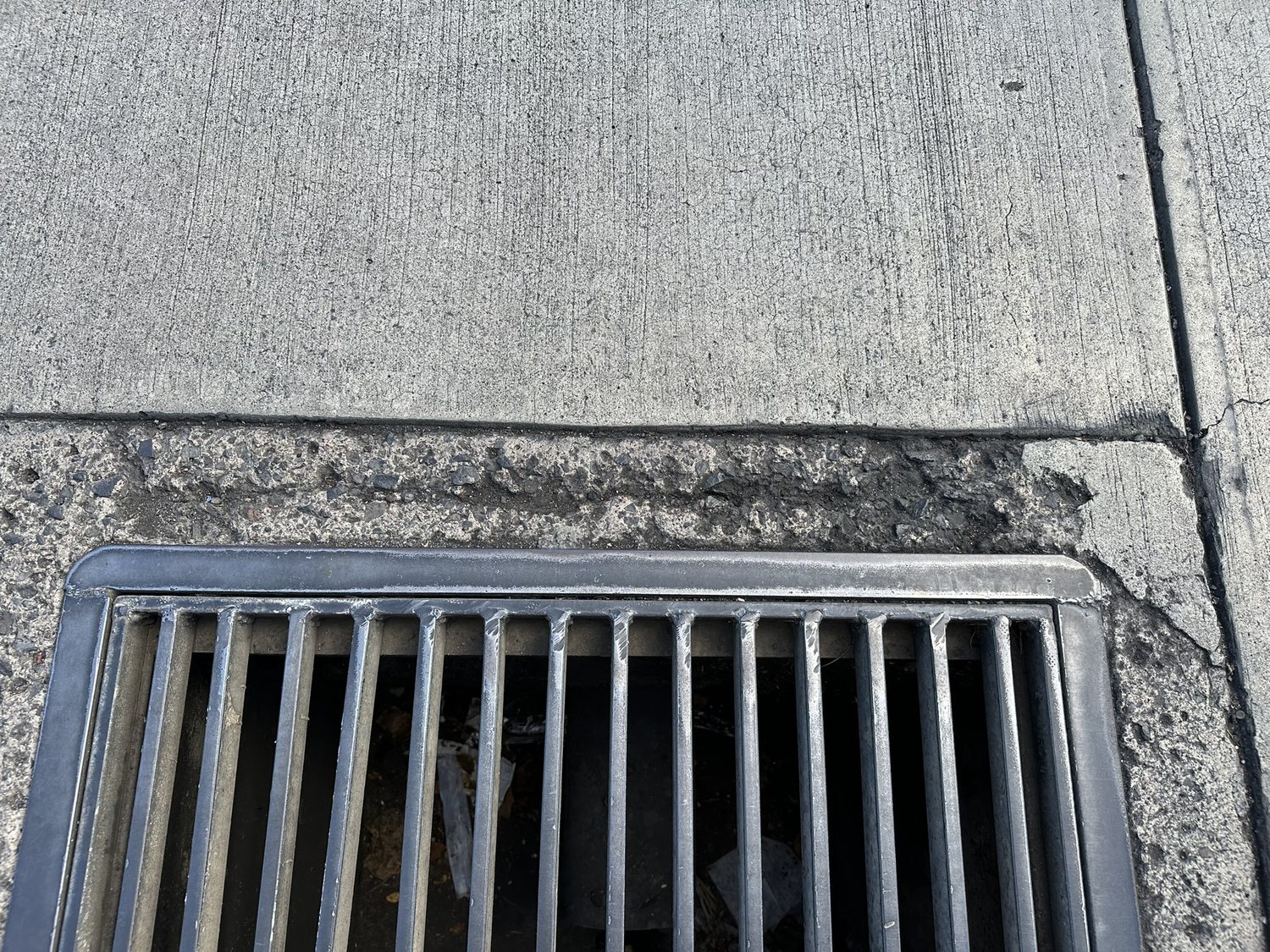
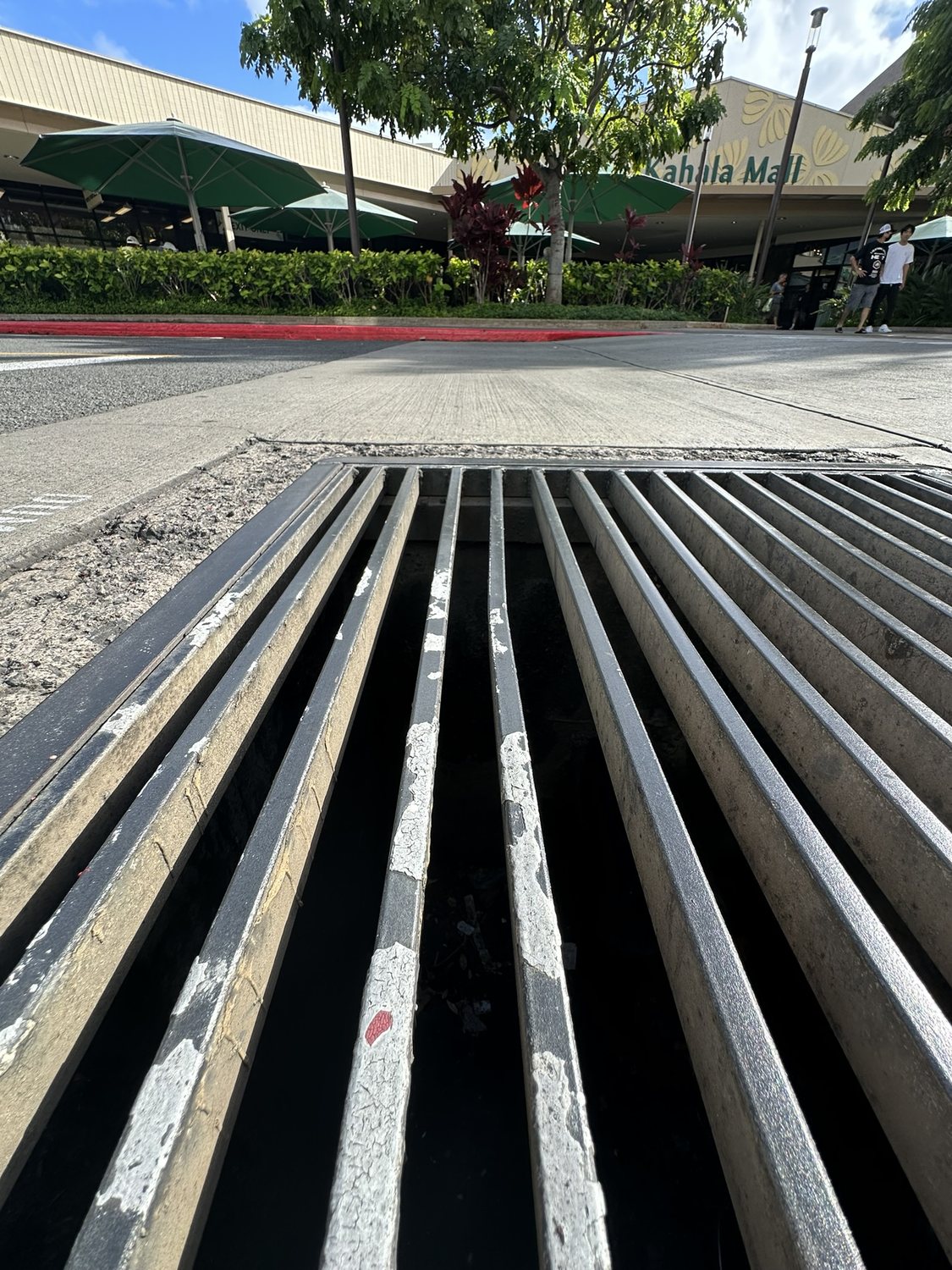
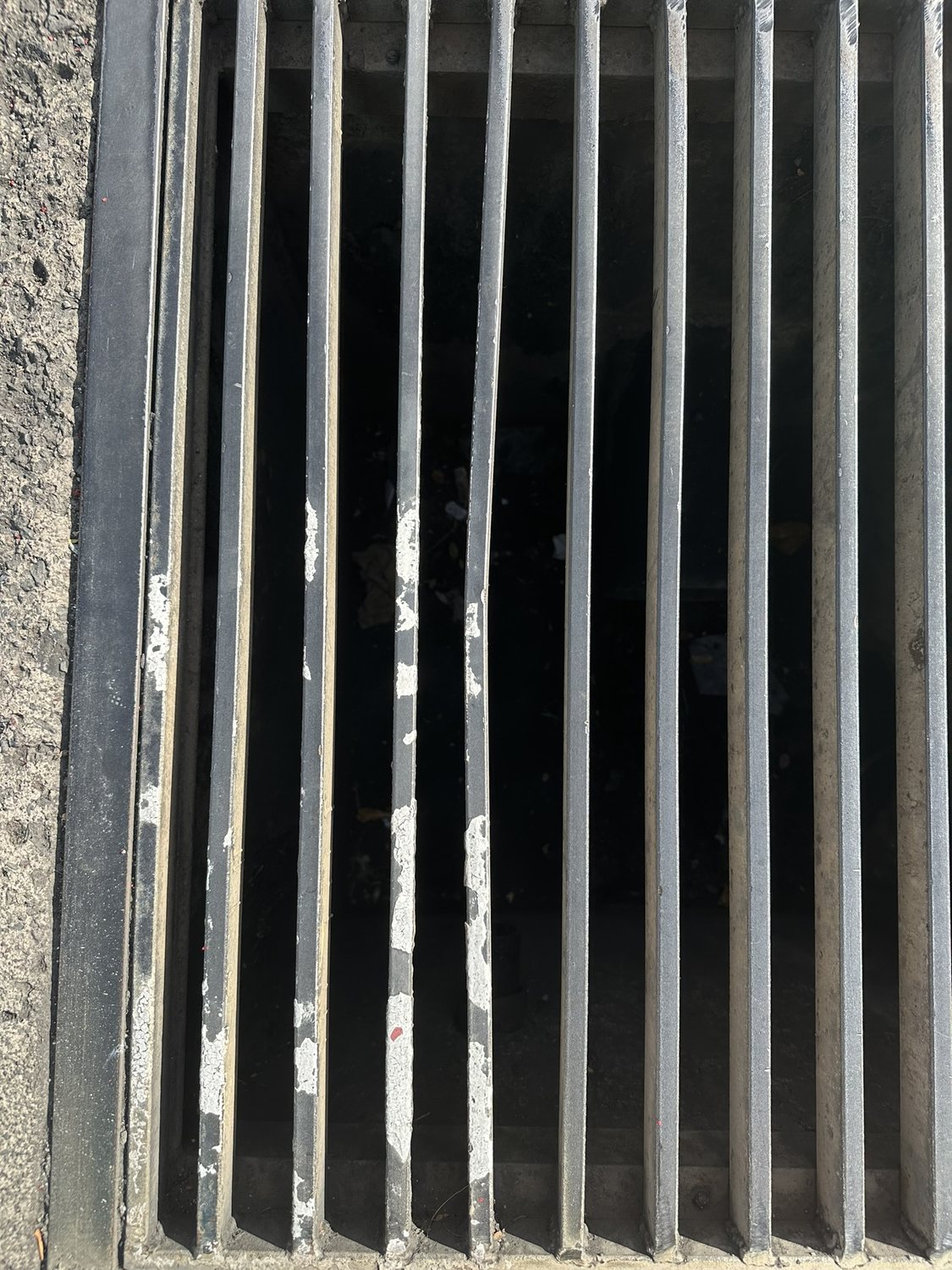
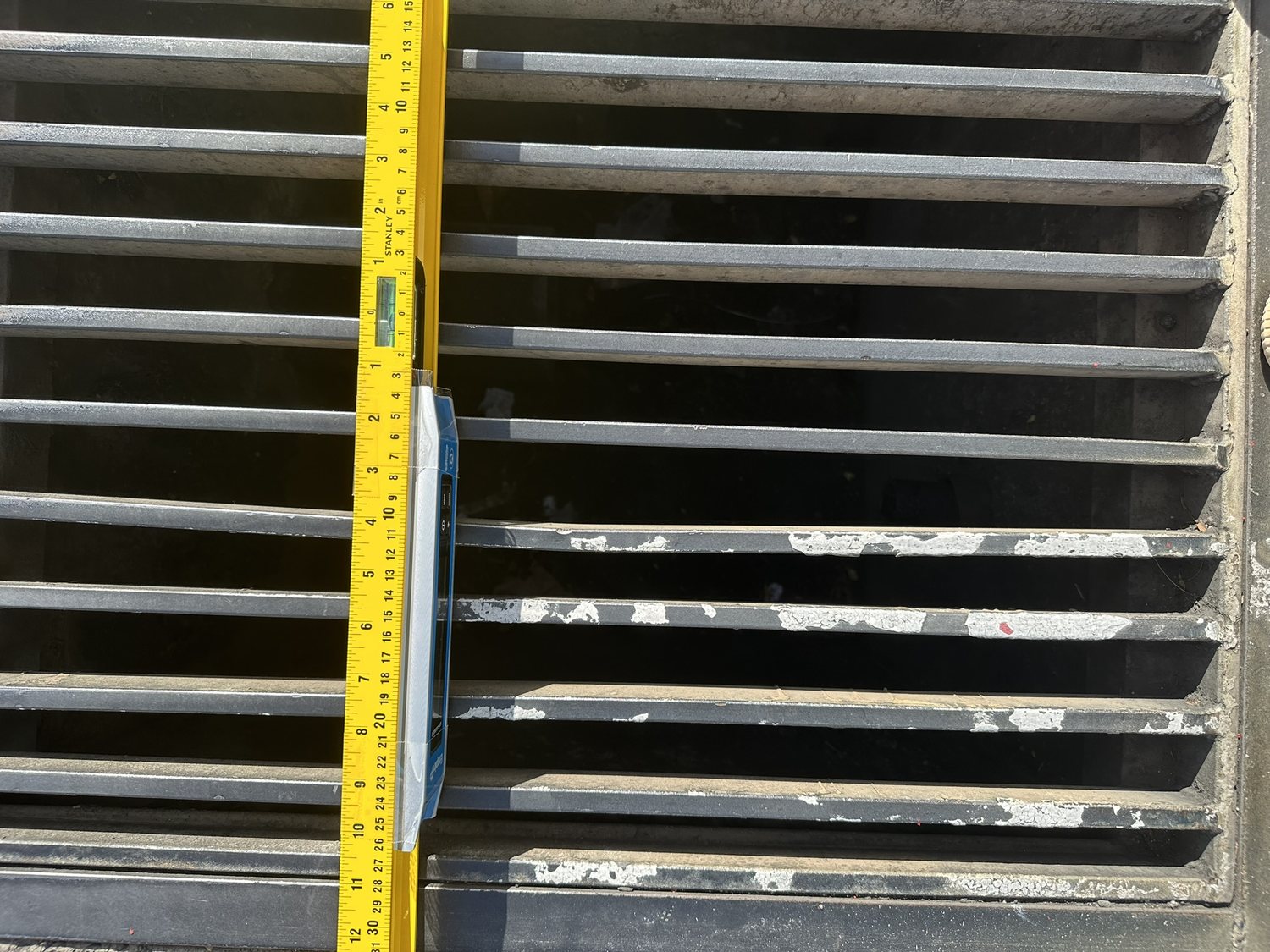
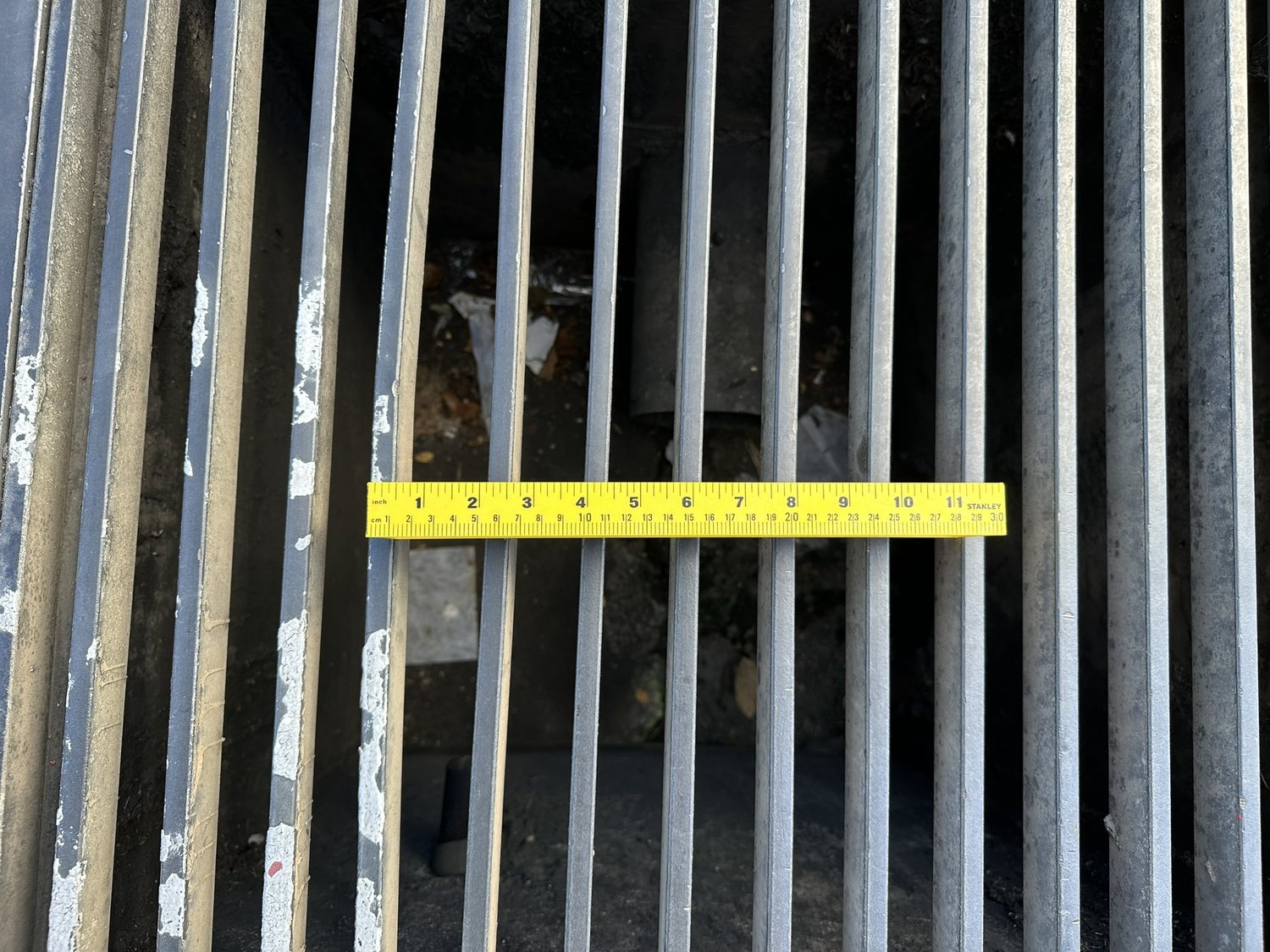
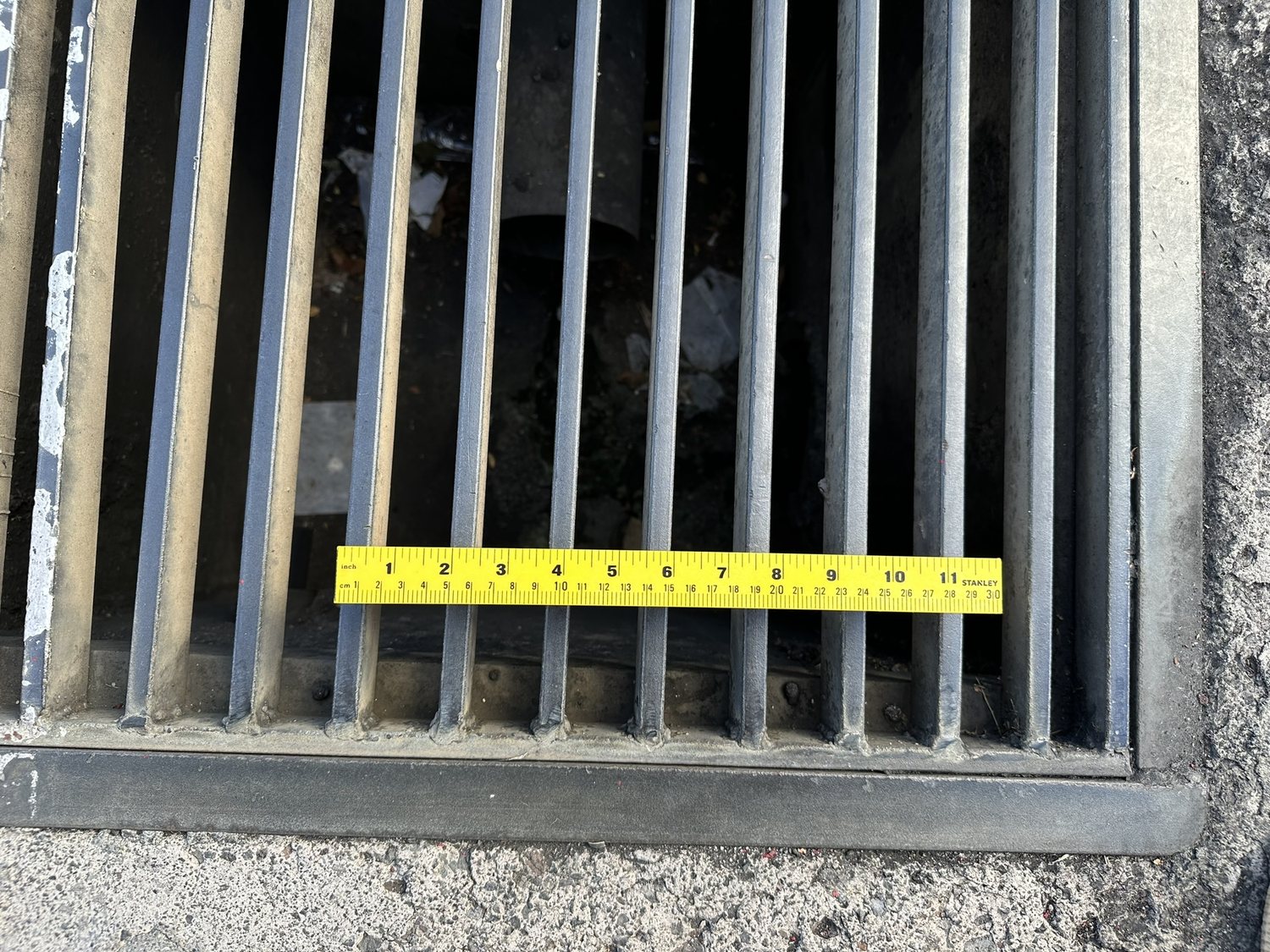
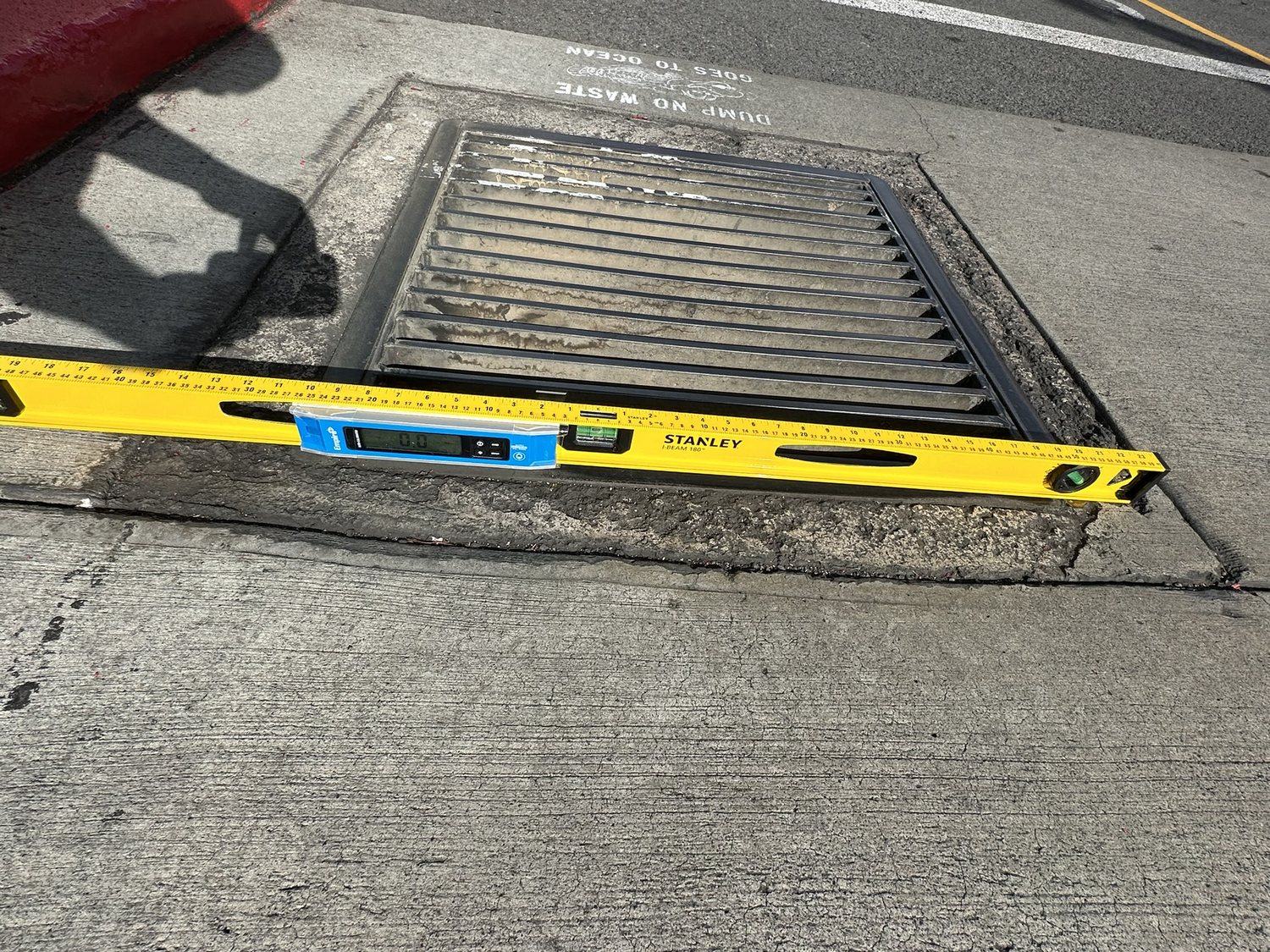
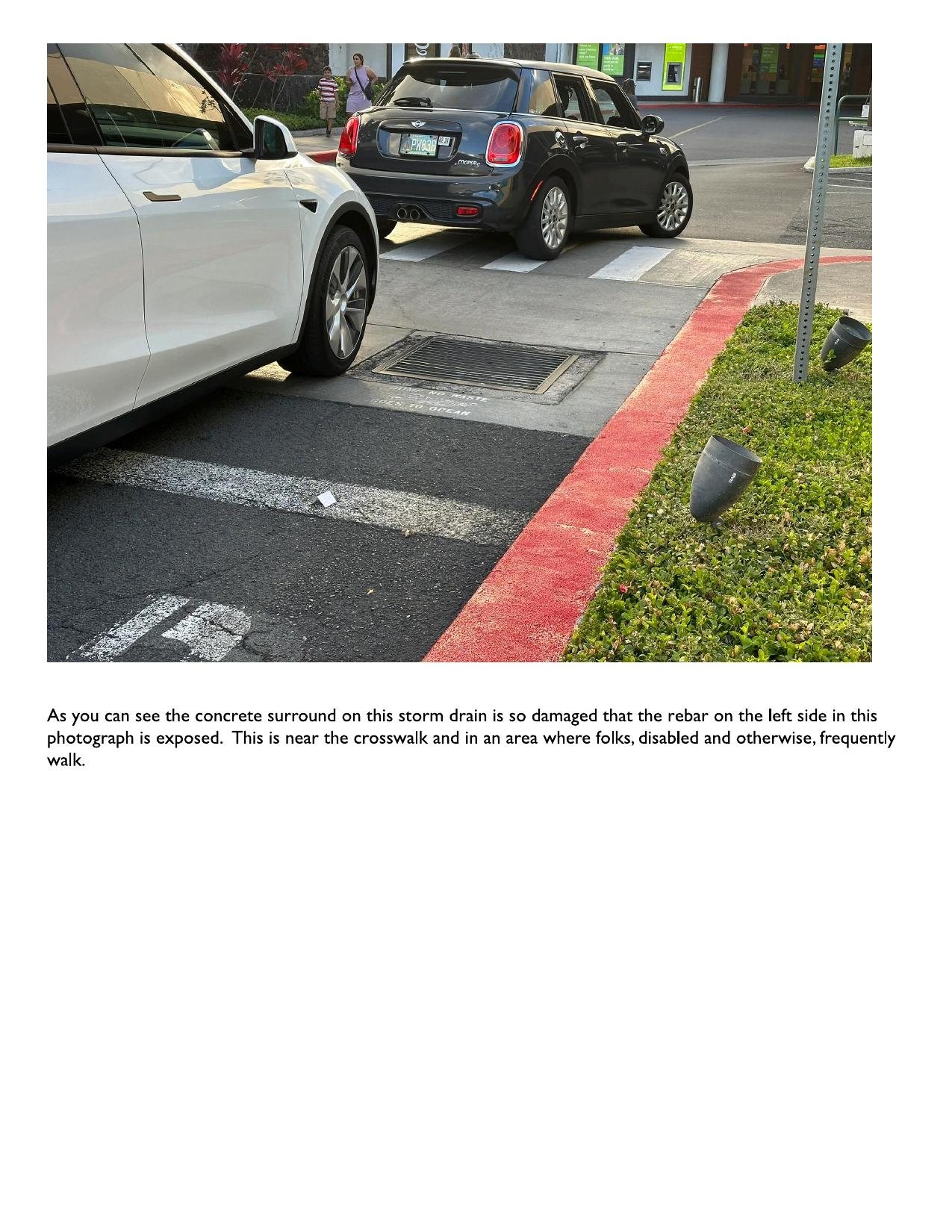
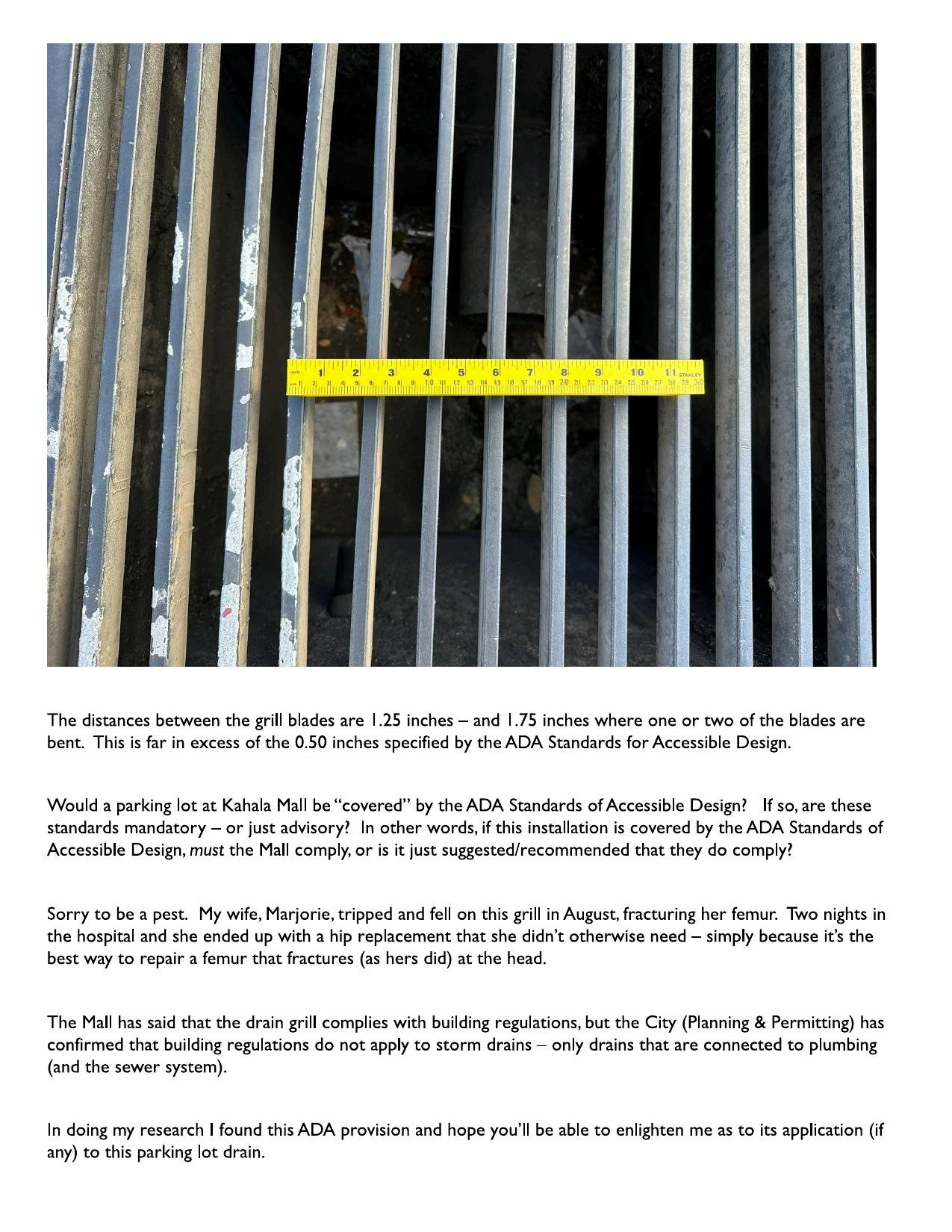
It sits in the roadway between a stop bar and a raised crosswalk, about five feet from the crosswalk, directly outside the Whole Foods entrance. Roughly thirty inches square. The gaps between its bars measure about 1.25 inches, and up to 1.75 inches where the bars are bent. The concrete around it is cracked and crumbling, with reinforcing steel showing through and depressions of a quarter to a half inch.
It does not appear on the 1986 permit drawings for the property.
Alongside it the mall has painted a legend, with a cartoon fish: DUMP NO WASTE — GOES TO OCEAN.
Craig Walsh had known Kahala Mall since 1956. In his deposition he was asked how many times he had stopped at that spot. I don’t know, a dozen. And whether he had ever noticed the drain. No, I wasn’t looking at the drain. I didn’t see the drain.
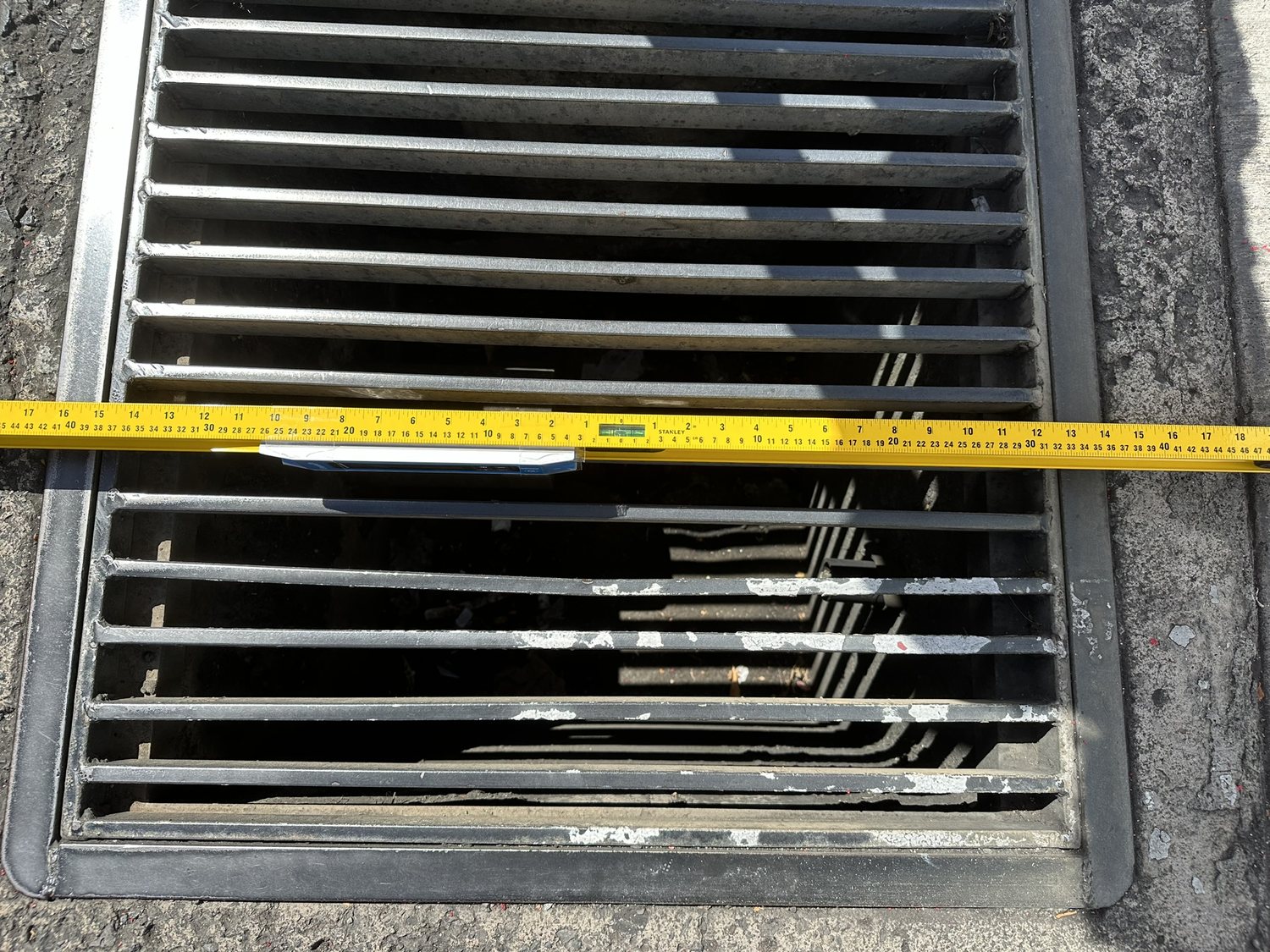
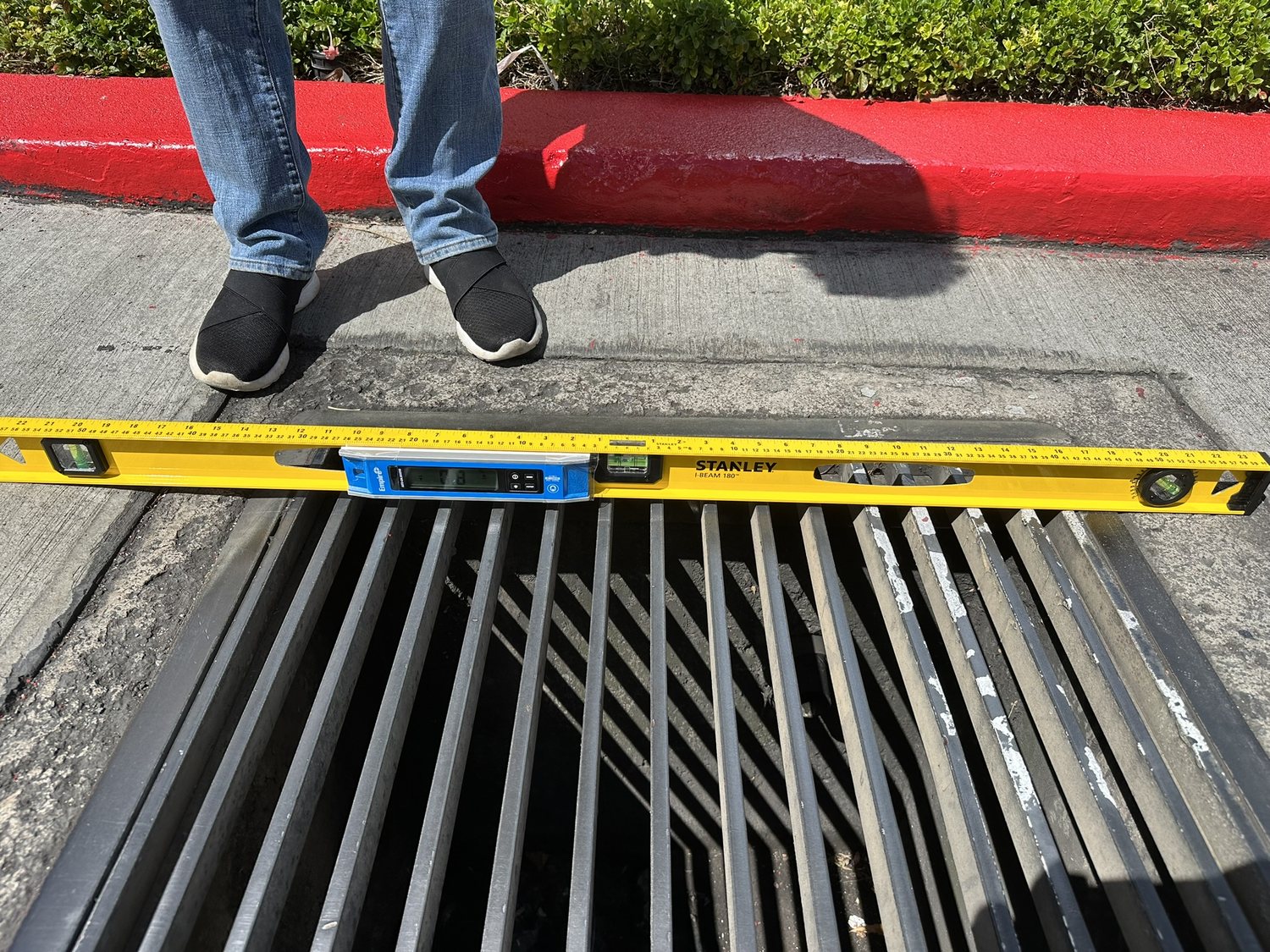
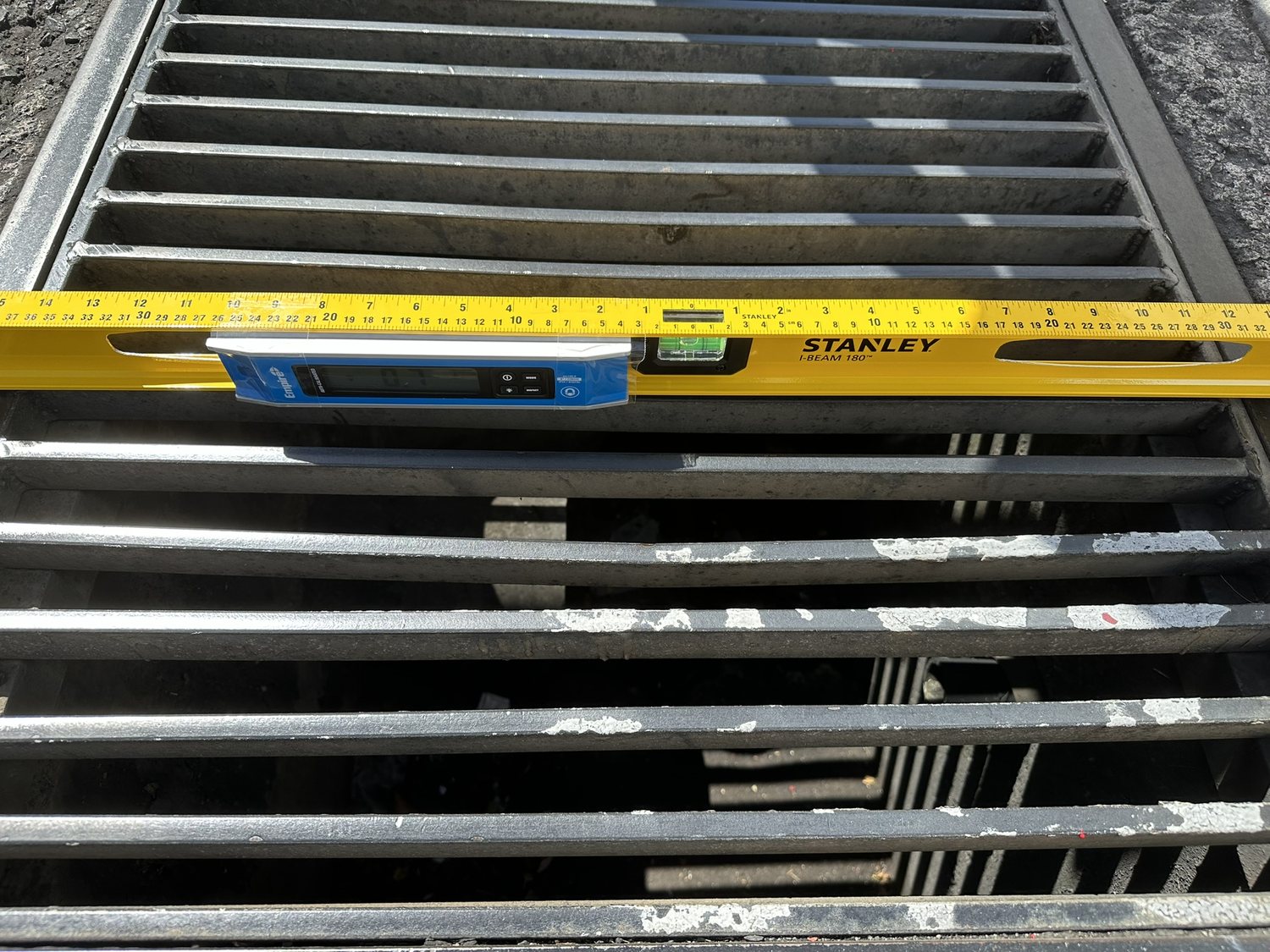
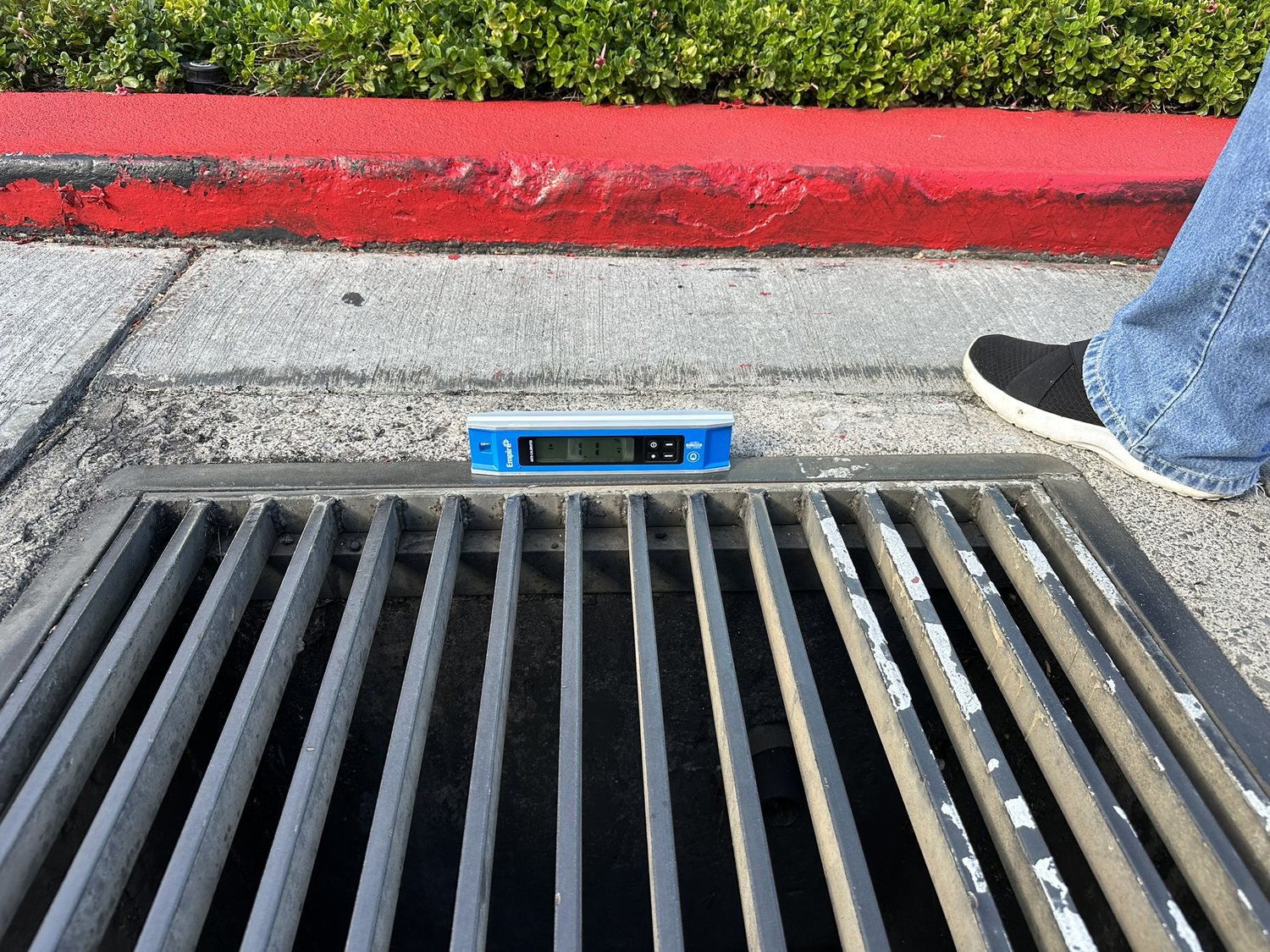
III. Six days later
On or about 22 August 2023 — six days after the fall, before any lawyer was involved, before any claim had been made — Craig Walsh spoke to Lisa Kinoshita, a claims adjuster at First Insurance Company of Hawaii. She told him the storm drain complied with the Building Code.
He asked which provision she meant.
He was still asking three years later. The question was put in interrogatories, again in the arbitration, and again in the Circuit Court:
In a telephone conversation on or about August 22, 2023 I was advised by Ms. Kinoshita at your insurance company … that the storm drain complied with the Building Code. Please provide the citation for the specific code that covers this storm drain to which Ms. Kinoshita referred.
The answer, each time, was an objection.
He asked the City instead. Franklin Lung at the Department of Planning and Permitting told him the building code governs drains connected to the sewer system. This one drains to the sea — the mall’s own cartoon fish says so. Storm drains, Craig was told, are not covered by the building code at all. He also spoke to the people who design drainage for City property, and was told this drain would not be installed on City land; the City requires kerbside catch basins.
So the proposition put to them six days after the fall — it complies with the building code — appears to have been a statement about a code that does not apply.
IV. Who was on the other side
First Insurance Company of Hawaii is a member of the Tokio Marine Group. Fifty-seven pages of this file carry a footer printed on the insurer’s own stationery:
A division of First Insurance Company of Hawaii, Ltd., a member of Tokio Marine Group, and all personnel, including attorneys, are its employees.
The defence was conducted by Randall Y. Kaya of the Law Offices of Leslie R. Kop. That office is the insurer’s in-house counsel. Its email domain is staffcounsel808.com.
The Walshes eventually wrote to Todd Takayama, President and CEO of First Insurance, by hand delivery, and to the Group Compliance Office of Tokio Marine Holdings at 2-1-1 Marunouchi, Chiyoda-ku, Tokyo, by FedEx.
They received no reply.
V. Filing
On 2 January 2024 the Walshes sued MMI Realty Services Inc., the company that manages Kahala Mall, for personal injury and loss of consortium. They filed pro se. With the complaint they filed an ex parte motion to waive the $515 filing fee under Chapter 607, on the ground of poverty; gross monthly income was stated as $3,316.22.
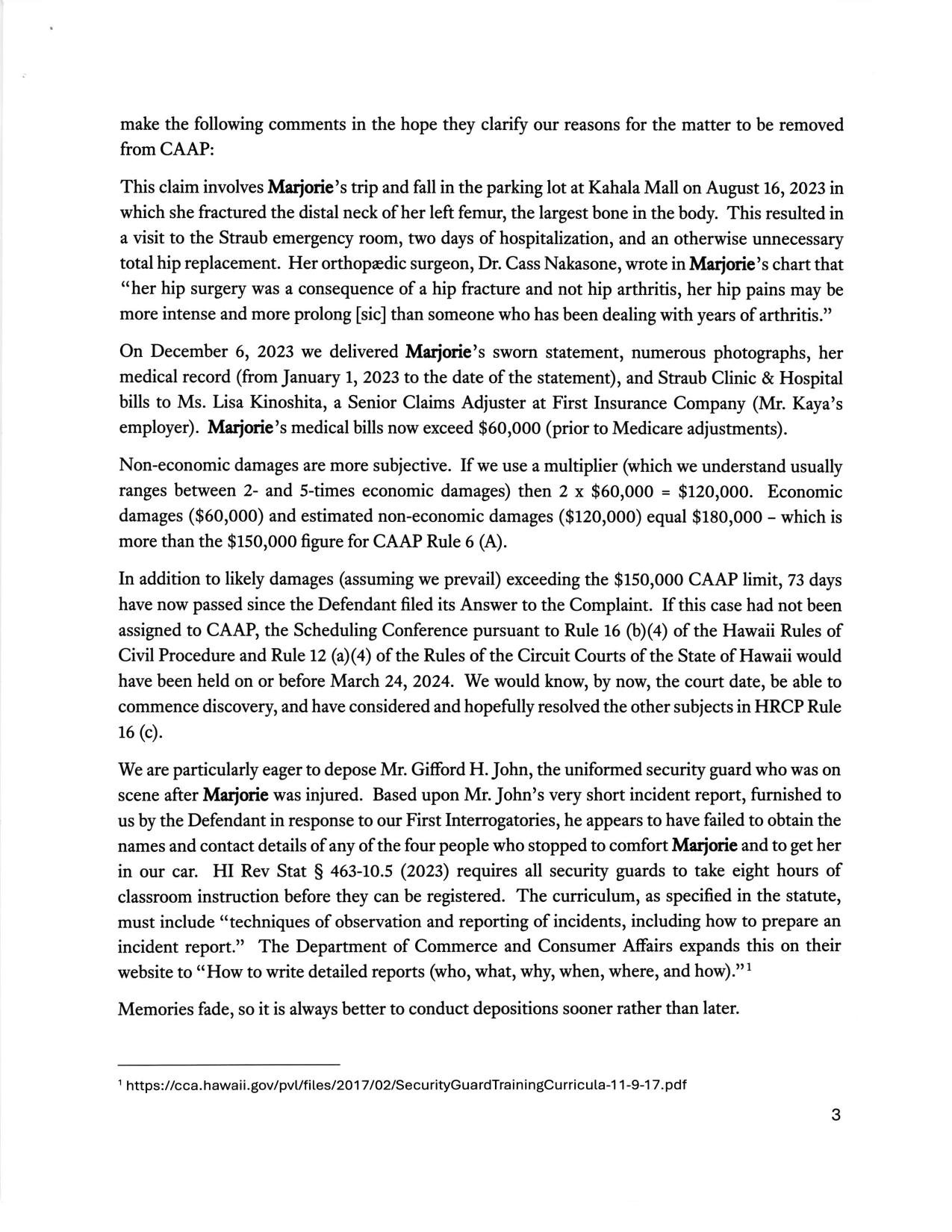
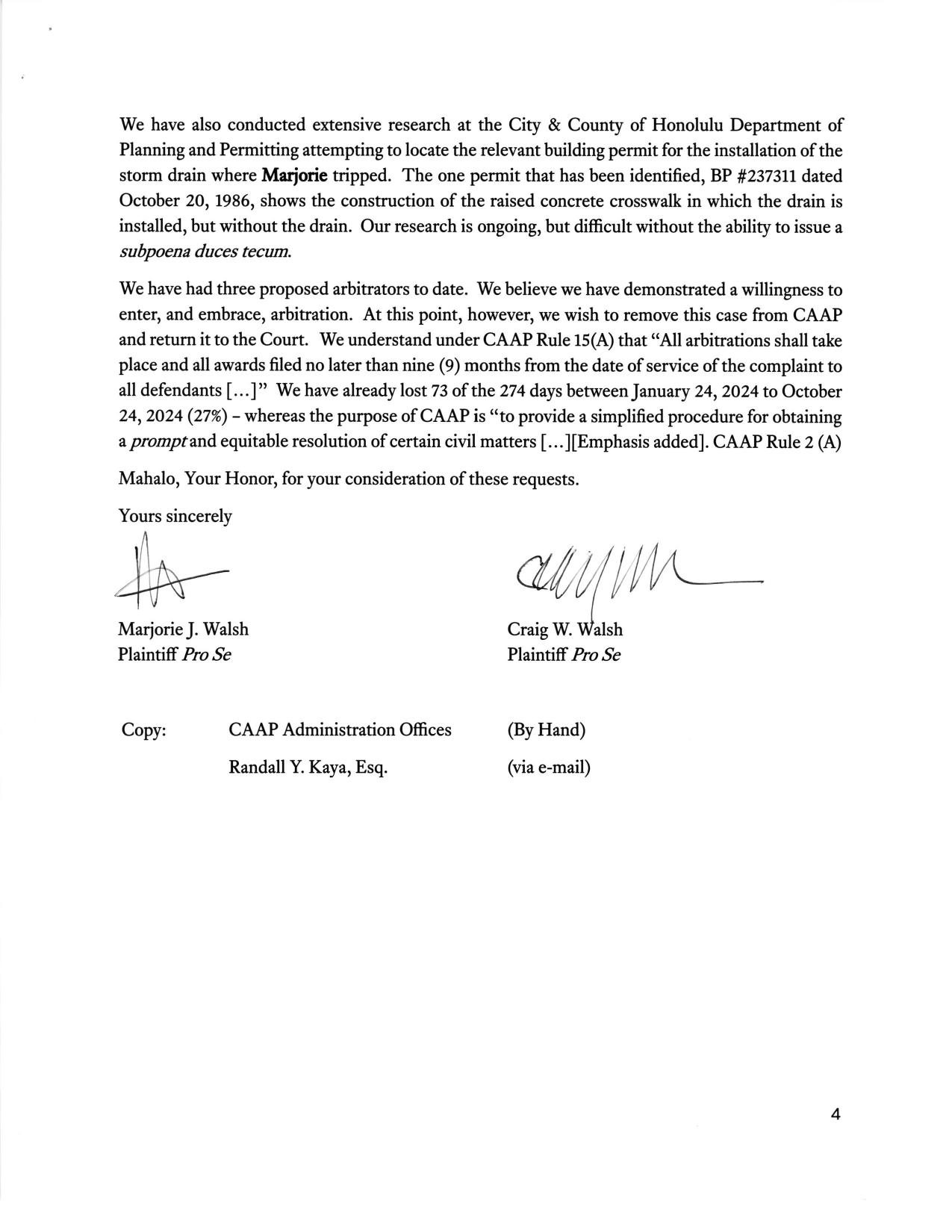
Because of its value the case went first to Hawai‘i’s Court Annexed Arbitration Program. That proceeding alone accounts for 394 pages of the file.
VI. Mary Jo Romano
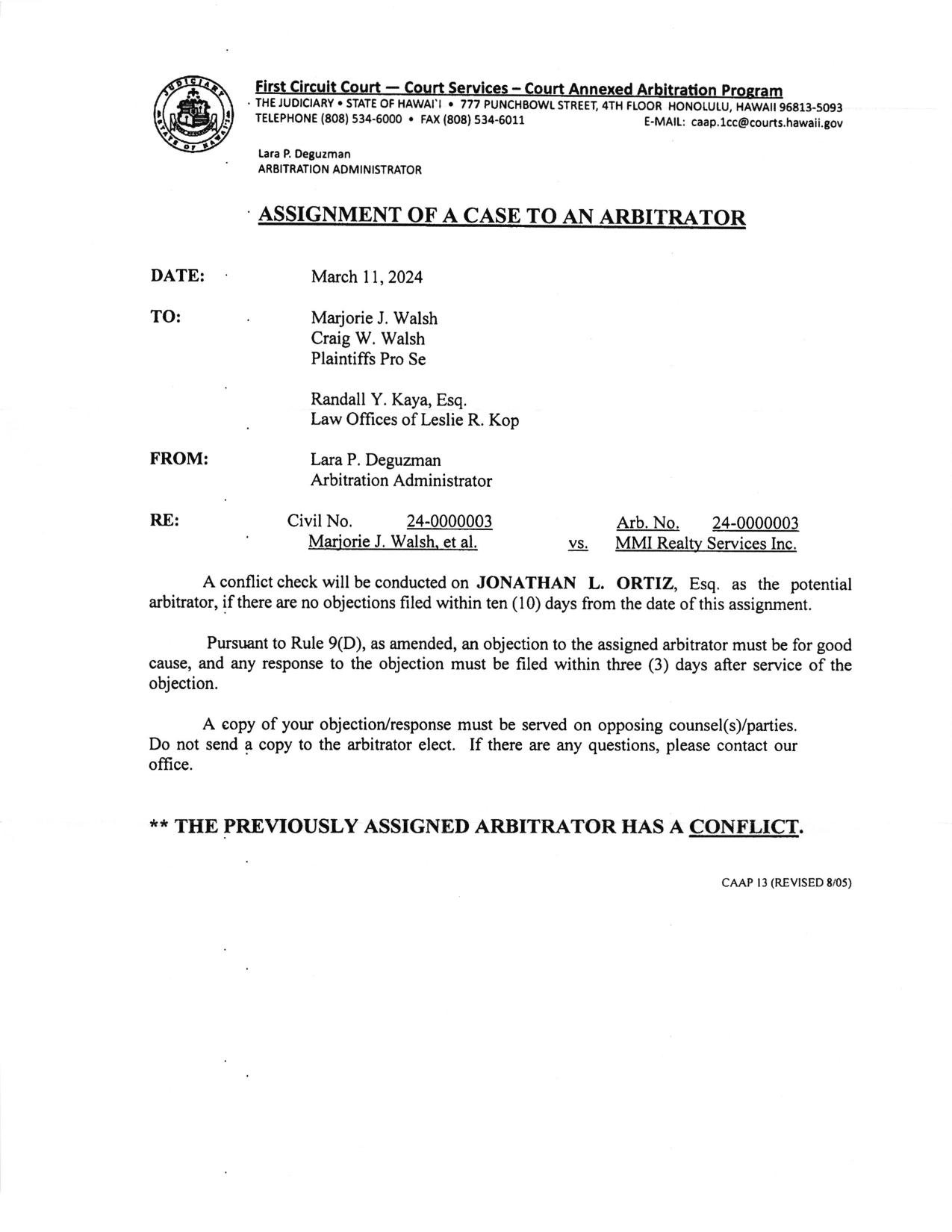
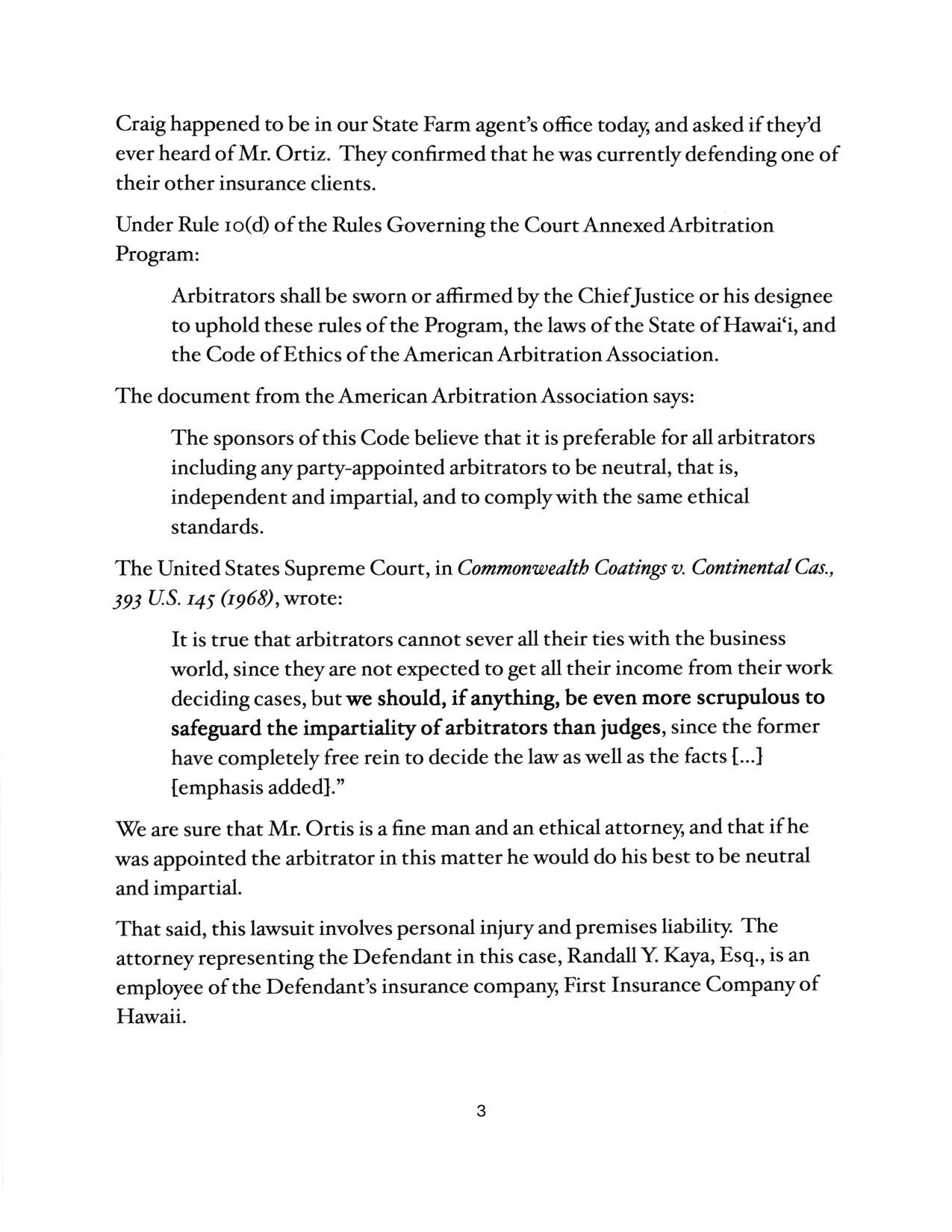
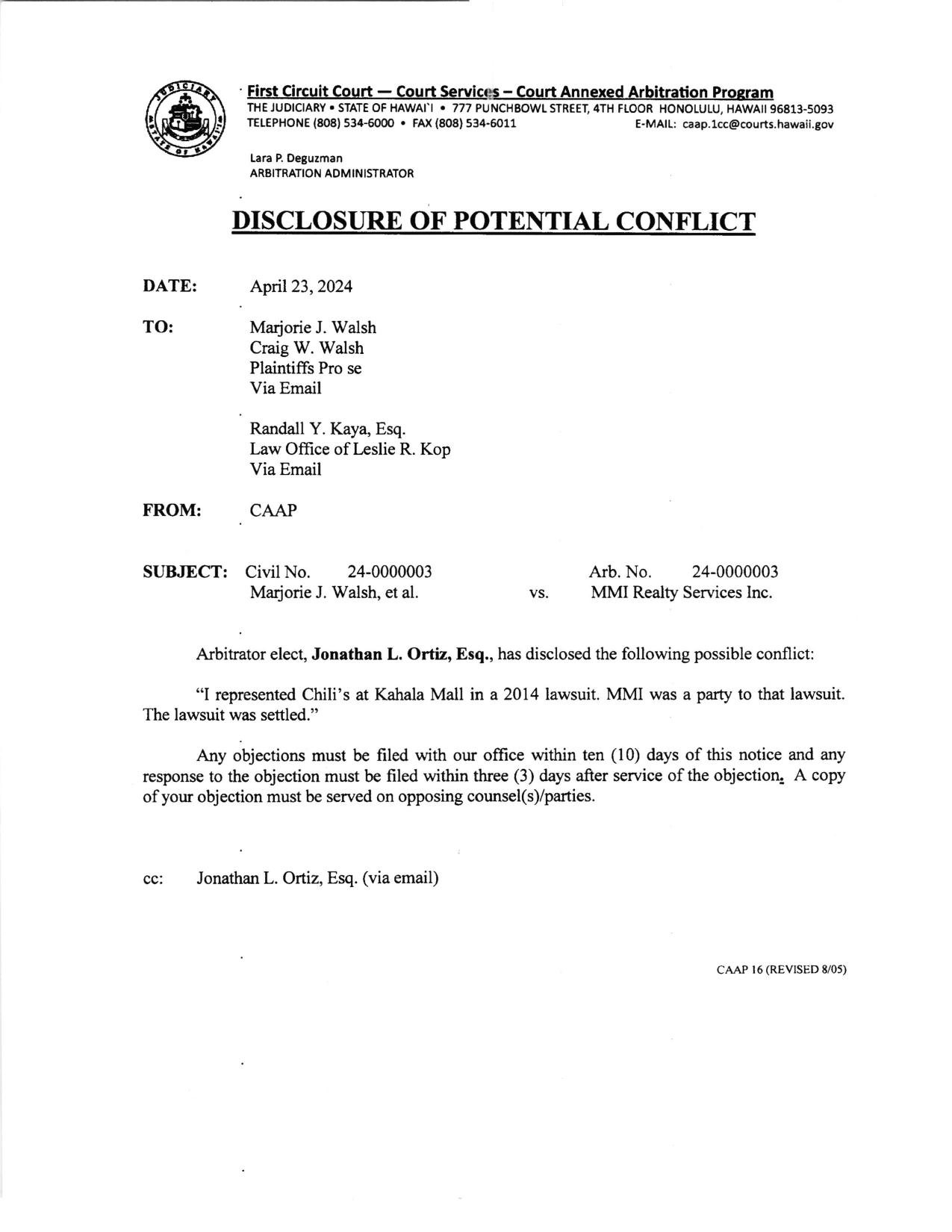
On 23 April 2024 the arbitration administrator circulated a disclosure. The arbitrator elect, Jonathan L. Ortiz, had something to declare:
I represented Chili’s at Kahala Mall in a 2014 lawsuit. MMI was a party to that lawsuit. The lawsuit was settled.
Just over an hour later Mr. Kaya replied that MMI had no objection, the representation being “years ago.”
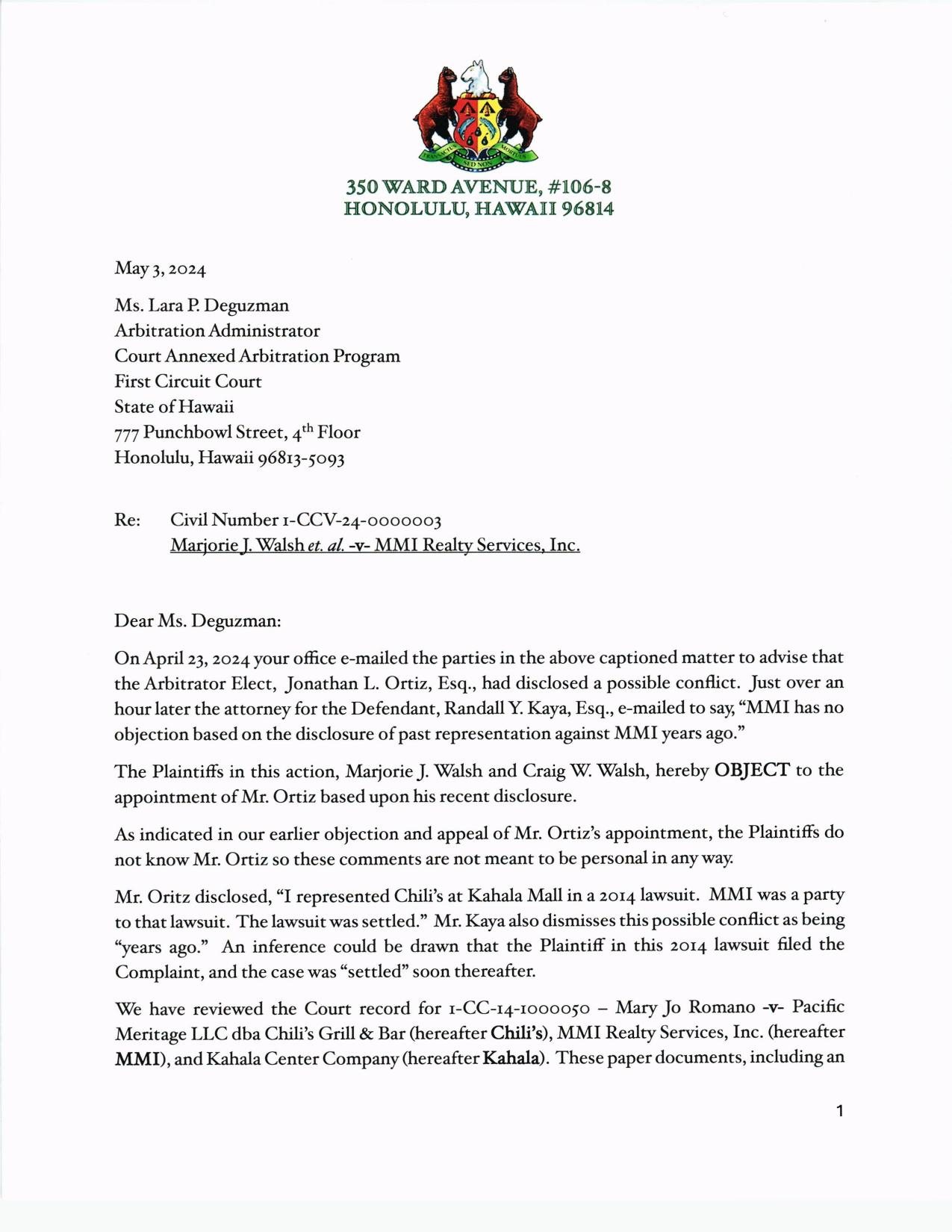
The Walshes went and read the file.
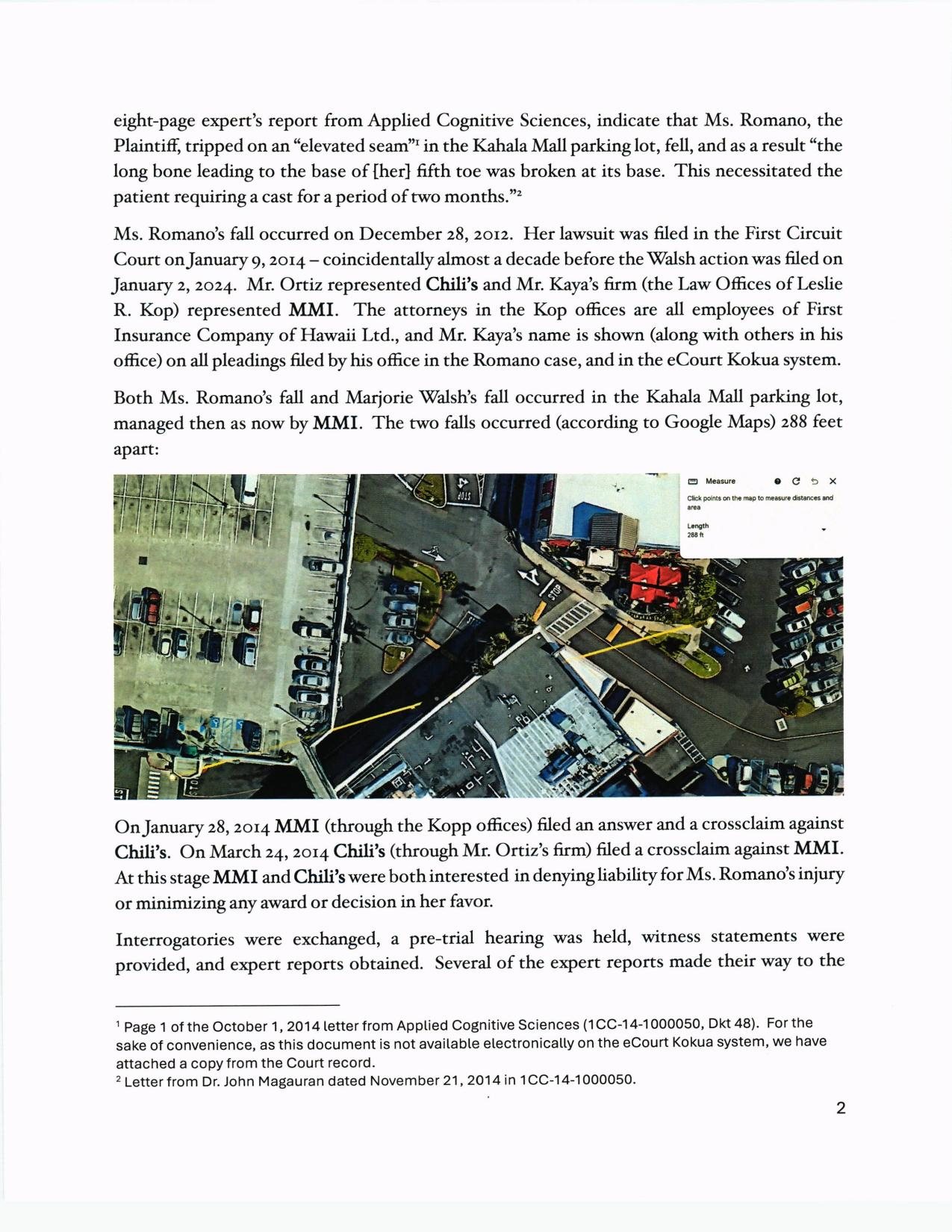
Mary Jo Romano v. Pacific Meritage LLC dba Chili’s Grill & Bar, MMI Realty Services, Inc., and Kahala Center Company, 1-CC-14-1000050. On 28 December 2012, Ms. Romano tripped on an elevated seam in the Kahala Mall parking lot and fell, breaking the long bone at the base of her fifth toe. Two months in a cast. She filed on 9 January 2014 — almost exactly a decade before the Walshes filed.
Chili’s was represented by Jonathan Ortiz. MMI was represented by the Law Offices of Leslie R. Kop, and Randall Y. Kaya’s name appears on the pleadings.
By Google Maps, Ms. Romano fell 288 feet from where Marjorie Walsh fell. Same parking lot. Same property. Same manager. Same insurer’s lawyers.
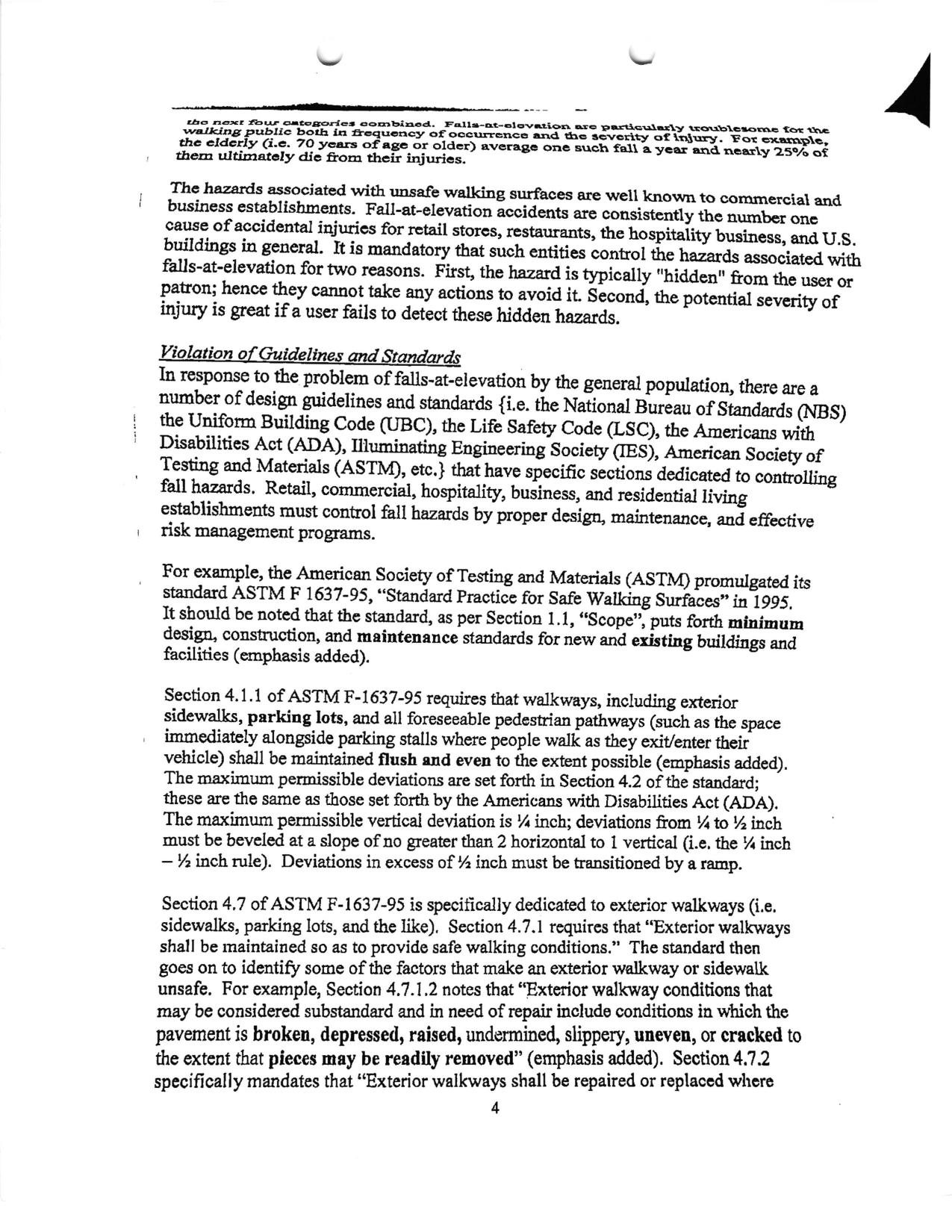
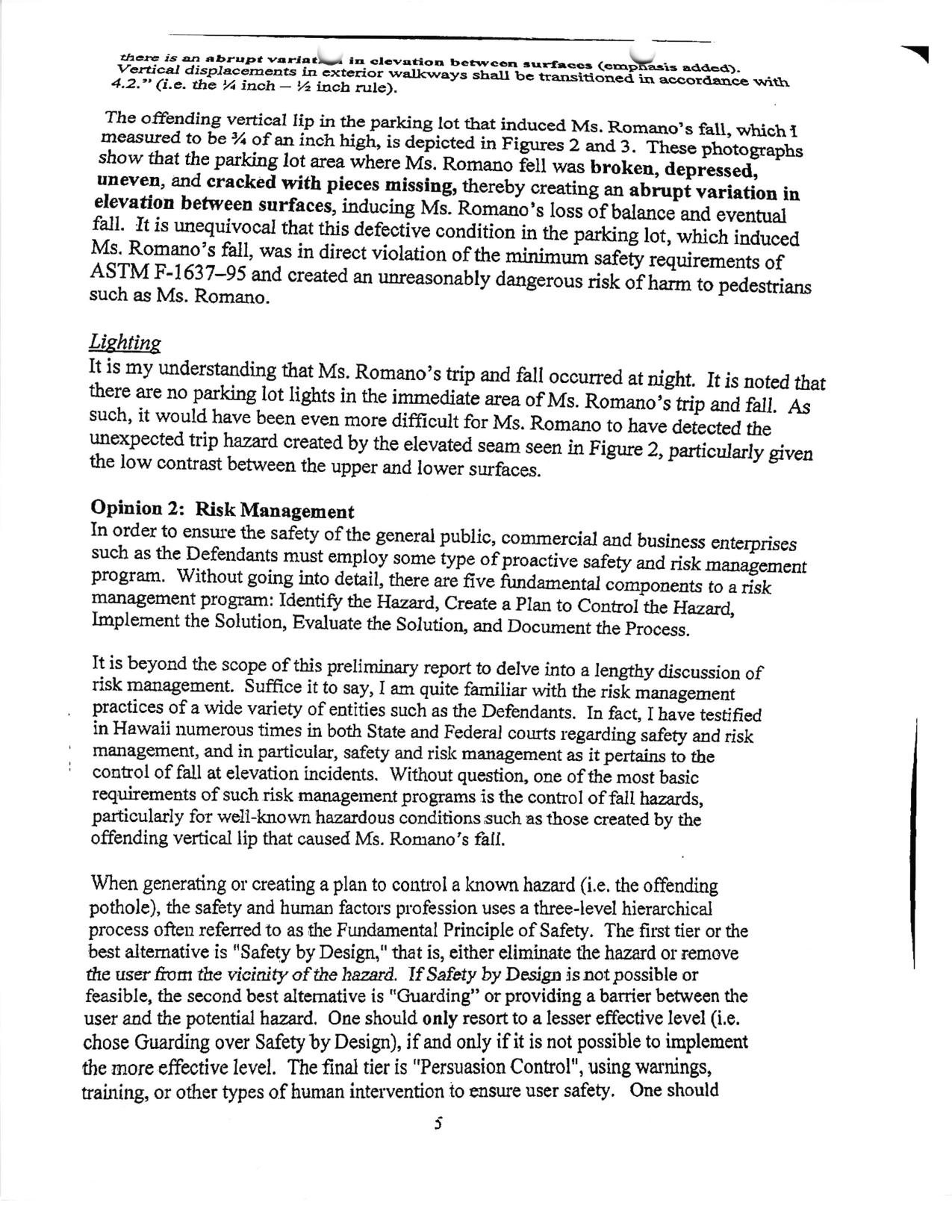
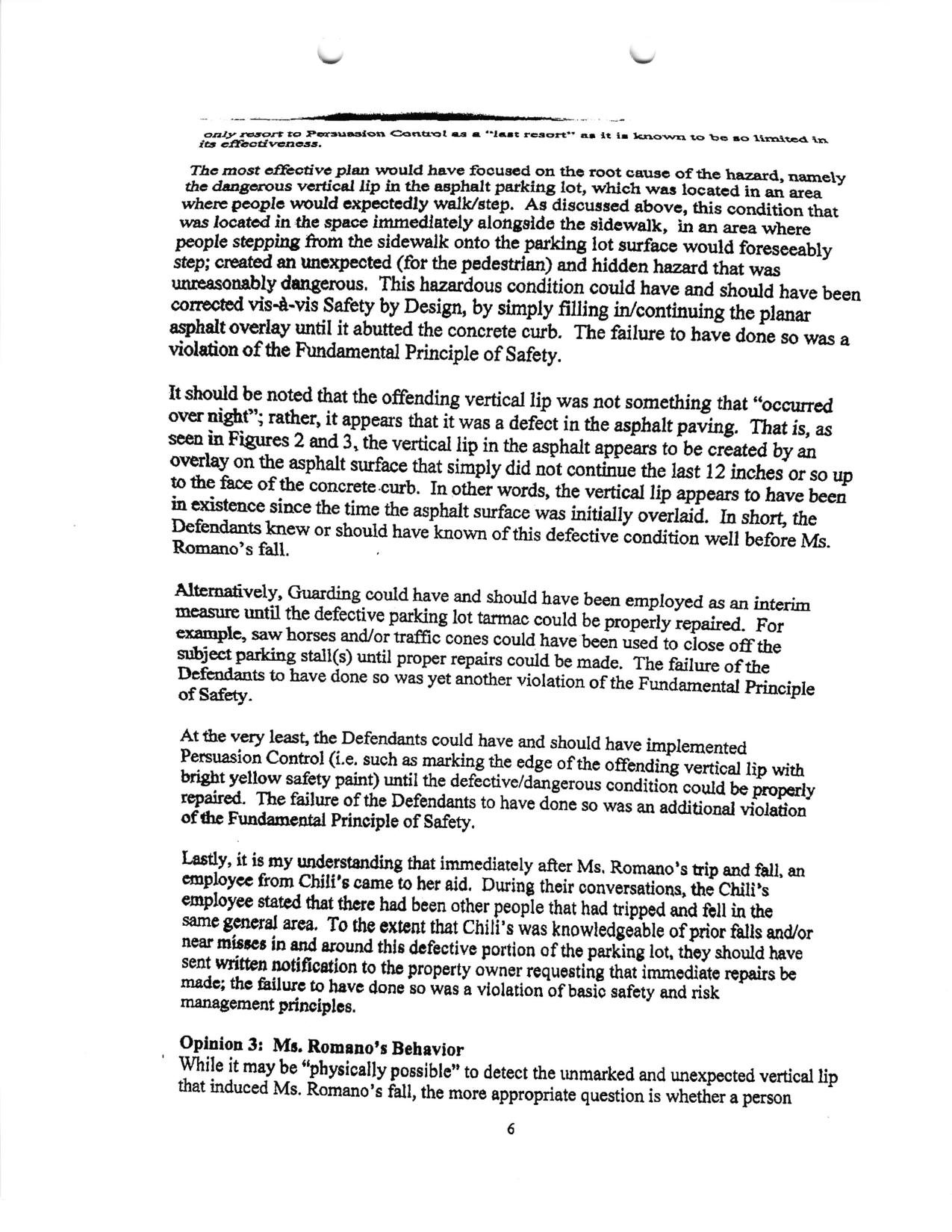
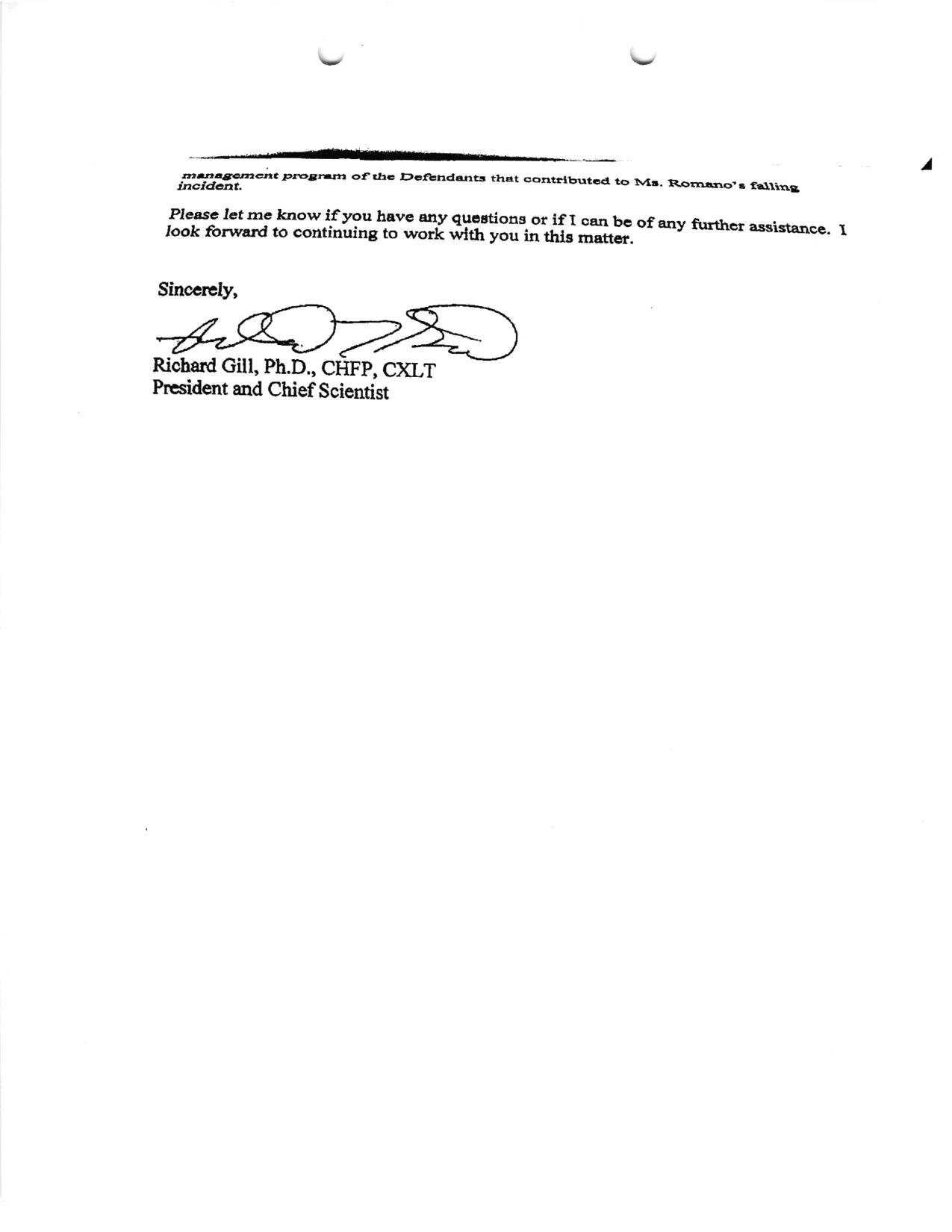
And in that case an expert had been retained: Dr. Richard Gill of Applied Cognitive Sciences, whose report of 1 October 2014 is in the papers. Having interviewed Ms. Romano and her sister, who witnessed the fall, Dr. Gill wrote:
Lastly, it is my understanding that immediately after Ms. Romano’s trip and fall, an employee from Chili’s came to her aid. During their conversations, the Chili’s employee stated that there had been other people that had tripped and fell in the same general area.
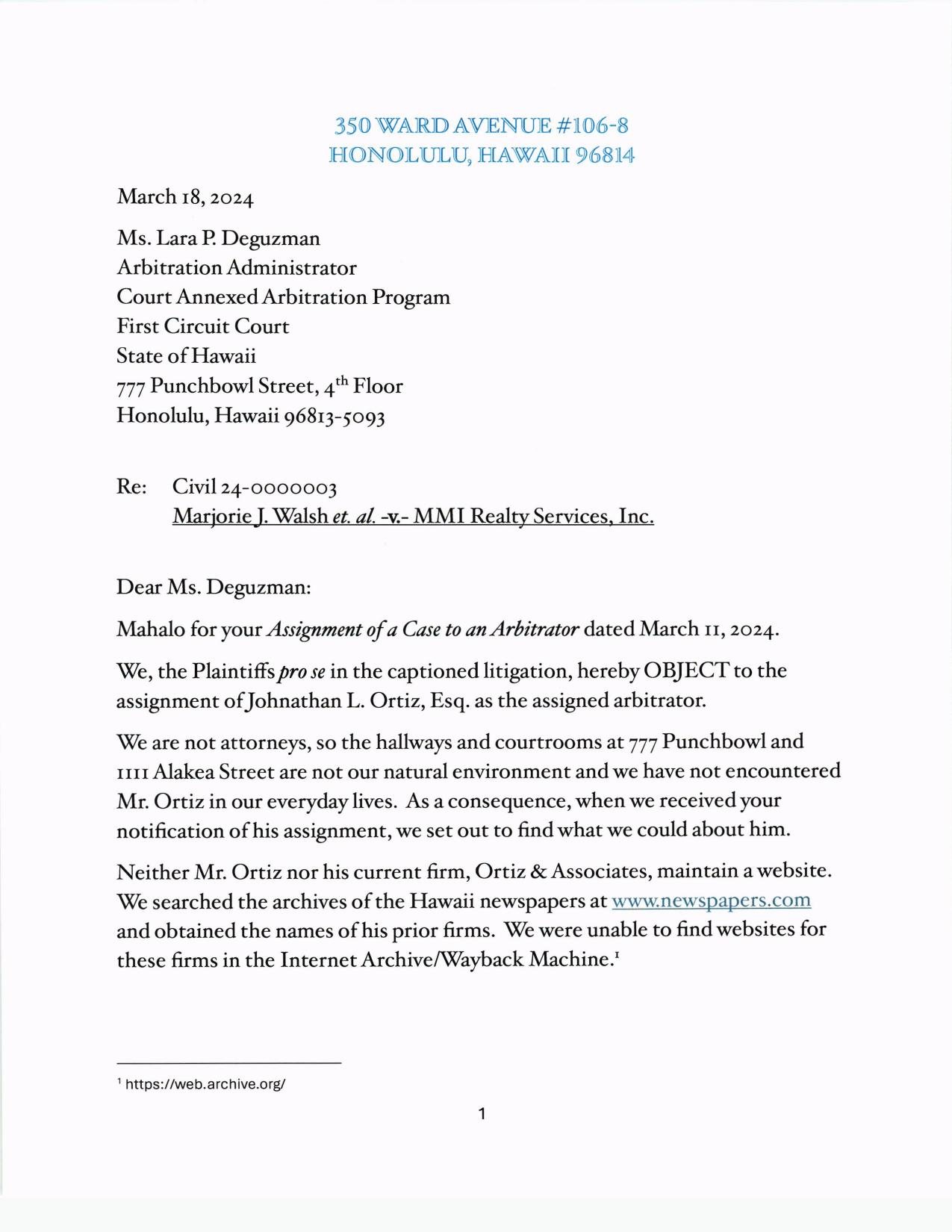
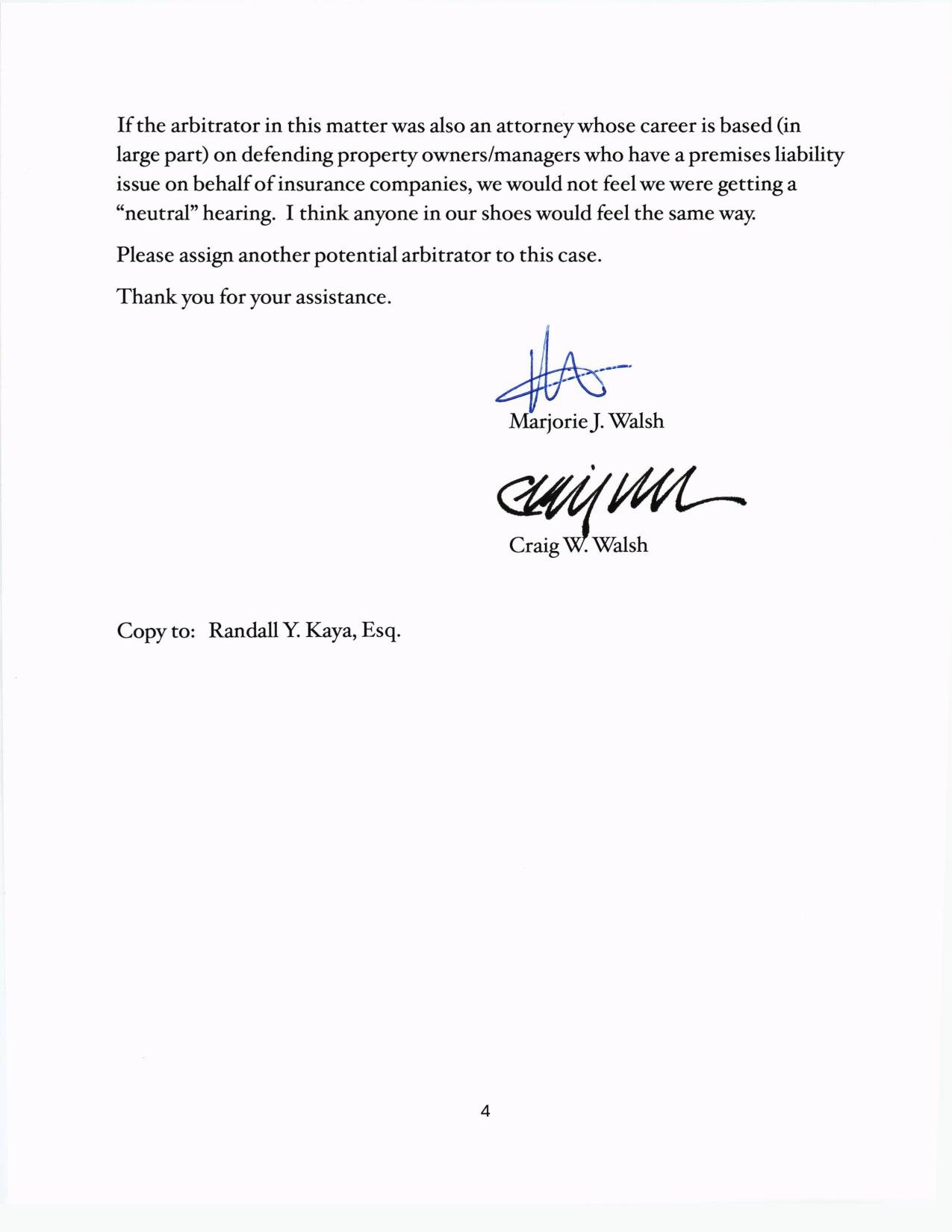
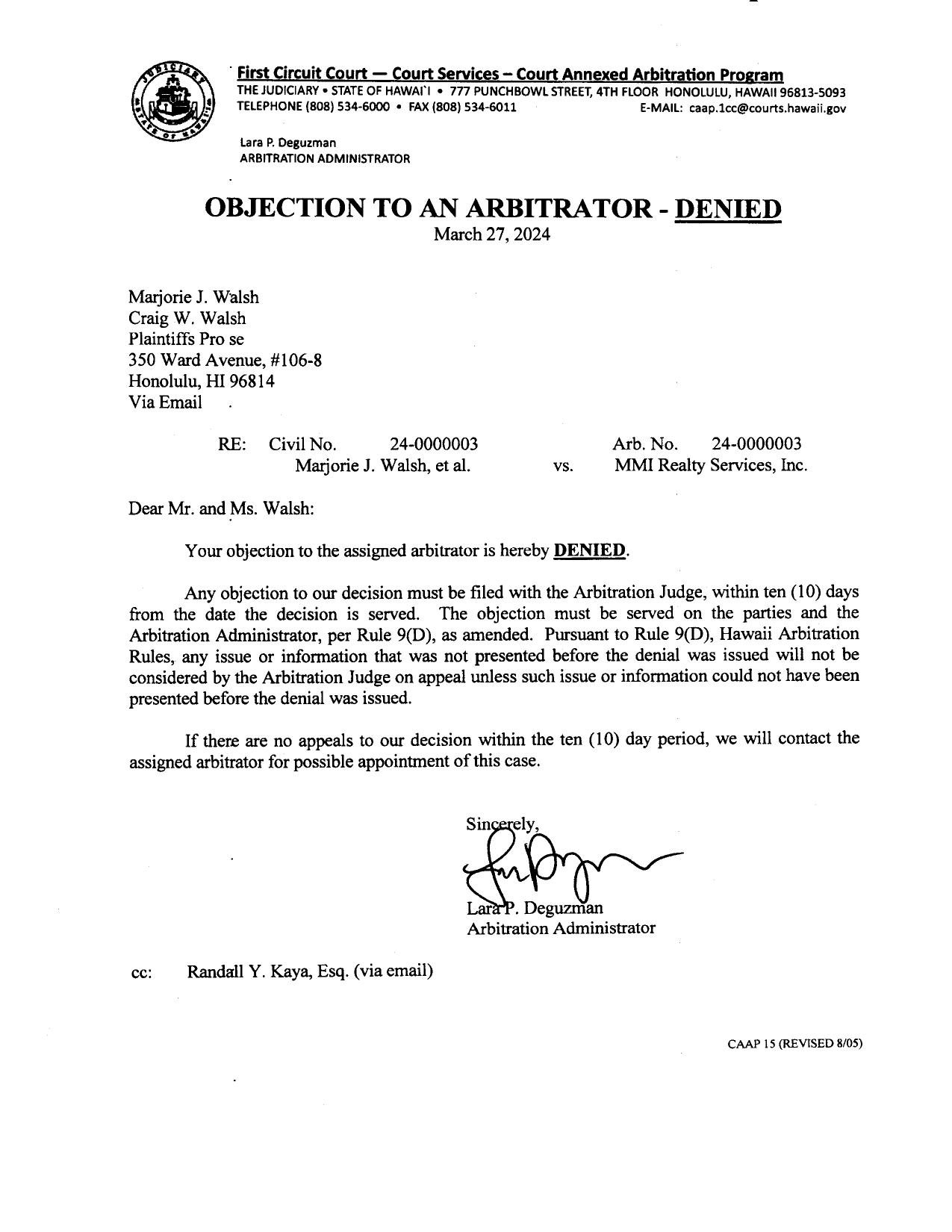
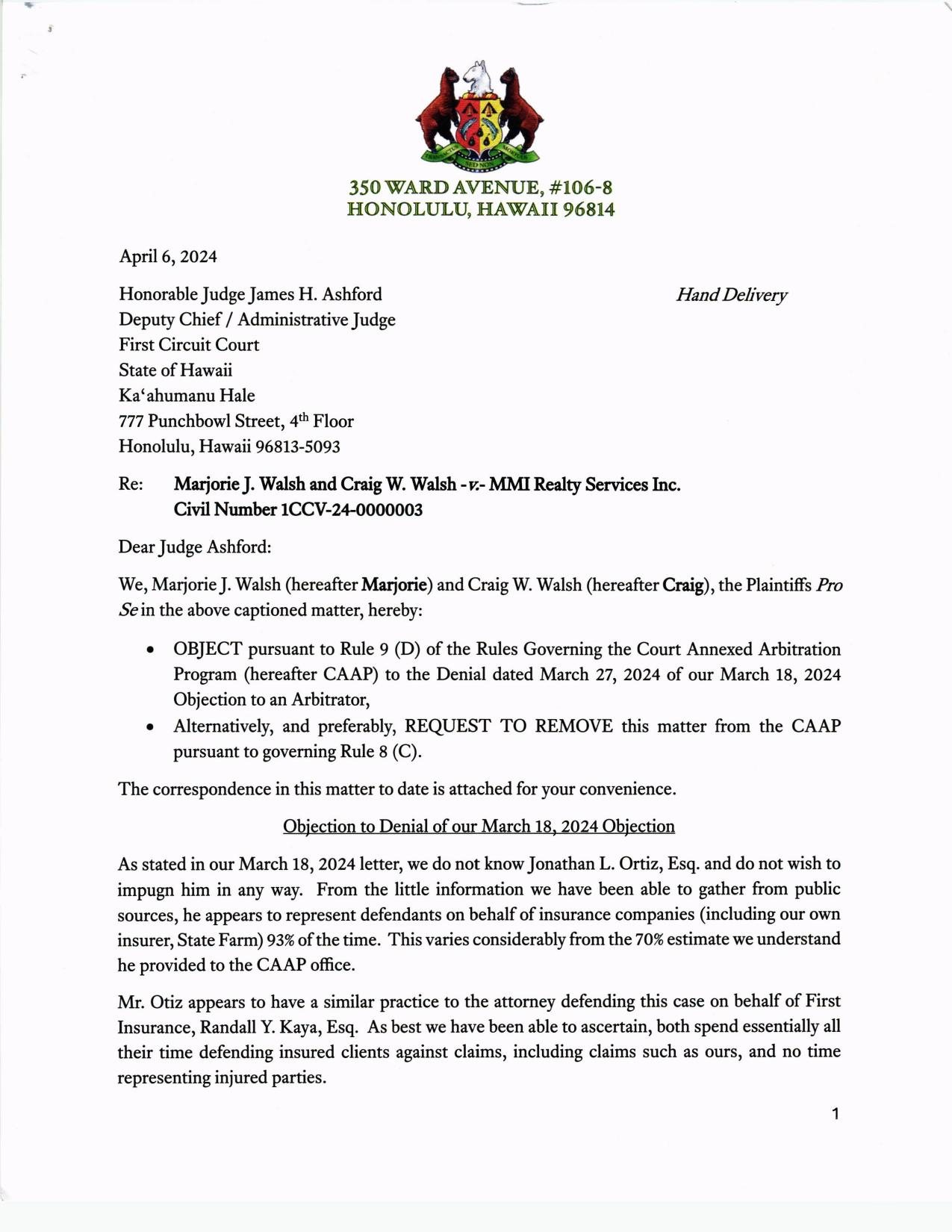
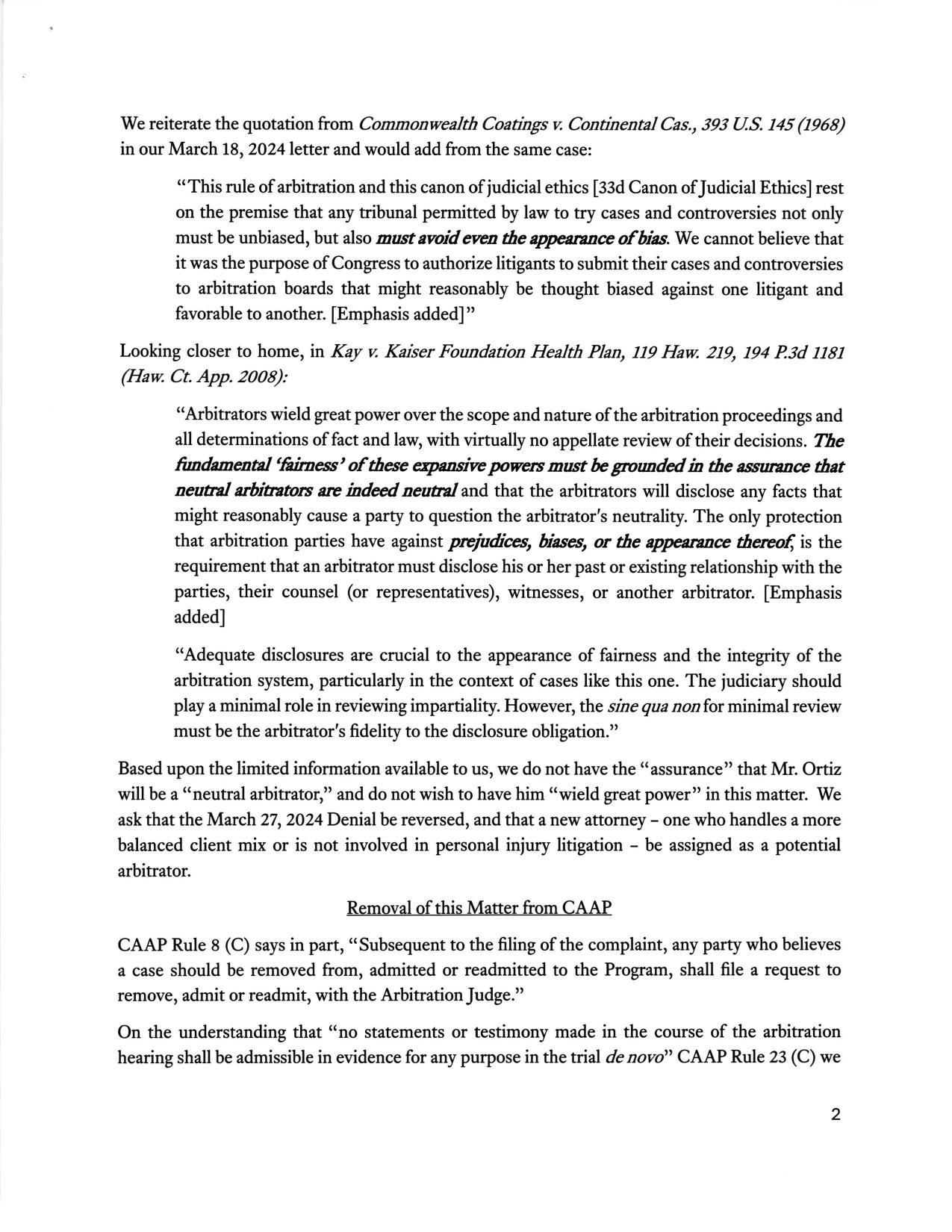
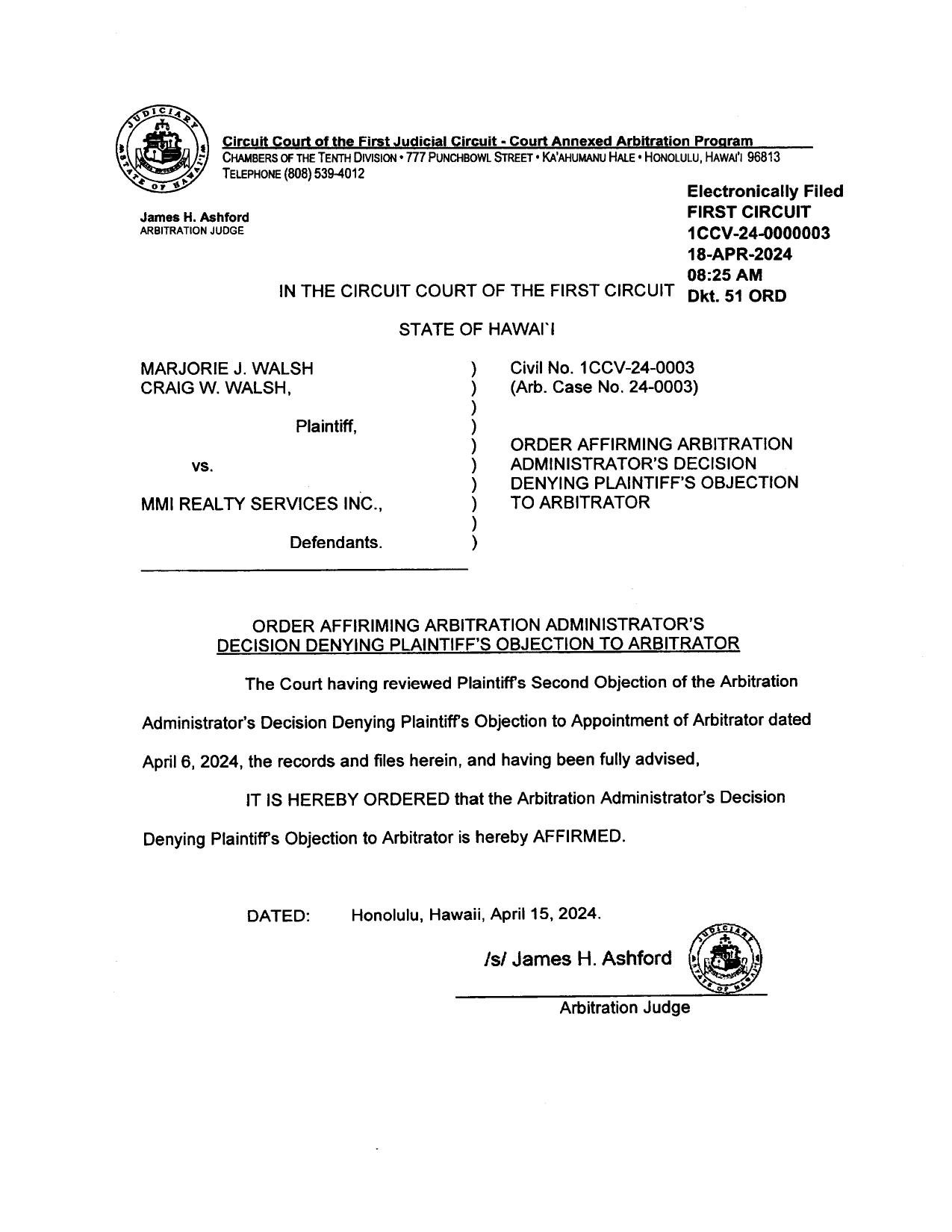
The Walshes objected to Mr. Ortiz’s appointment.
They had objected once already, before the Romano disclosure, on a simpler ground: that he is a lawyer who defends people sued on behalf of insurers.
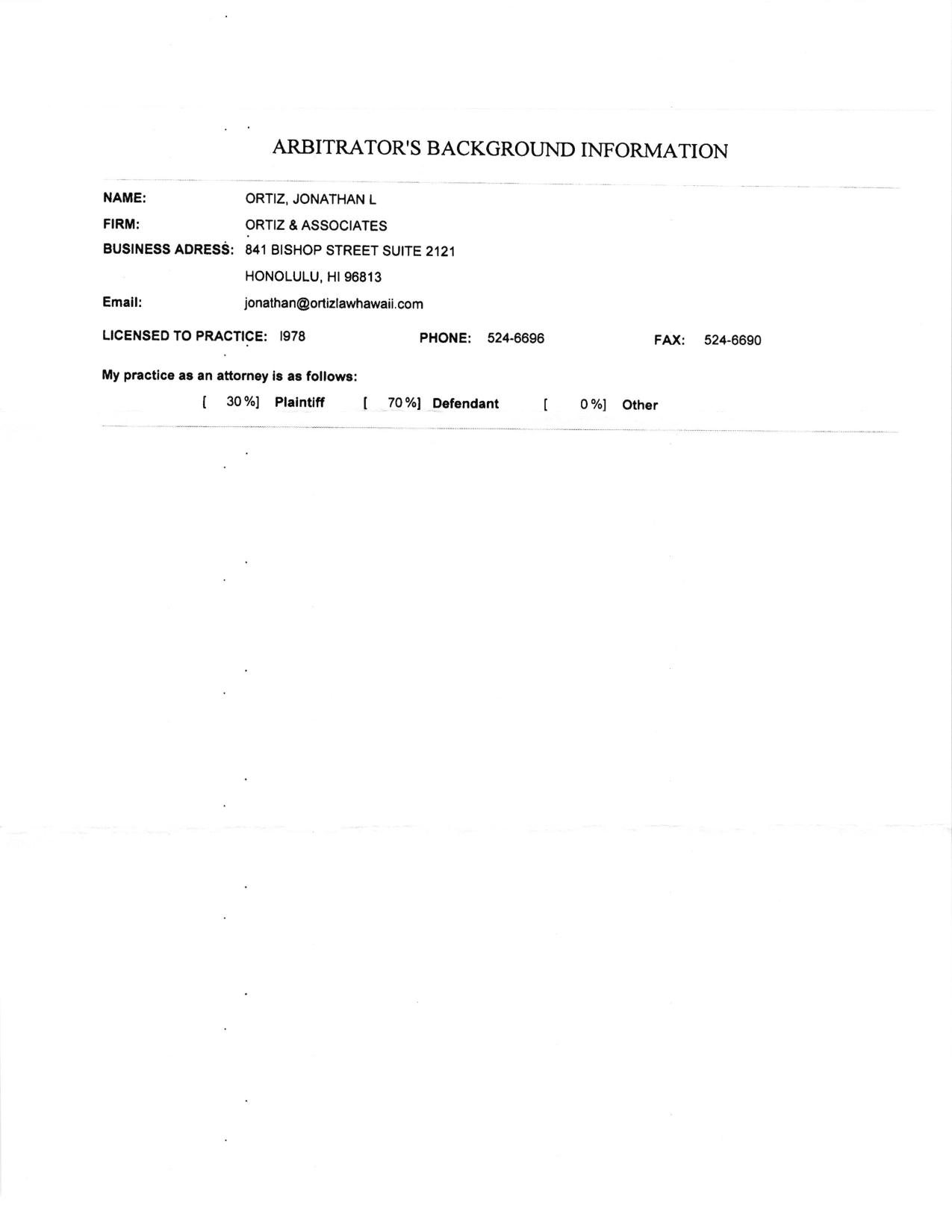
The arbitration programme asks each prospective arbitrator to fill in a background form declaring how their practice divides. Mr. Ortiz’s form, listing Ortiz & Associates of 841 Bishop Street, admitted to practice since 1978, gives:
[ 30% ] Plaintiff · [ 70% ] Defendant · [ 0% ] Other
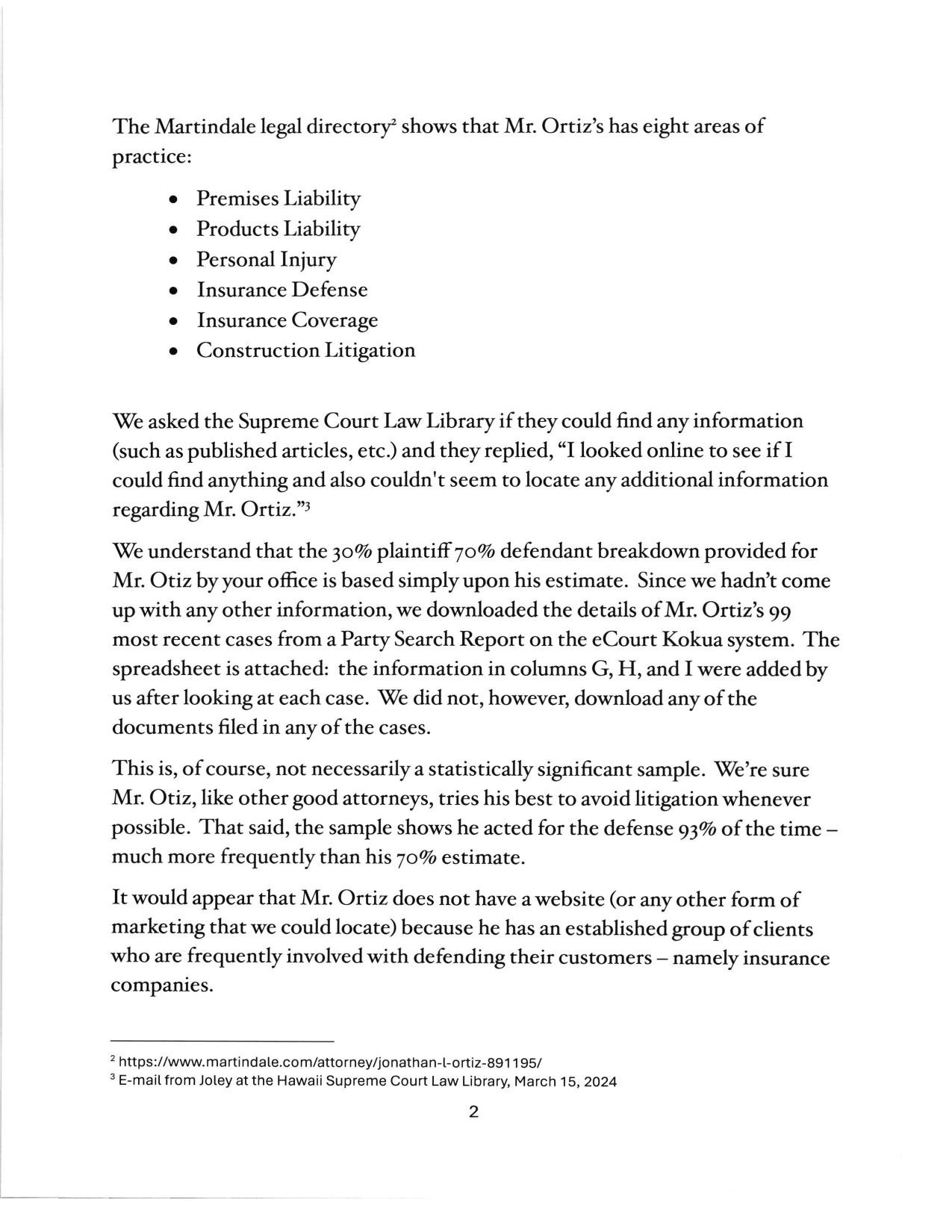
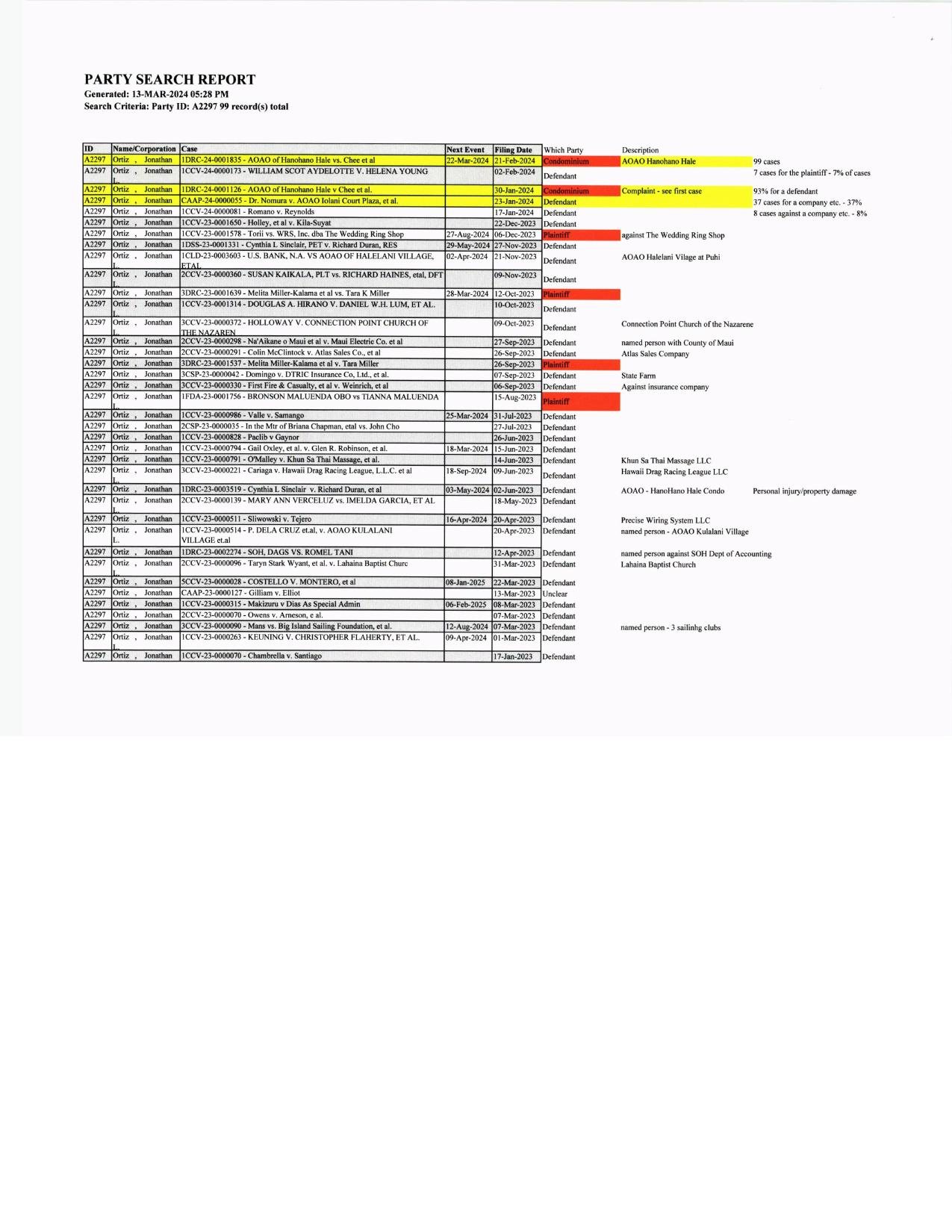
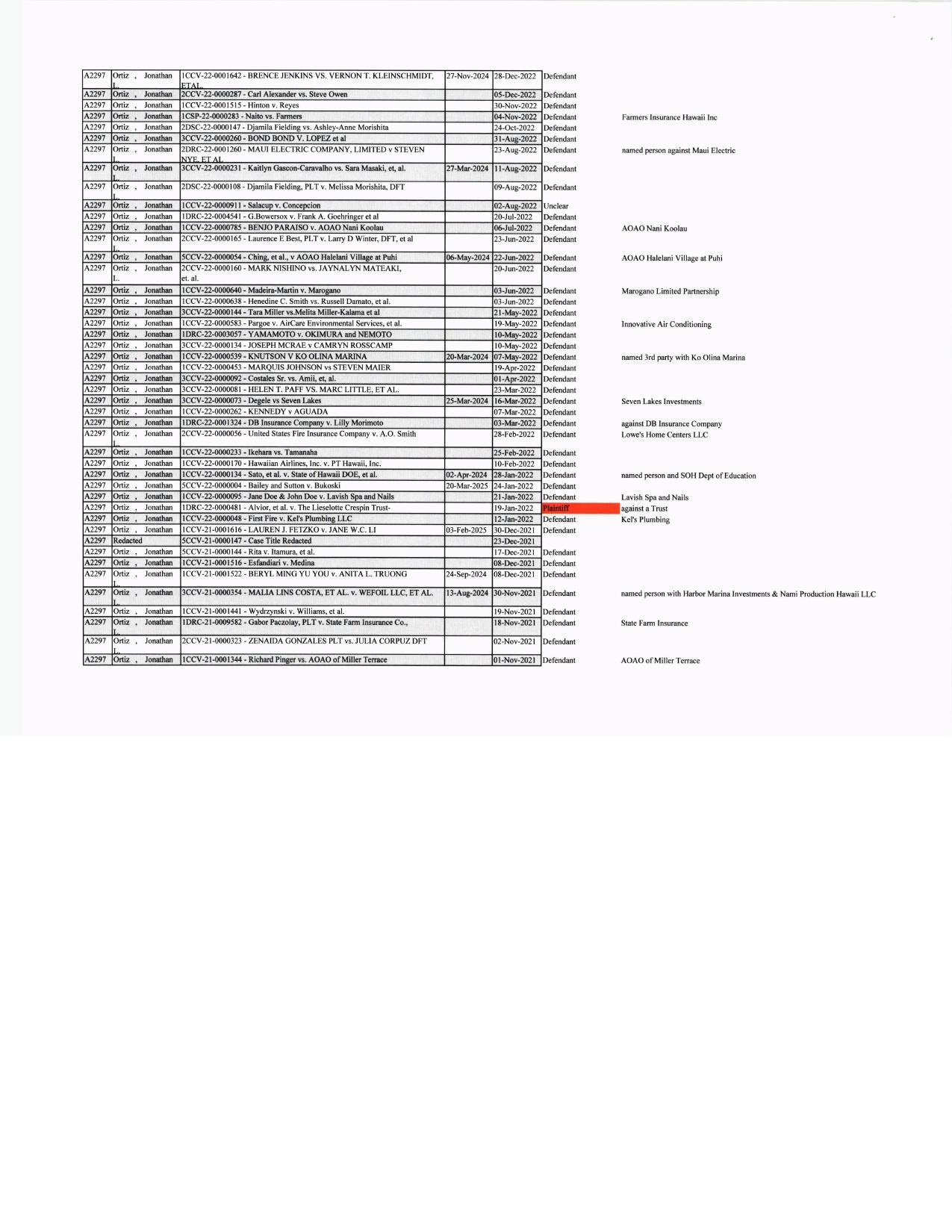
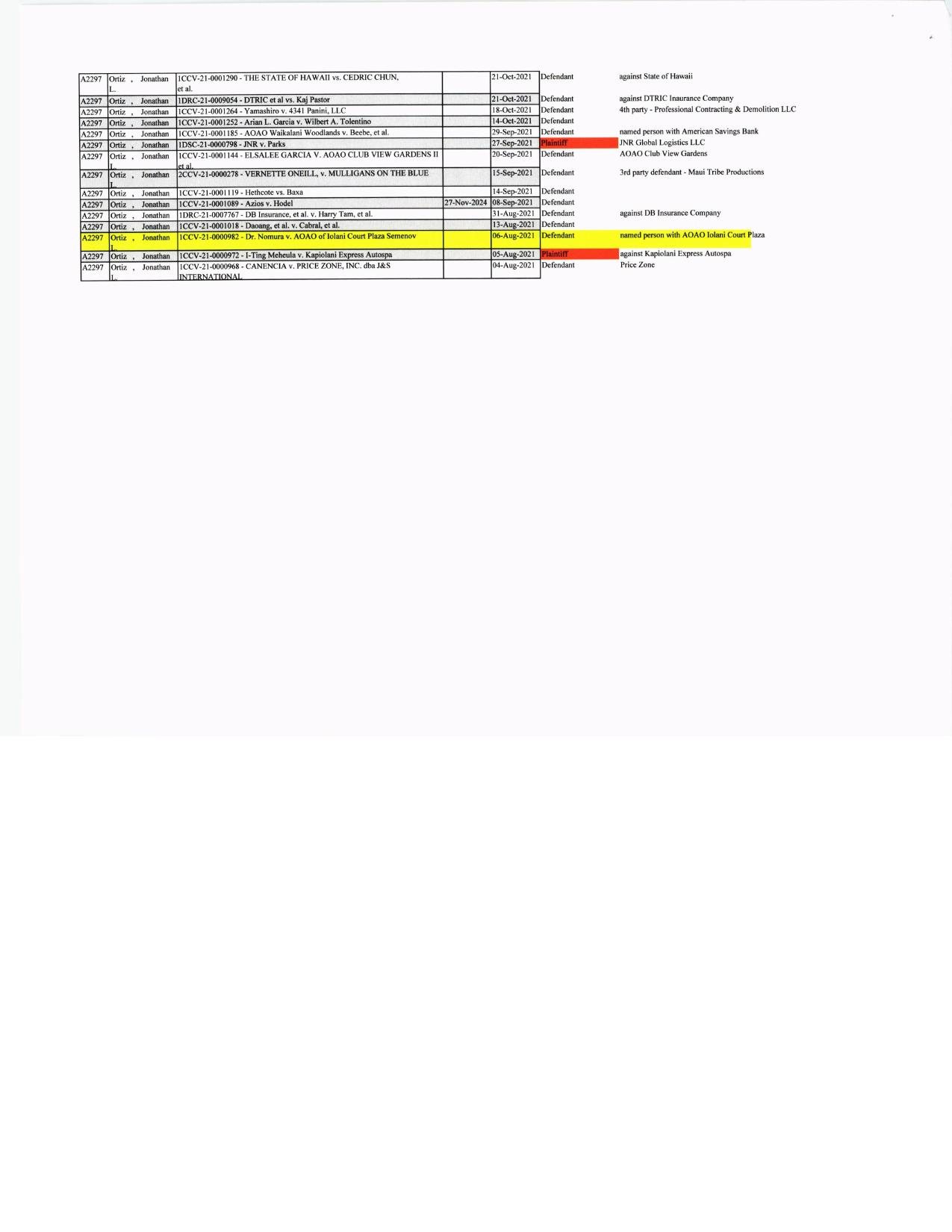
The Walshes were told by the programme that this figure was the arbitrator’s own estimate. So they checked it. They ran a party search of the court’s own records against his identifier on eCourt Kokua and downloaded his 99 most recent cases, then read the docket of each one and classified it themselves. Their tabulation:
7 cases for the plaintiff — 7% of cases 93% for a defendant
Thirty per cent by his own estimate; seven per cent on the court’s record.
The comparison is not perfect, and the Walshes said so in the filing itself: a party search shows cases that reached litigation, not every file a lawyer opens, and ninety-nine cases is not necessarily a statistically significant sample. A practice can settle a great many plaintiff matters that never appear on any docket.
What the docket does show is the shape of the work that gets litigated. For comparison, another candidate on the list — Robert Kohn of the Department of the Corporation Counsel — declared 70% plaintiff, 30% defendant.
Thirty-seven of the ninety-nine were for a company.
The list runs to several pages and reads much the same all the way down: Defendant — State Farm. Defendant — Farmers Insurance Hawaii Inc. Defendant — DTRIC Insurance Co. Defendant — against insurance company. Defendant — AOAO Halelani Village at Pu‘uloa. Defendant. Defendant. Defendant. Carriers named among his clients include State Farm, Farmers, DTRIC, DB Insurance and First Fire & Casualty; homeowners’ associations appear a dozen times.
Mr. Ortiz is in private practice, with his own firm. What he does in it, on the court’s own record, is defend insured defendants. That is also what Mr. Kaya does — the difference being that Mr. Kaya does it as a salaried employee of the carrier.
So the man appointed to decide the case did, in private practice, the work that opposing counsel did in-house.
Quoting the canon that a tribunal “not only must be unbiased, but also must avoid even the appearance of bias,” the Walshes asked that the objection be sustained.
Mr. Kaya’s answer was that they had no standing to make it:
Plaintiffs’ objection is on a basis that’s solely within the province of Defendant MMI (e.g. that he would not be fair/impartial because he previously represented a party making a claim against Defendant MMI). Plaintiffs have no standing to make such an objection about Ortiz’s potential partiality on Defendant MMI’s behalf.
That is: the conflict ran in MMI’s favour, so only MMI could complain of it, and MMI did not wish to.
The programme administrator denied the objection.
Mr. Kaya’s answer to the objection, on 3 May 2024, was that the Walshes were “shopping” for a less qualified arbitrator, and that the Romano material concerned —
a different issue in a different parking lot.
His letter ends: It appears Plaintiffs seek arbitrators who have no personal injury experience for their personal injury case.
Two years later, answering the Gill report on summary judgment, he called it “old Richard Gill hearsay reports” employed “for what appears to be a dissimilar fact issues completely.”
The distinction is a real one, and worth stating plainly: Mary Jo Romano tripped on an elevated seam in the asphalt, not on a storm drain, and she fell in front of Chili’s, not in front of Whole Foods.
The Walshes’ answer was that Kahala Mall is a single property — tax map parcel 350160010000 — with a single security services contract and a single contractor services agreement, and that the question at issue was not whether the same defect had injured someone twice, but whether the manager of a parking lot knew, or by reasonable care should have known, that its parking-lot surfaces were injuring pedestrians.
Dr. Gill’s finding in the Romano case had been that the asphalt lip appears to have been in existence since the time the asphalt surface was initially overlaid, so that the Defendants knew or should have known of this defective condition well before Ms. Romano’s fall.
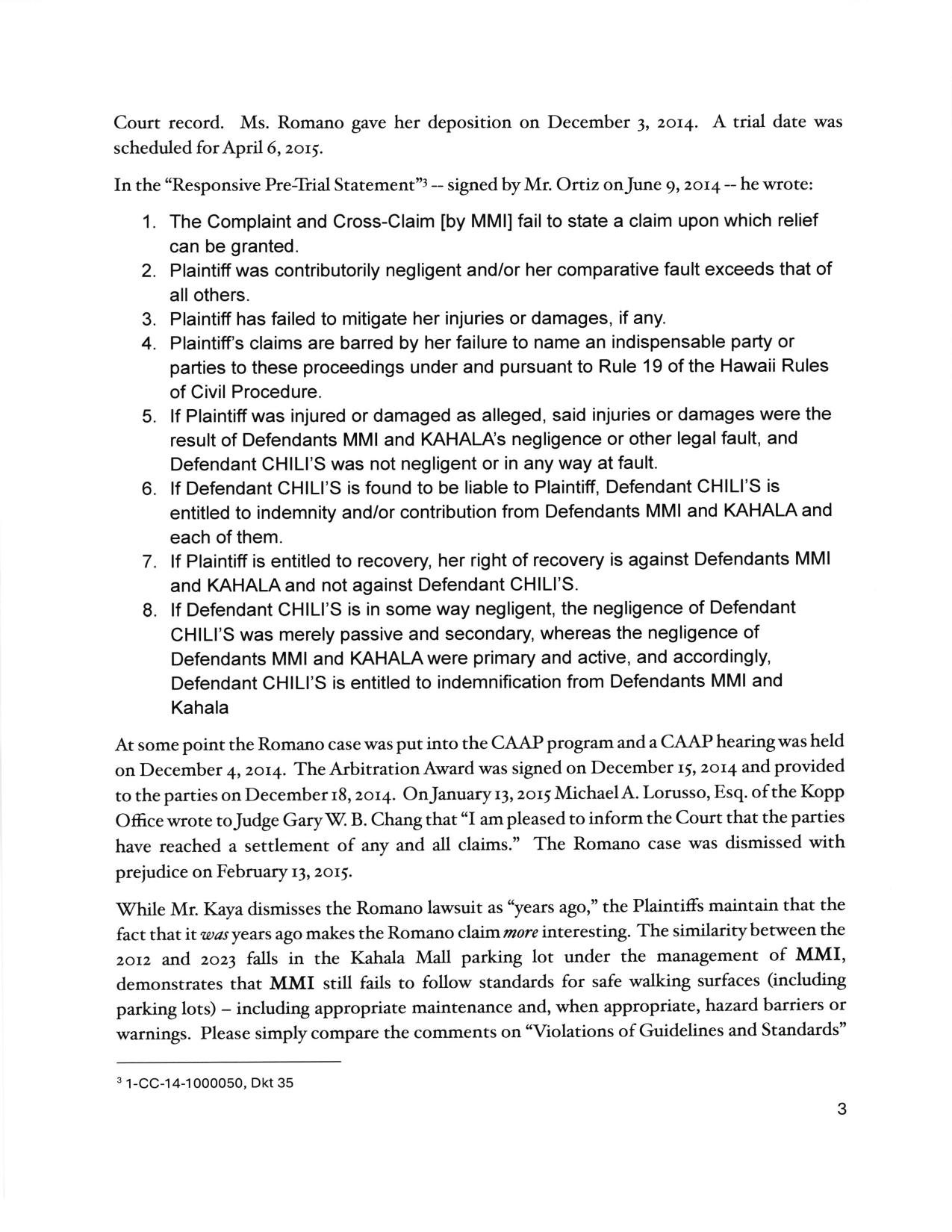
The Romano case went to arbitration too. The award was signed on 15 December 2014. On 13 January 2015 Michael A. Lorusso of the Kop office wrote to Judge Gary W. B. Chang: I am pleased to inform the Court that the parties have reached a settlement of any and all claims. It was dismissed with prejudice on 13 February 2015.
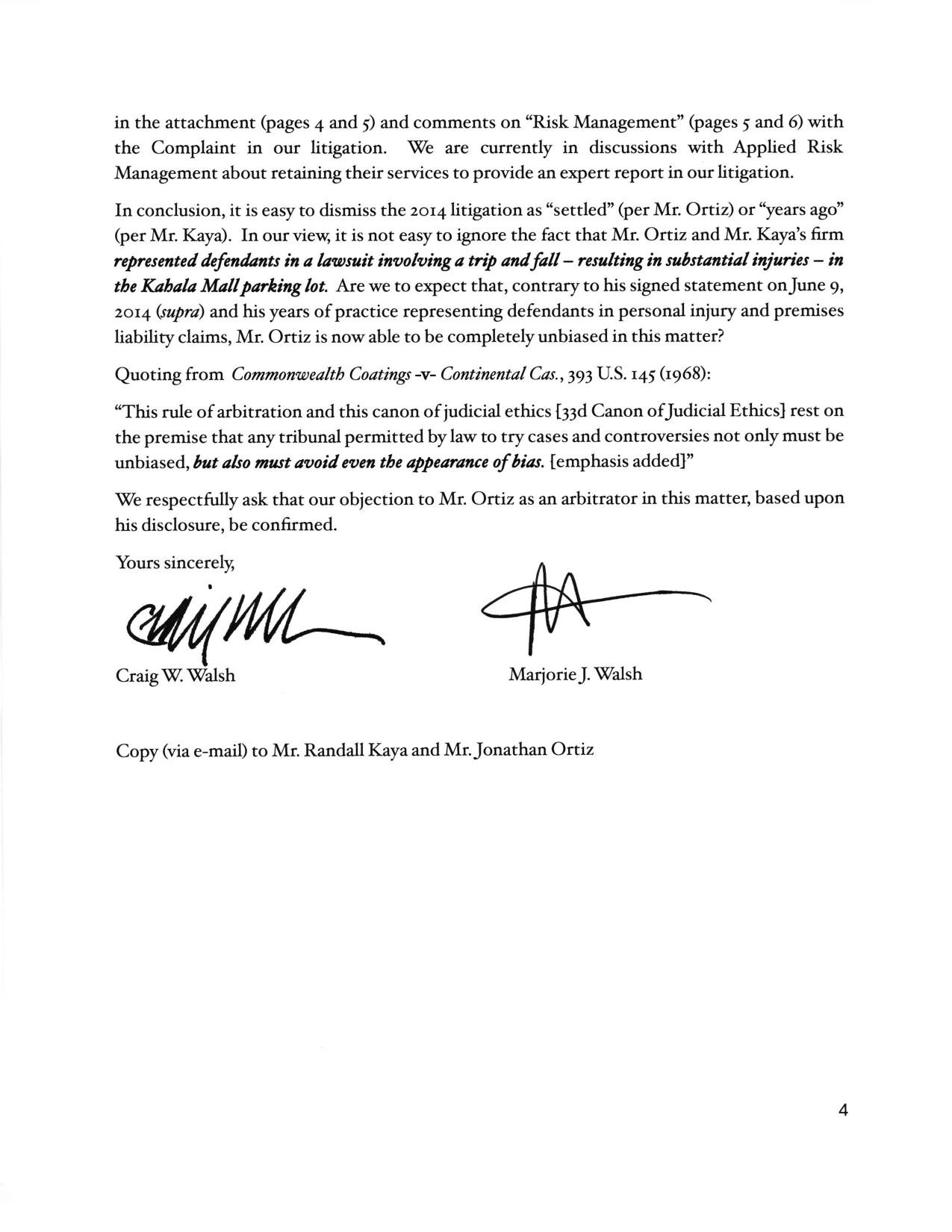
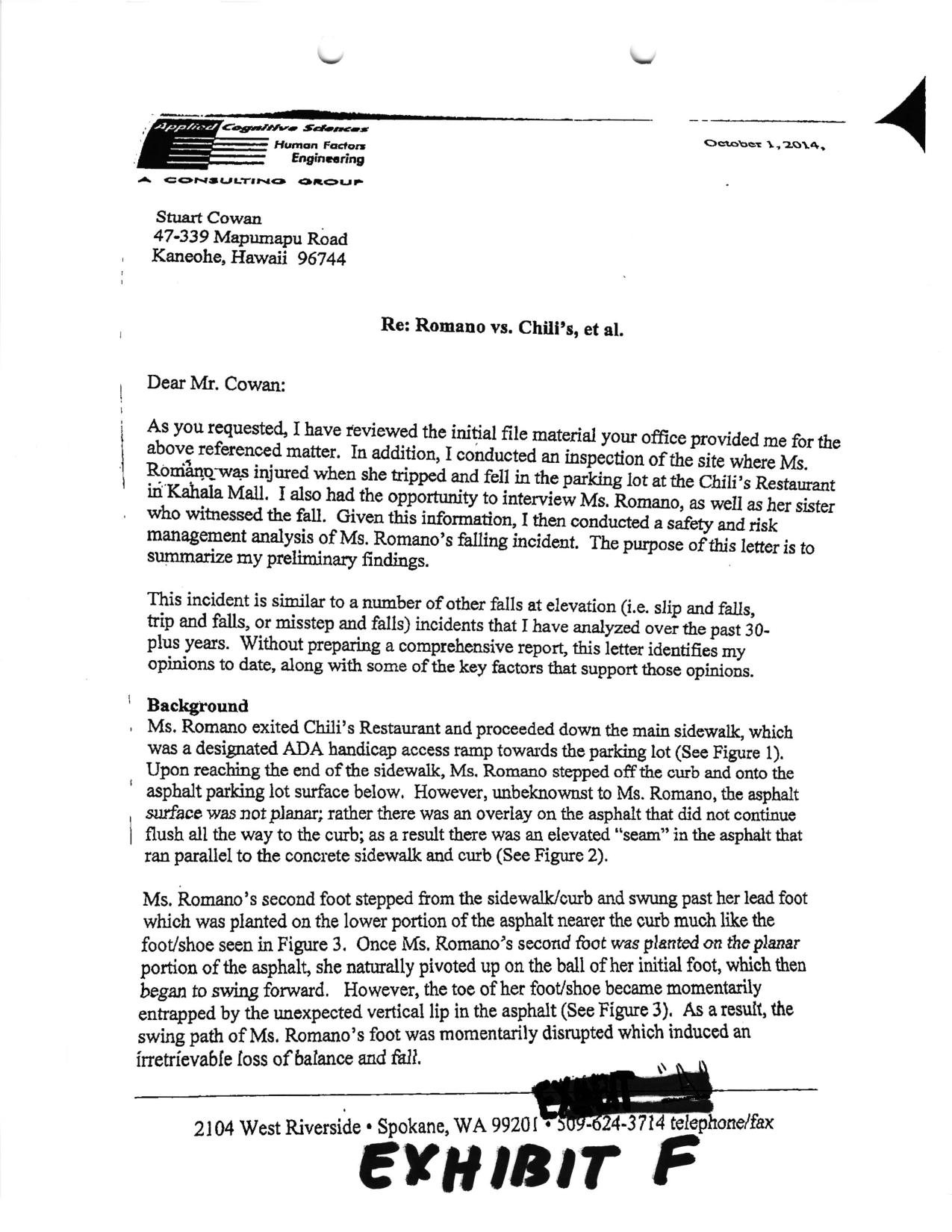
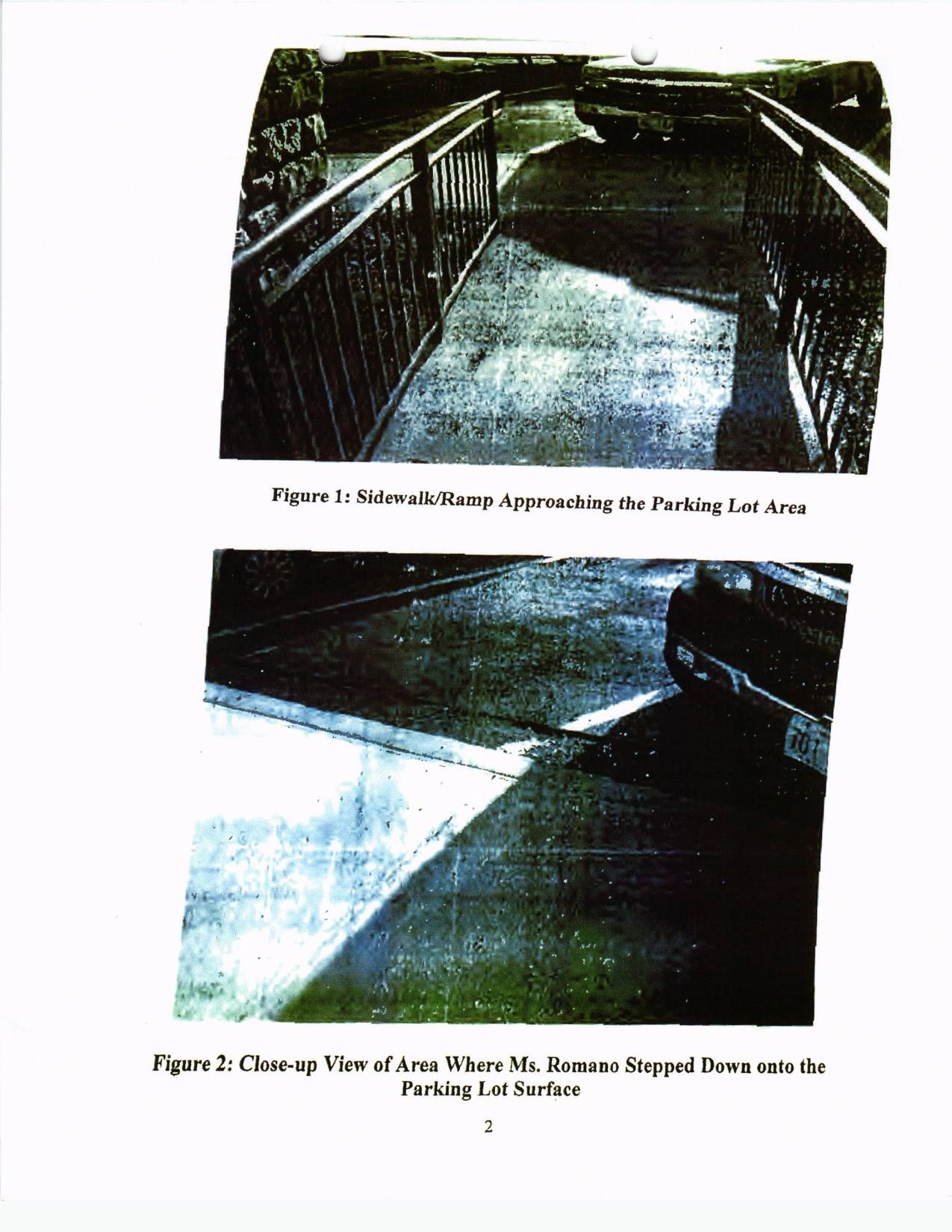
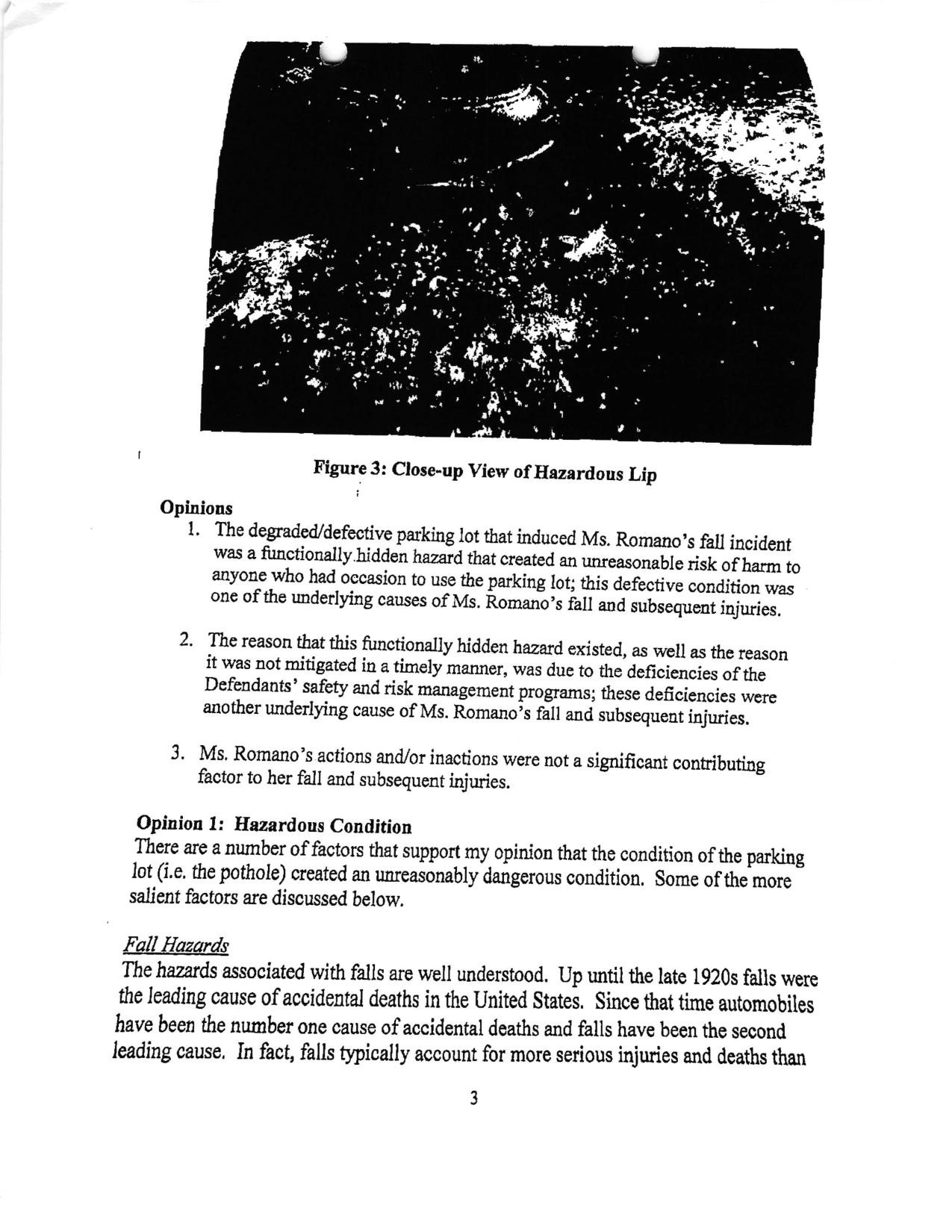
VII. The arbitration award
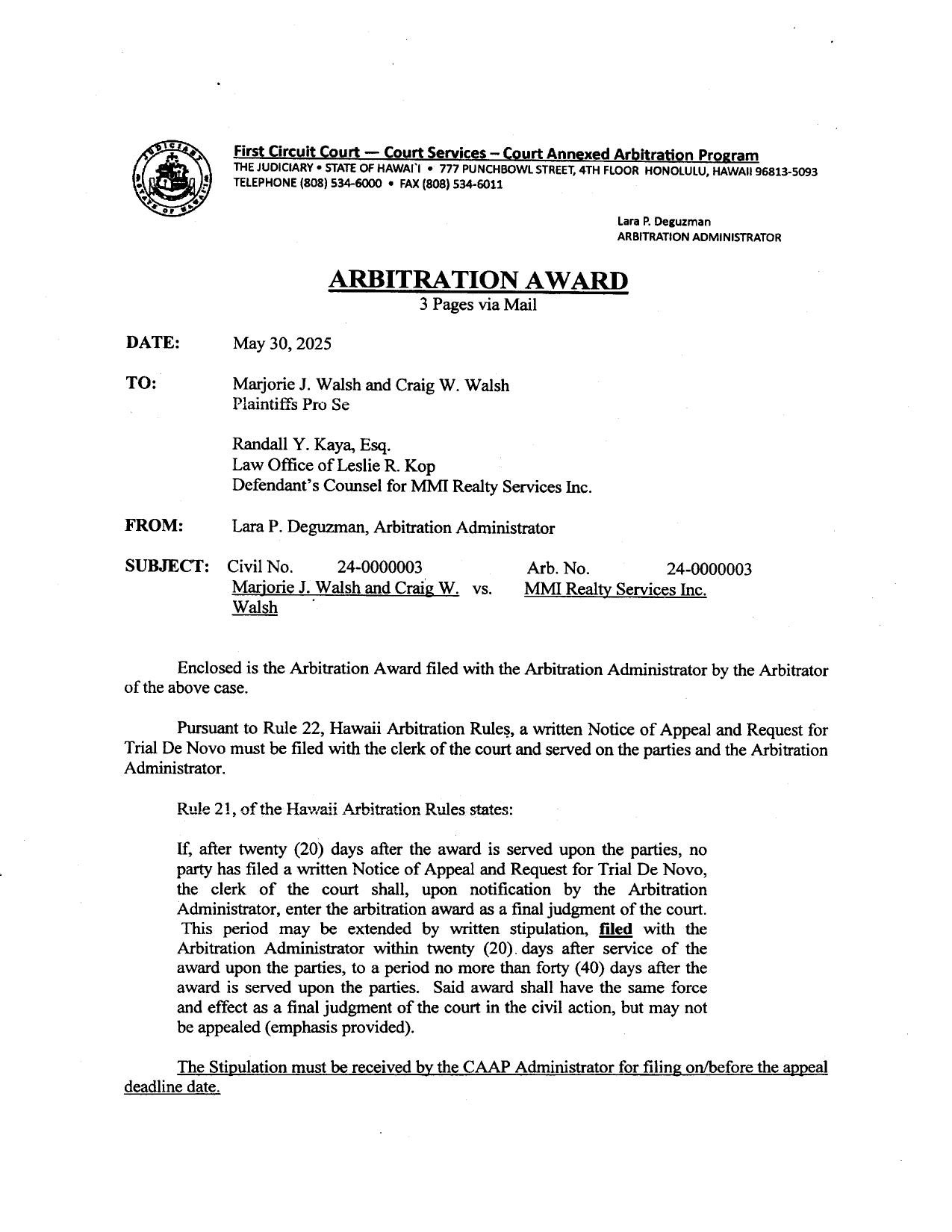
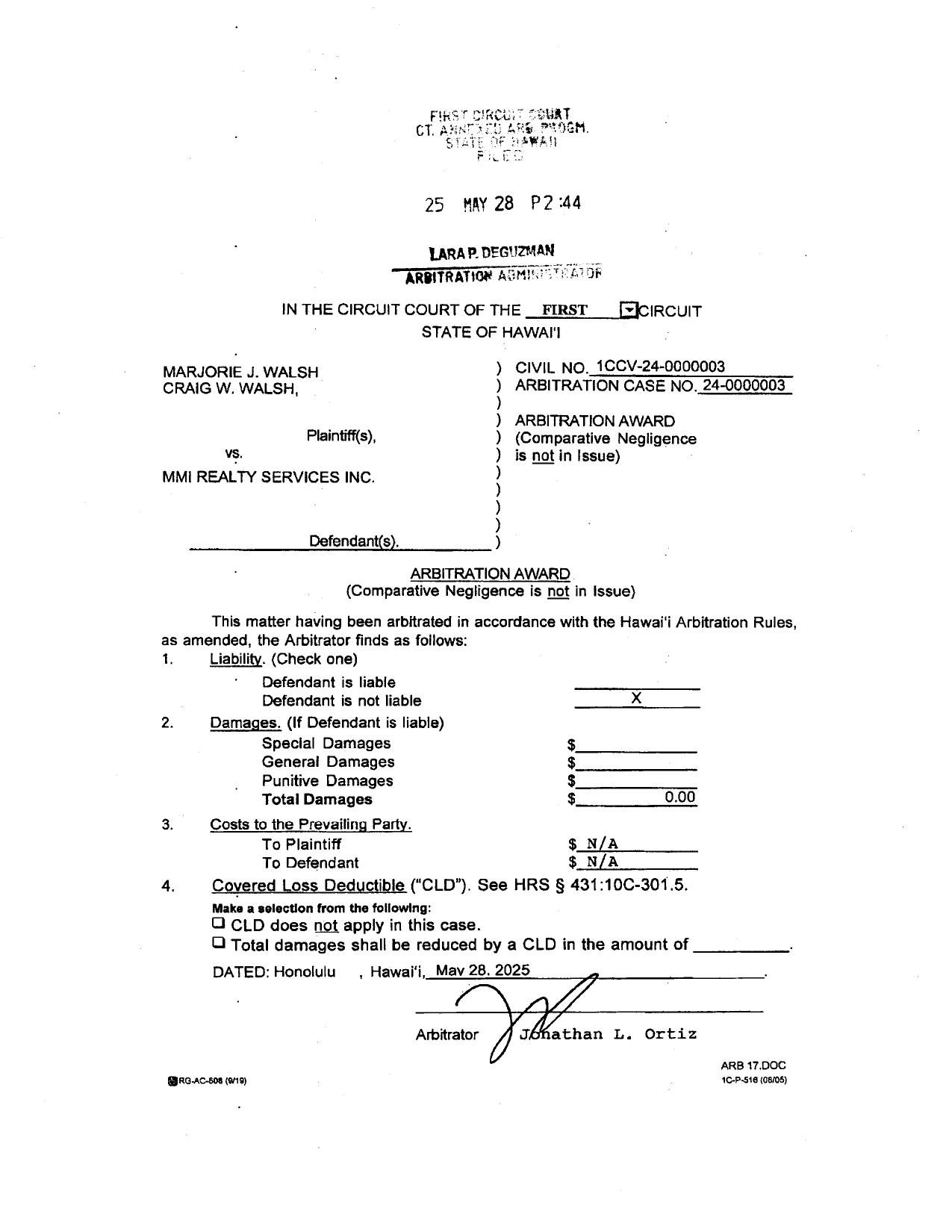
Jonathan Ortiz signed his award on 28 May 2025. It is a one-page form. Against Liability, the box marked Defendant is not liable is ticked. Total damages, $0.00. Costs to the prevailing party, N/A.
A plaintiff who appeals an arbitration award and then fails to improve on it puts himself at risk of paying the other side’s attorney’s fees. As the Walshes pointed out during the arbitration, the rules impose no equivalent exposure on a defendant appealing against pro se plaintiffs.
Under the current Rules, the Defendants get essentially a risk-free appeal.
They appealed anyway. The Notice of Appeal and Request for Trial de Novo was filed on 12 June 2025, docket item 62.
That is how the case came back to the Circuit Court, and how it came to have a trial date of 29 June 2026.
VIII. Esmeralda Paeste
The defence came to rest on one proposition: nobody had ever fallen at that drain, so the mall had no notice of any danger.
It came from the deposition of Esmeralda Paeste, General Manager of Kahala Mall, taken on 12 November 2025. She had been in the role over fifteen years. She reports to Mark Babin and John Mendelson.
Shown a document headed Kahala Mall Property Overview, she said she had not seen it.
The Walshes then handed her a general manager’s job description. It was not hers; it was a typical one, drawn up so that she could mark what did and did not form part of her duties. She said she had not seen it before. Asked whether it described her role, she took issue with one line — the one making the general manager responsible for compliance with “ADA and local building codes” — because, she said, the mall relies on engineers, architects and third-party consultants for those things.
A. I mean, it wouldn’t be me because I’m not an ADA professional. So we rely on, you know, a third party.
On maintenance: performed by a third-party vendor. On inspections: performed by the vendor. On security and incident reports: Allied Universal, a contractor.
Q. And do they give you a summary of incident report by month, by quarter, by year? Or is it just ad hoc, one report then another? A. Yes. They normally just give us a copy of the report as it happens. Q. Okay. So there’s no oversight to see we’ve had a certain number of reports of this nature during, for example, the last quarter? A. What do you mean? Q. So you just get reports when it happens? You don’t get any sort of overriding report that gives you a breakdown of the types of reports during, for example, the past year? A. They don’t provide us that.
Asked who at the mall is responsible for maintaining safe premises for the public, she said the question was very vague.
On accessible routes:
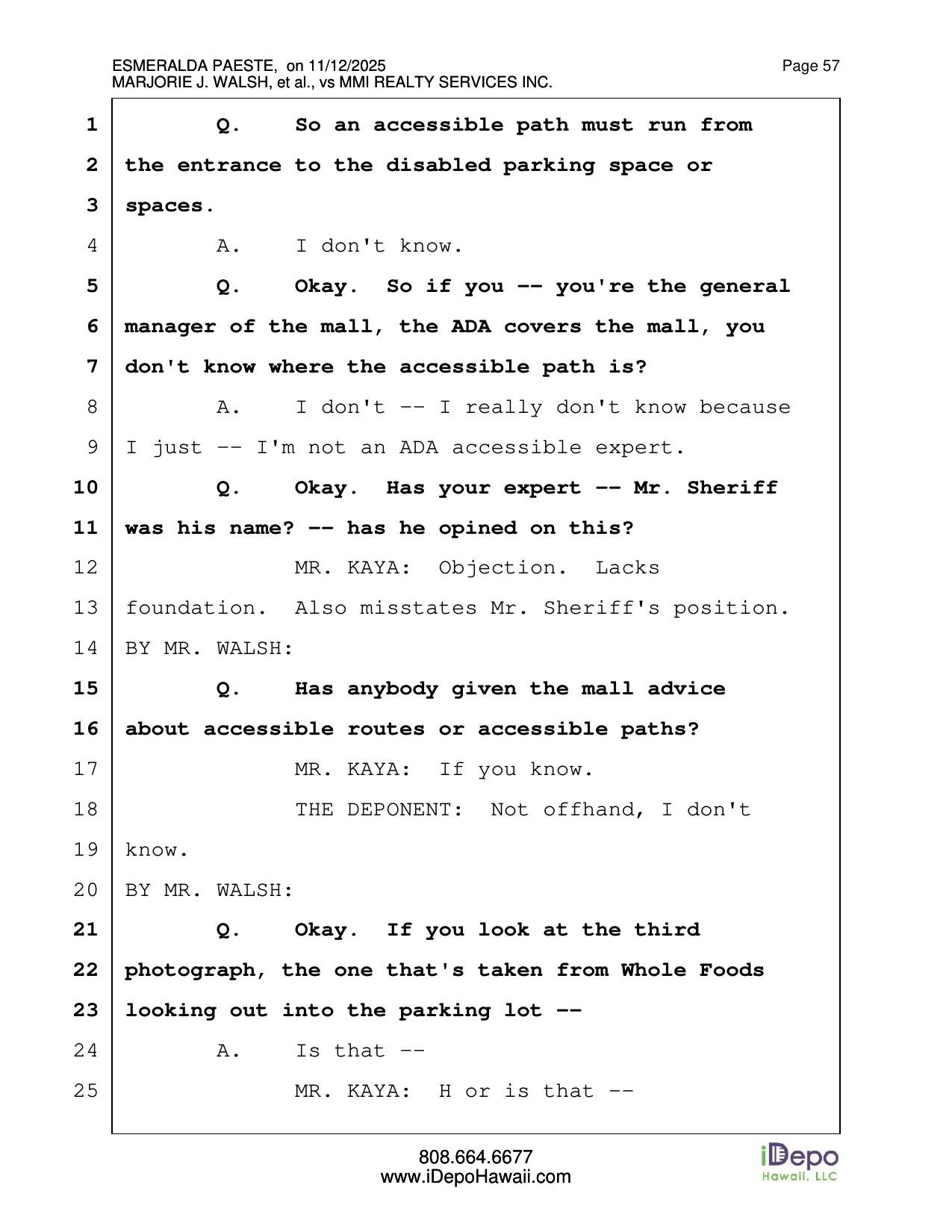
Q. So an accessible path must run from the entrance to the disabled parking space or spaces. A. I don’t know. Q. Okay. So if you — you’re the general manager of the mall, the ADA covers the mall, you don’t know where the accessible path is? A. I don’t — I really don’t know because I just — I’m not an ADA accessible expert.
Q. So do you know what architects call a “path of desire”? A. No.
Q. …know where to go? A. Yeah, I don’t know. I’ve never been in a wheelchair before. I don’t know.
None of this was evasion. She was answering honestly. That was the plaintiffs’ point:
That testimony establishes the absence of her personal knowledge. It does not — and given Defendant’s own operational architecture cannot — establish the absence of prior falls.
…A property owner who has structured its operations to make discovery institutionally impossible cannot then defend on the ground that no incident came to its attention. The duty of Knodle is not satisfied by structural ignorance; it is defeated by it.
IX. Paul Sheriff
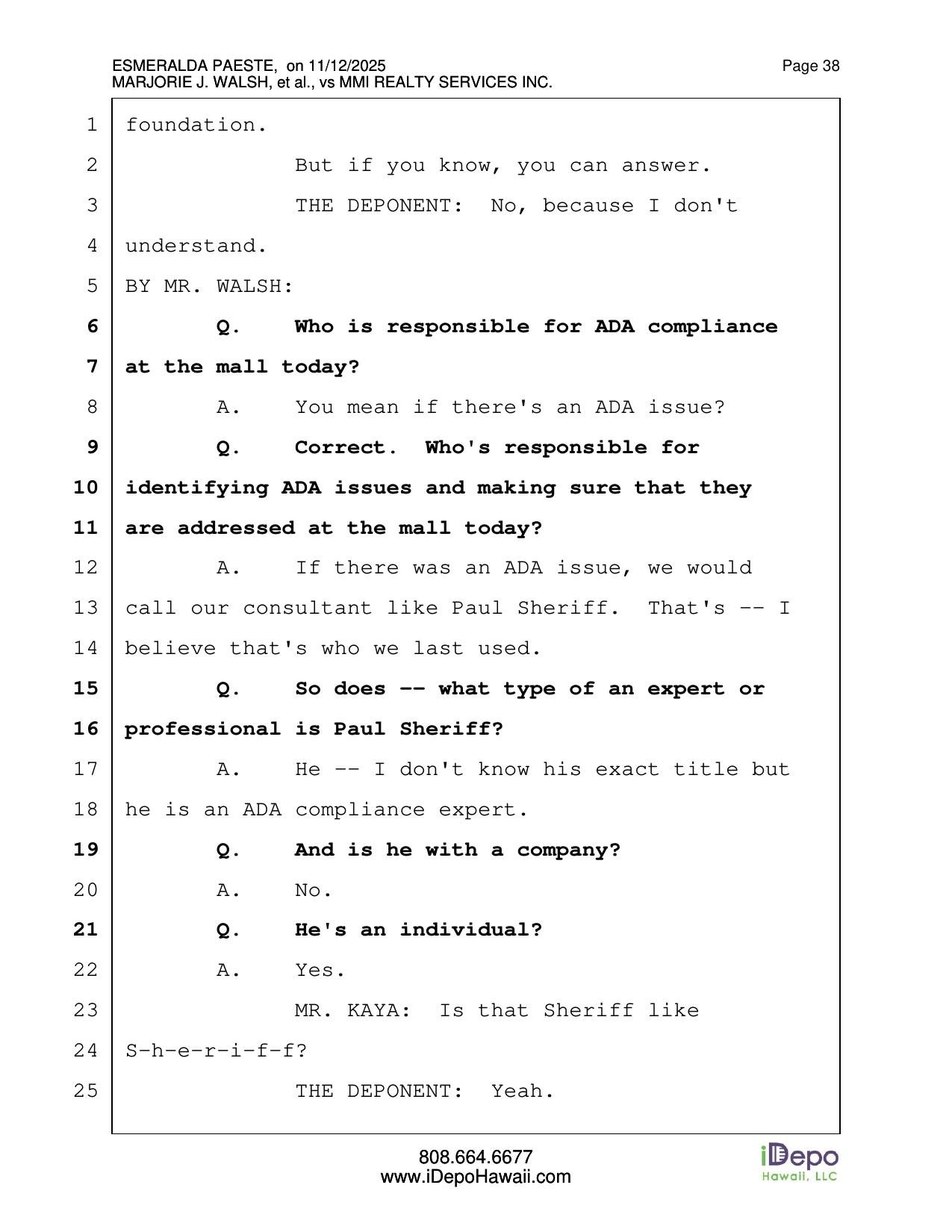
There was one question to which Ms. Paeste had a ready answer. Asked who is responsible for ADA compliance at the mall:
A. If there was an ADA issue, we would call our consultant like Paul Sheriff. That’s — I believe that’s who we last used. Q. So does — what type of an expert or professional is Paul Sheriff? A. He — I don’t know his exact title but he is an ADA compliance expert. Q. And is he with a company? A. No. Q. He’s an individual? A. Yes.
MR. KAYA: Is that Sheriff like S-h-e-r-i-f-f? THE DEPONENT: Yeah.
Paul Sheriff died on 26 October 2017.
His obituary is in the Dignity Memorial registry, under the care of Borthwick Mortuary in Honolulu. He was a sole practitioner and the practice did not survive him. He had been dead eight years when the General Manager named him as the mall’s ADA consultant, and nearly six years when Marjorie Walsh fell.
She also testified that he was not on a retainer, and that he had not visited the property, so far as she knew, in 2024 or 2025.
Nobody had noticed. Nobody had replaced him.
Asked in discovery to produce records of any ADA consultant, MMI answered:
This request assumes there is a need or requirement for an “ADA consultant.”
X. The repair to the drain that did not need repairing
The arbitration hearing was held in May 2025 and the award signed on 28 May. The arbitrator had ordered that nothing at the site be altered until the litigation concluded.
Seven weeks later, MMI engaged Steel Constructors LLC.
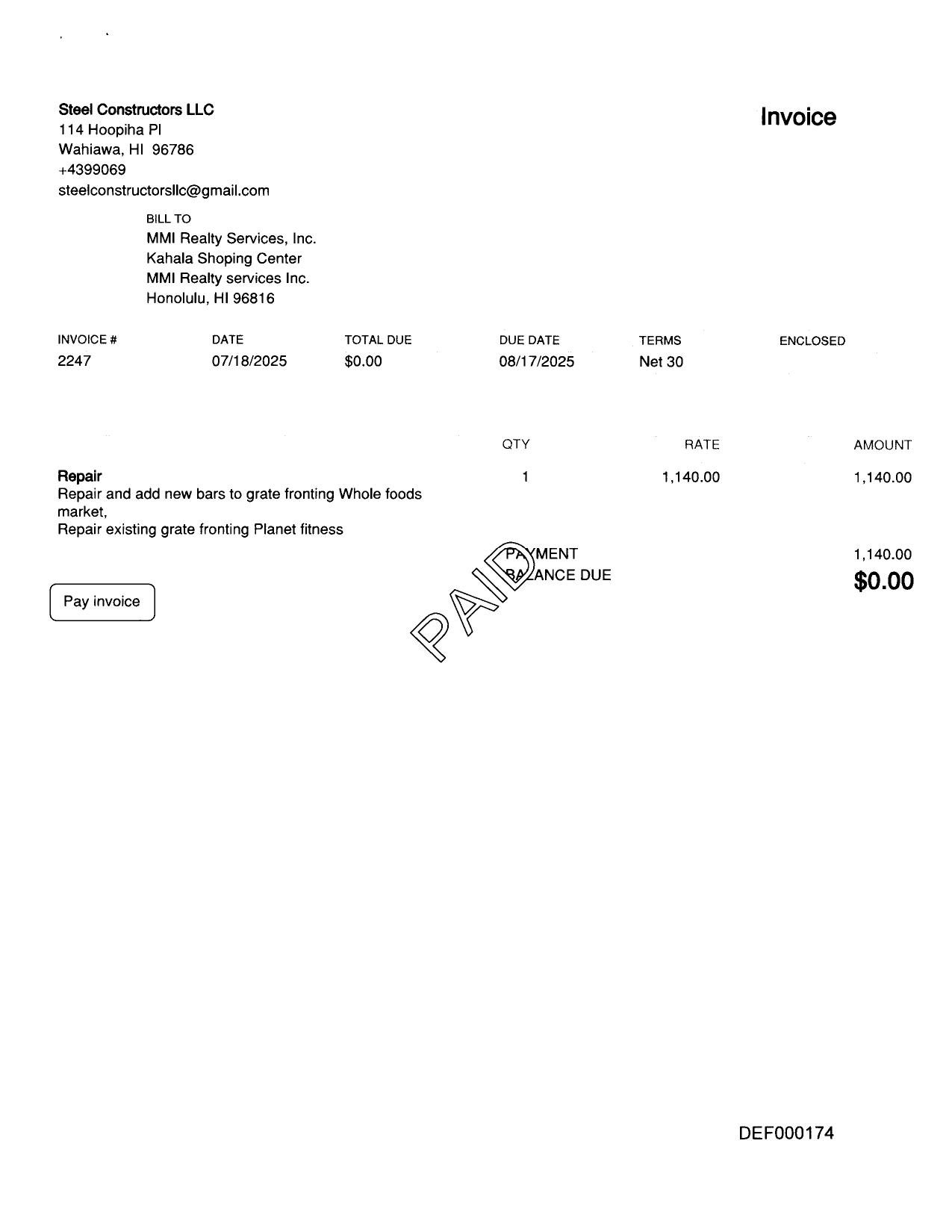
Invoice No. 2247, 18 July 2025, $1,140, produced by the defendant at Bates DEF000174:
Repair and add new bars to grate fronting Whole Foods market.
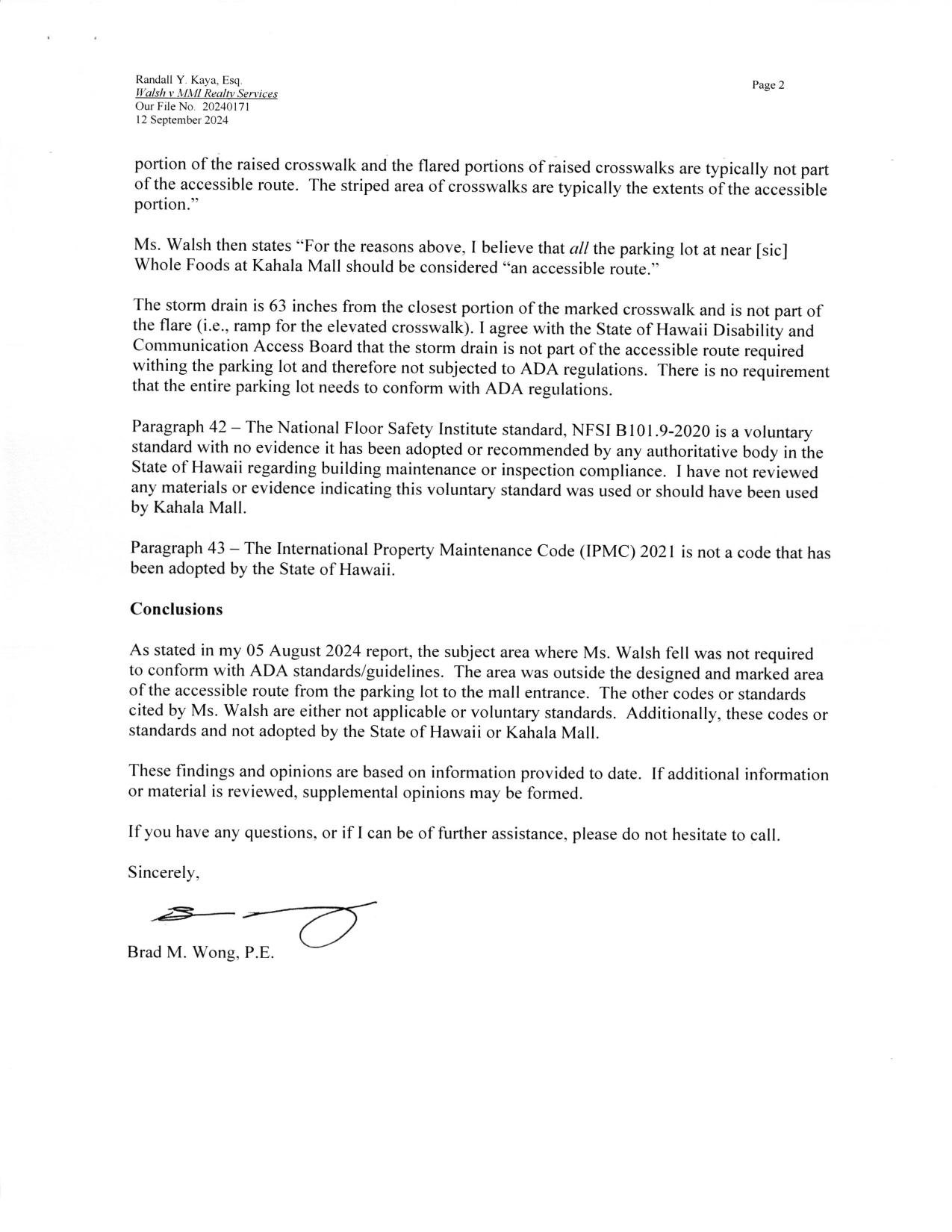
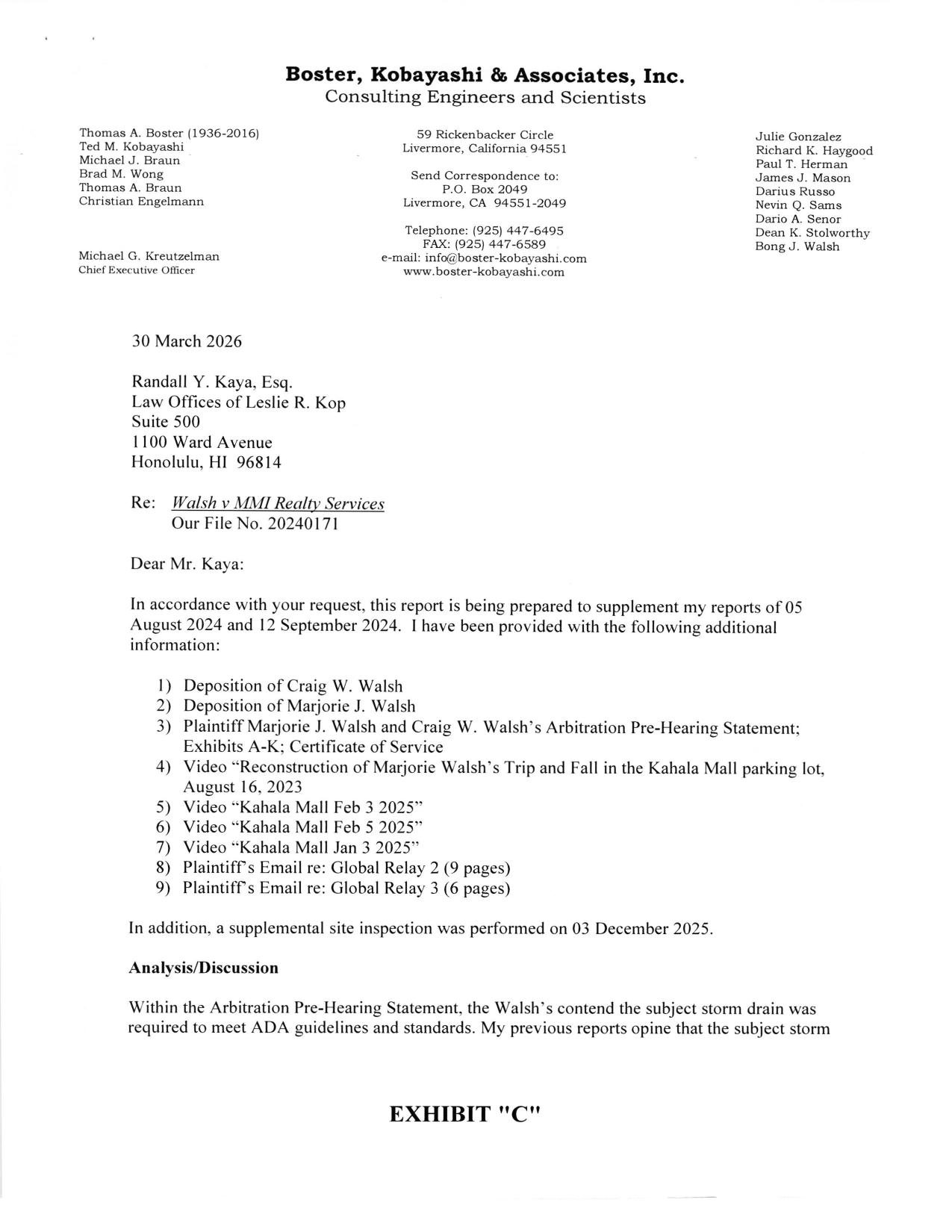
Bars were added to the existing damaged grate. The deteriorated concrete, the exposed rebar and the uneven surface were left as they were. The grate itself had been taken away and worked on in a shop, then reinstalled the other way round — a white paint mark in the lower left corner of a photograph from 28 September 2023 appears in the upper right corner of one taken on 21 November 2025.
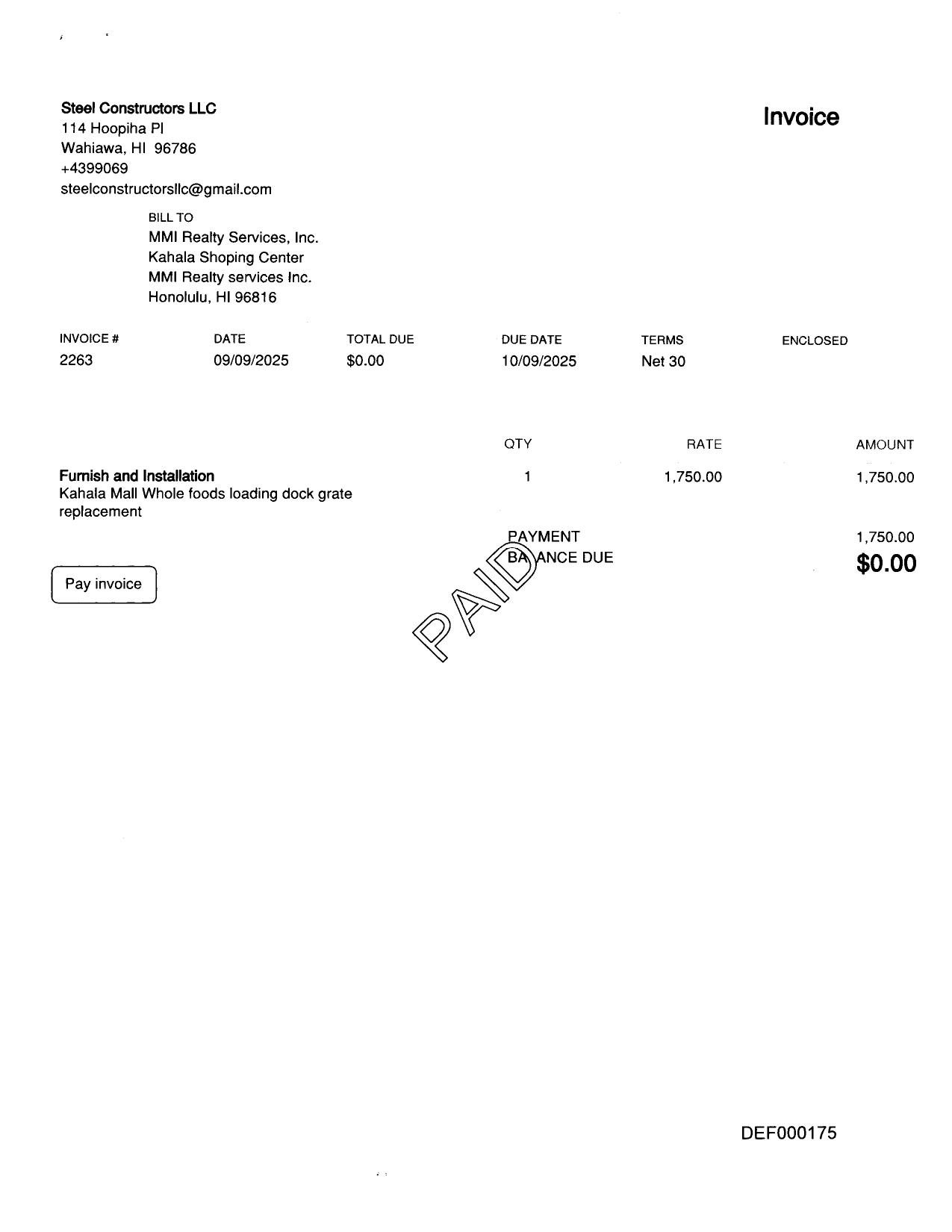
Seven weeks after that, Invoice No. 2263, 9 September 2025, $1,750, Bates DEF000175: Furnish and Installation — Kahala Mall Whole Foods loading dock grate replacement.
At the loading dock, the grate was replaced. At the drain that broke Marjorie Walsh’s femur, bars were welded onto the old one.
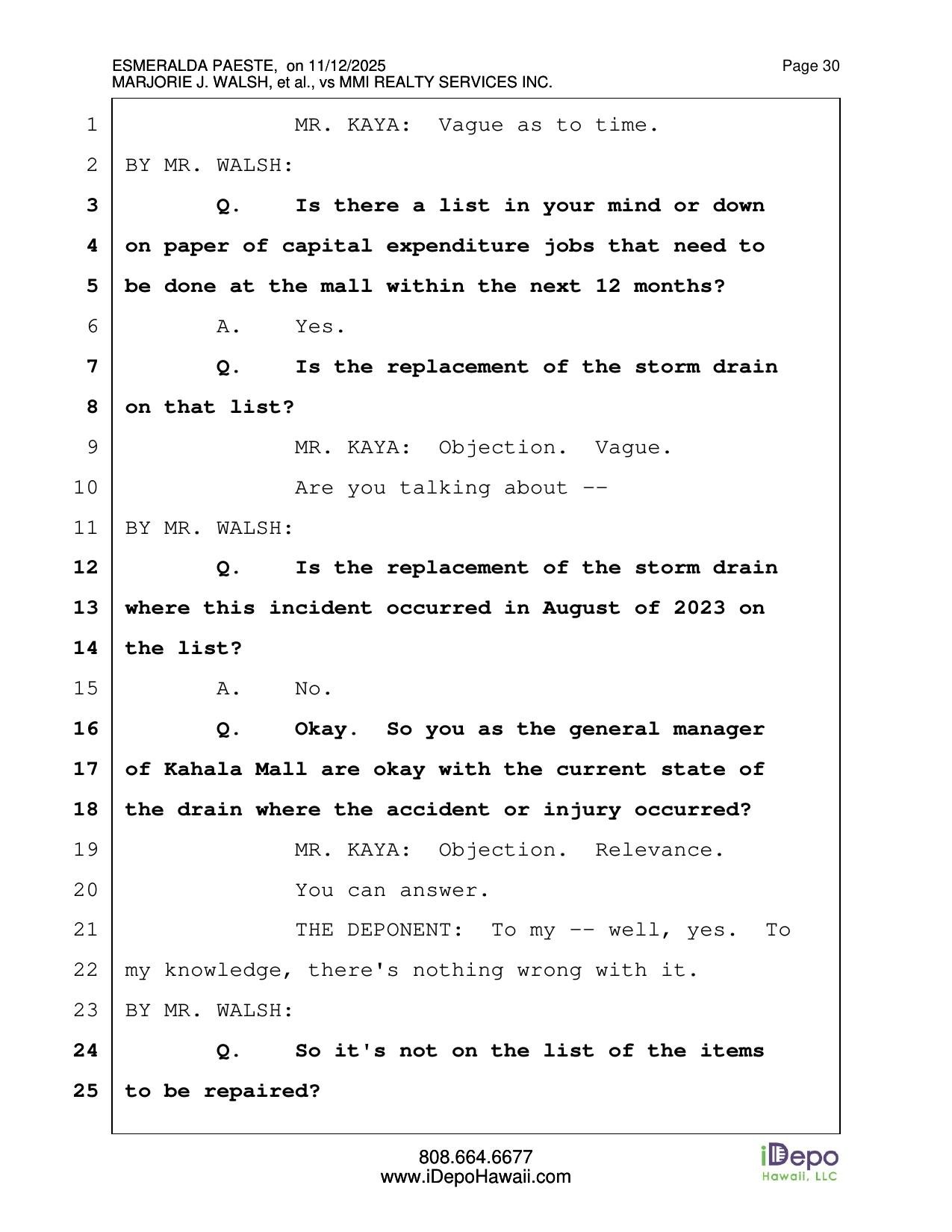
Four months after the first invoice, Ms. Paeste was deposed. She was asked about the mall’s list of capital expenditure jobs for the coming year.
Q. Is the replacement of the storm drain where this incident occurred in August of 2023 on the list? A. No. Q. Okay. So you as the general manager of Kahala Mall are okay with the current state of the drain where the accident or injury occurred? … THE DEPONENT: To my — well, yes. To my knowledge, there’s nothing wrong with it.
Asked about the work Steel Constructors had done, she did not know its scope, and named as the contractor a company that does not exist.
When the invoices were produced in discovery, MMI’s answer invoked Rule 407 of the Hawai‘i Rules of Evidence — the rule excluding subsequent remedial measures — and described the work as having been done long after Plaintiff’s incident.
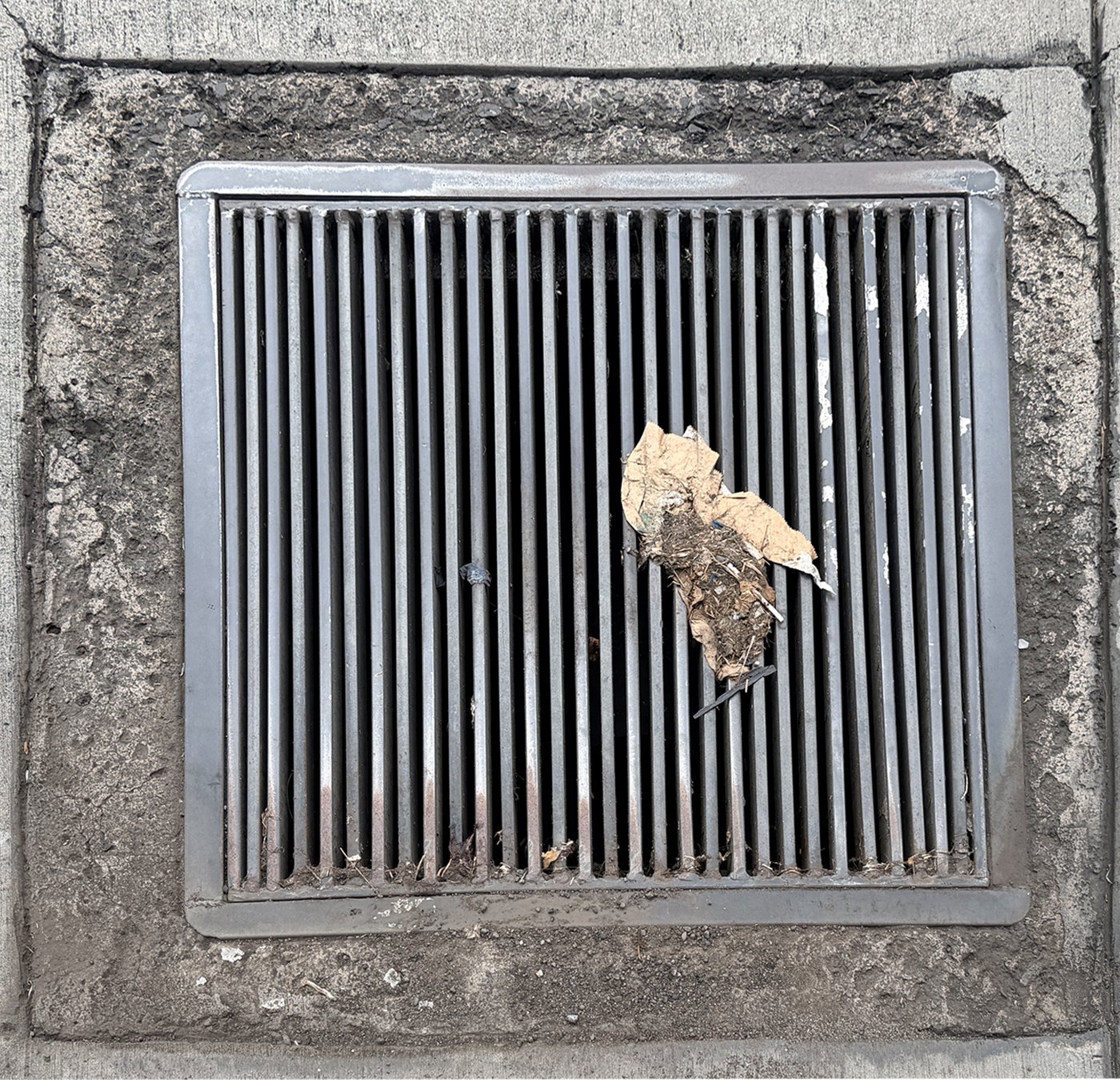
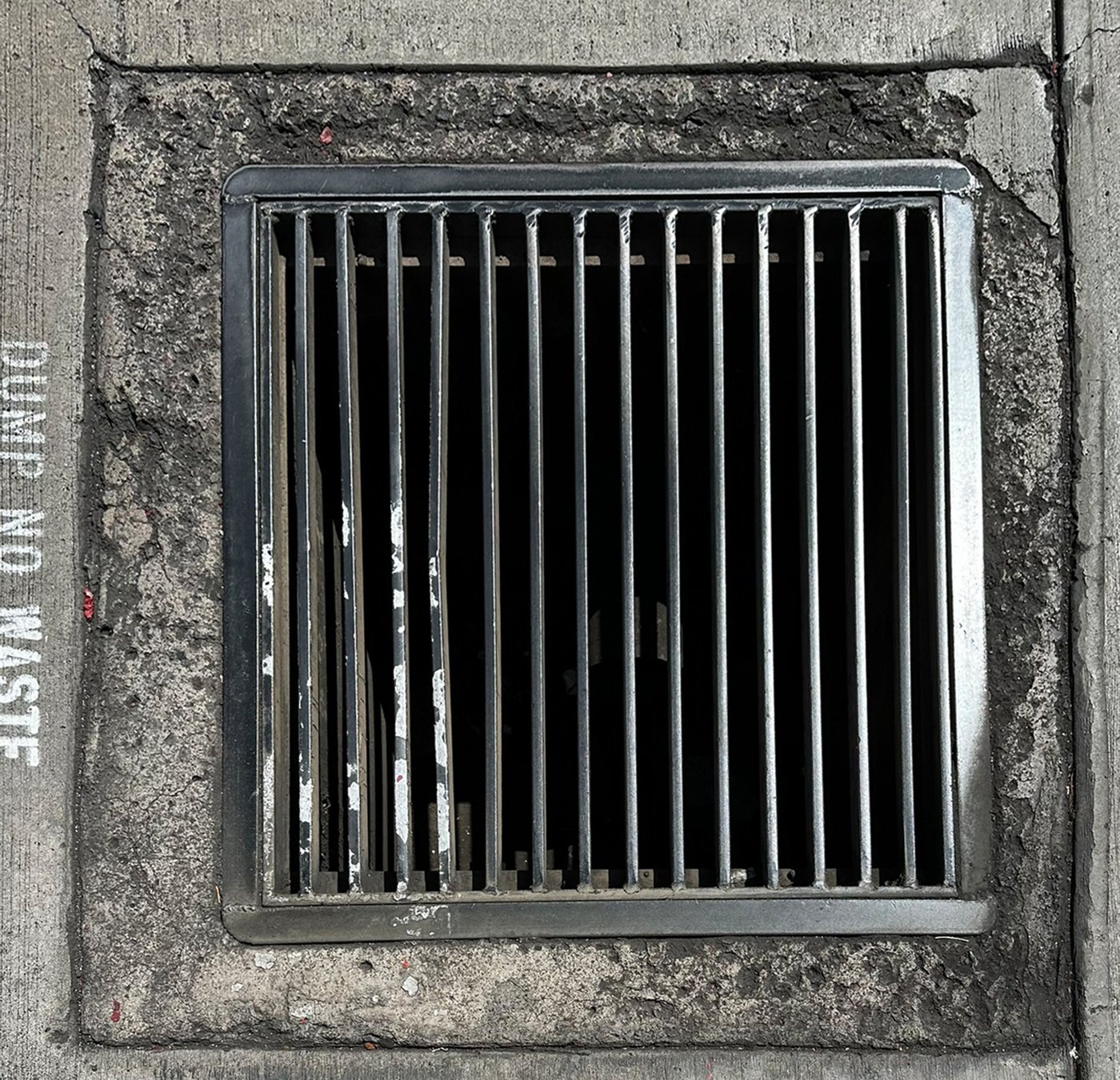
28 September 2023
21 November 2025
Steel Constructors’ work of July 2025. Bars have been added between the existing bars.
The concrete surround, the exposed reinforcing steel and the uneven pavement are the same in
both photographs, crack for crack.
XI. The State’s opinion
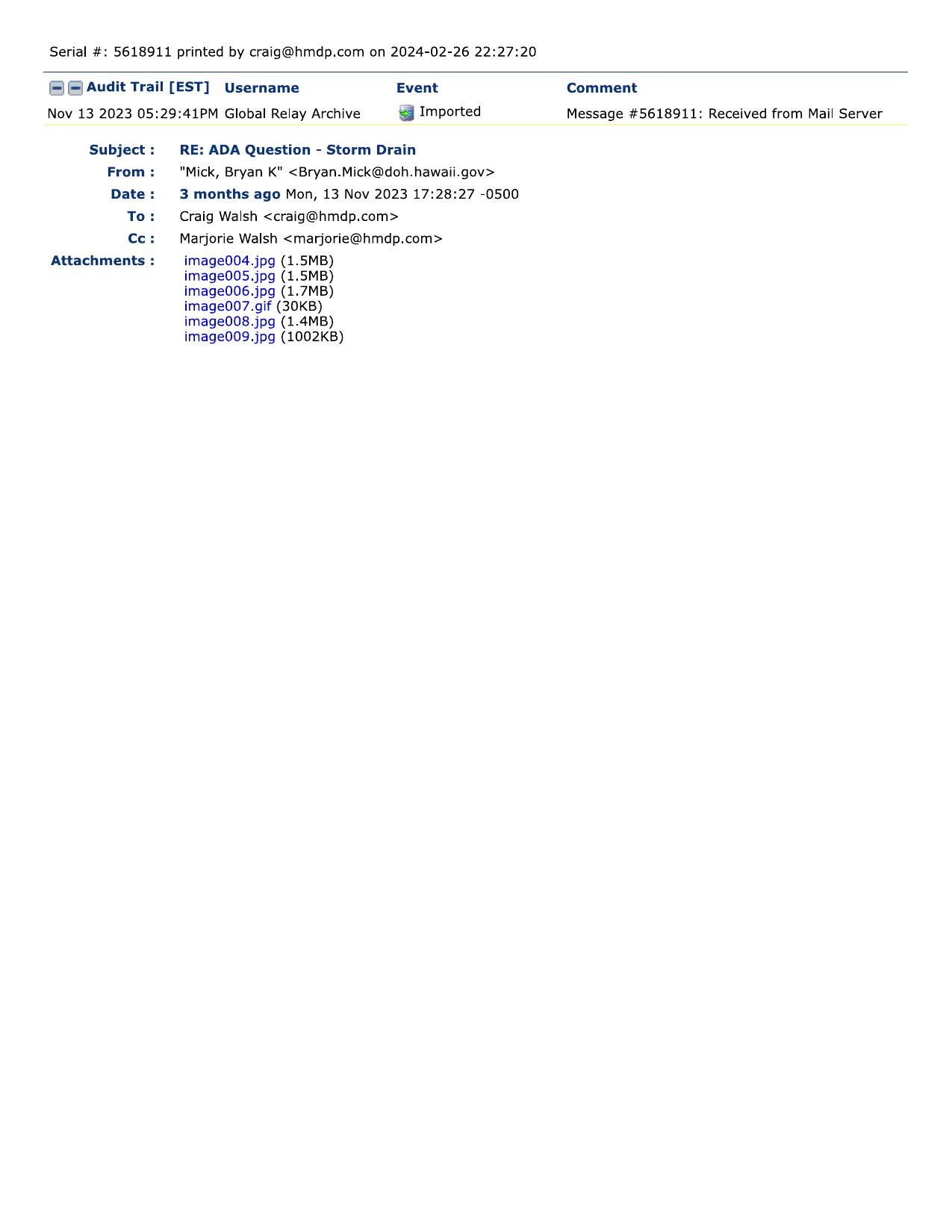
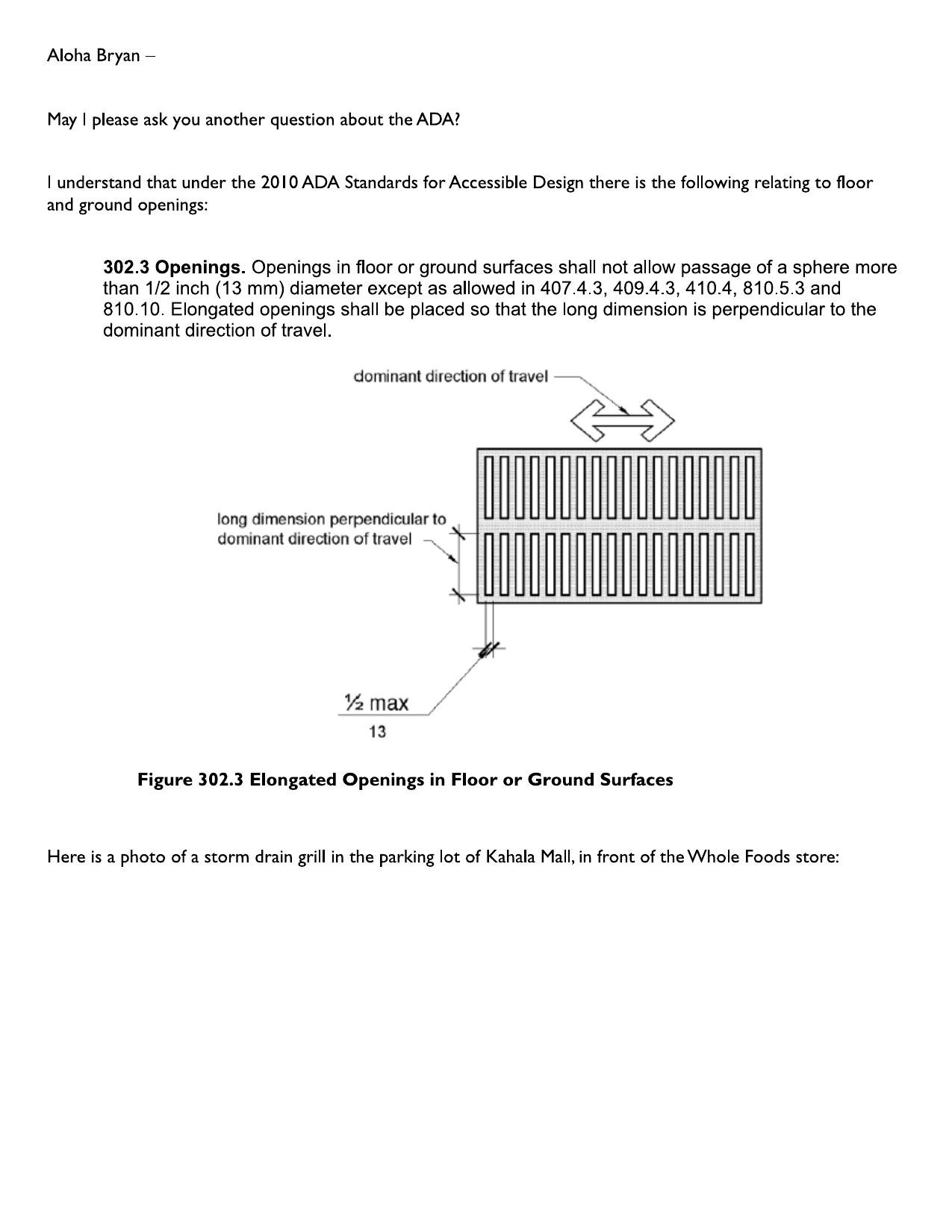
On 7 November 2023 Craig Walsh emailed Bryan K. Mick, Coordinator of Program & Policy Development at the State of Hawai‘i Disability and Communication Access Board. He set out ADA Standard 302.3 — openings in a walking surface must not pass a half-inch sphere — gave the measurements, and asked whether the standard applied and whether it was mandatory.
Mr. Mick asked a colleague and passed the answer on the same afternoon:
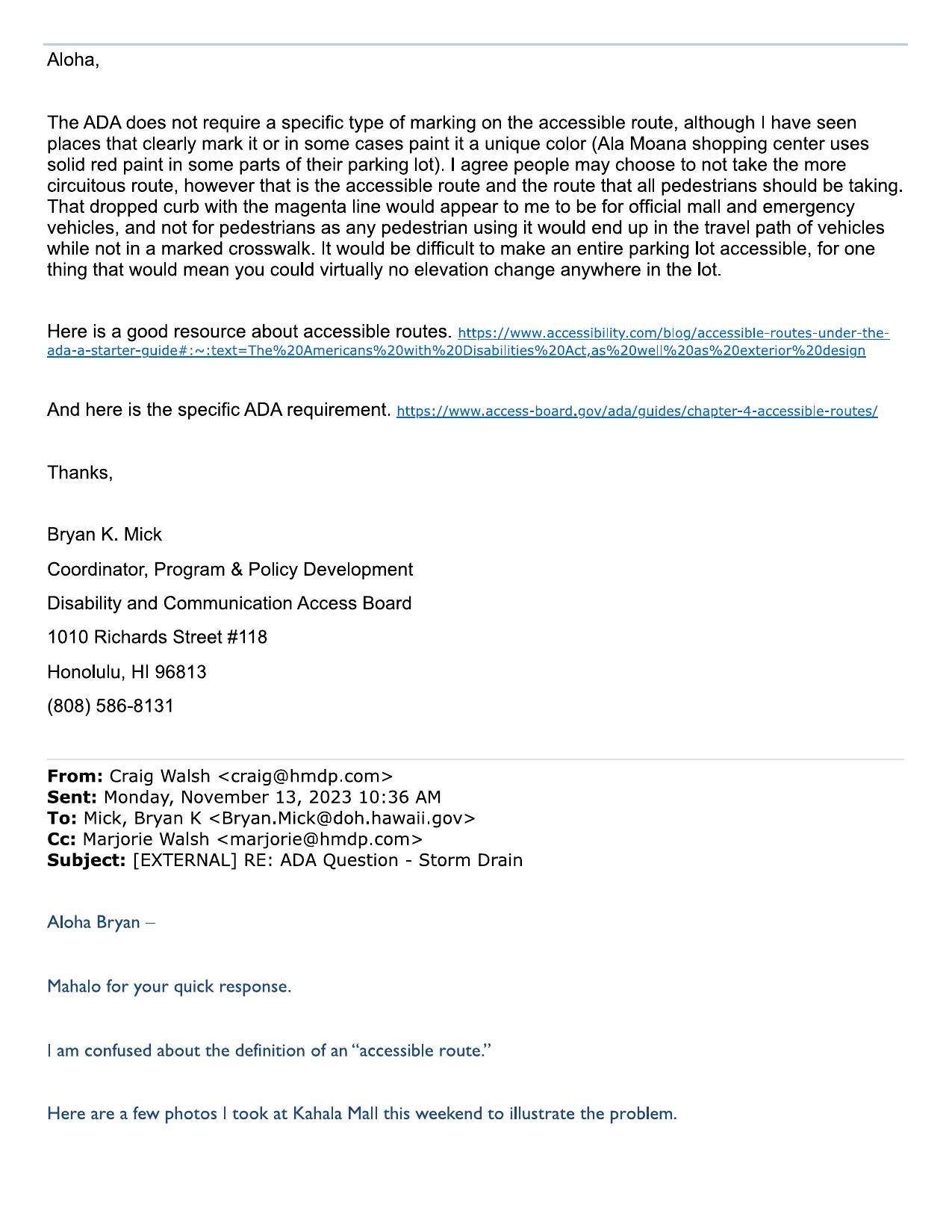
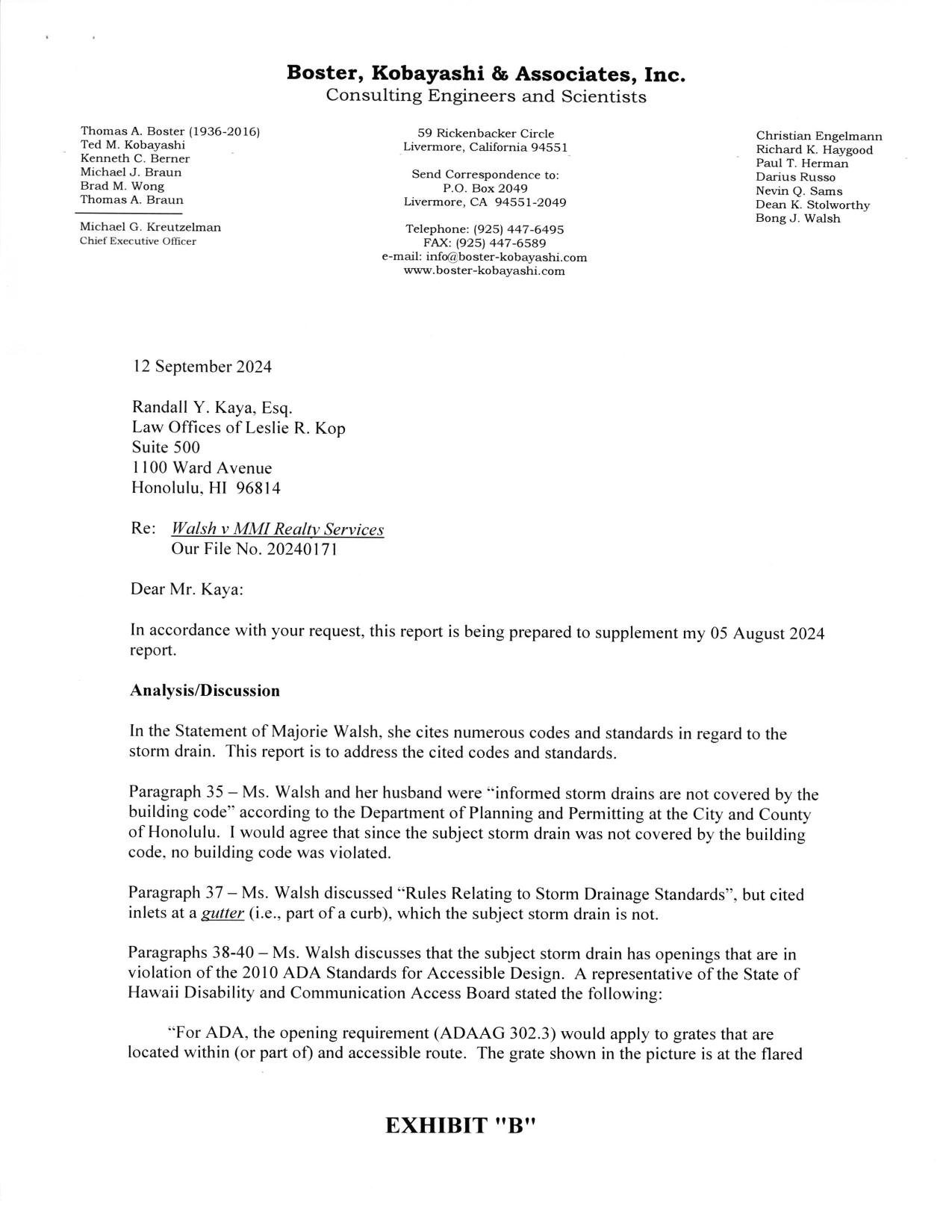
Kahala Mall and the public parking lot would be covered by the ADA and the requirements would be mandatory as it is a public accommodation. For ADA, the openings requirement (ADAAG 302.3) would apply to grates that are located within (or part of) an accessible route. The grate shown in the picture is at the flared portion of the raised crosswalk and the flared portions of raised crosswalks are typically not part of the accessible route.
He added, in his own voice: I’m surprised to find out the building code does not apply, seems like a very dangerous thing to not have any regulations on.
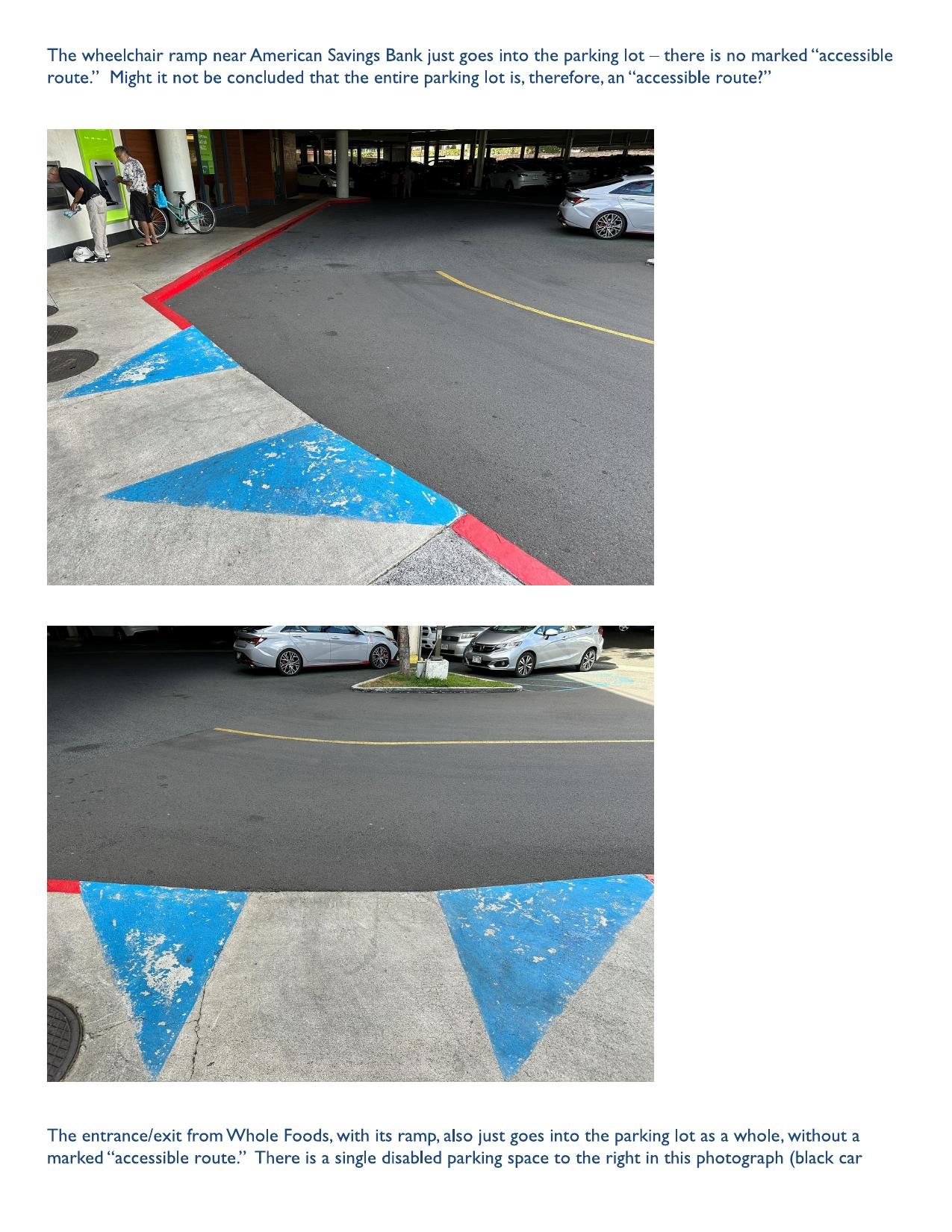
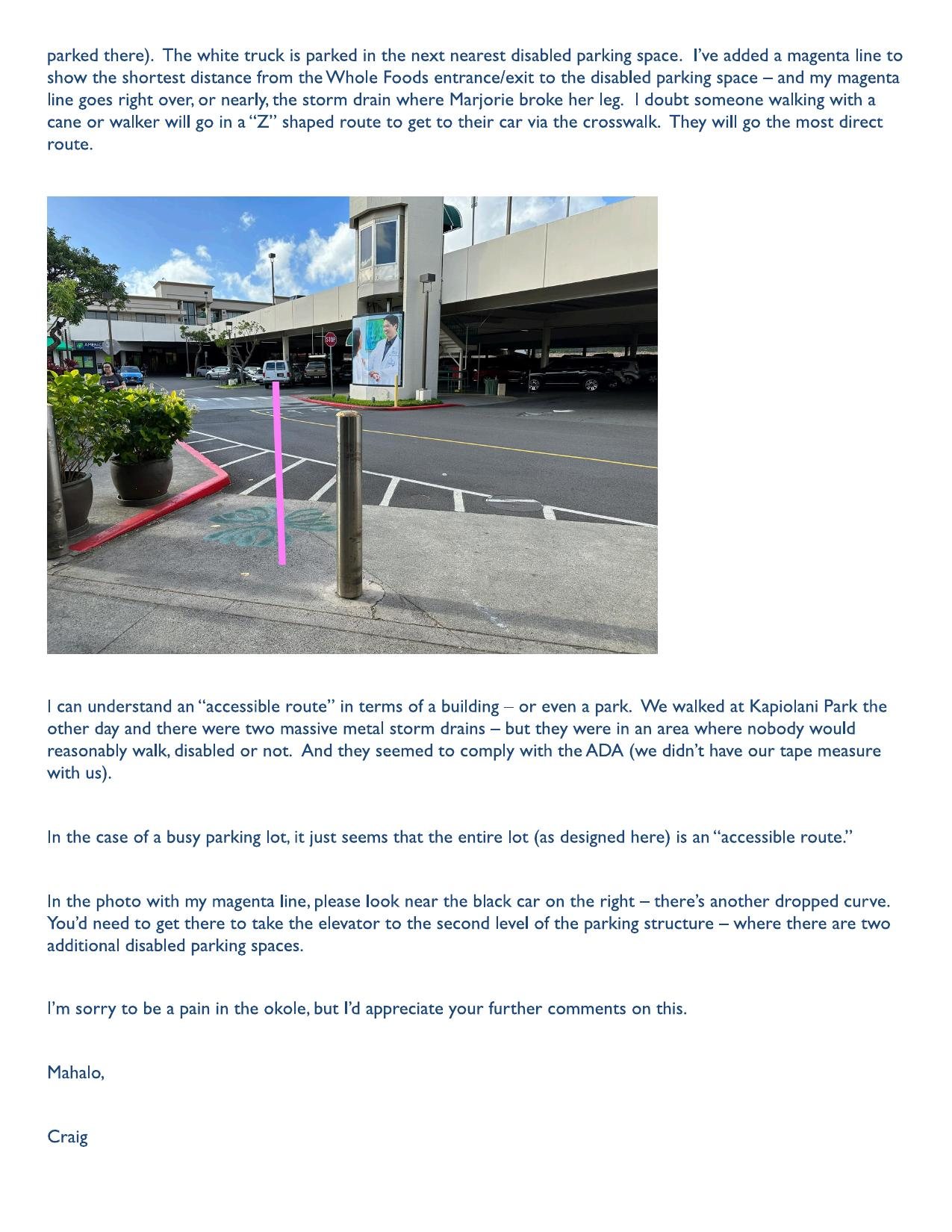
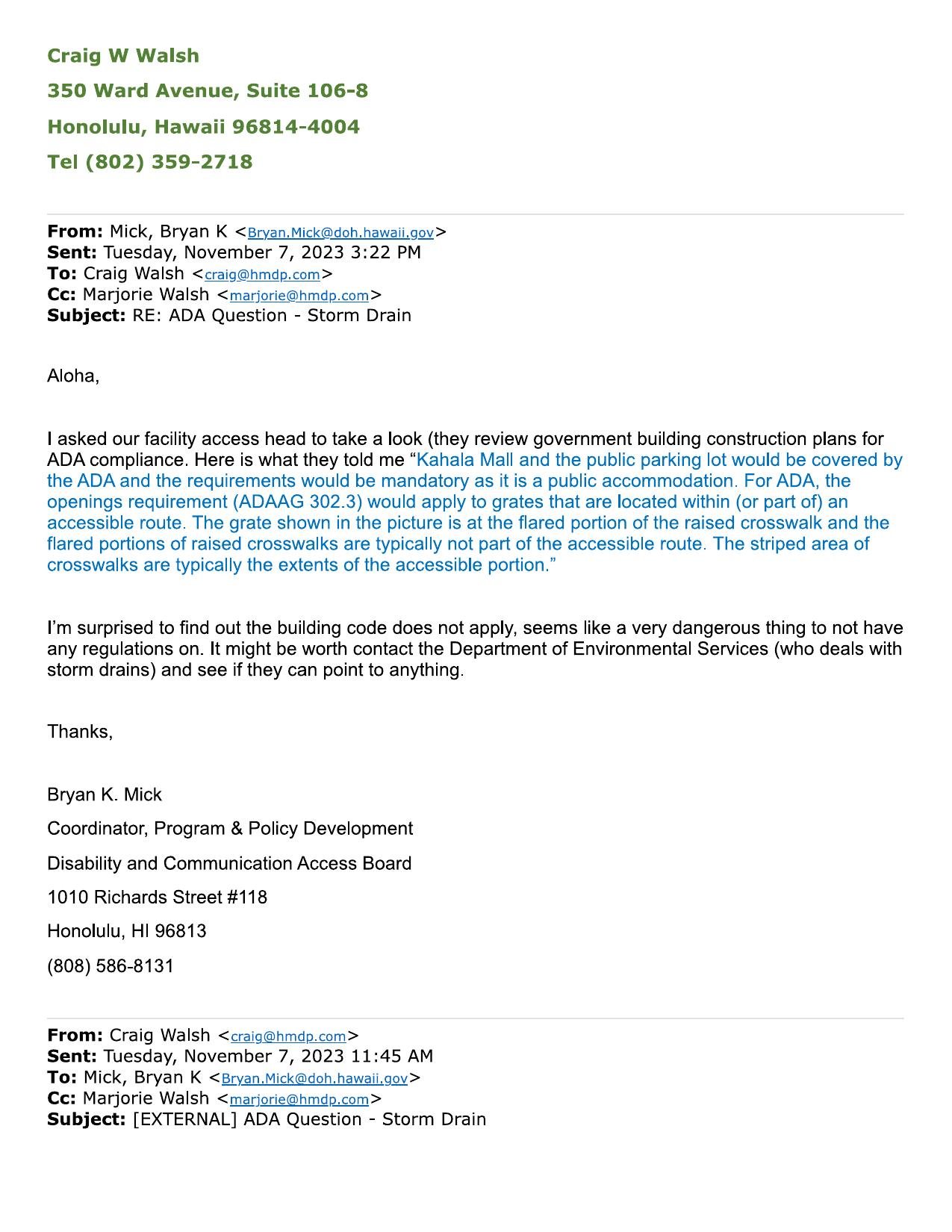
Craig wrote back with photographs. The wheelchair ramp by the American Savings Bank simply delivers you into the parking lot; there is no marked accessible route anywhere. The Whole Foods exit ramp does the same. He drew a magenta line from the door to the nearest disabled space — the shortest way — and it runs straight over the drain.
I doubt someone walking with a cane or walker will go in a “Z” shaped route to get to their car via the crosswalk. They will go the most direct route.
Mr. Mick replied on 13 November 2023:
I agree people may choose to not take the more circuitous route, however that is the accessible route and the route that all pedestrians should be taking. That dropped curb with the magenta line would appear to me to be for official mall and emergency vehicles, and not for pedestrians…
That email — an informal opinion from a state officer whose Board administers the disabled parking permit programme, relaying the view of an unnamed colleague, about photographs — became the foundation of the defence’s ADA position.
Two years later, on 3 December 2025, the Walshes wrote to DCAB asking it to correct the record, citing ADA Standard 206.3: accessible routes shall coincide with or be located in the same general area as the general circulation path. They attached a draft declaration Mr. Mick could sign, or rewrite in his own words.
DCAB declined to provide a declaration.
XII. Brad M. Wong, P.E.
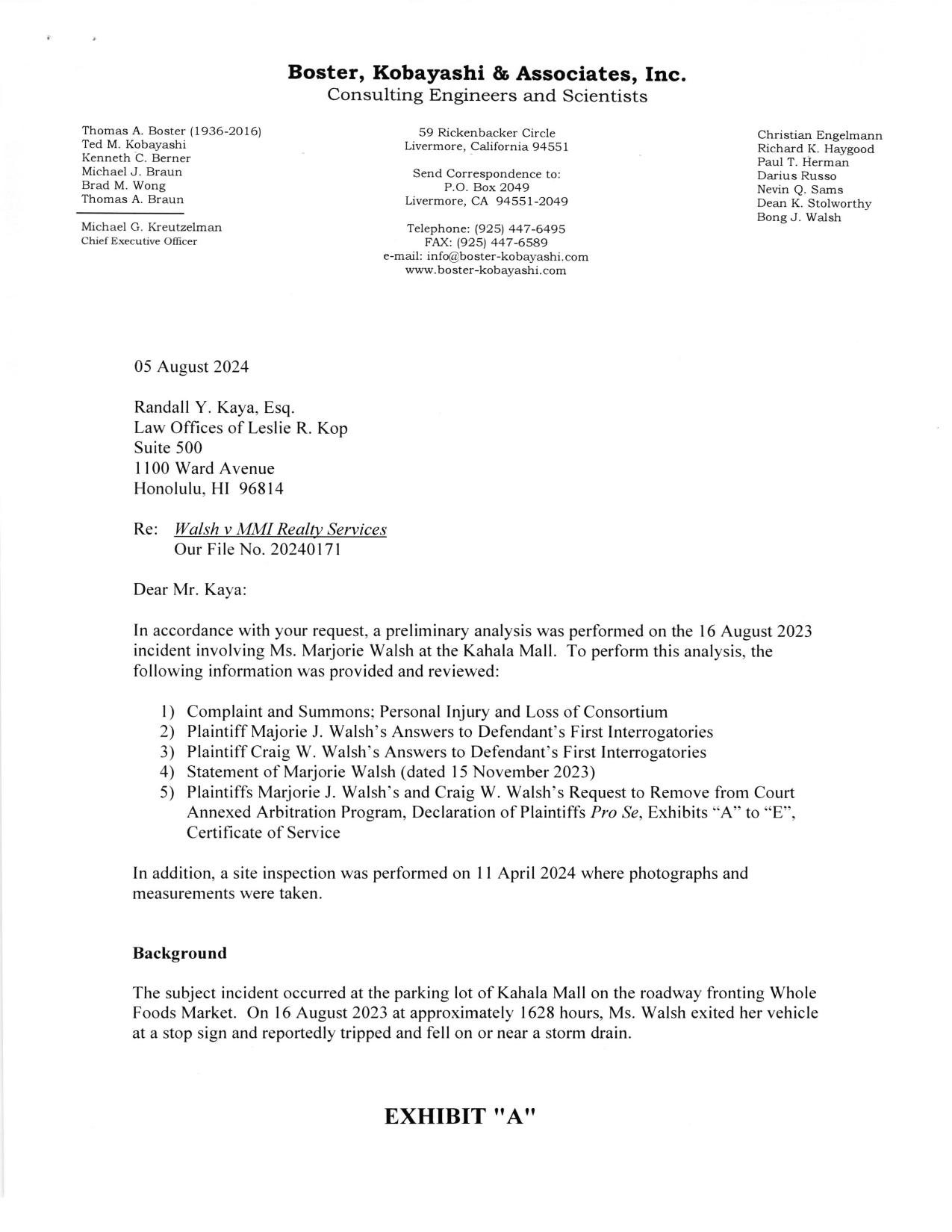
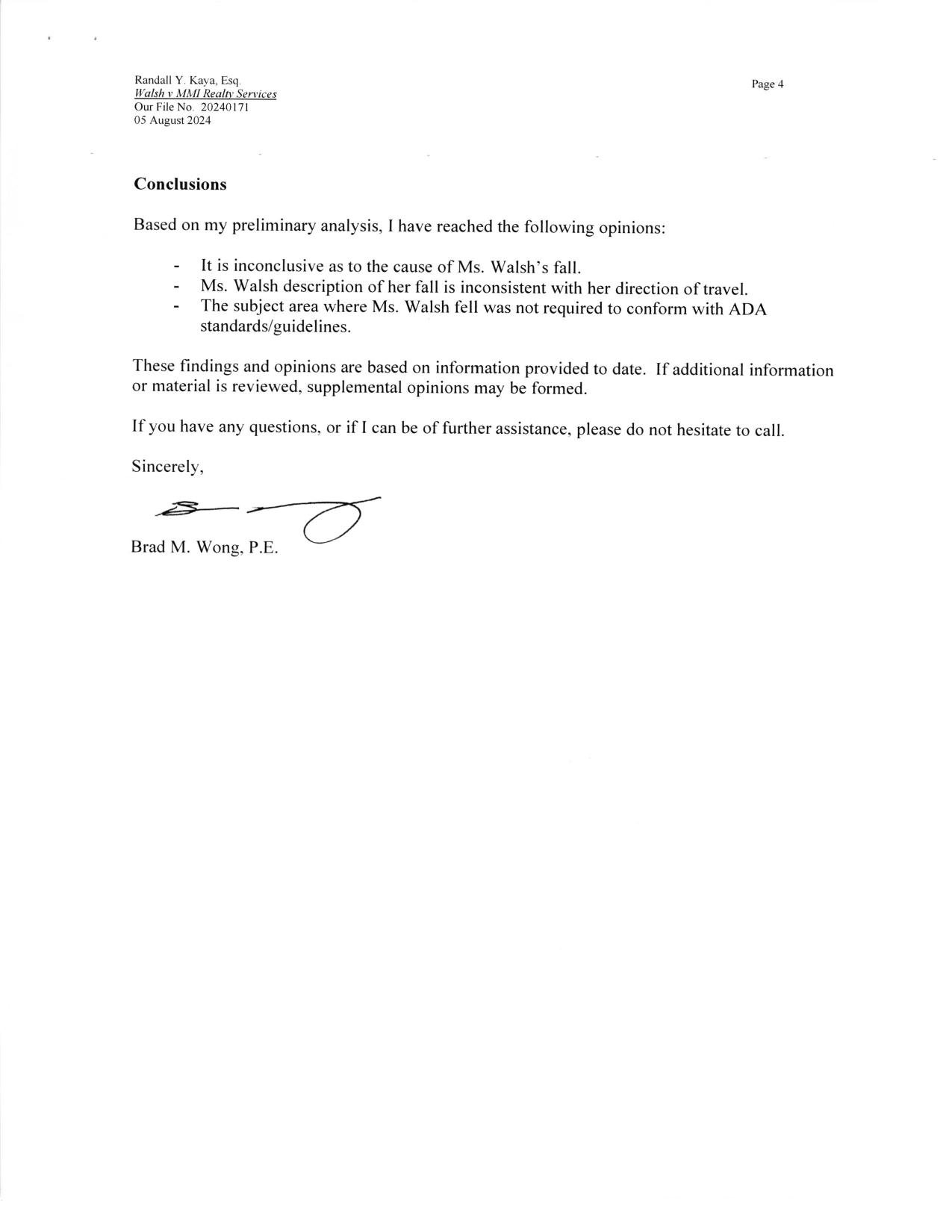
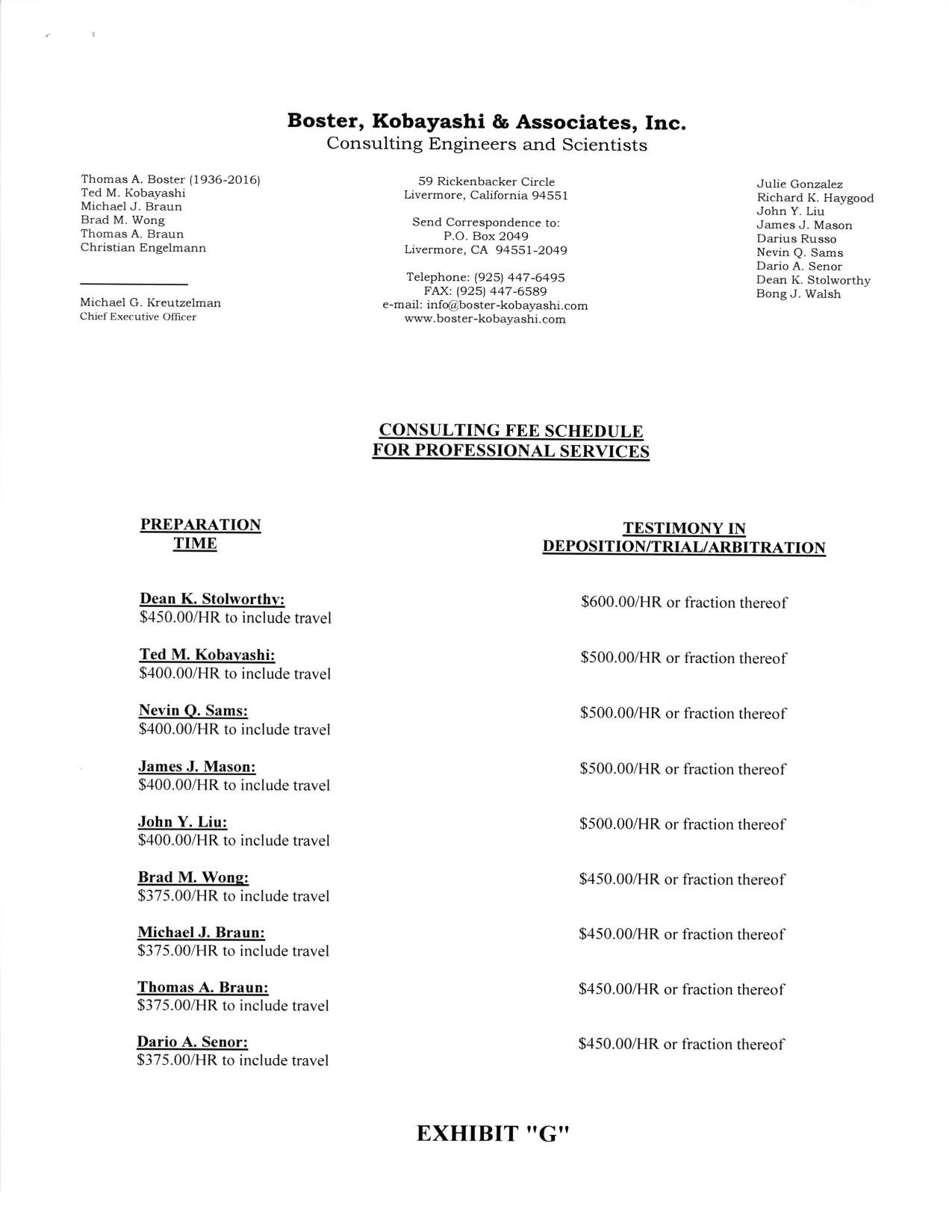
MMI’s expert was Brad M. Wong of Boster, Kobayashi & Associates, Livermore, California — a firm specialising in accident reconstruction, highway design and injury causation. He produced three reports: 5 August 2024, 12 September 2024, and 30 March 2026.
The Walshes retained no expert at all.
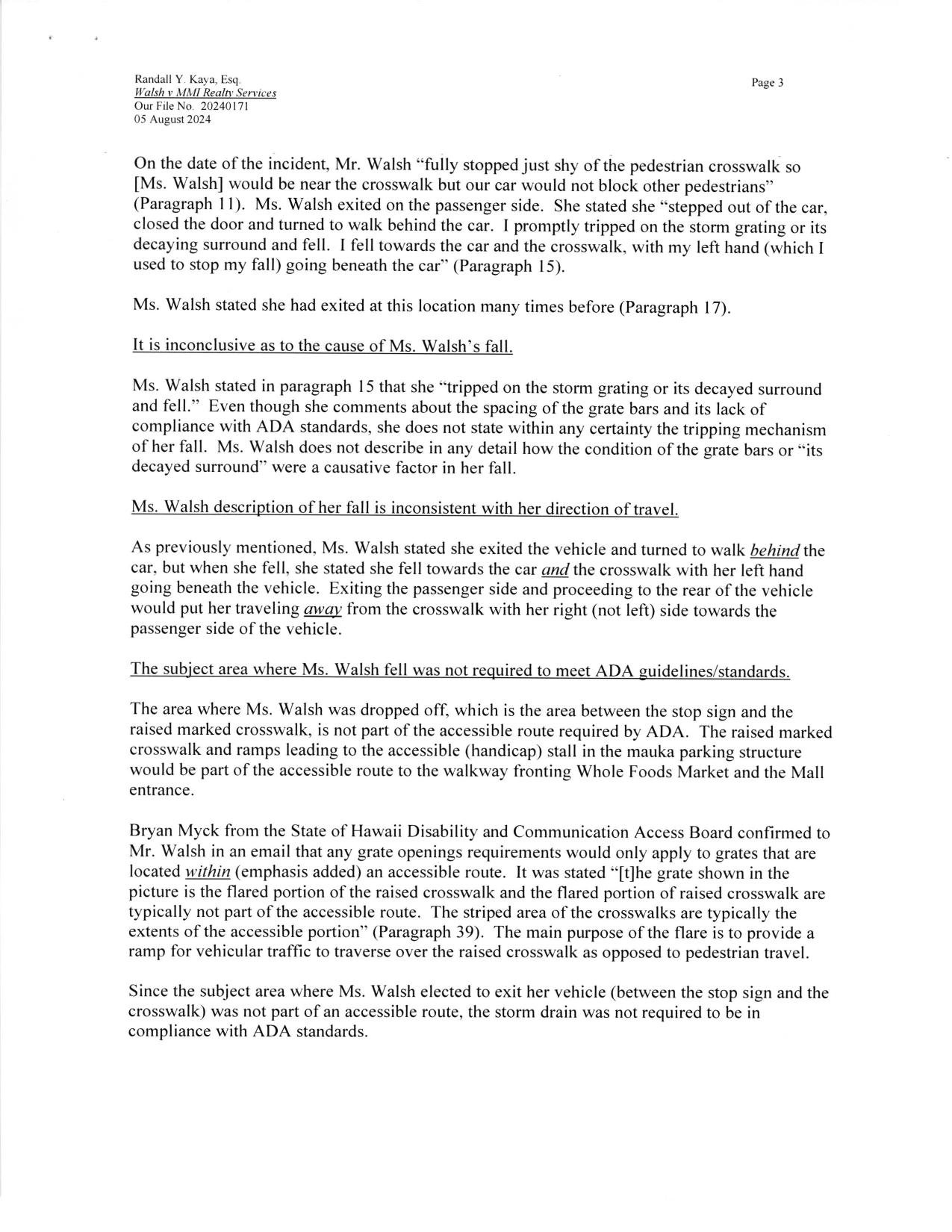
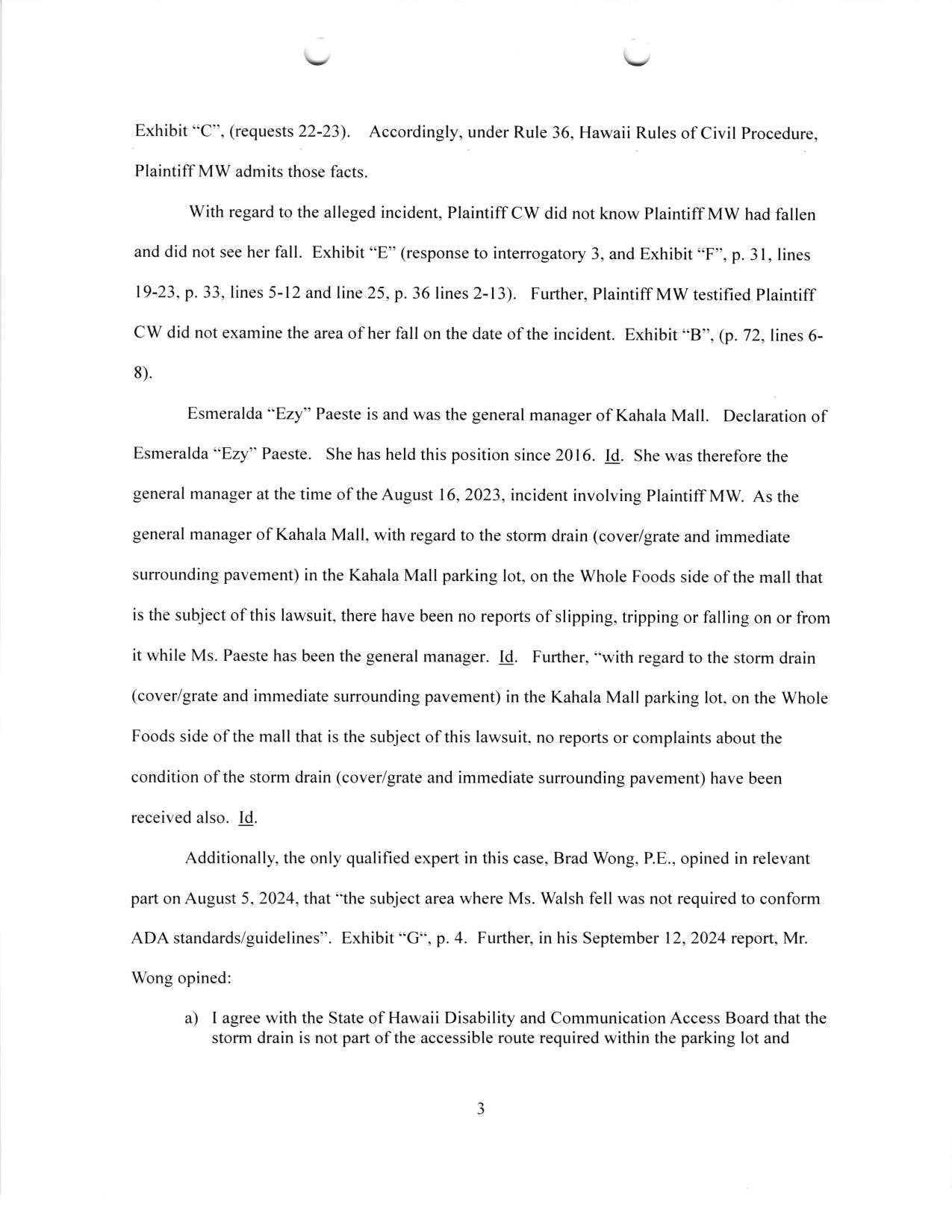
His conclusions. That the area where Ms. Walsh fell was not required to conform to ADA standards. That he agreed with the State Board that the drain is not part of the accessible route. That NFSI B101.9-2020 is a voluntary standard. That ASTM F1637-95 is voluntary and adopted by no municipality. That the plaintiffs’ reconstruction of the fall is not based on reasonable engineering certainty.
The defendant’s motion observed that none of these opinions “have ever been controverted.”
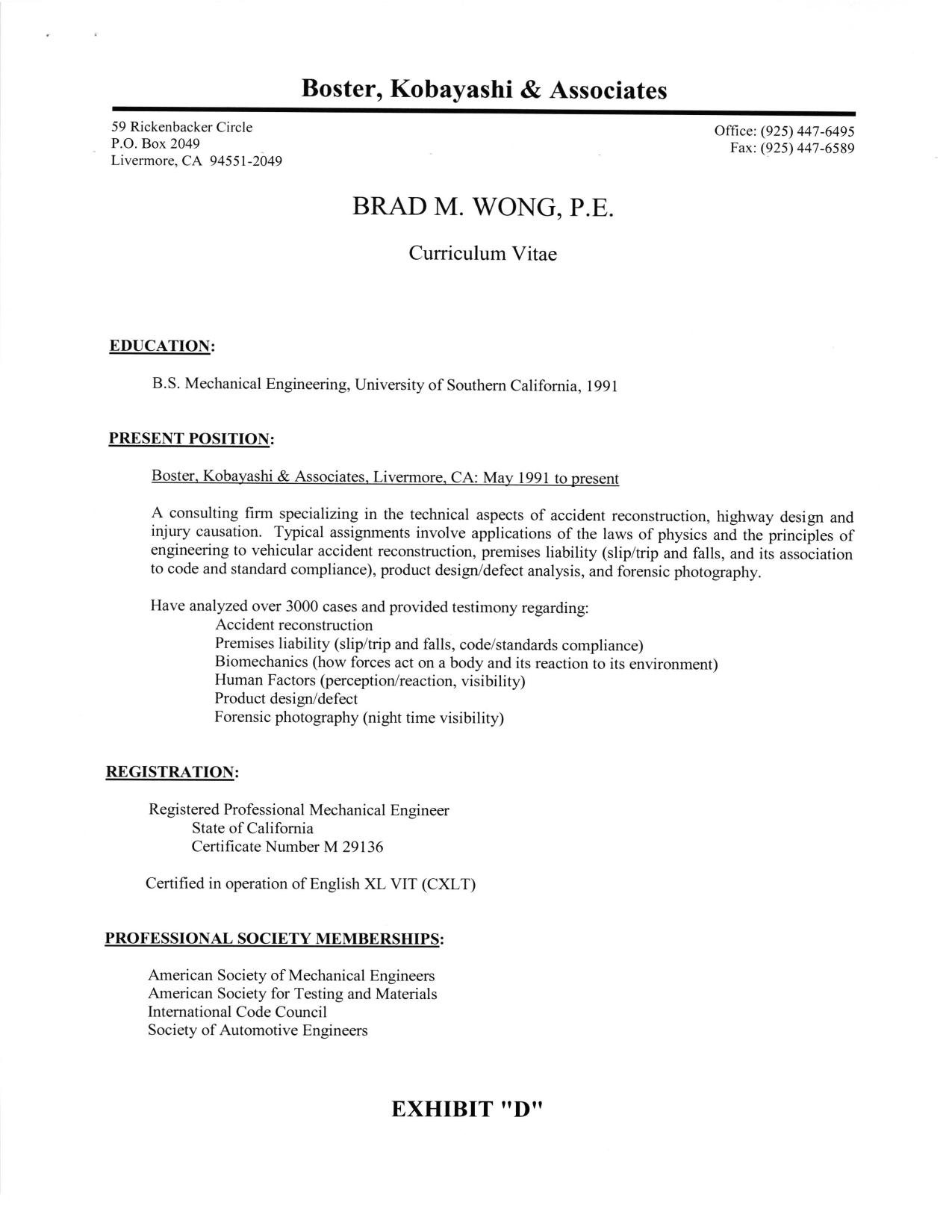
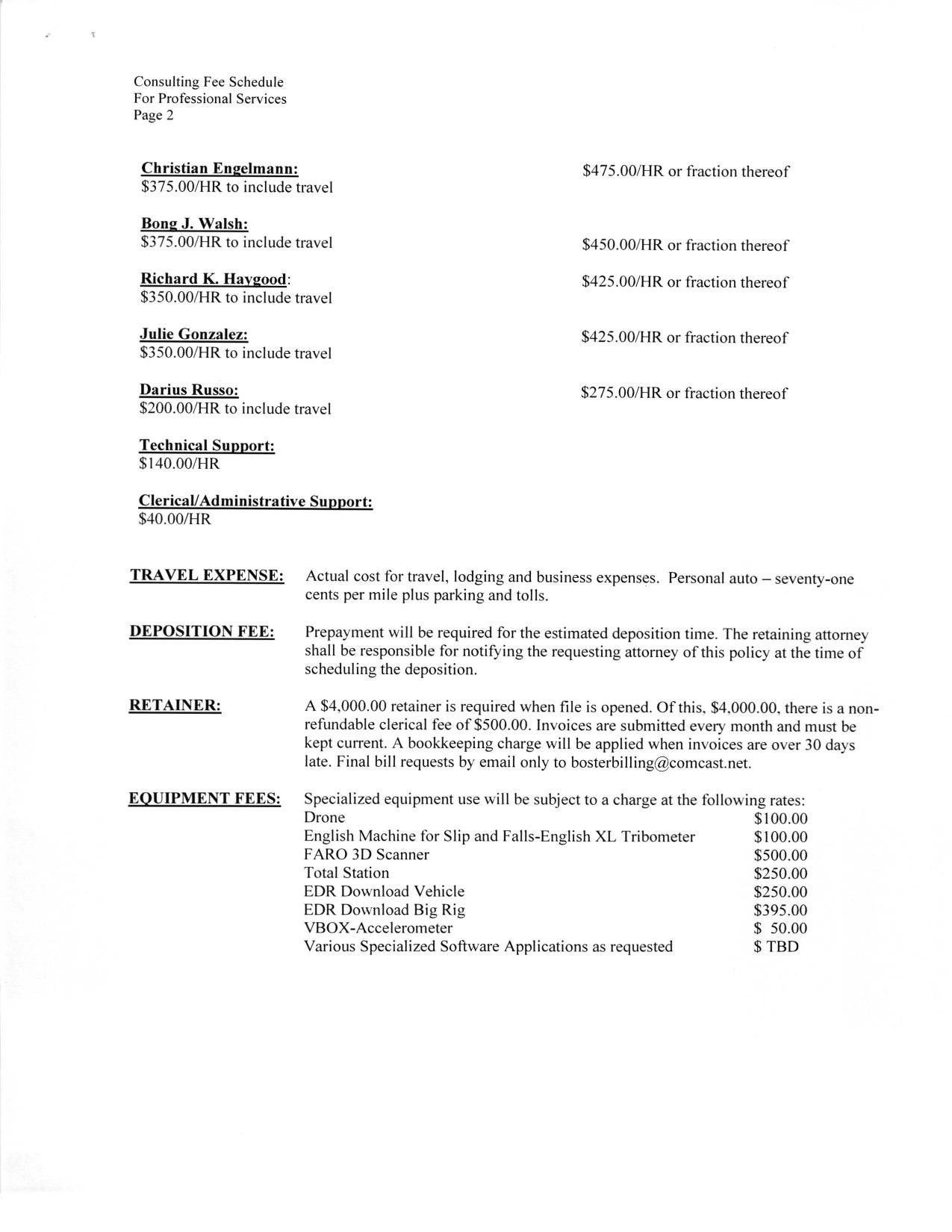
His qualifications. B.S. Mechanical Engineering, University of Southern California, 1991. Boster, Kobayashi since May of that year. Over three thousand cases analysed.
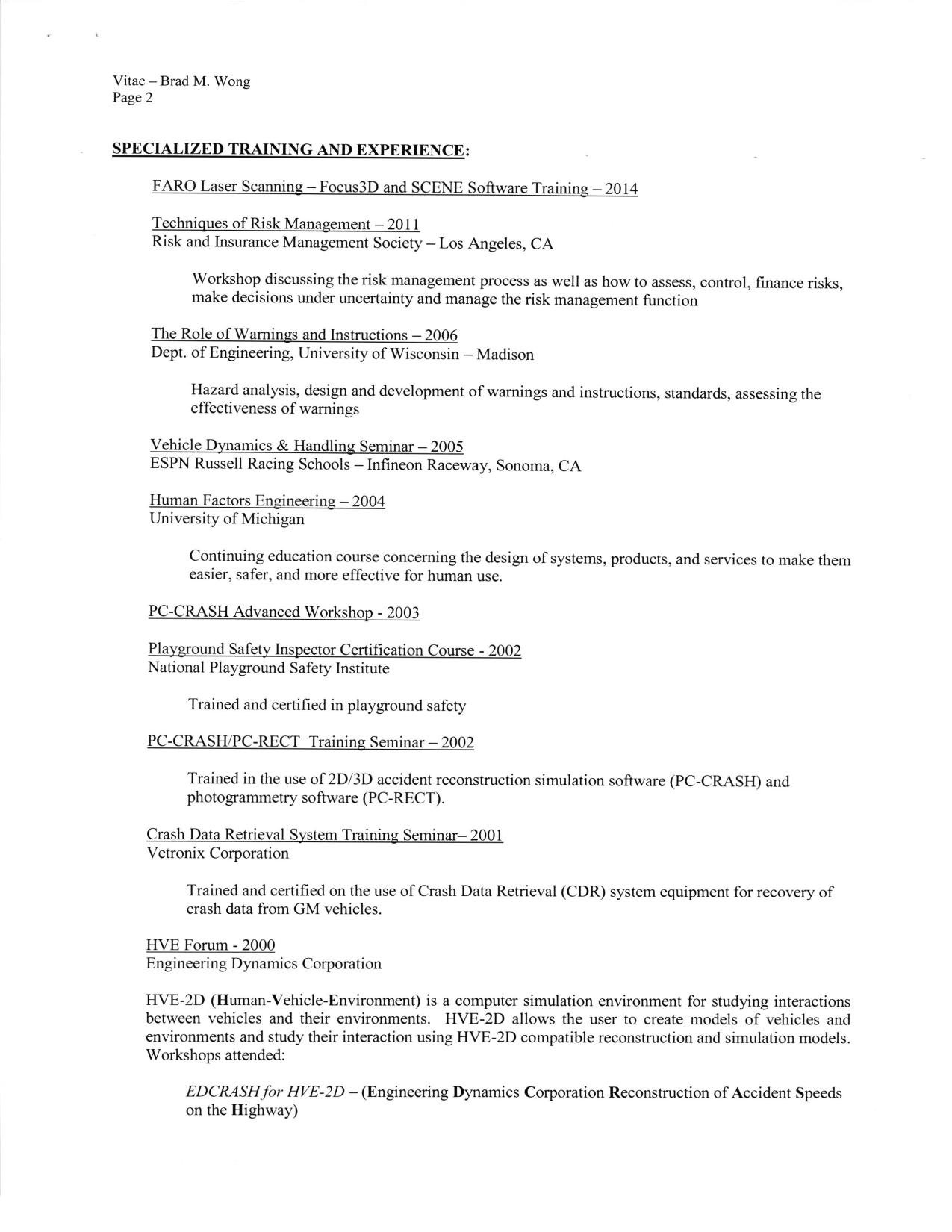
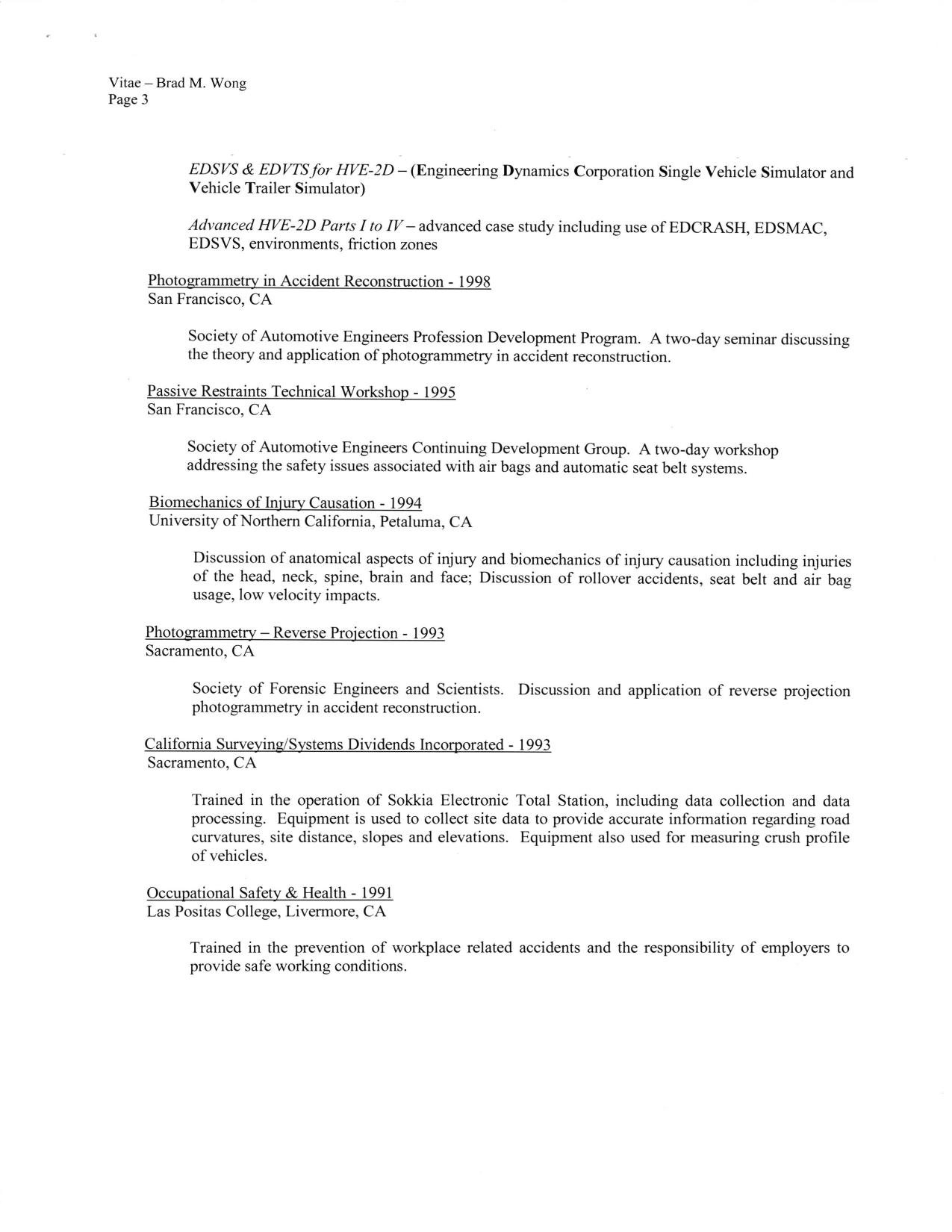
His CV lists his specialised training in full, and it is worth reading in full, because it is a portrait of a career.
FARO laser scanning. Techniques of Risk Management, at the Risk and Insurance Management Society. The Role of Warnings and Instructions, University of Wisconsin–Madison. A vehicle dynamics and handling seminar at the ESPN Russell Racing School, Infineon Raceway, Sonoma. Human Factors Engineering, University of Michigan. PC-CRASH advanced workshop. Crash Data Retrieval System training, on recovering crash data from General Motors vehicles. Photogrammetry in Accident Reconstruction — a two-day seminar. Passive Restraints — a two-day workshop. Reverse-projection photogrammetry. Training on the Sokkia Electronic Total Station.
And Biomechanics of Injury Causation, 1994, at the University of Northern California, Petaluma — an institution whose law school was never accredited by the American Bar Association or the State Bar of California, and whose registration the State Bar terminated in 2013.
He holds one certification of the kind that matters here. From 2002, the National Playground Safety Institute: Trained and certified in playground safety.
There is no ADA training anywhere on the document. Not a course, not a certificate, not a seminar. As the opposition put it: his curriculum vitae, submitted by Defendant, reflects no ADA training of any kind.
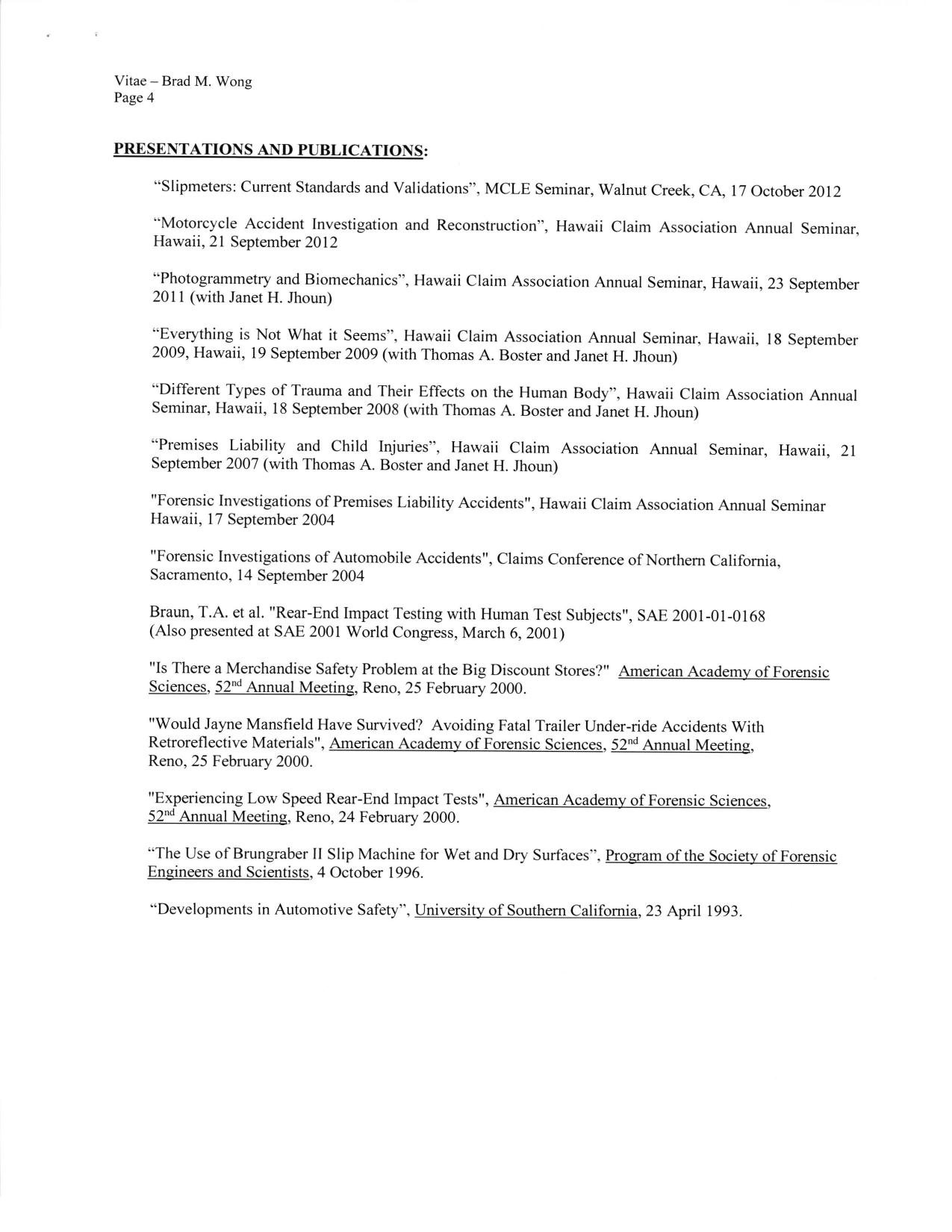
His audience. The presentations listed on his CV were given, almost without exception, to the Hawaii Claim Association Annual Seminar — 2008, 2009, 2011, 2012 — together with an MCLE seminar on slipmeters in Walnut Creek. His professional audience is insurance claims adjusters.
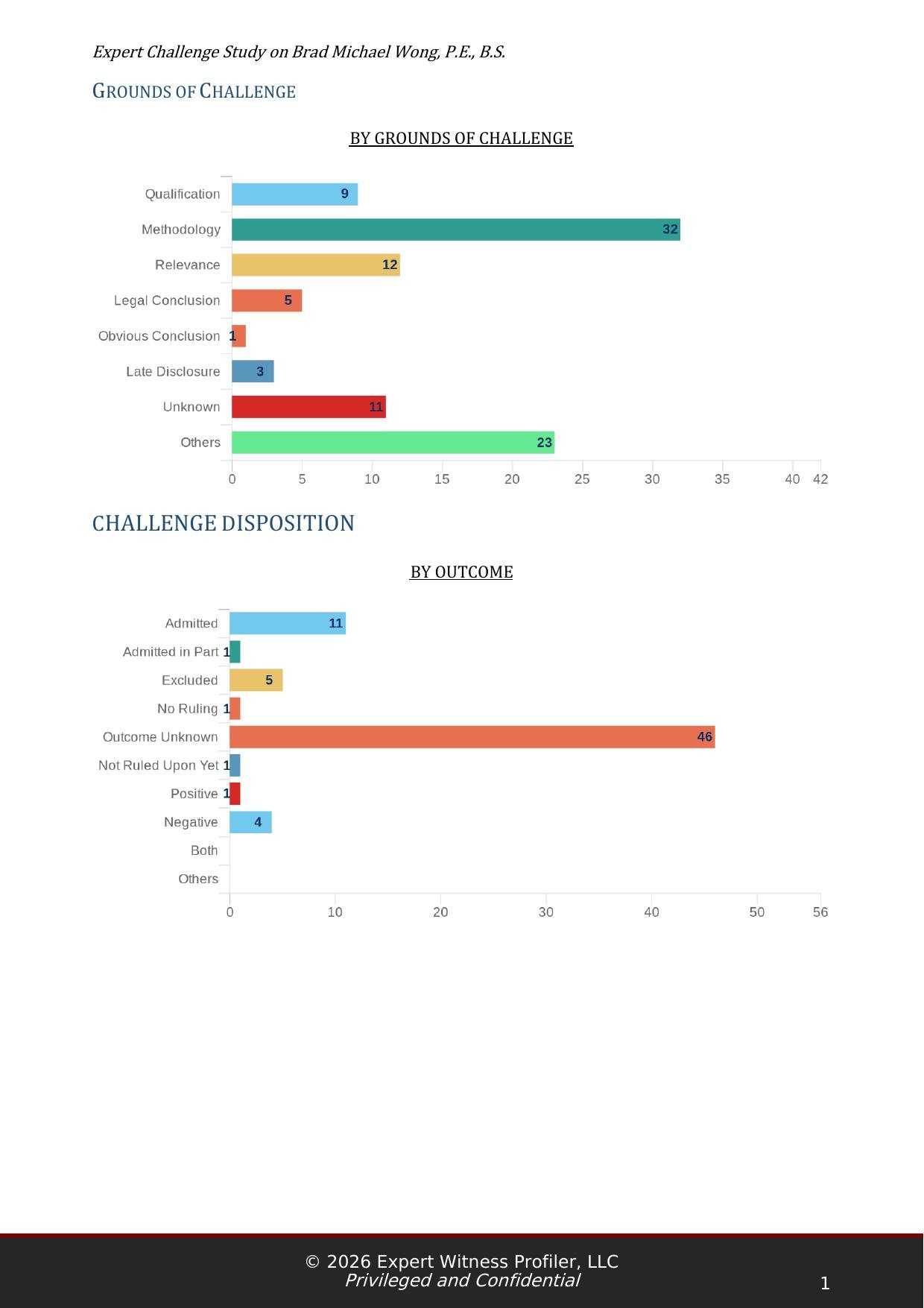
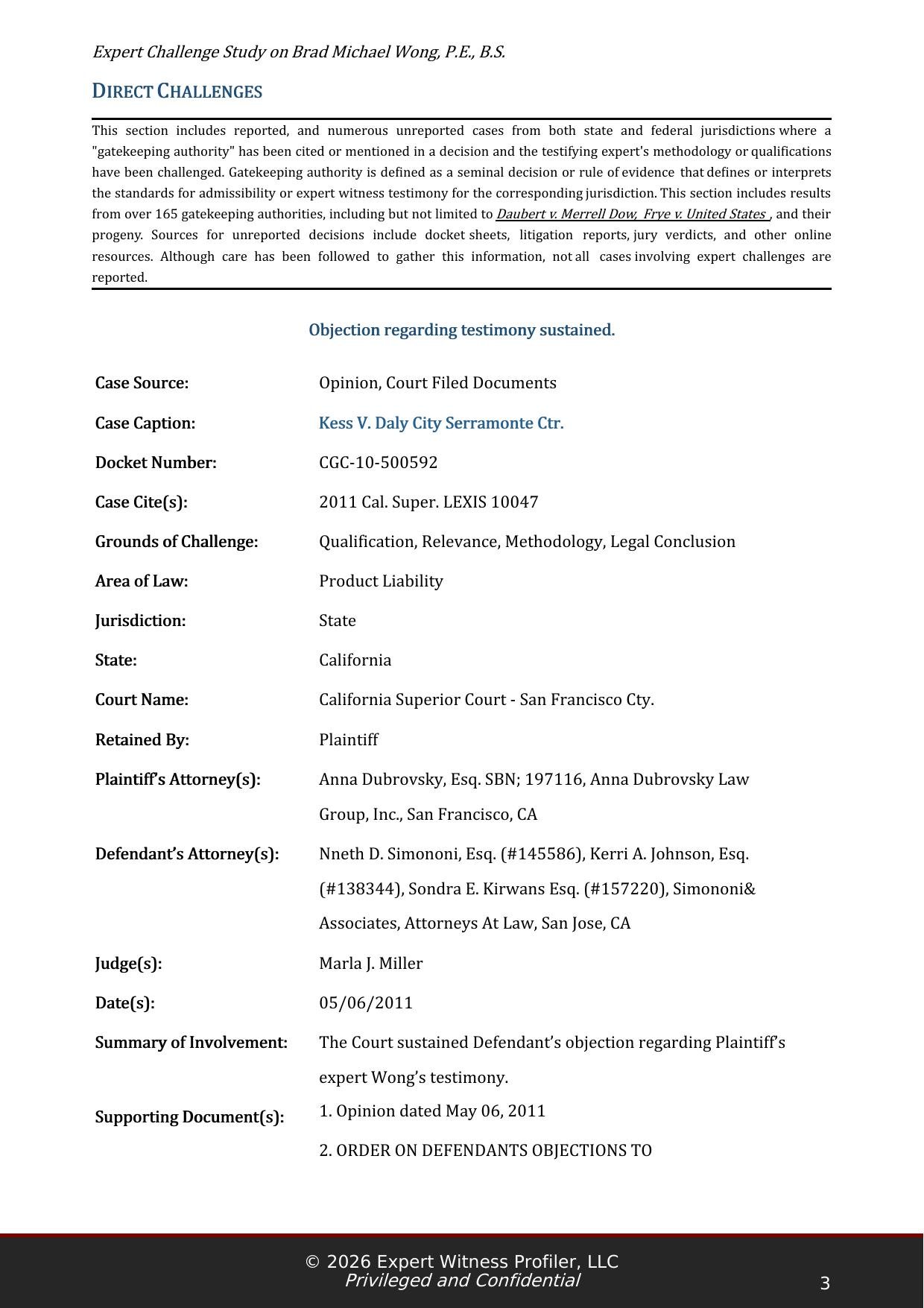
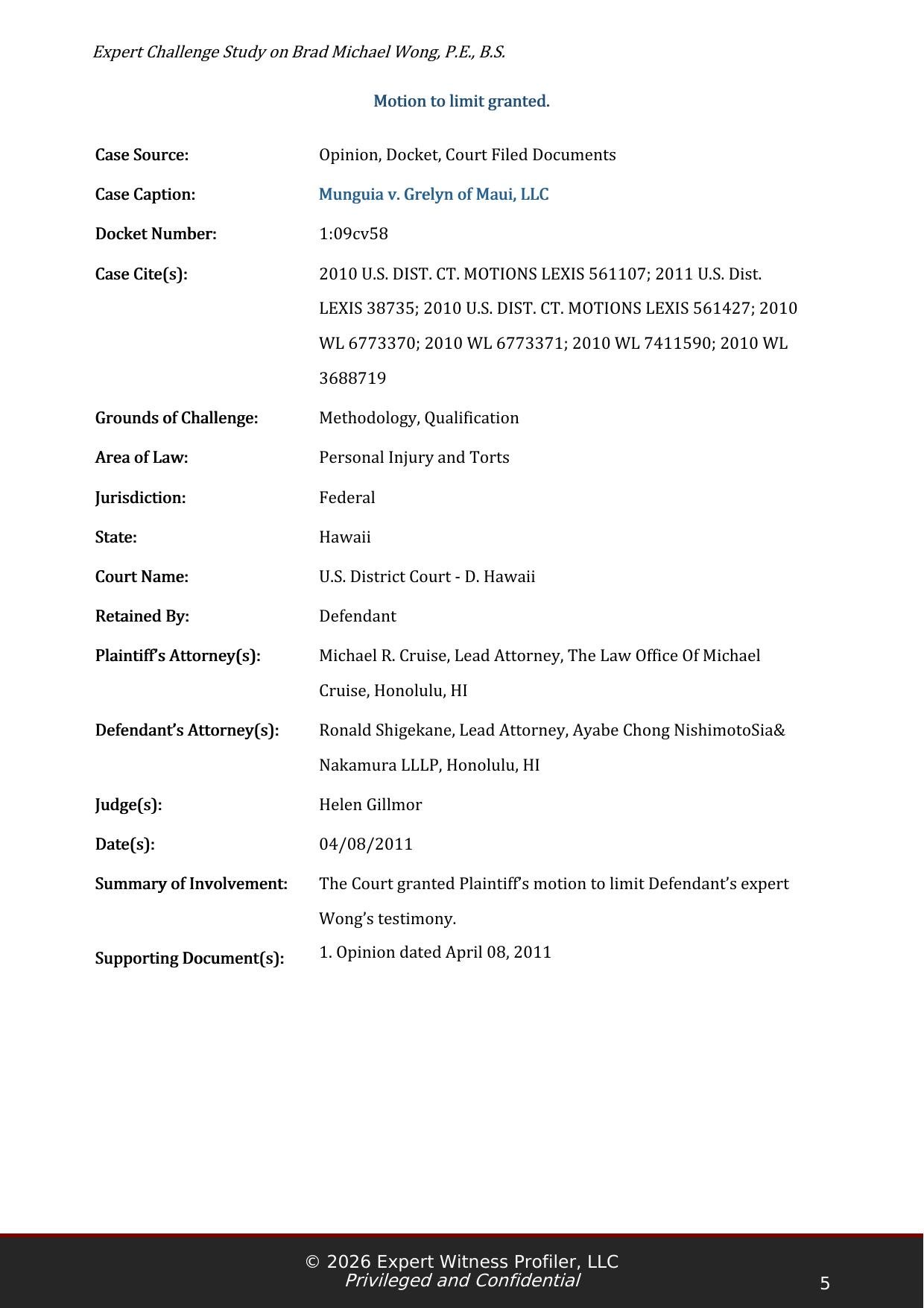
His record. Filed in this case is a commercial expert-challenge study of some seventy pages, cataloguing 139 entries in which Mr. Wong’s opinions have been challenged. He is retained by plaintiffs and defendants in roughly equal measure — thirty and twenty-three in the entries that say. The grounds recorded against him are methodology (13), methodology and relevance (9), qualification and methodology (3), late disclosure, legal conclusion, and “others” (22).
The outcomes read as a litany: objection regarding declaration sustained; motion to exclude filed; motion to limit granted; testimony limited; testimony admitted in part and excluded in part; declaration and opinion found inadmissible.
Two entries deserve setting out.
In a wrongful death case, Bombardier, the defendant’s motion recorded that Mr. Wong, having failed to provide a speed calculation for Nicole’s vehicle in his previous two reports, used his third report to change the subject to the other driver’s visibility.
And in a water-park case in which he had already been excluded, an appellate brief recorded that the only evidence the appellant could muster was the declaration of his excluded expert —
wherein Mr. Wong speculated that tubing down a flume is unlike river rafting, based upon the unfounded assumption that a water slide is not analogous to recreational sporting activities like river rafting…
What he did not dispute. He visited Kahala Mall and took measurements. He did not dispute that some bars were wider than others, that the concrete surround was deteriorated, or that the drain is absent from the 1986 permit drawings. His measurements confirmed the drain’s location and dimensions as Marjorie Walsh had described them.
His argument on causation was that her account was inconsistent with her direction of travel: that someone leaving the passenger door for the rear of the car moves away from the crosswalk, right side toward it, not left.
The reconstruction
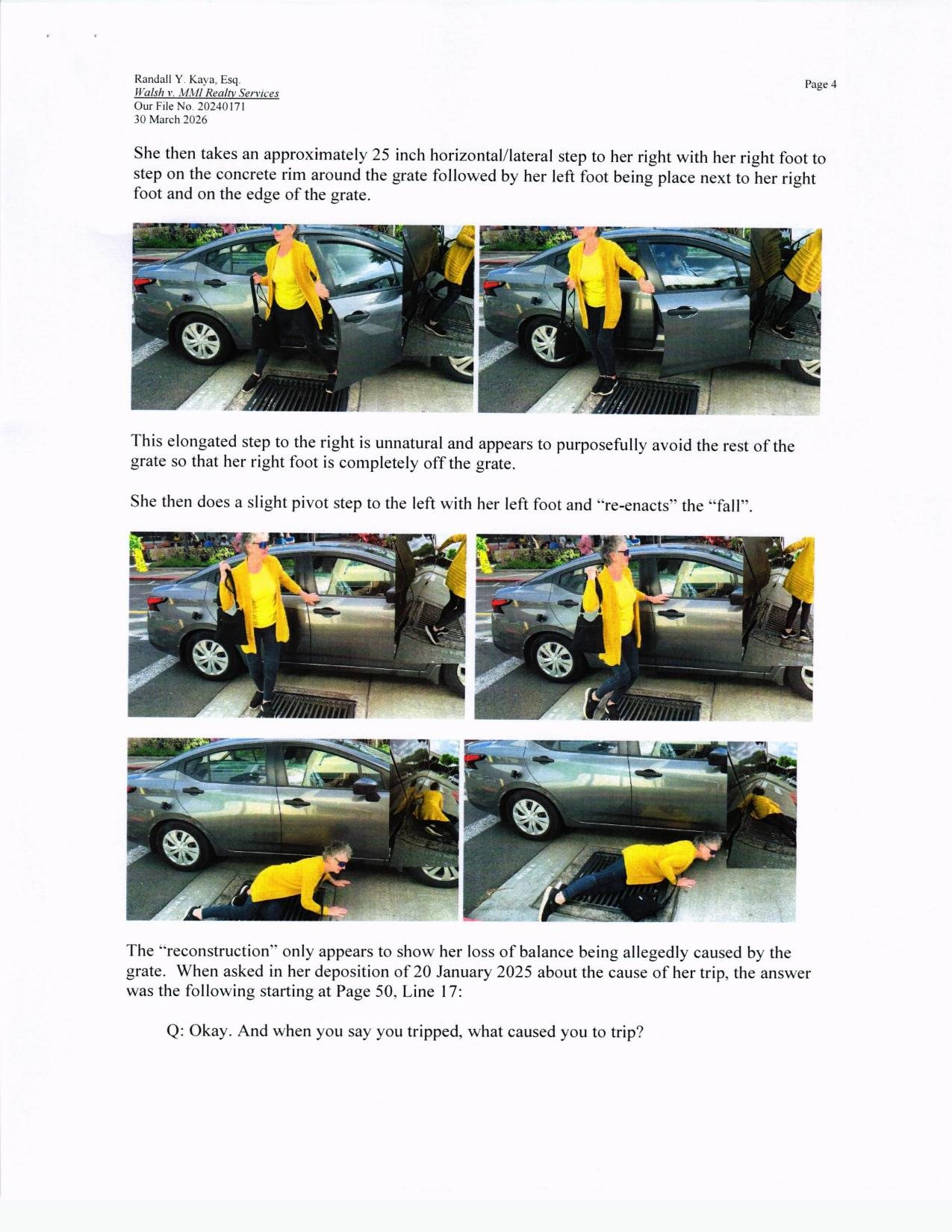
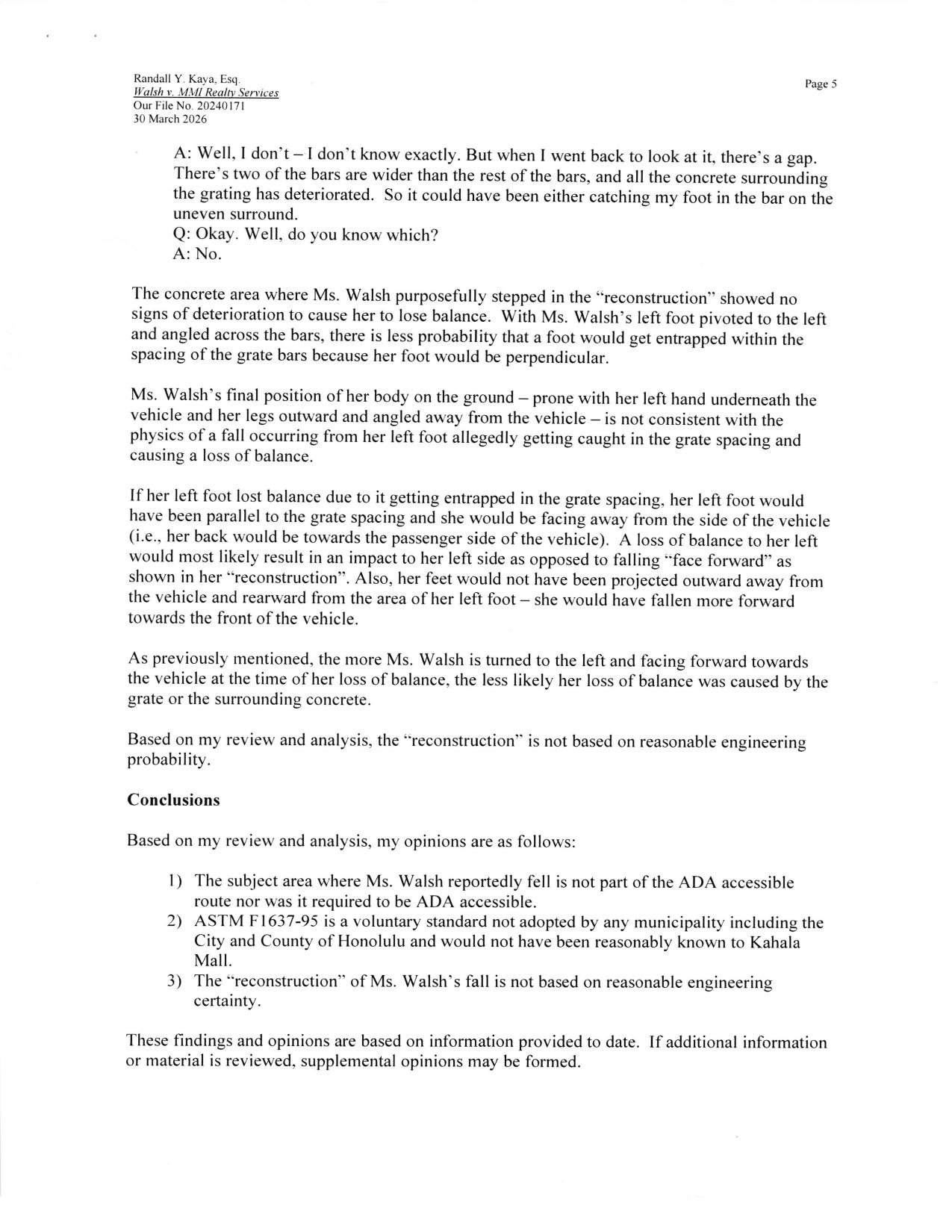
Mr. Wong’s third report, of 30 March 2026, went further. It analysed a video frame by frame — measuring Marjorie Walsh’s steps, characterising her foot placement, reasoning from the physics of a fall — and concluded that the plaintiffs’ reconstruction was not based on reasonable engineering certainty.
The video he analysed had been dead for ten months.
It was made during the arbitration to illustrate how the fall had happened. On 15 May 2025 Craig Walsh sent it to Mr. Kaya, and in the same email disclosed its defect, in these words:
Please note in the video Marjorie obviously looks down — repeatedly — for the simple reason that she did not want to trip and fall again.
Having already broken her femur on that drain, she had watched her feet the whole way. That is not how she had been walking on the day.
Earlier the same day, at 12:18 p.m., Mr. Kaya had already written his own view of the reconstruction:
that is late, never properly disclosed and never furnished to Defendant and therefore prejudicial. The arbitrator should therefore not allow or consider it.
In the days that followed, the Walshes concluded that the flaw Craig had himself pointed out made the video useless for its purpose. At the arbitration hearing on Monday 19 May 2025 they told Mr. Kaya and the arbitrator that they were withdrawing it. They never relied on it again.
Ten months later it became the evidentiary foundation of the defendant’s expert’s opinion on how Marjorie Walsh fell.
As the opposition put it:
Defendant cannot have it both ways. A piece of demonstrative material that Defendant itself rejected as unreliable, prejudicial, and improperly disclosed, and that Plaintiffs in turn affirmatively withdrew and did not rely upon, cannot serve as the precise evidentiary record from which Defendant’s expert reconstructs Mrs. Walsh’s fall.
And the feature Mr. Wong’s critique was built on — the downward gaze — was not something his analysis uncovered. It had been volunteered in writing, by the plaintiff’s husband, on the day the video was handed over.
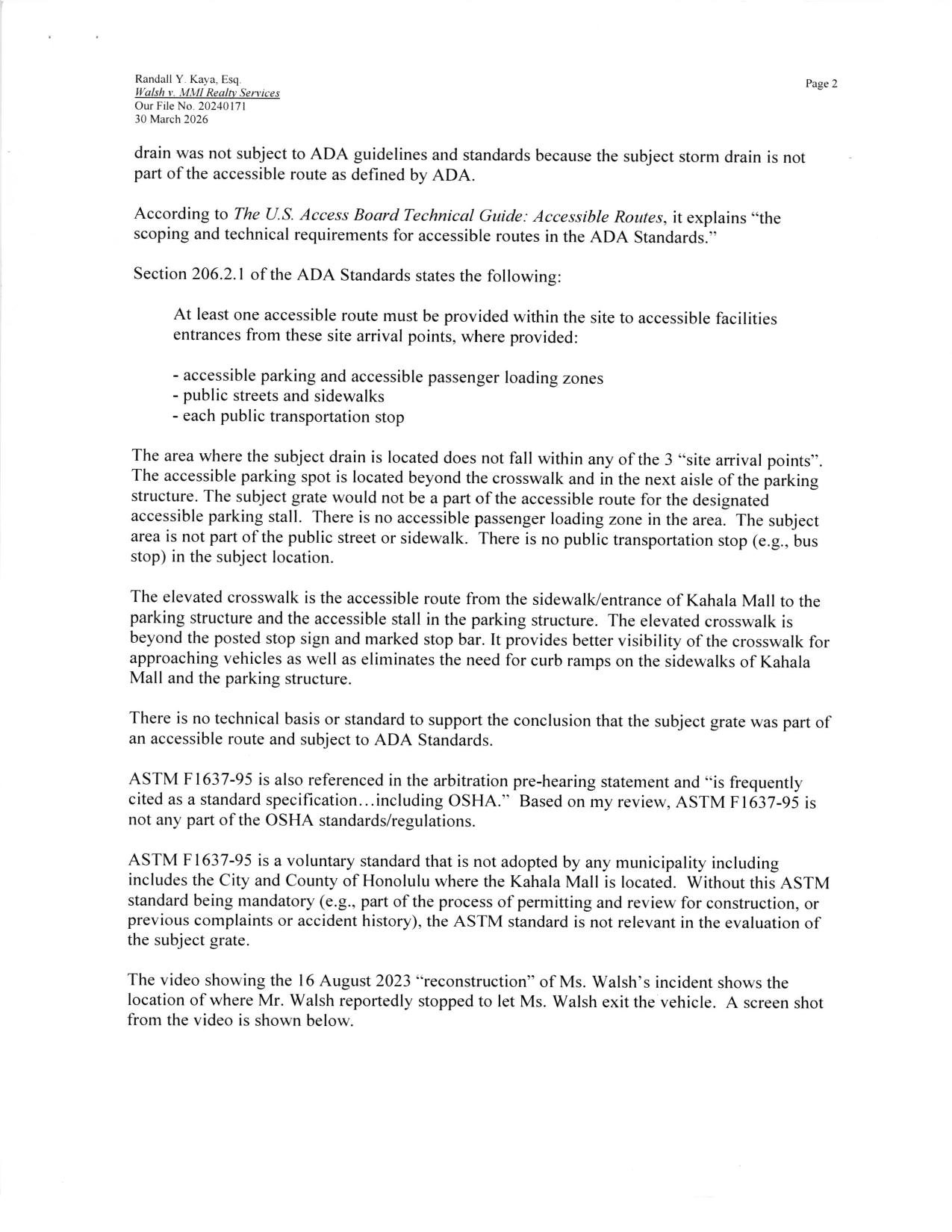
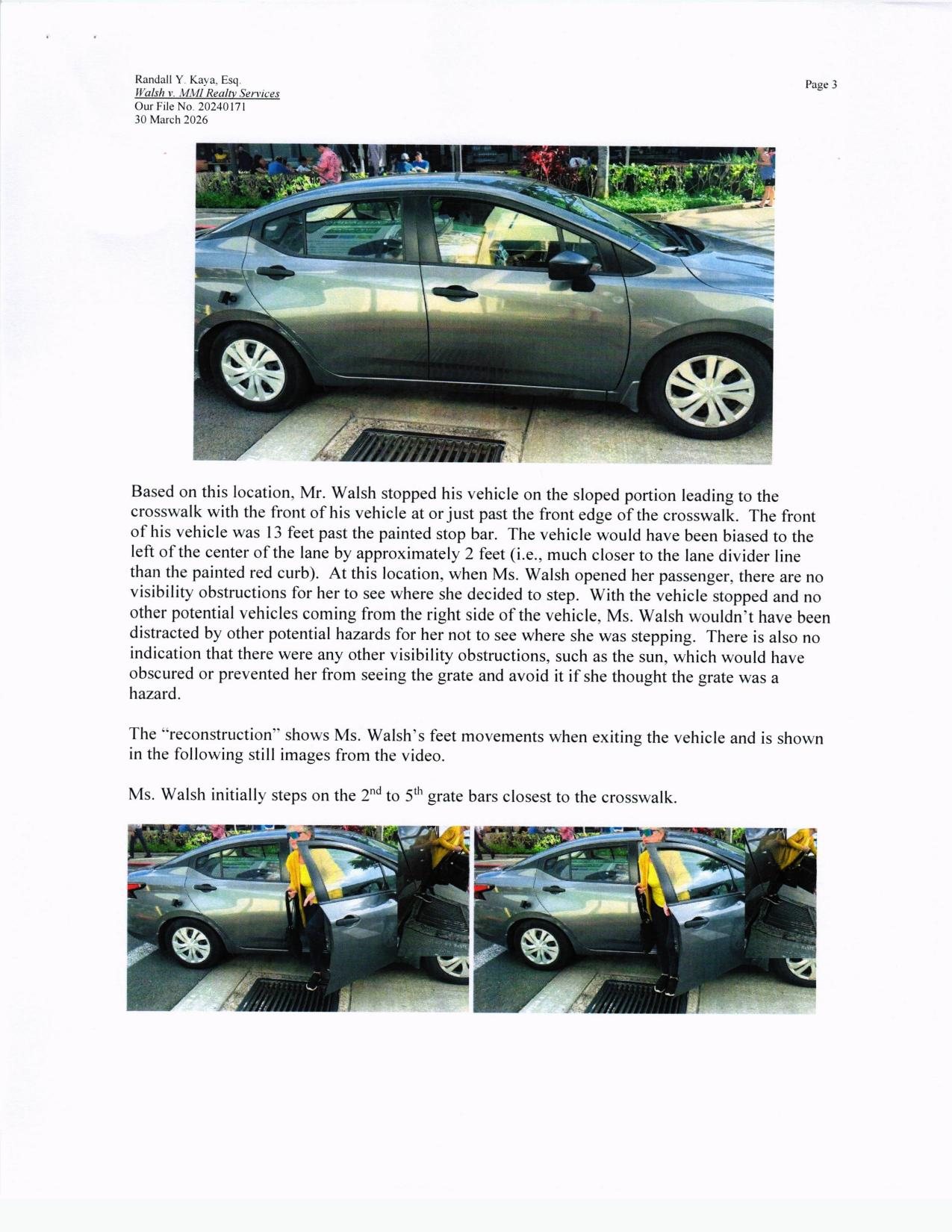
The reconstruction video is not reproduced here. It was withdrawn from the case in May 2025 and never formed part of the evidence; it shows a woman deliberately watching her feet, which is precisely why it was withdrawn.
XIII. The videos
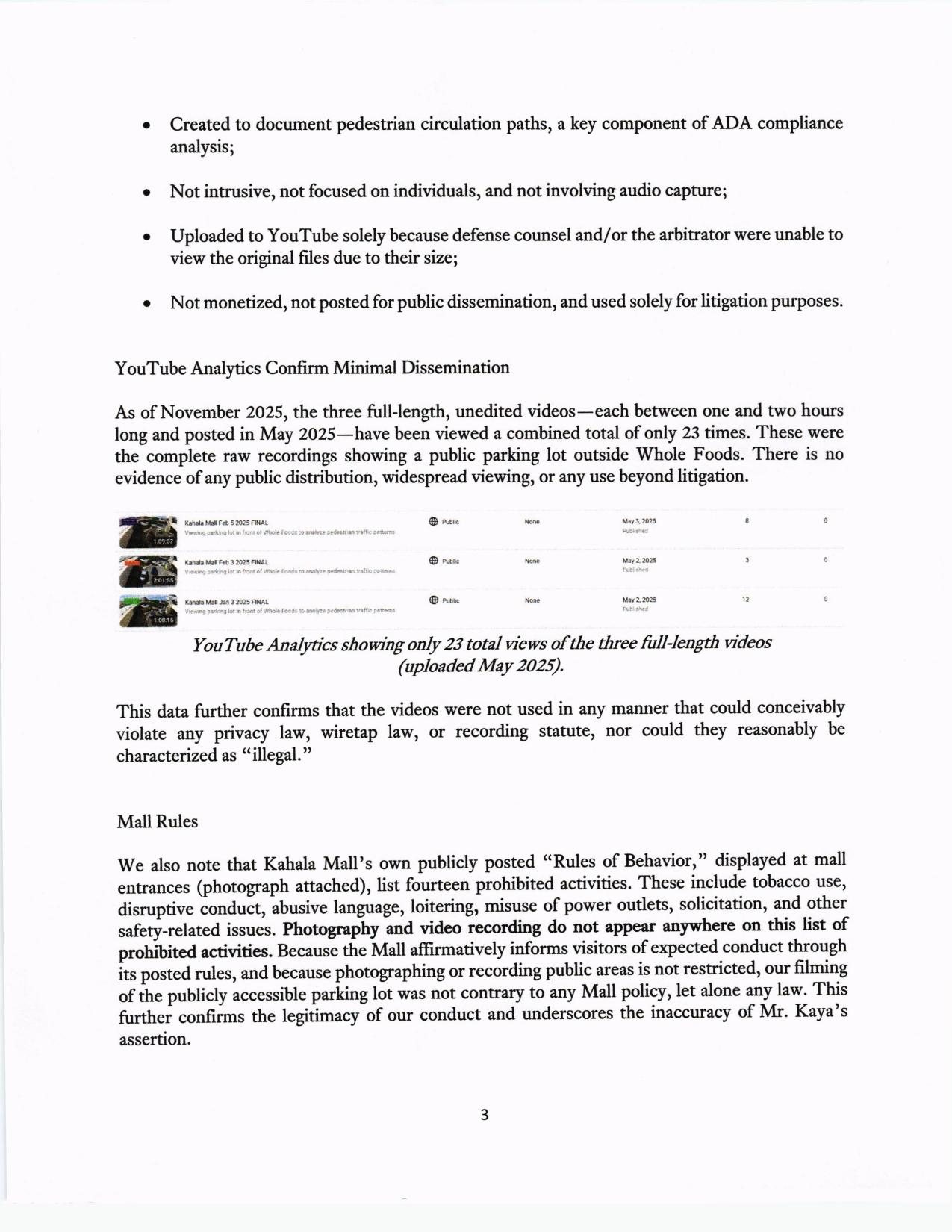
To document how people actually cross that parking lot, the Walshes filmed the area from the public second-floor walkway on three days in early 2025, using a fixed GoPro. The footage was kept in three forms — the original unaltered recordings, a time-coded version, and a compilation checkable against the source. All of it went to the defence in May 2025, a year before the hearing. The raw files were put on YouTube only because they were too large for counsel and the arbitrator to open.
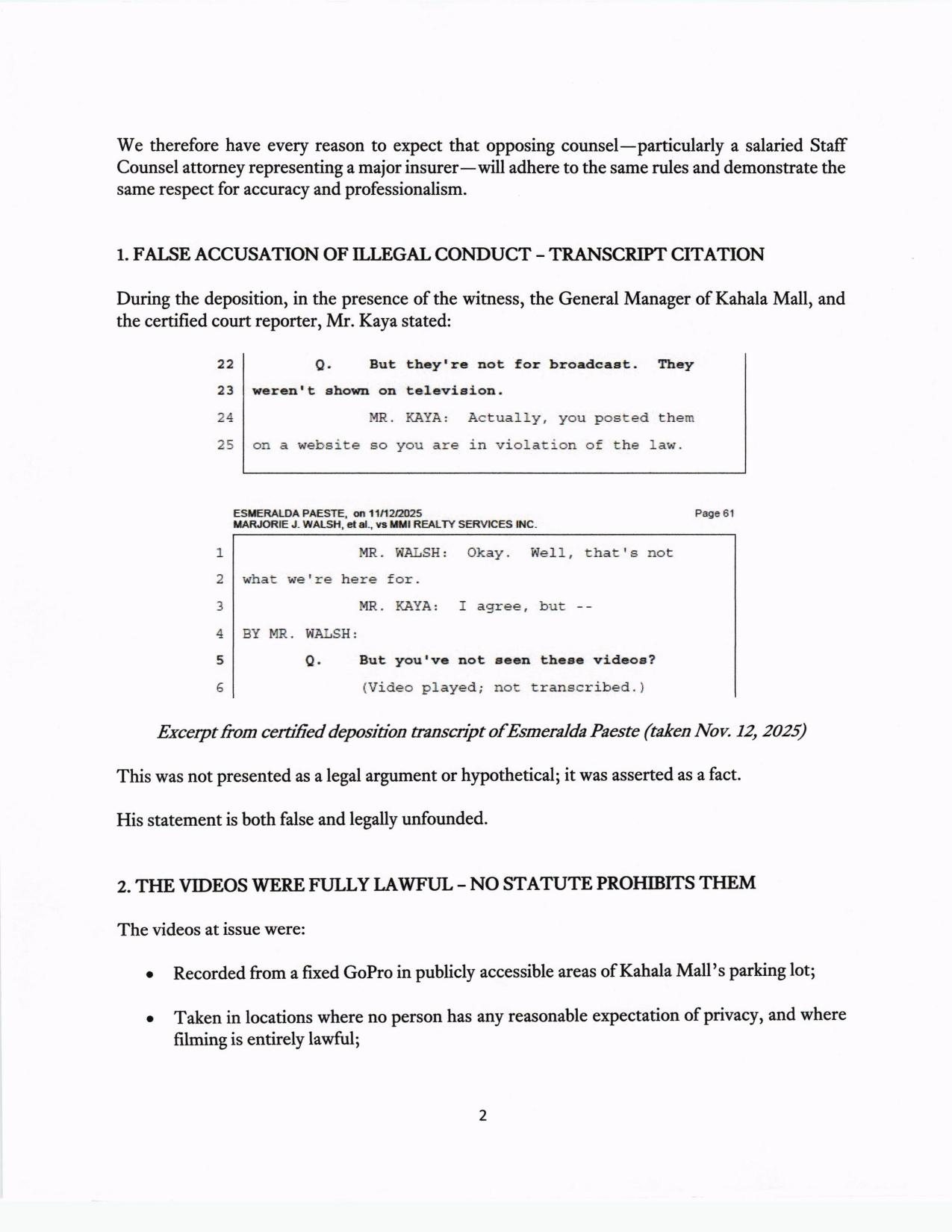
At Ms. Paeste’s deposition, in front of the witness and the court reporter:
Q. But they’re not for broadcast. They weren’t shown on television. MR. KAYA: Actually, you posted them on a website so you are in violation of the law.
No statute was cited, then or afterwards. He acknowledged on the record that the recording shows a public area.
The three raw videos, each one to two hours long and posted in May 2025, had been viewed a combined 23 times.
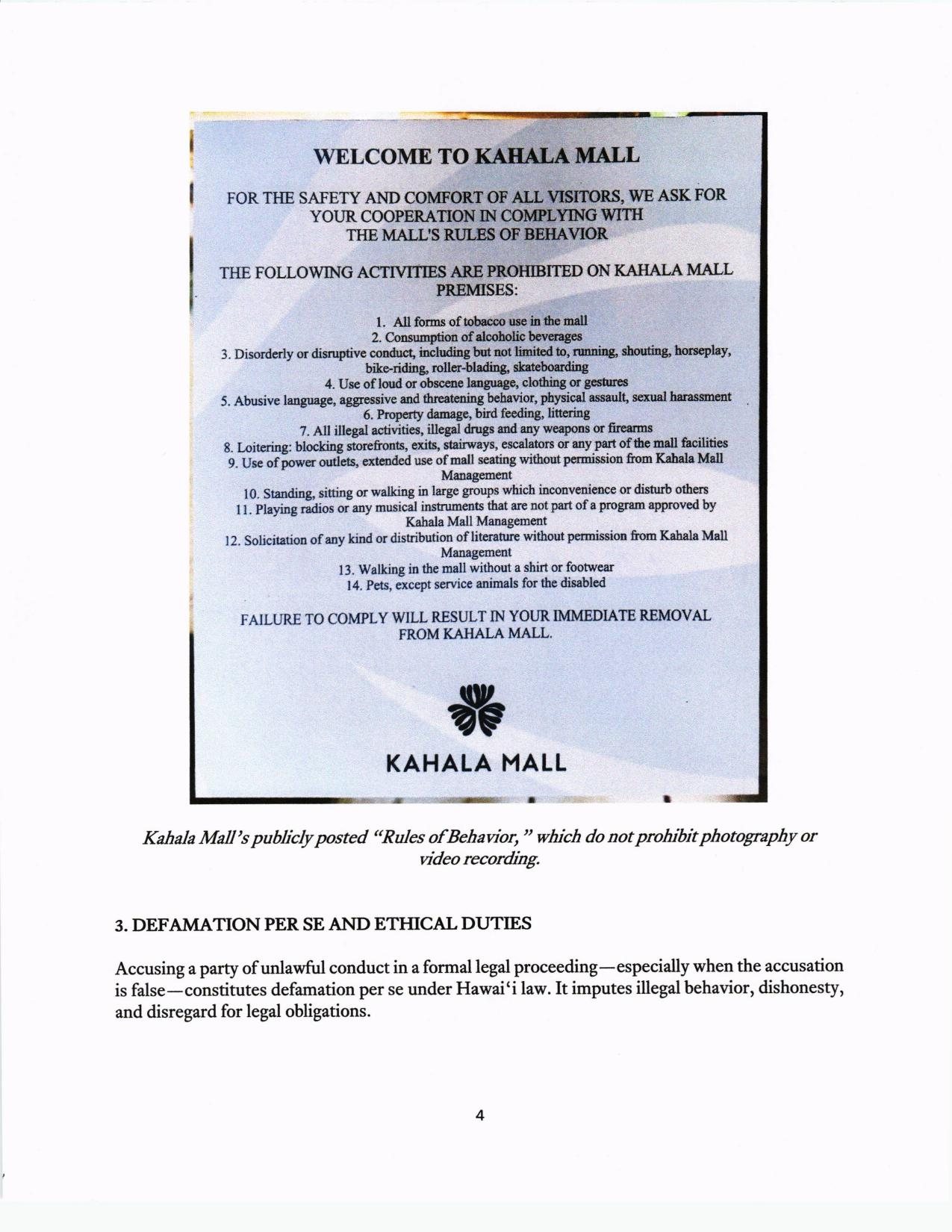
The mall posts a notice at its entrances headed Rules of Behavior, listing fourteen prohibited activities — alcohol, skateboarding, obscene language, bird feeding, loitering, solicitation, going shirtless, pets other than service animals. Photography is not among them.
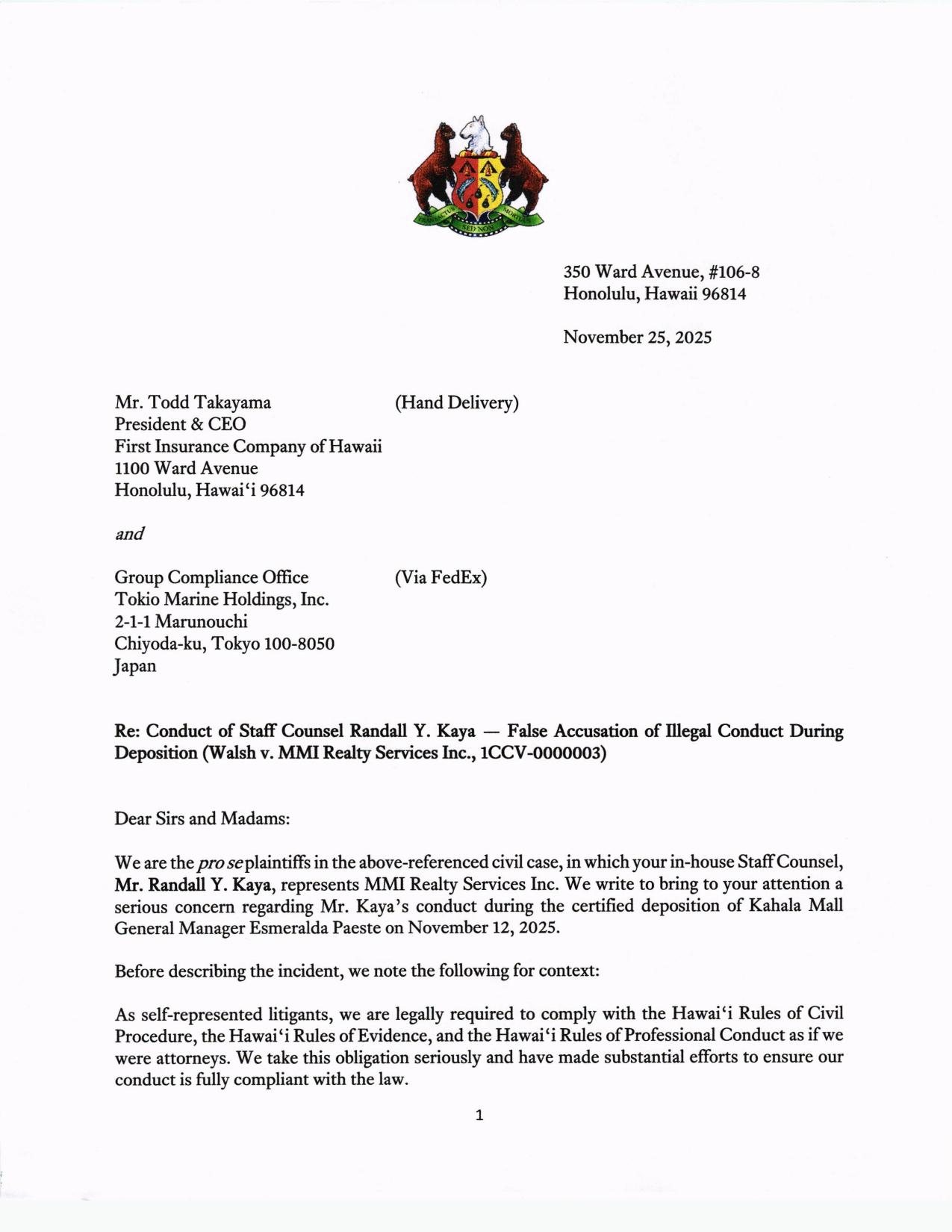
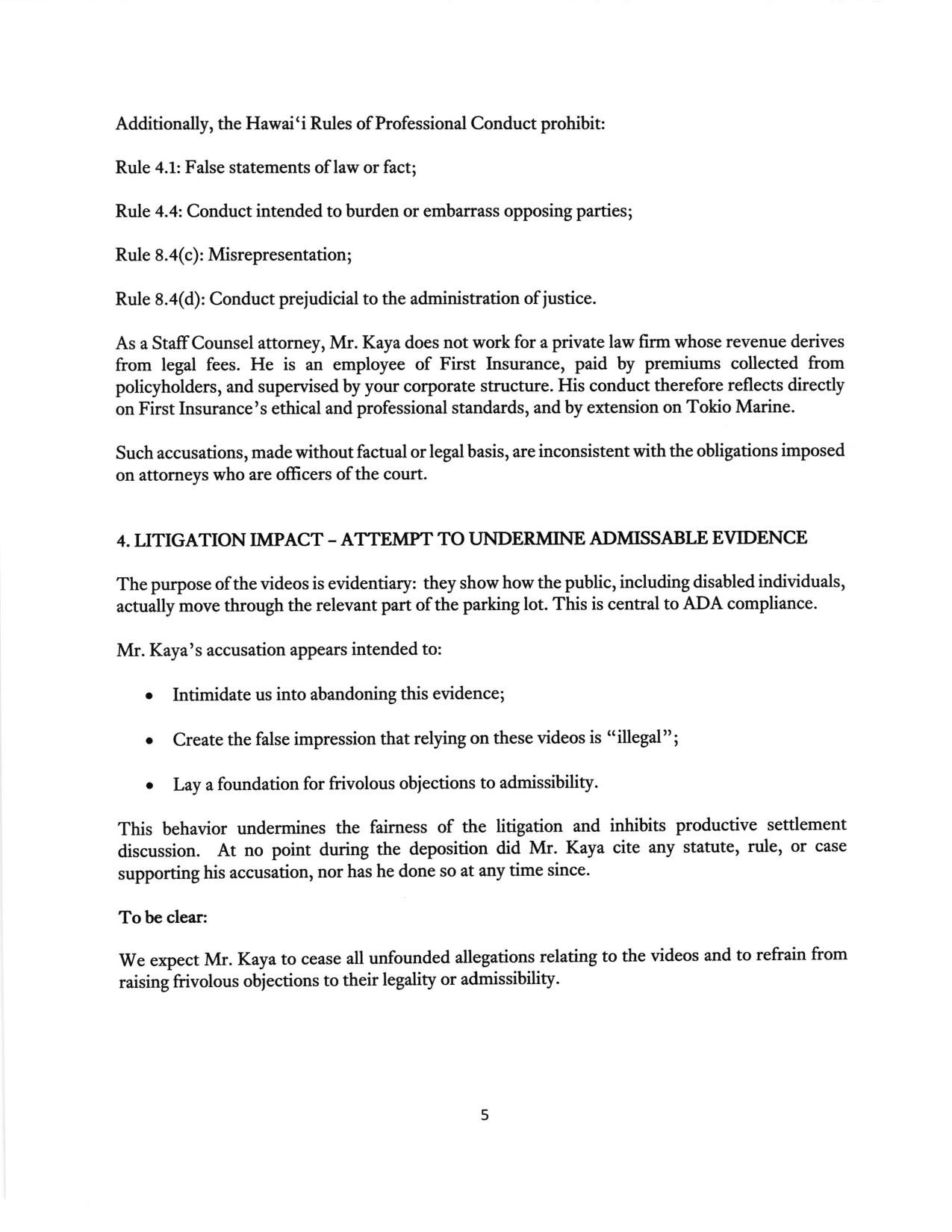
On 25 November 2025 the Walshes wrote to the President and CEO of First Insurance, and to Tokio Marine’s compliance office in Tokyo, setting out the accusation and asking for a correction. They cited Hawai‘i Rules of Professional Conduct 4.1, 4.4, 8.4(c) and 8.4(d). The letter ends:
This is not a request for damages. It is a request for accuracy, integrity, and professional accountability.
XIV. The highlighting
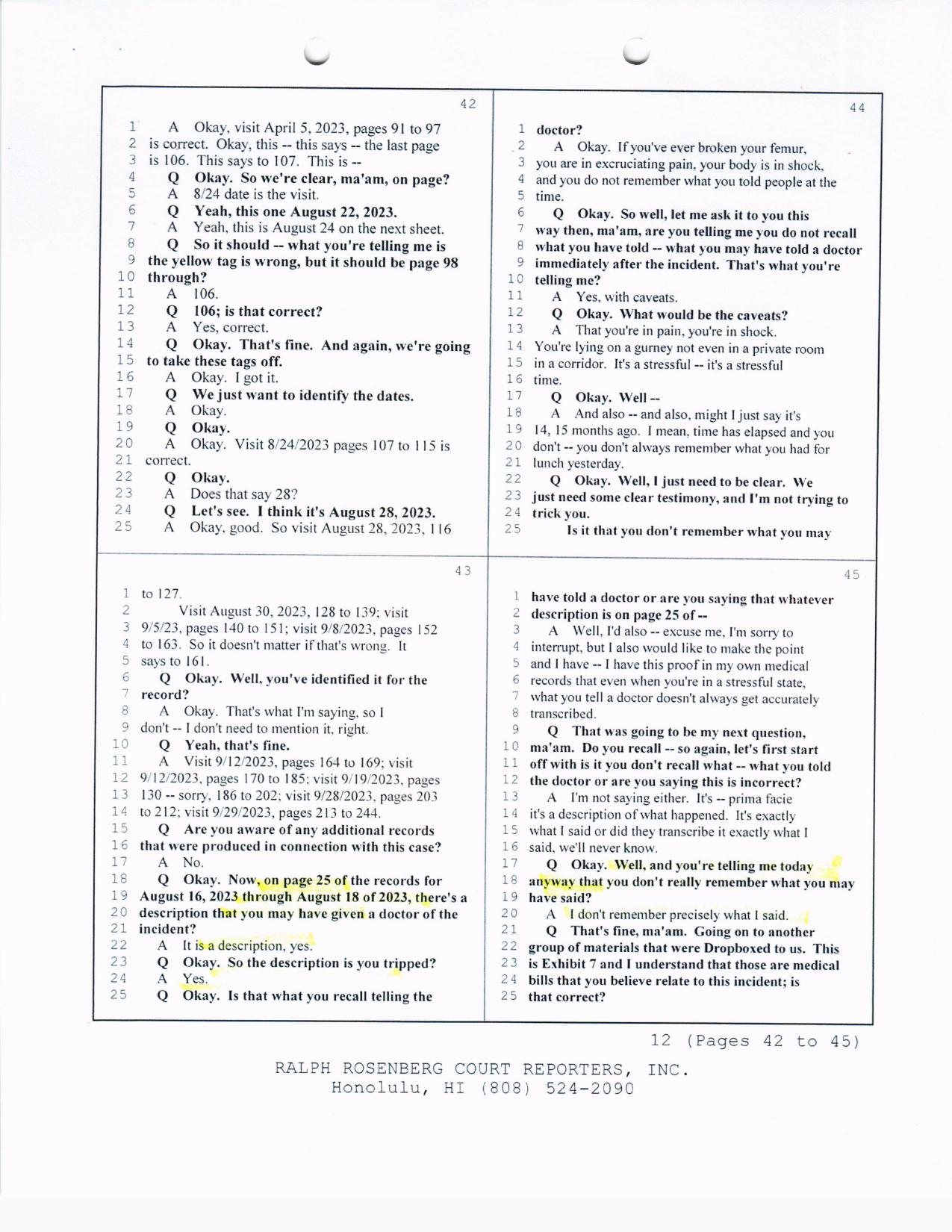
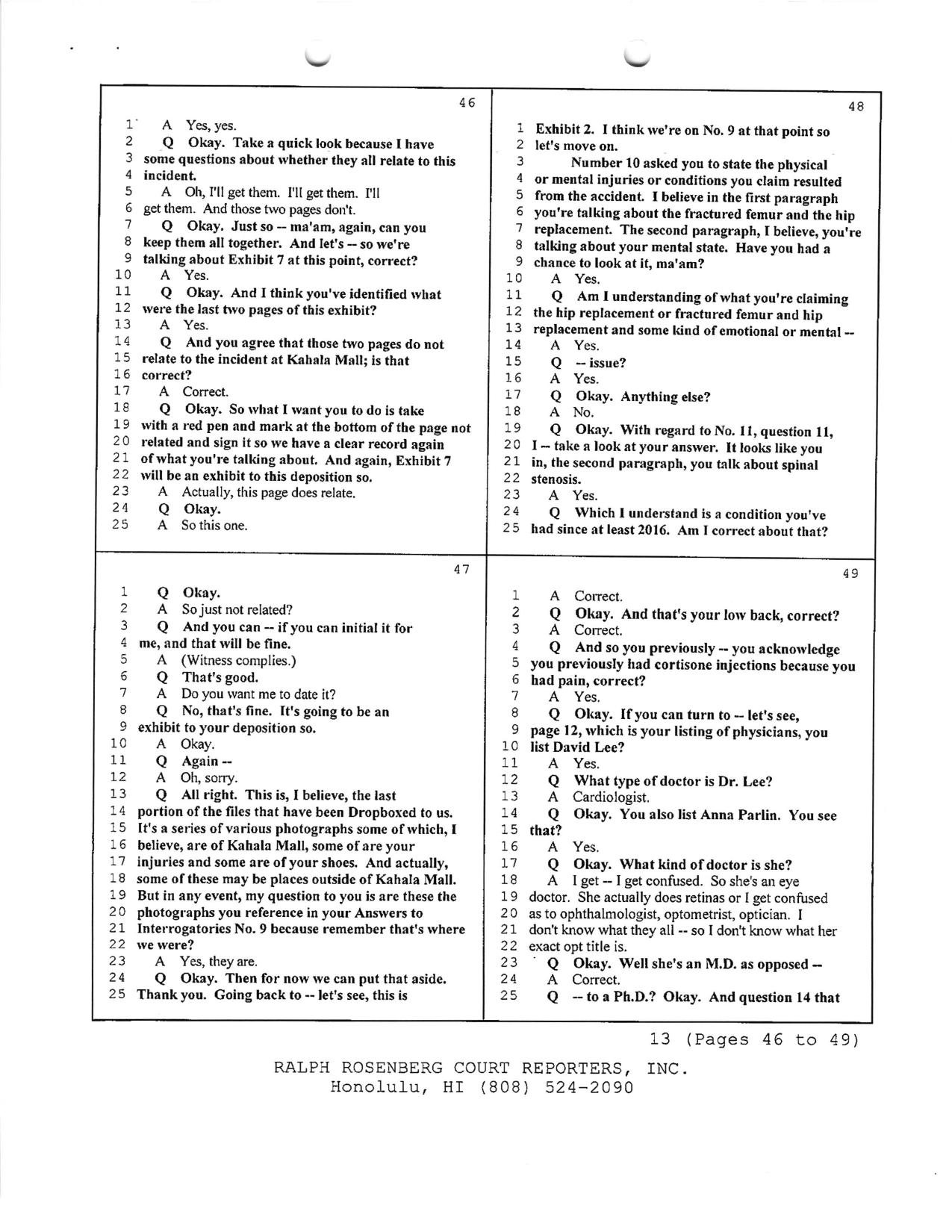
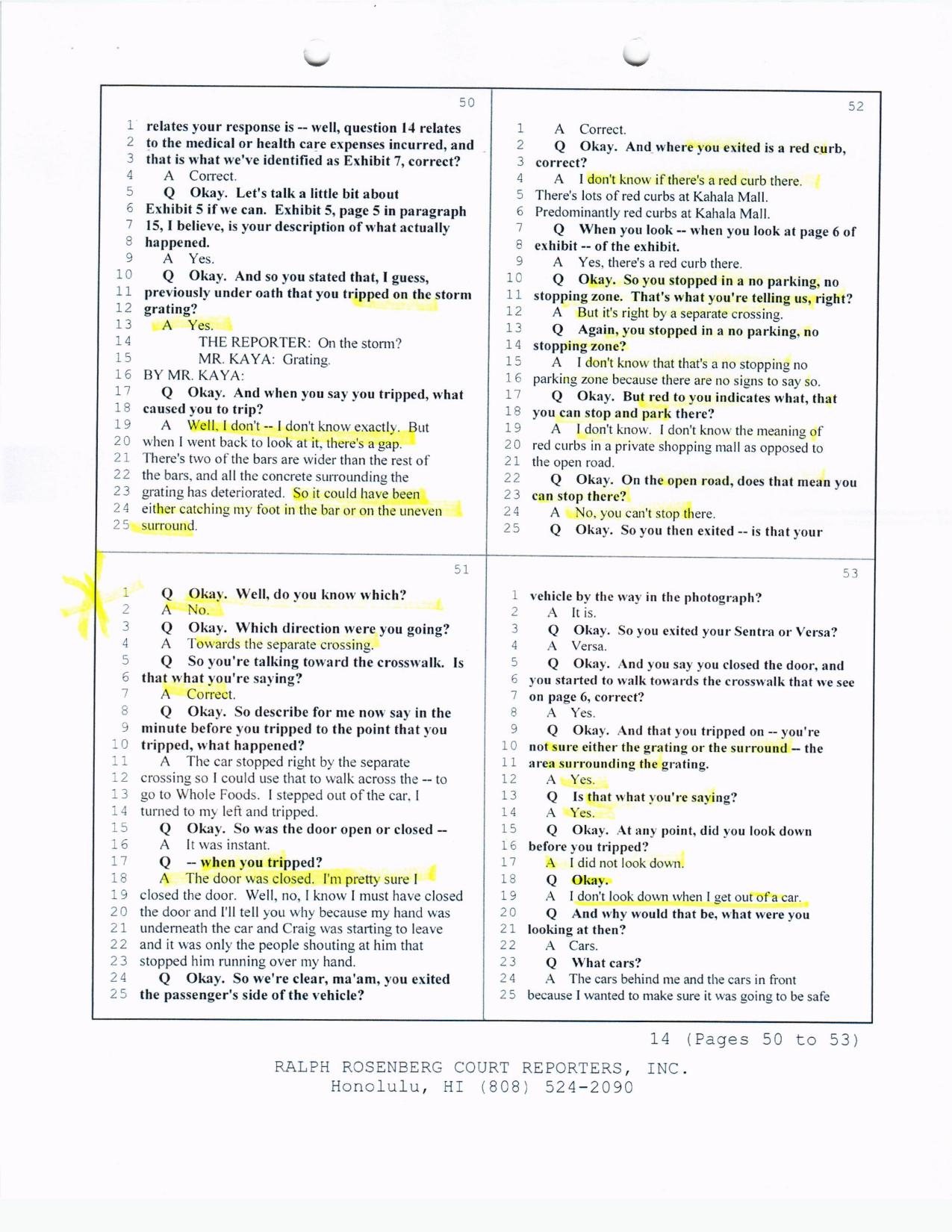
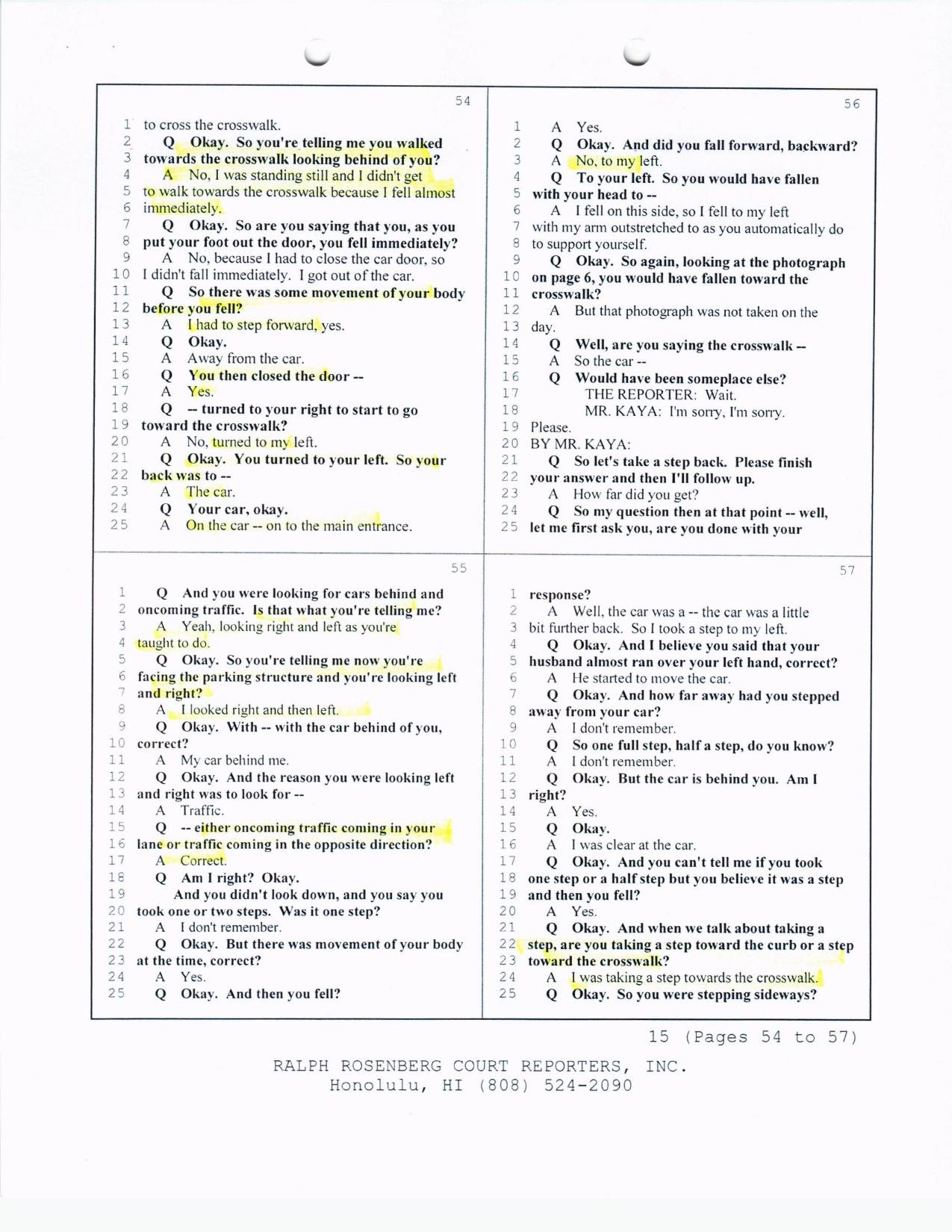
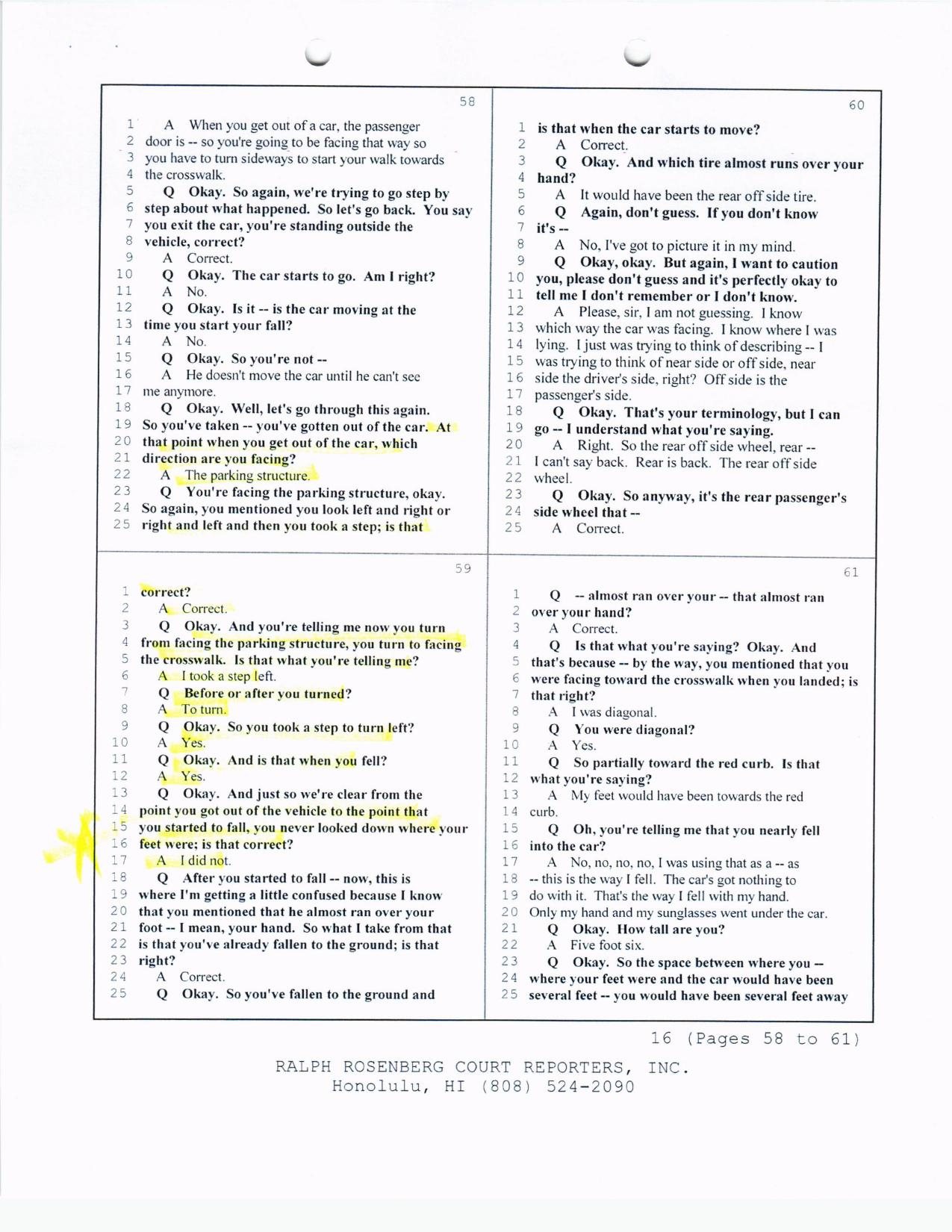
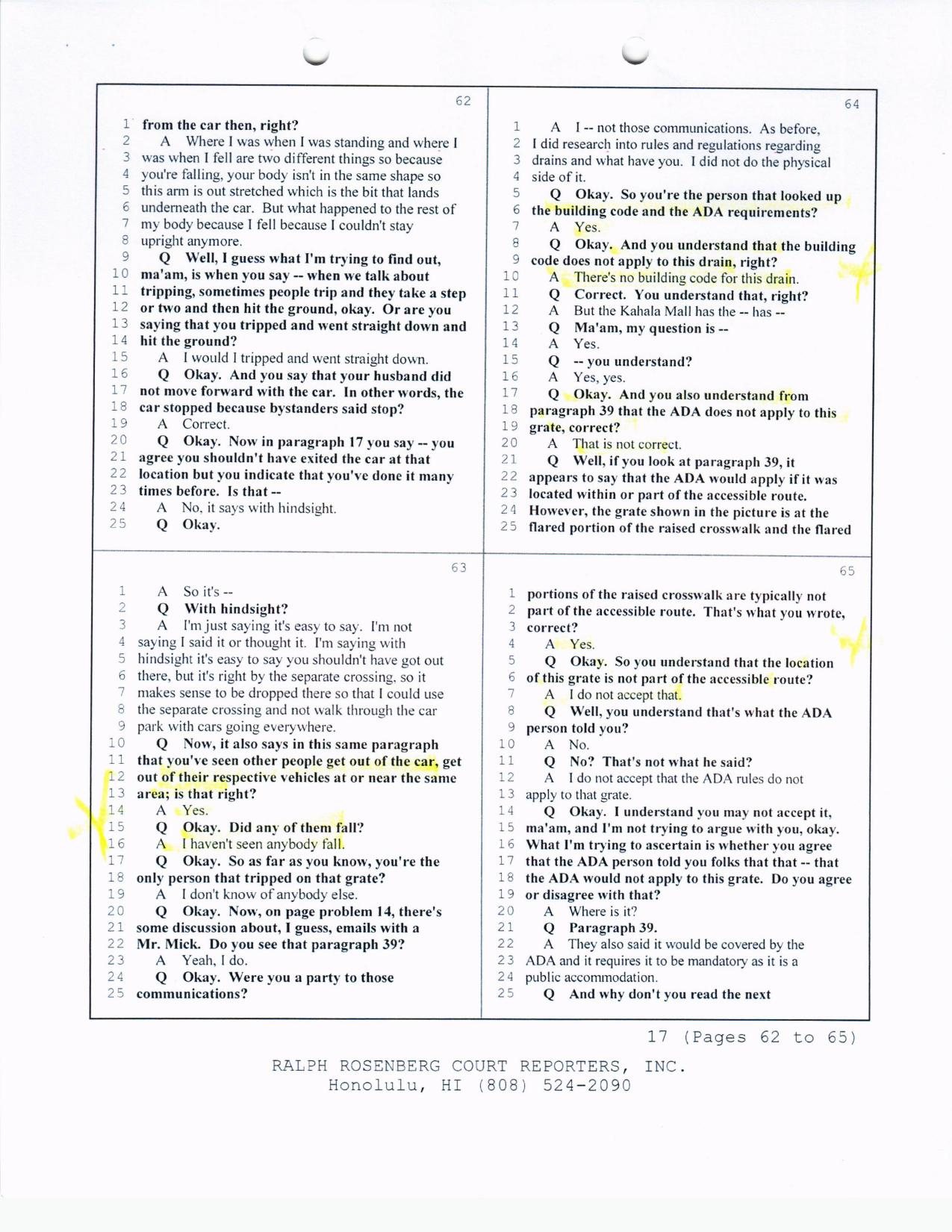
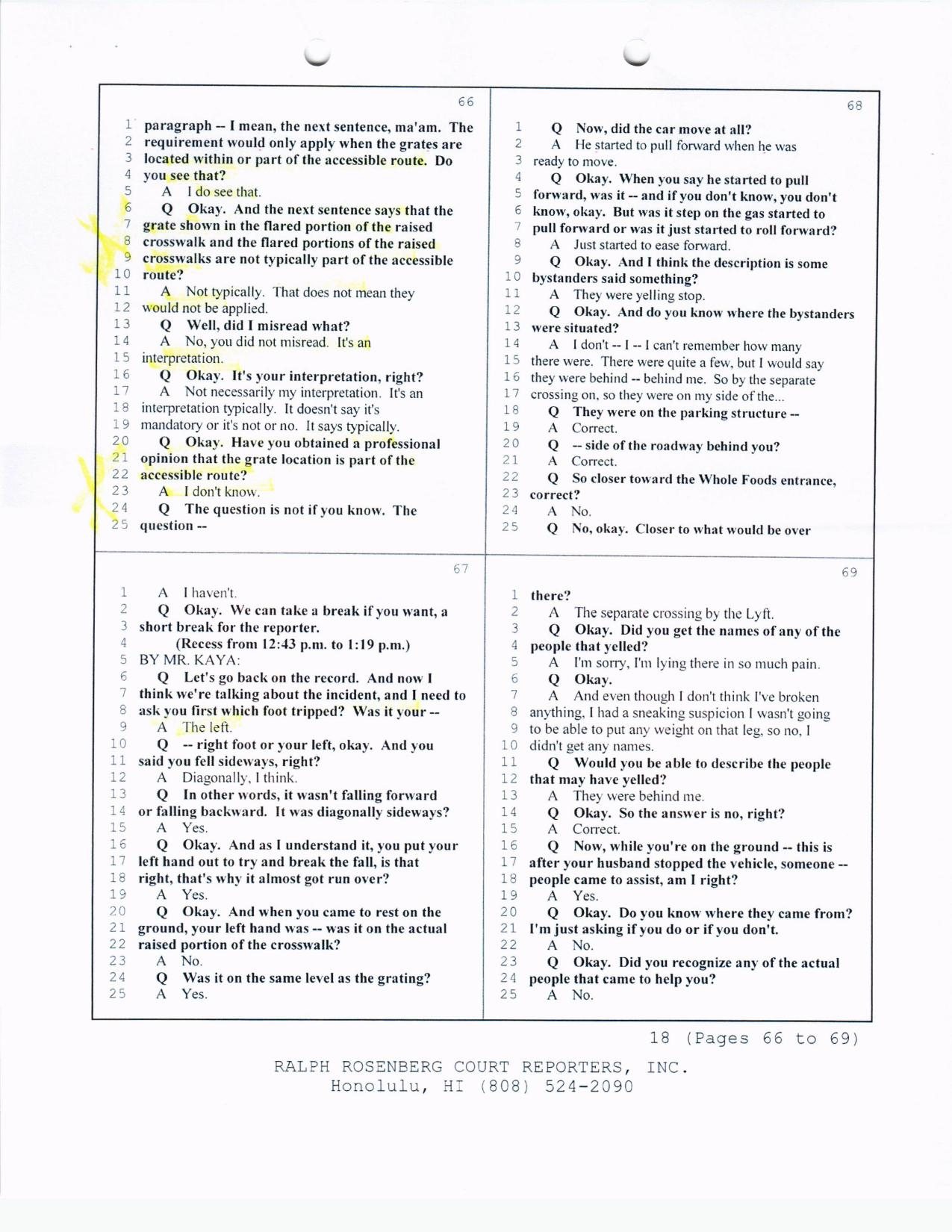
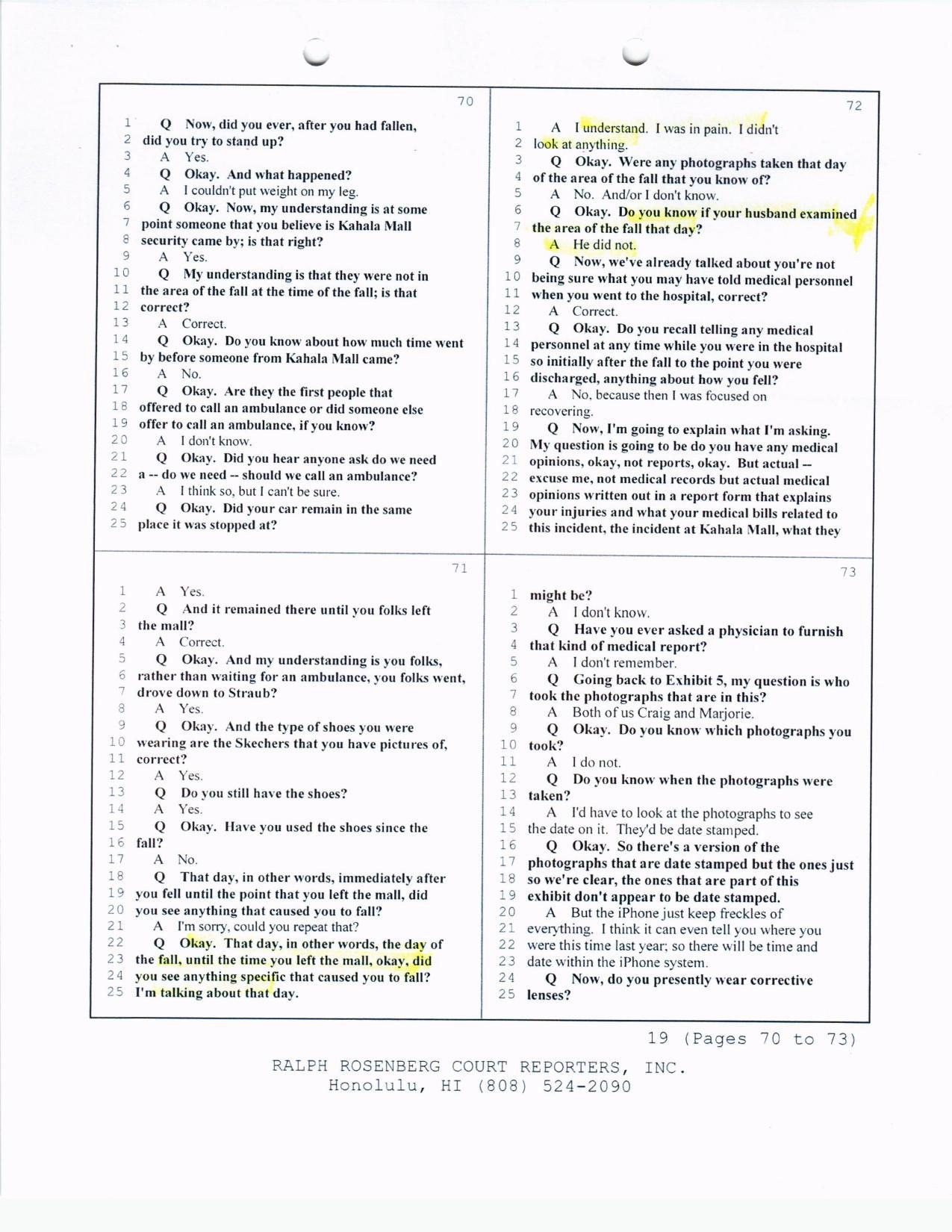
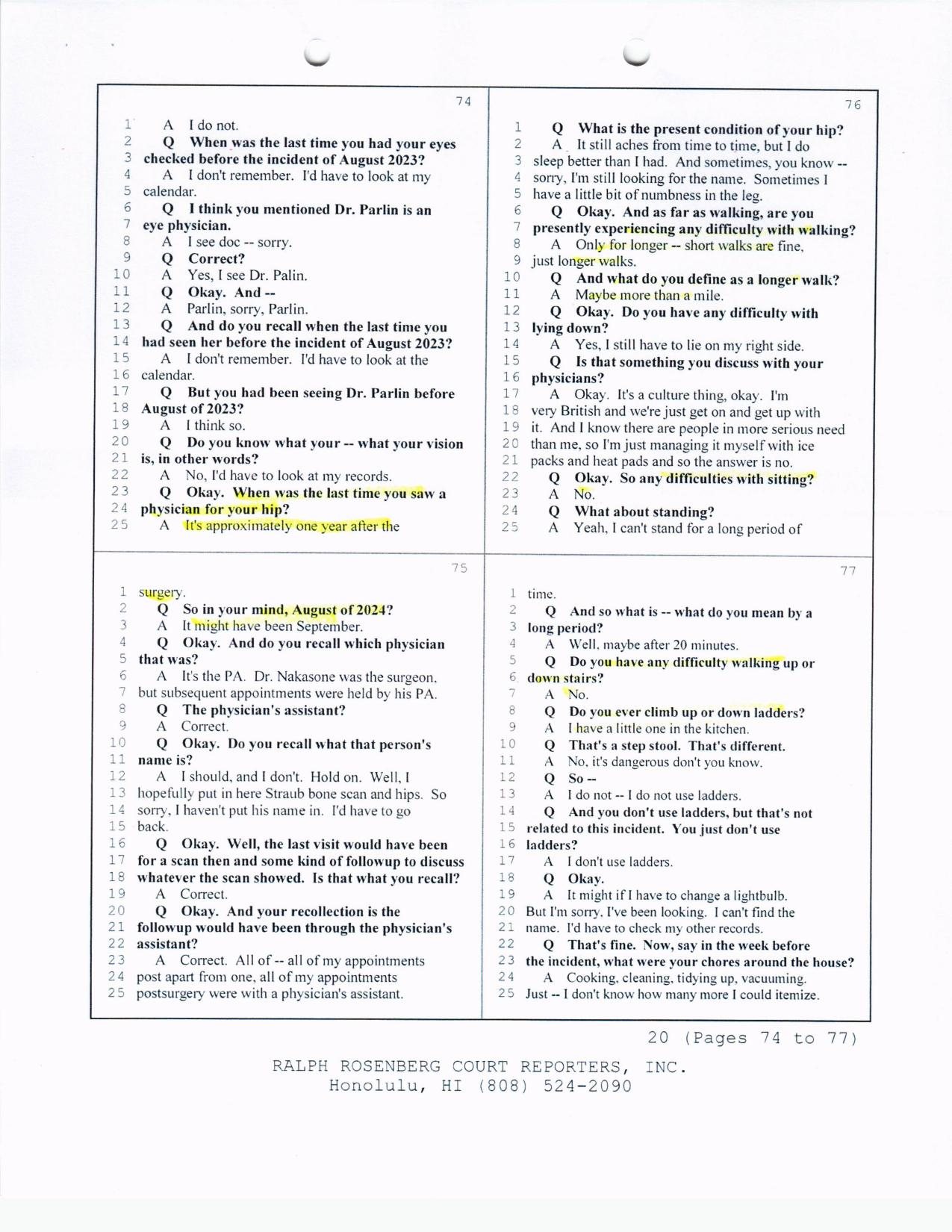
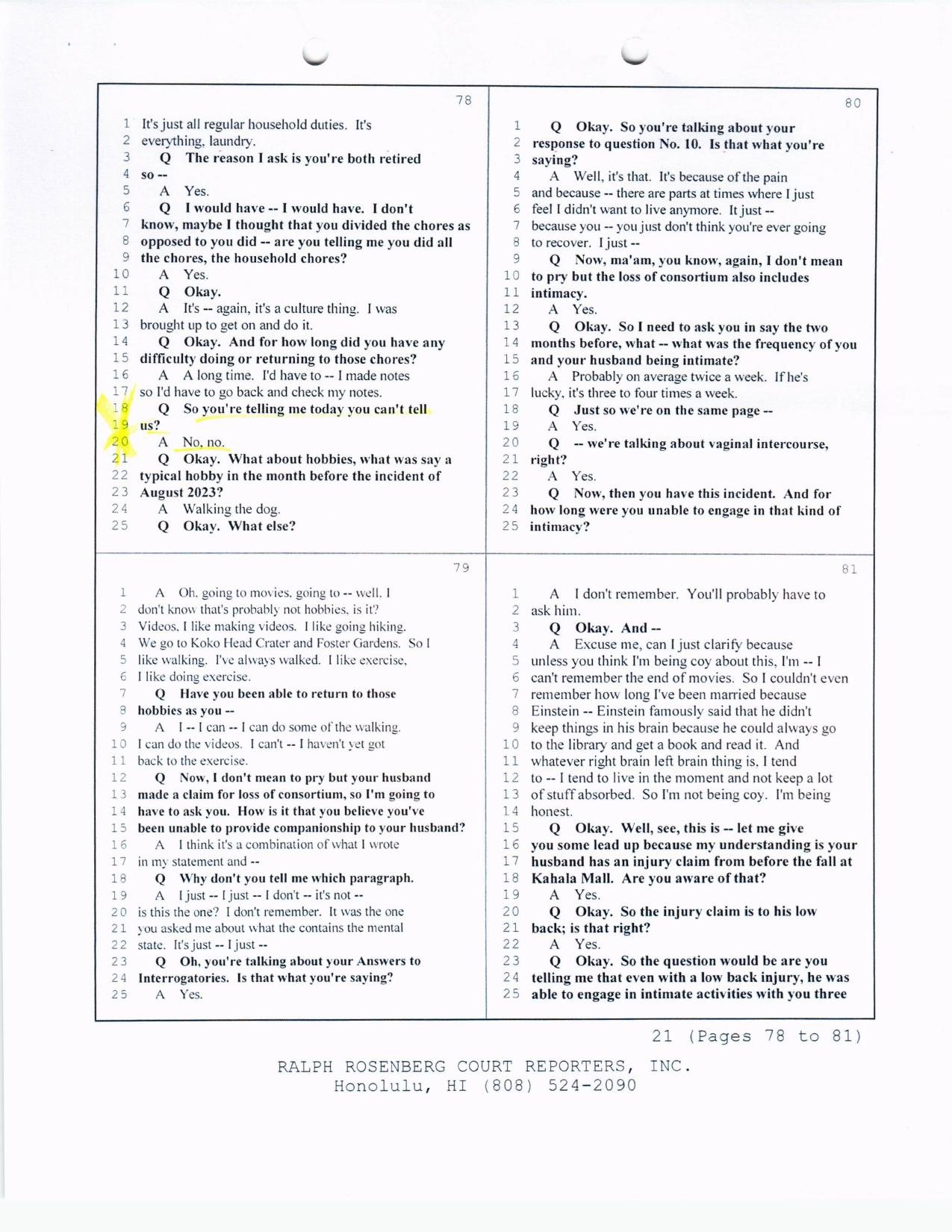
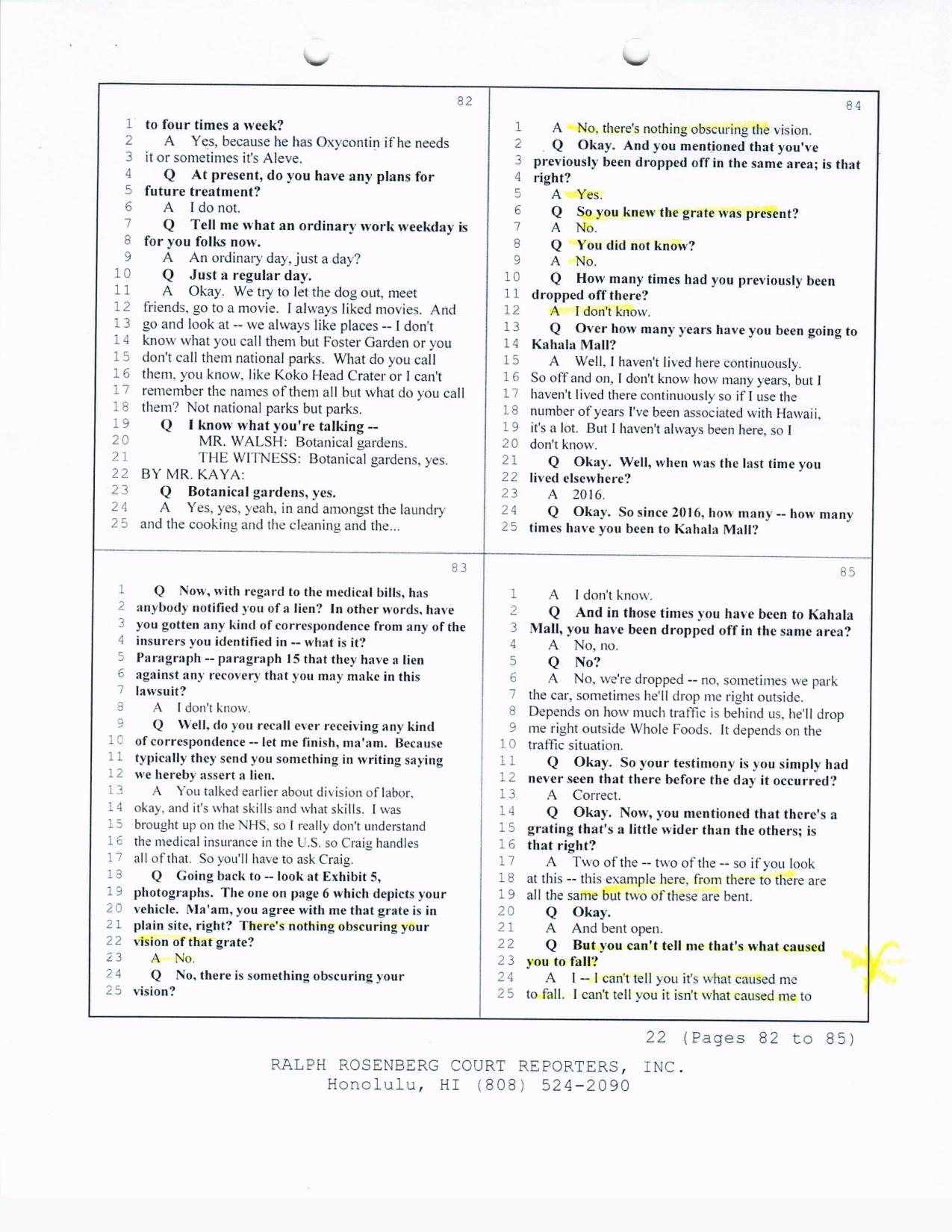
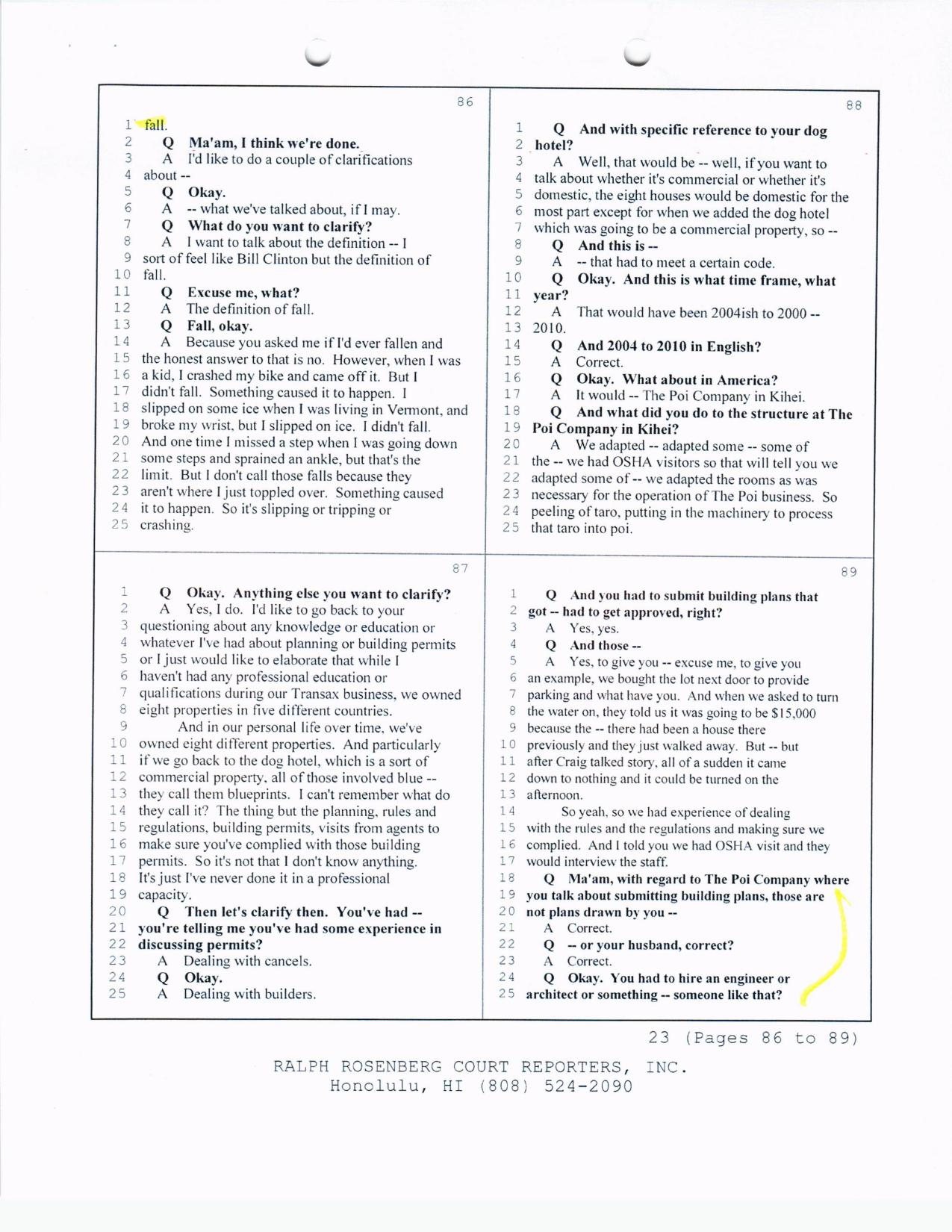
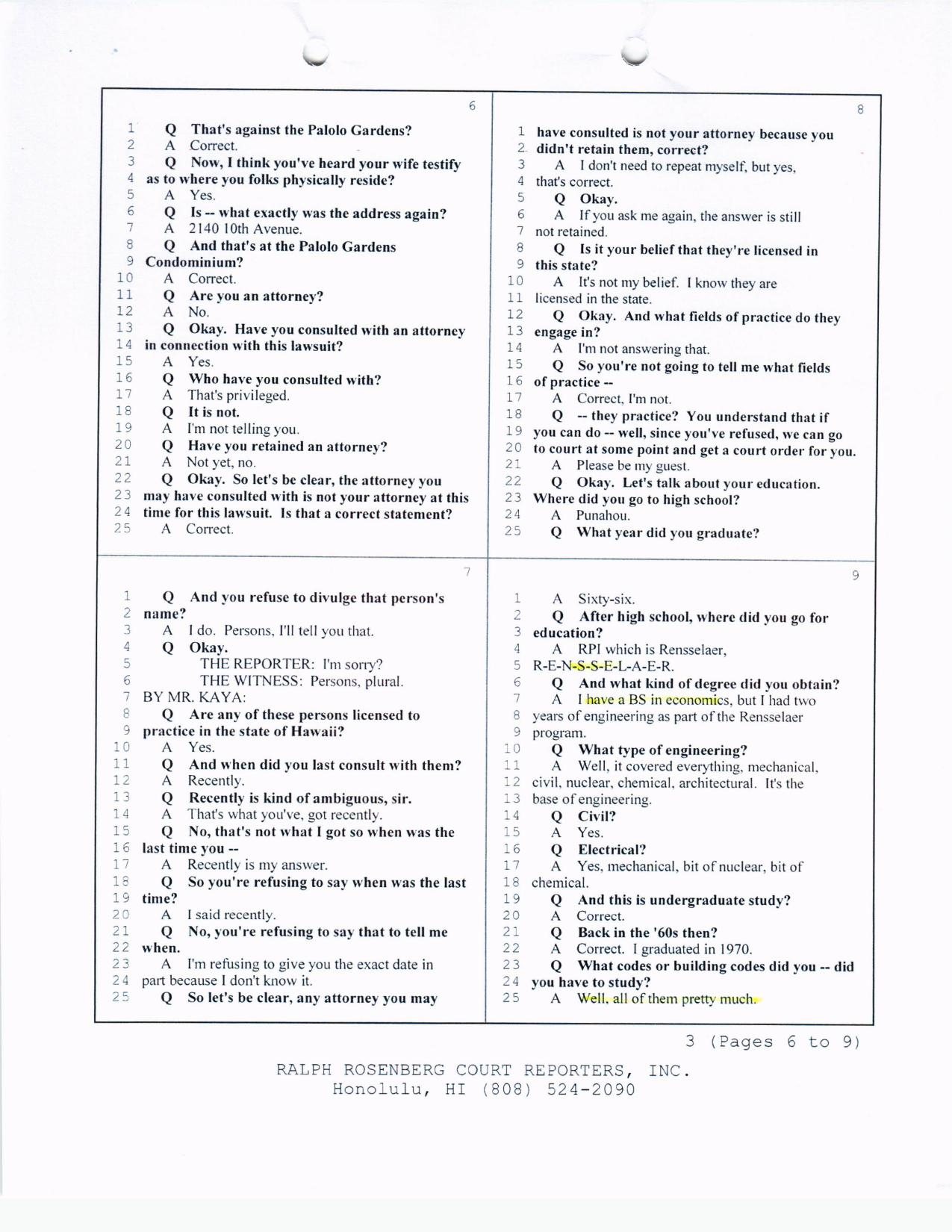
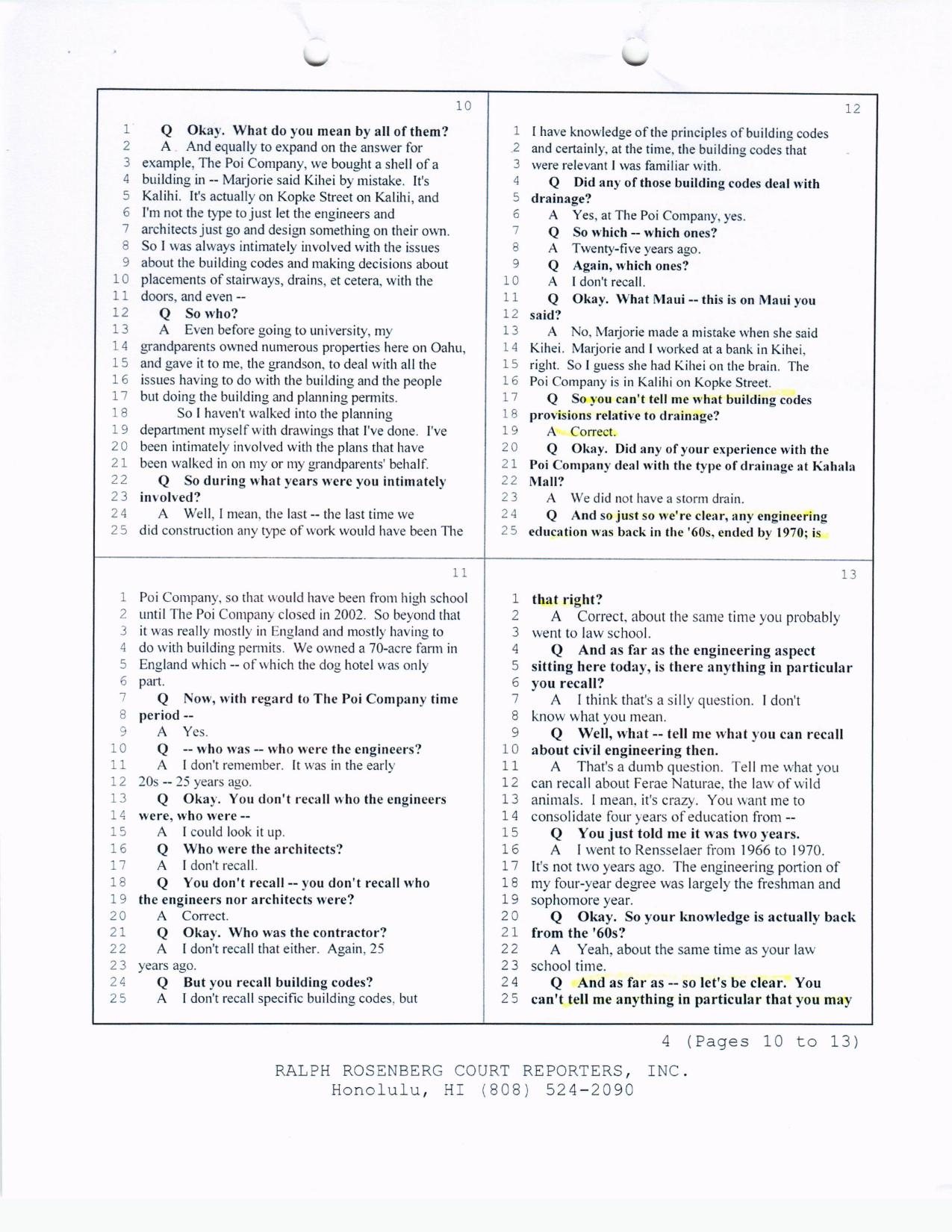
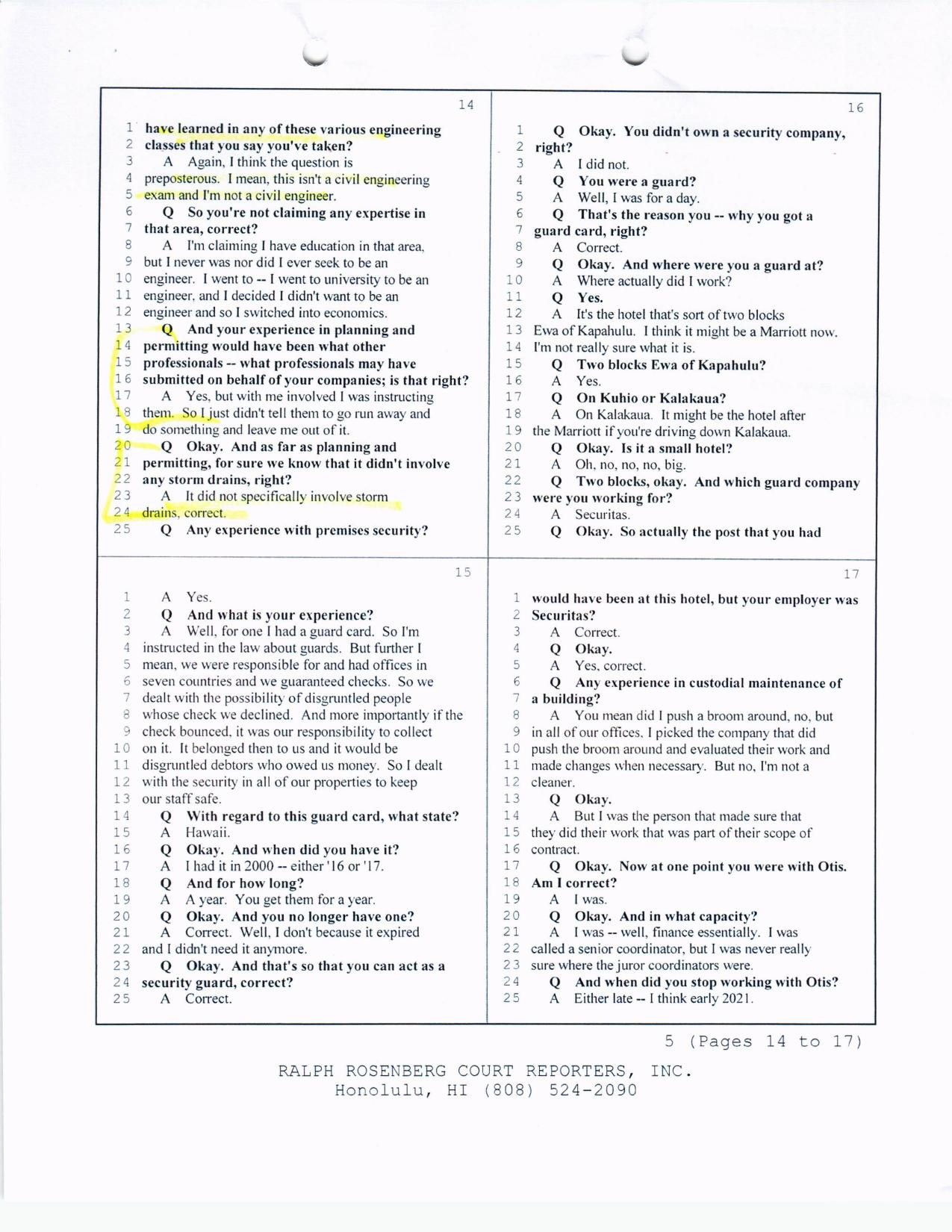
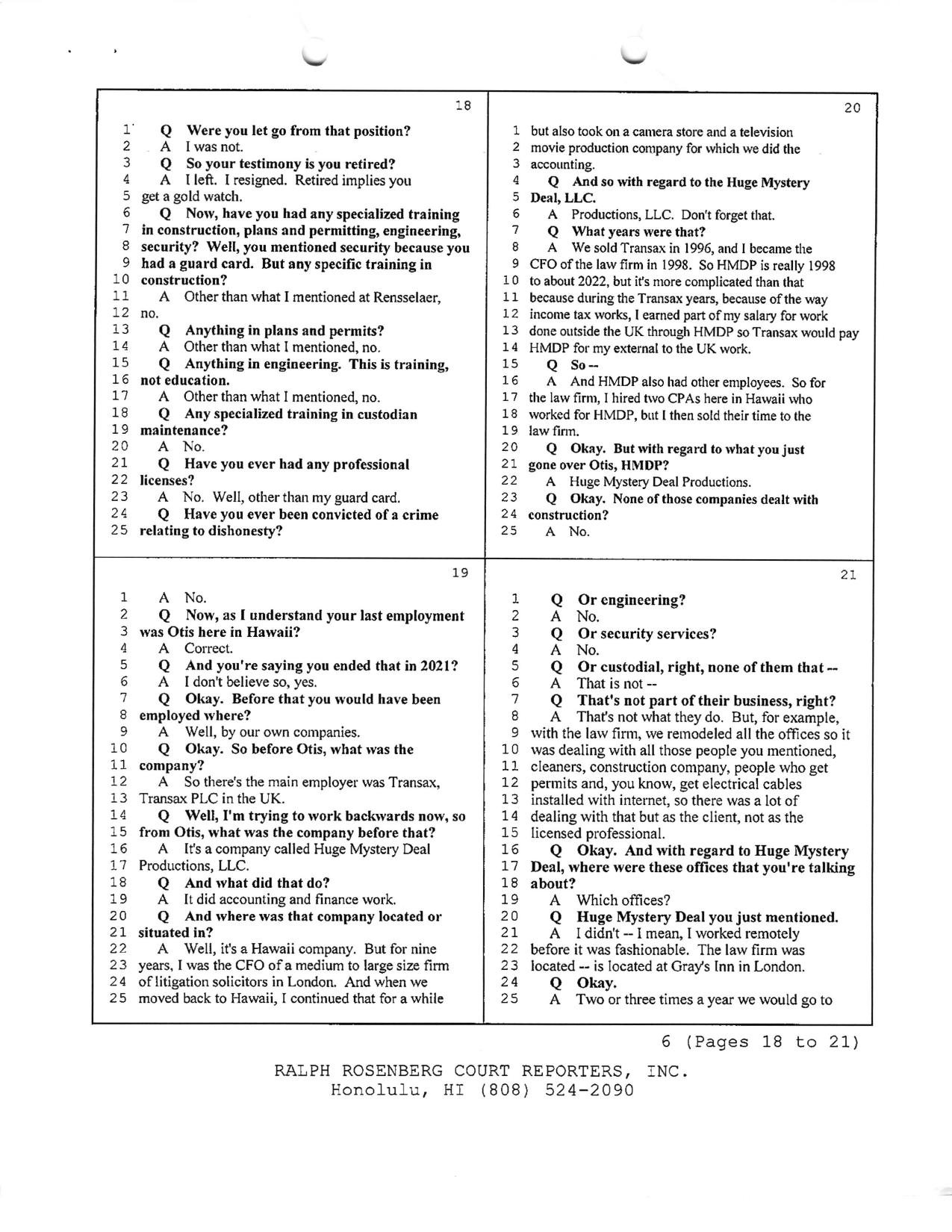
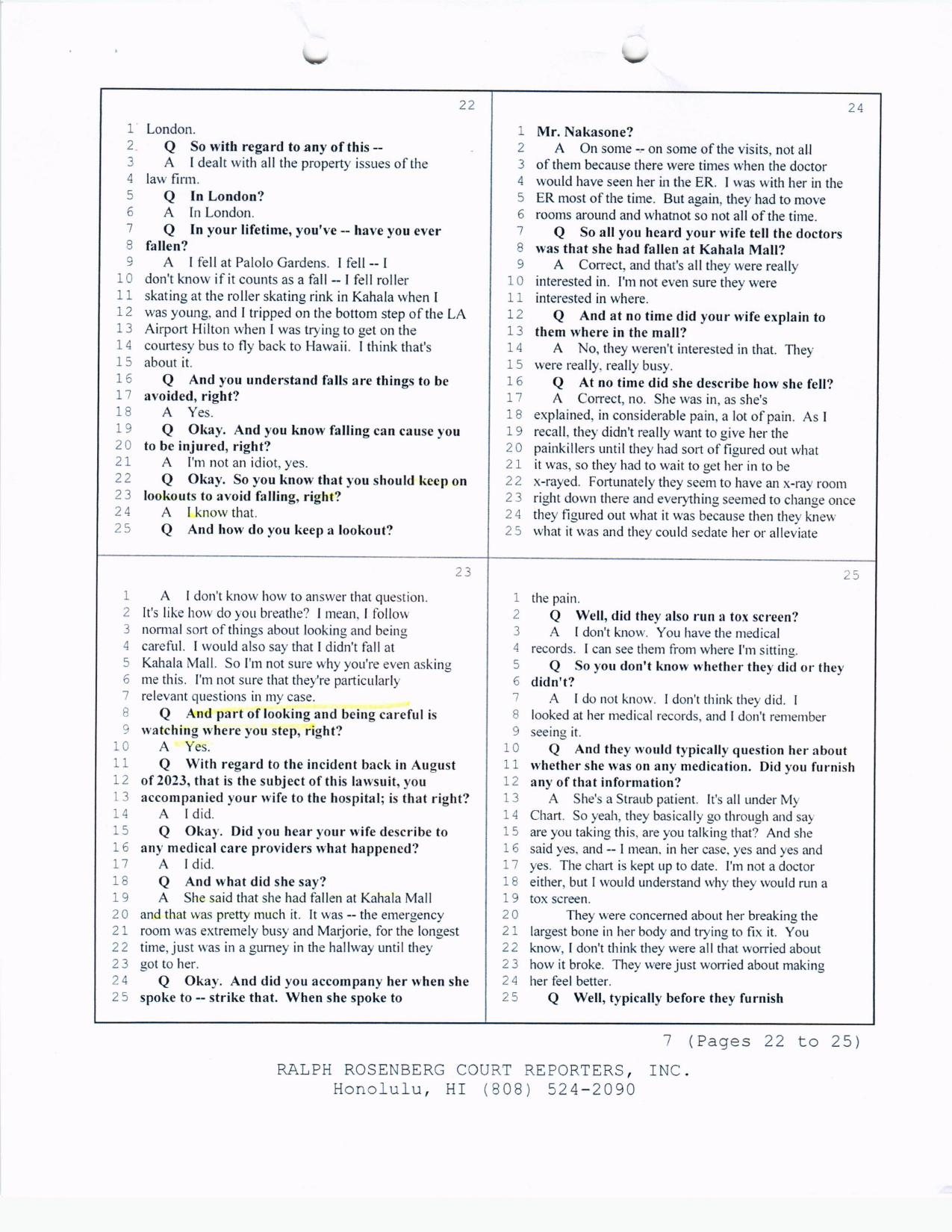
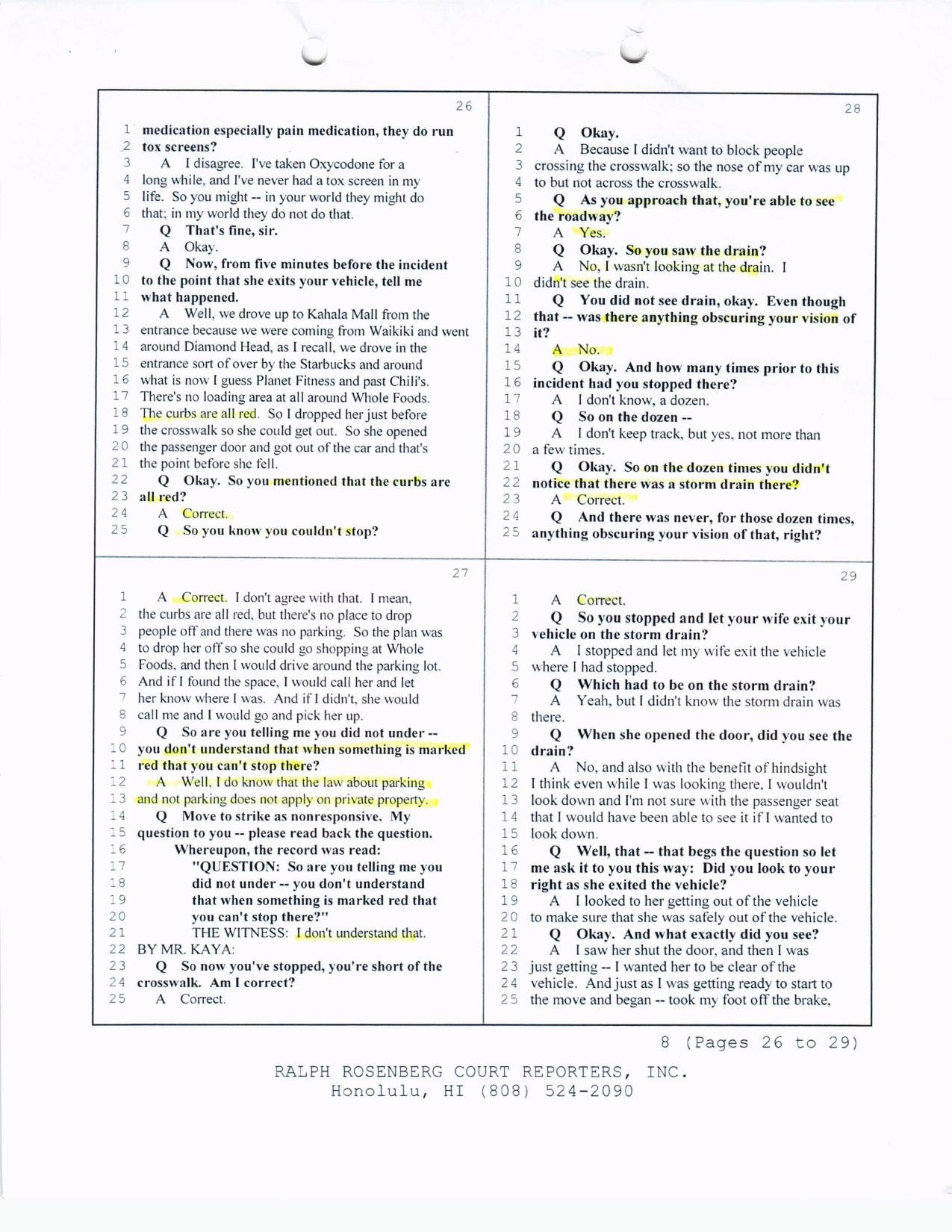
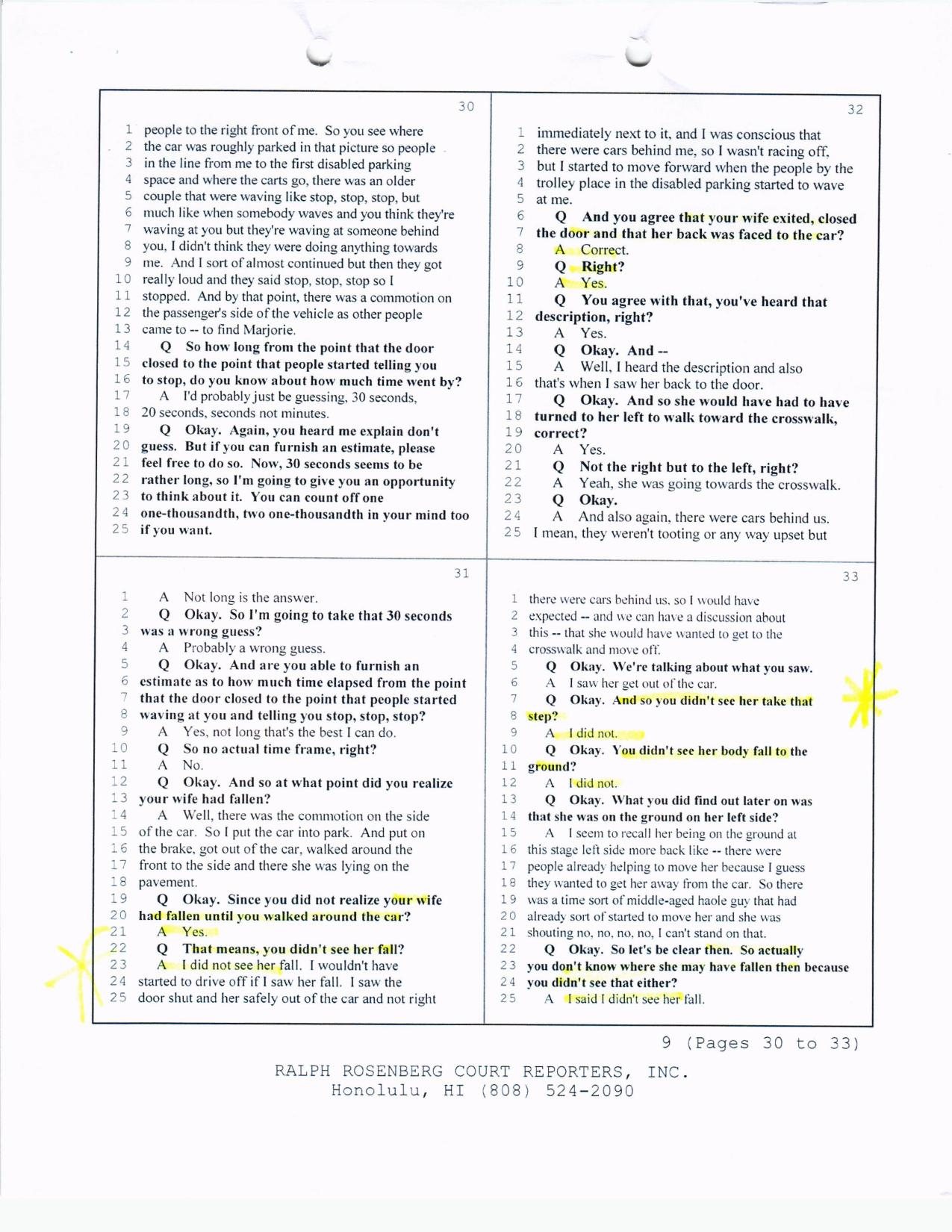
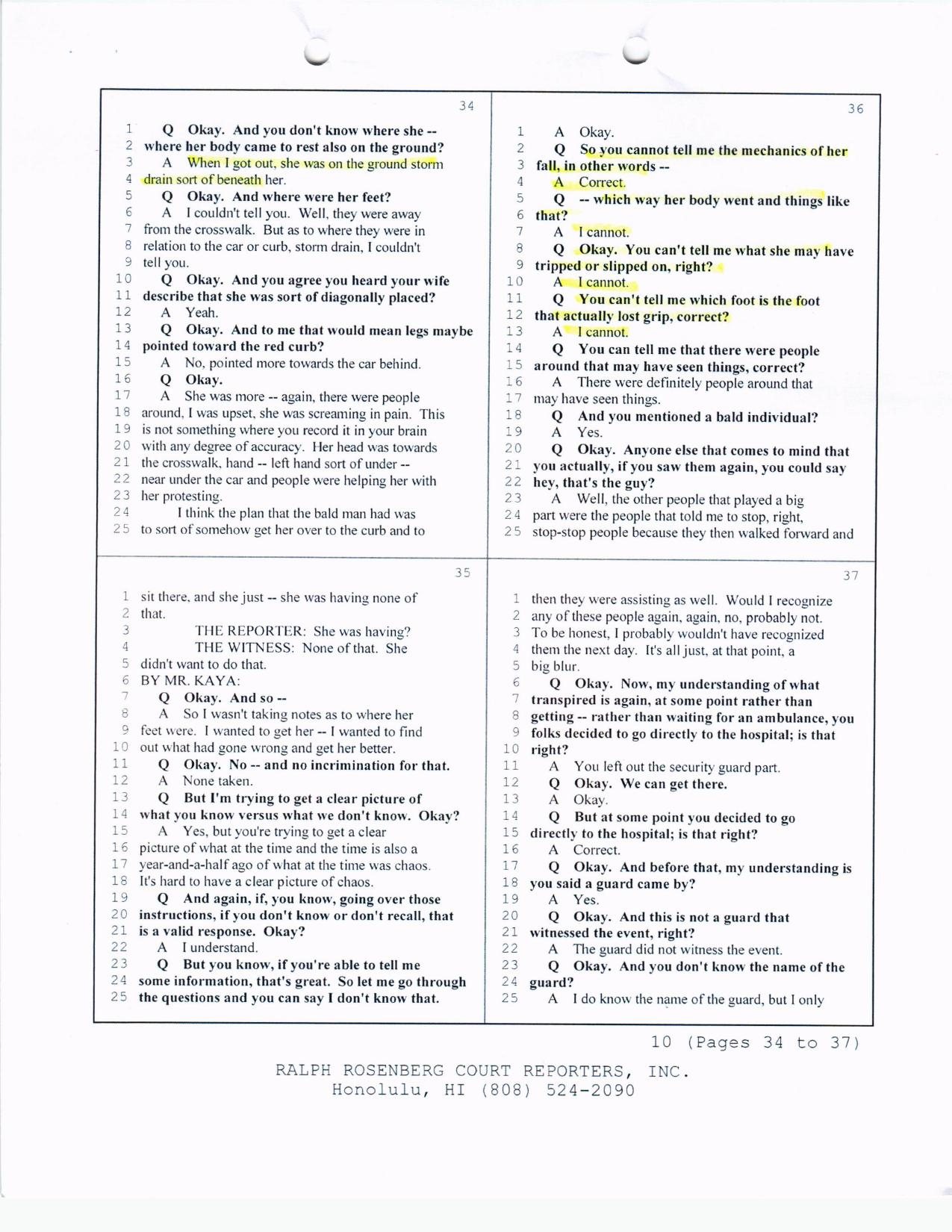
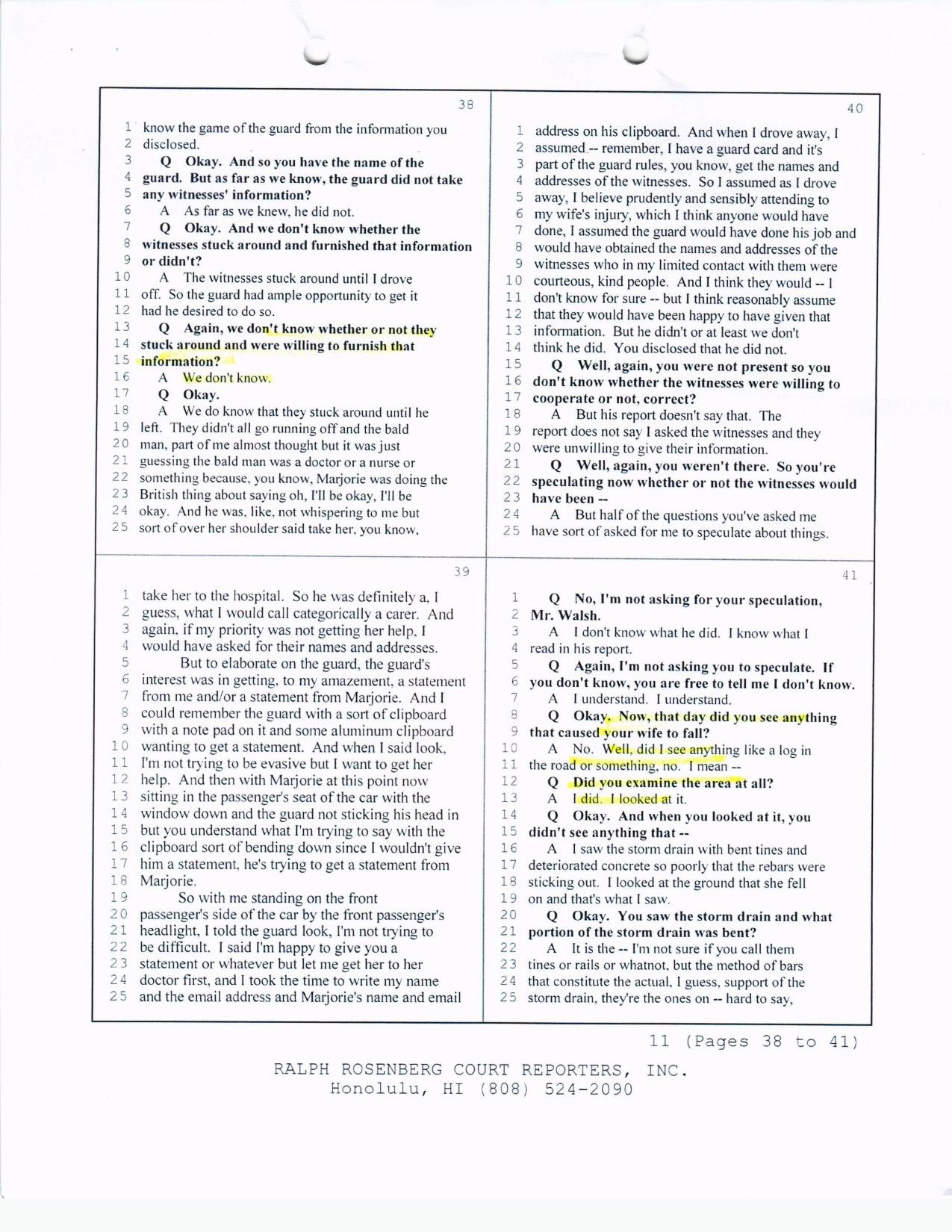
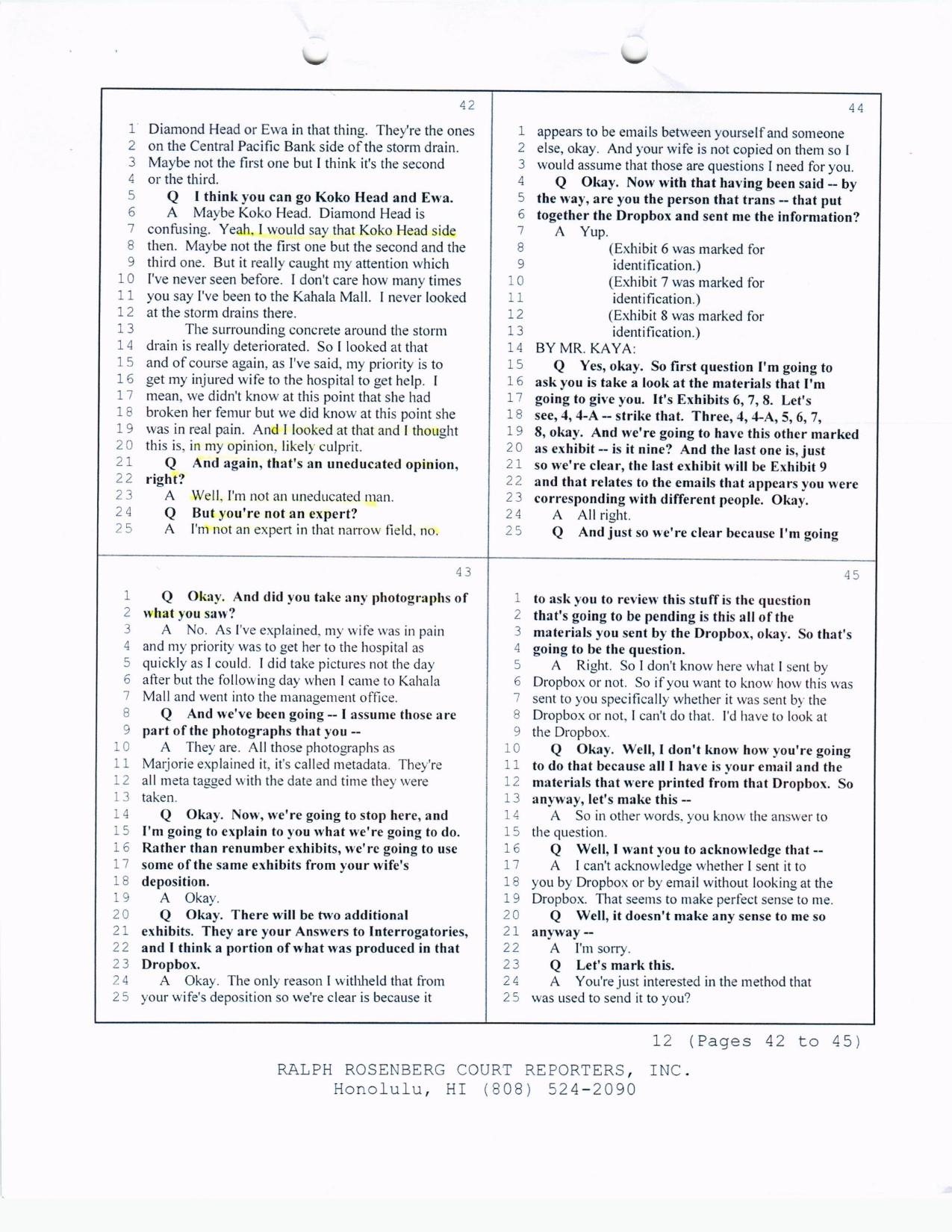
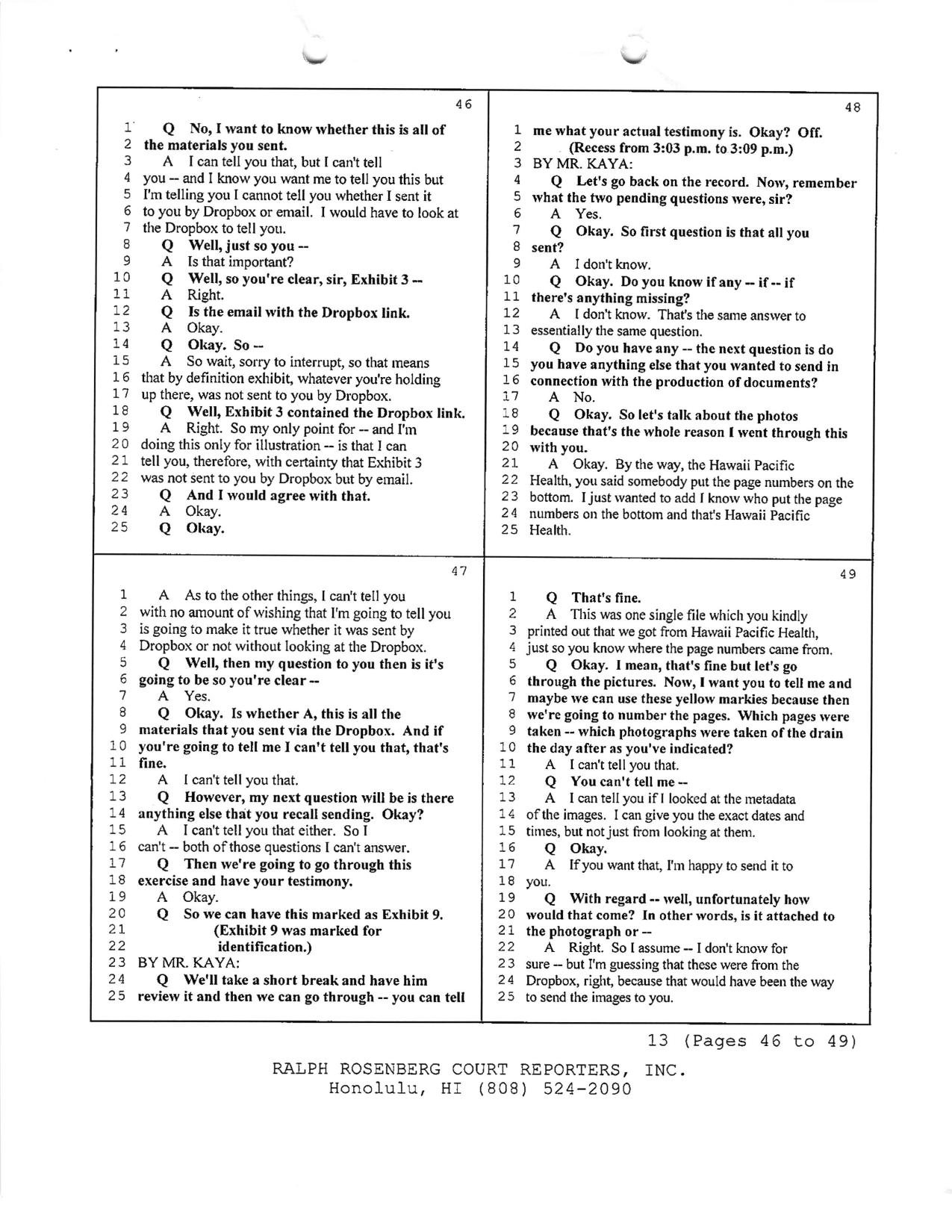
When Mr. Kaya submitted the Walshes’ own depositions to the Court, he submitted them highlighted — passages marked in yellow, with notes in the margins.
The plaintiffs objected, and cited the literature: Gier, Kreiner & Natz-Gonzalez, Harmful Effects of Preexisting Inappropriate Highlighting on Reading Comprehension and Metacognitive Accuracy, 136 J. Gen. Psychol. 287 (2009); Silvers & Kreiner, 36 Reading Research & Instruction 217 (1997); and Malin v. Hospira, 762 F.3d 552 (7th Cir. 2014), reversing summary judgment where the movant had “cherry-picked isolated phrases” from a deposition.
Plaintiffs respectfully ask the Court to consider the certified record itself, read in the light most favorable to Plaintiffs.
The depositions went in as twenty-three condensed sheets, four transcript pages to a sheet. The yellow runs through them. What it marks, almost without exception, is uncertainty: every “I don’t know”, every “I’m not sure”, every “I don’t know exactly”.
XV. Four thousand dollars
Running alongside all of this was a smaller matter, and a simpler one.
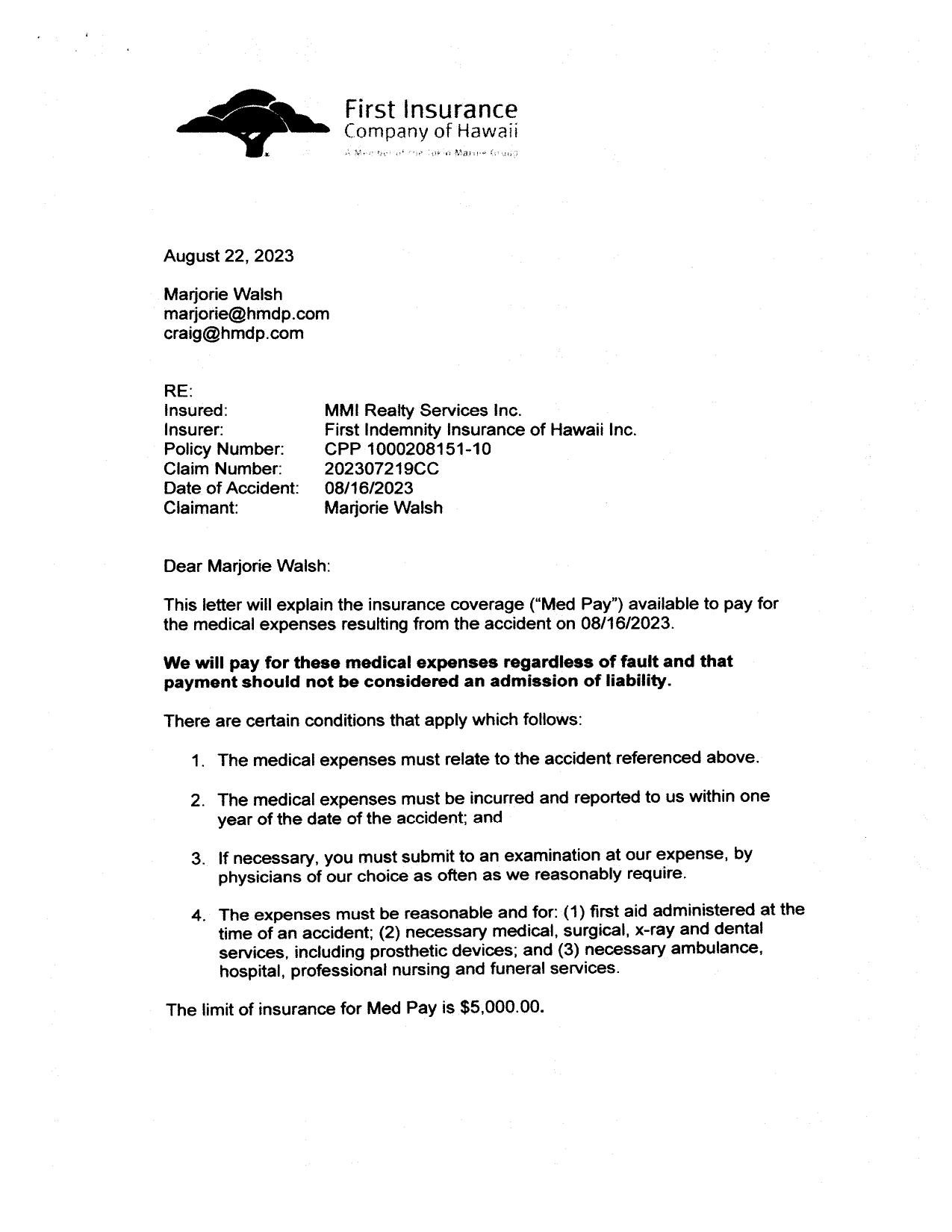
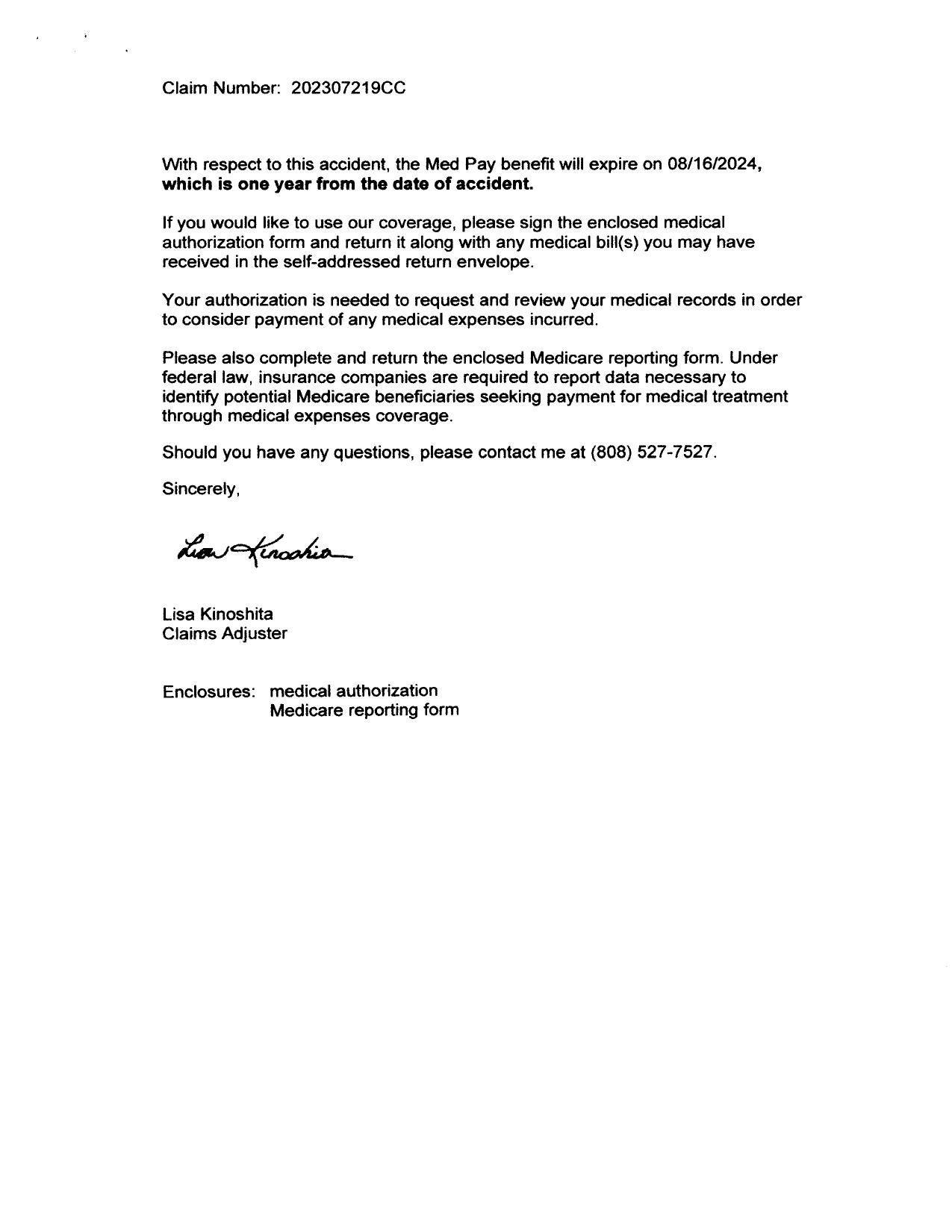
On 22 August 2023 — the same day as the telephone call about the building code — First Insurance sent Marjorie Walsh a letter over the signature of Lisa Kinoshita, claims adjuster. It explained the medical payments coverage available on the mall’s policy, payable regardless of fault and without any admission of liability. It stated:
The limit of insurance for Med Pay is $5,000.00.
She was told by telephone that in order for the coverage to be paid, Straub would have to reverse its billing to her health insurer, HMSA, repay HMSA, and rebill the charges directly to First Insurance. She questioned this and suggested submitting only part of the charges. She was told the rebilling was routine.
Straub did as asked. It reversed the billing, repaid HMSA, and rebilled the insurer.
Then nothing, for many months.
She eventually learned — from Straub, not from the insurer — that First Insurance had paid $1,000 and no more. No payment letter had been sent to her. No explanation of benefits. No notice that the coverage was considered exhausted. On 21 December 2023 the insurer had written to Straub saying the benefit was exhausted and telling it to bill the patient’s own health insurer for the balance. Marjorie was sent nothing.
Only after repeated enquiries did the answer come, by email on 2 December 2025:
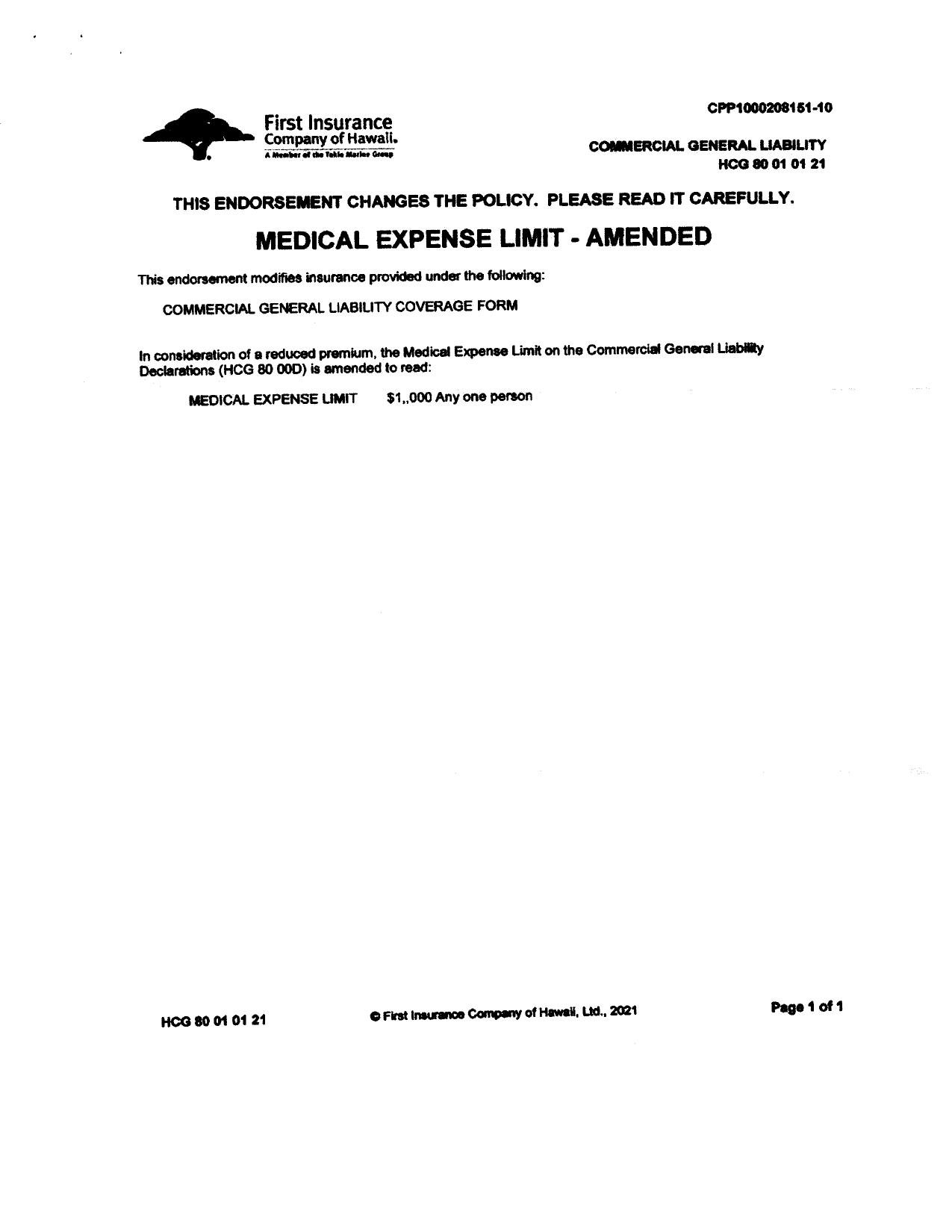
The initial MedPay letter noted $5,000 in MedPay benefits, due to a clerical error and the actual MedPay policy limit is $1,000. FICOH will not pay more than the $1,000 MedPay policy limit.
Two years and three months after the letter she had relied on.
On 3 December 2025 the Walshes complained to Scott Saiki, the State Insurance Commissioner, citing the Unfair Claims Settlement Practices Act, HRS § 431:13-103(a). In a letter to the Insurance Division of 6 January 2026, First Insurance acknowledged that it had initially advised her the limit was $5,000, and said it had later concluded that an endorsement reduced it to $1,000.
On 20 January 2026 Marjorie Walsh filed in the Small Claims Division of the District Court of the First Circuit: 1DSC-26-0000050, Marjorie J. Walsh v. First Insurance Company of Hawaii, Ltd. The claim was for the remaining $4,000, on the straightforward ground that an insurer which represents a limit in writing, induces a claimant to unwind her health-insurance billing in reliance on it, and then declares the figure a clerical error, may not keep the difference.
The disposition of that case is a matter of public record.
XVI. Summary judgment
There were two motions, filed on consecutive days. The reason there were two is worth understanding.
The first motion, and the questions with two answers
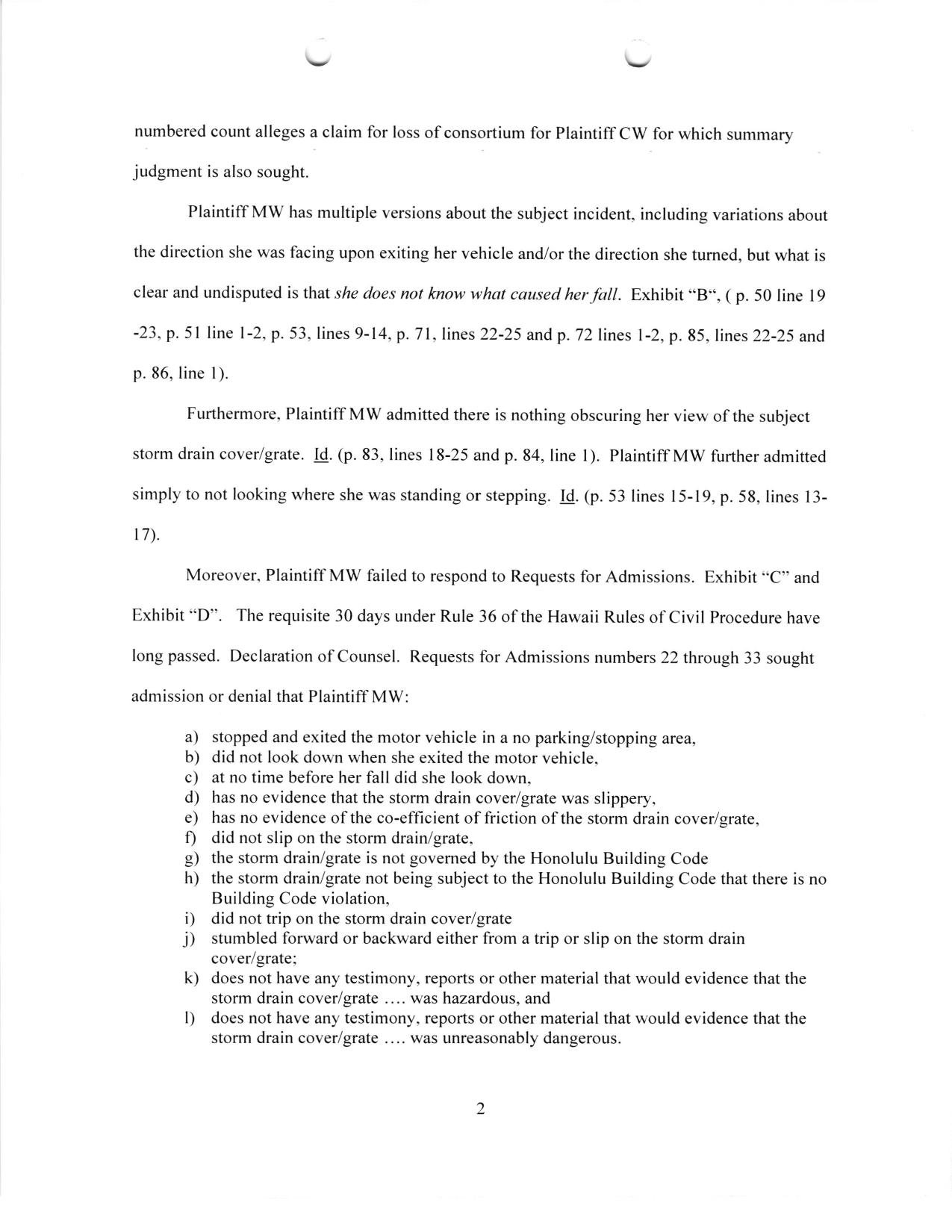
Some months earlier MMI had served Requests for Admissions. These are not questions in the ordinary sense. They are propositions, to be admitted or denied, and under Rule 36 of the Hawai‘i Rules of Civil Procedure a proposition that is not denied within thirty days is deemed admitted — treated by the court as an established fact, exactly as if the party had conceded it in the witness box.
Dkt. 152 was filed on 6 May 2026, and a substantial part of it is built on the proposition that the Walshes had not answered. Requests 22 to 33, the motion said, had gone unanswered, the requisite 30 days under Rule 36 … have long passed, and accordingly Marjorie Walsh had admitted that she had no evidence that:
a) the storm drain cover/grate was slippery, b) of the co-efficient of friction …, c) the storm drain/grate being governed by the Honolulu Building Code, d) of a building code violation, e) she tripped on the storm drain cover/grate, f) of stumbling forward or backward either from a trip or slip …, g) that the storm drain cover/grate … was hazardous, and h) that the storm drain cover/grate … was unreasonably dangerous.
The last two are the case. On the strength of not having replied to a form, she would have conceded that the thing she tripped on was neither hazardous nor unreasonably dangerous.
Marjorie Walsh’s responses were served on Mr. Kaya through JEFS on the evening of 6 May 2026 — the same day the motion was filed. Her position was not that she had answered late. It was that the deadline had not passed at all:
Substantive responses were timely served on May 6, 2026, in advance of the deadline calculated under HRCP Rule 6(e).
And, in a second message:
For the record, my Response to the Request for Admissions was served on you the evening of May 6, 2026, before any service of the motion on me has occurred.
Rule 6(e) adds days to a deadline where service was made by mail. On her calculation the time to respond had not yet run out when she responded — and the motion asserting otherwise had not yet reached her. A notarised copy, sworn and with the notary’s acknowledgment dated 7 May, followed the next day, with the original going to Mr. Kaya’s office by certified mail.
Every one of Requests 22 to 33 was denied, at length, with reference to the photographs, the permit drawings, Craig Walsh’s sworn testimony about the bent bars and the exposed rebar, and the measurements taken by MMI’s own expert.
The second motion
Dkt. 158 was filed on 7 May 2026 — the day after Dkt. 152, and the day the responses were filed.
It does not mention the admissions. It takes a different route entirely: not that the drain was safe, but that none of the standards the Walshes relied on — the ADA, the Honolulu Building Code, NFSI B101.9-2020, IPMC 2021, ASTM F1637-95 — imposed any duty on MMI at all. They were, it said, irrelevant, unadopted and merely voluntary provisions. And Mr. Wong’s opinions saying so were, in the motion’s words, opinions which have never been controverted — because the plaintiffs had no expert.
The opposition, filed 18 May, argued that the physical facts were substantially conceded by the defendant’s own engineer; that MMI could not rely on ignorance it had structured itself to maintain; that there was affirmative evidence of prior falls in the same lot; and that expert testimony is required only where a question is beyond a lay juror — whereas a bent grate and crumbling concrete are things a juror can see in a photograph and measure with a tape.
The absence of a retained expert for Plaintiffs is not a defect in their case; the case does not require one.
There was also a technical objection, and it went to the heart of the motion.
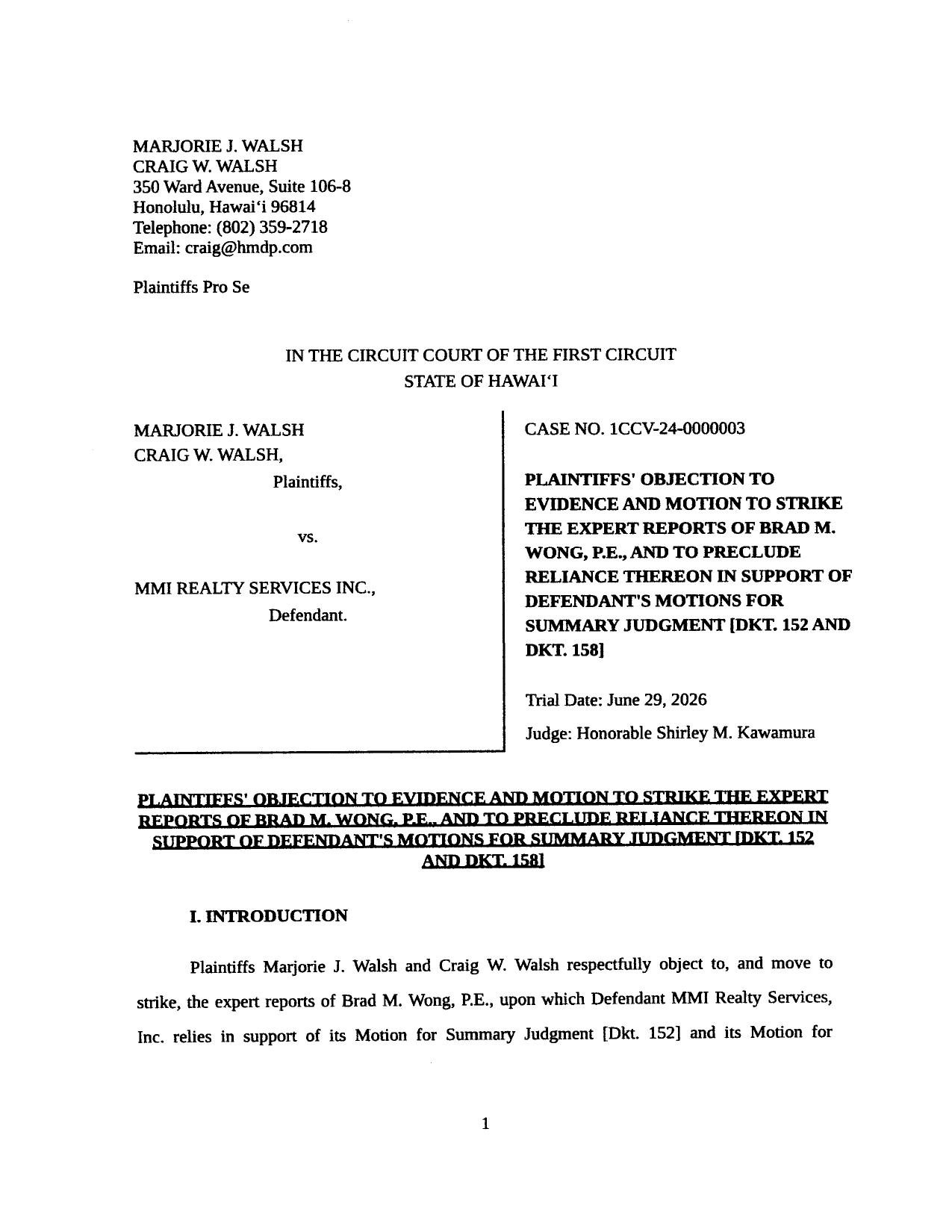
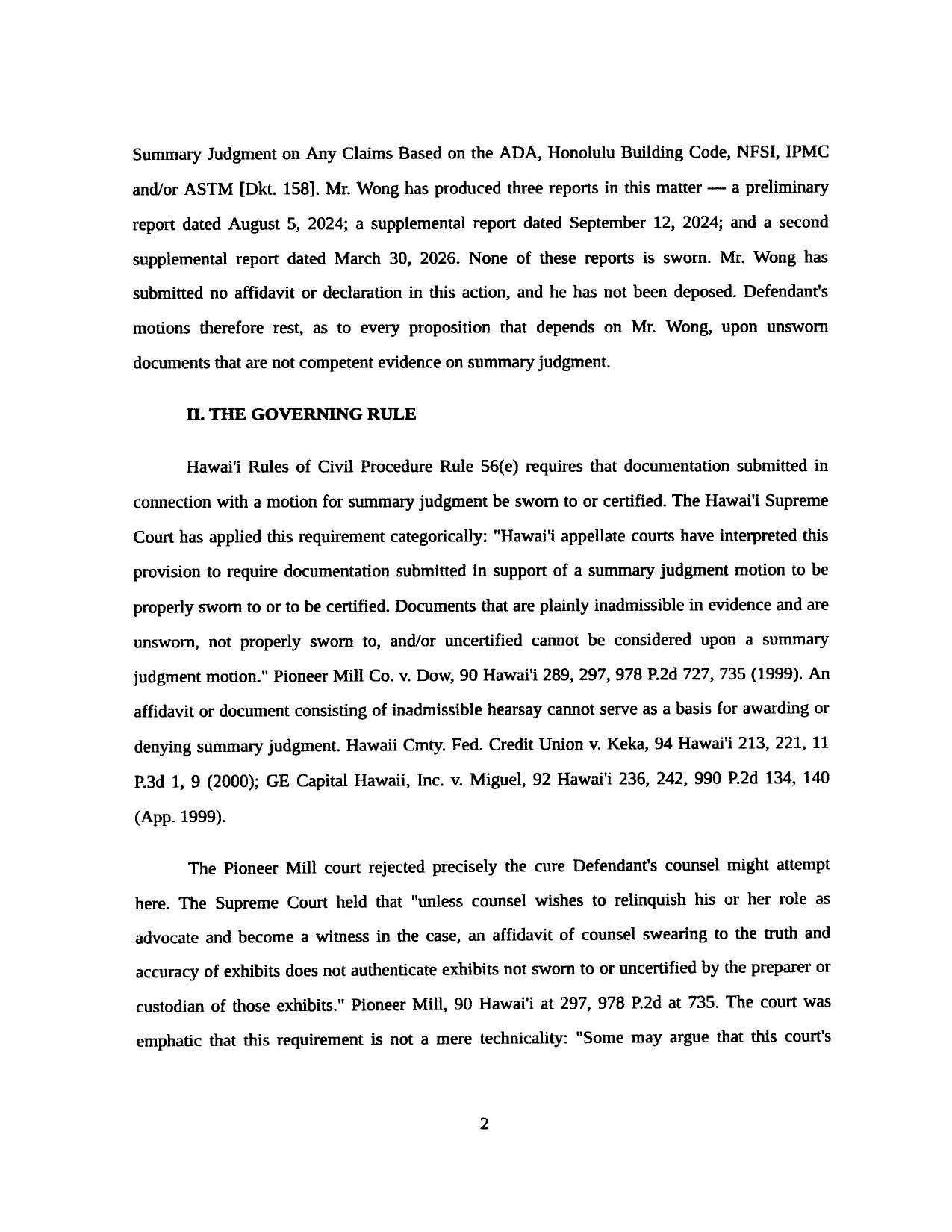
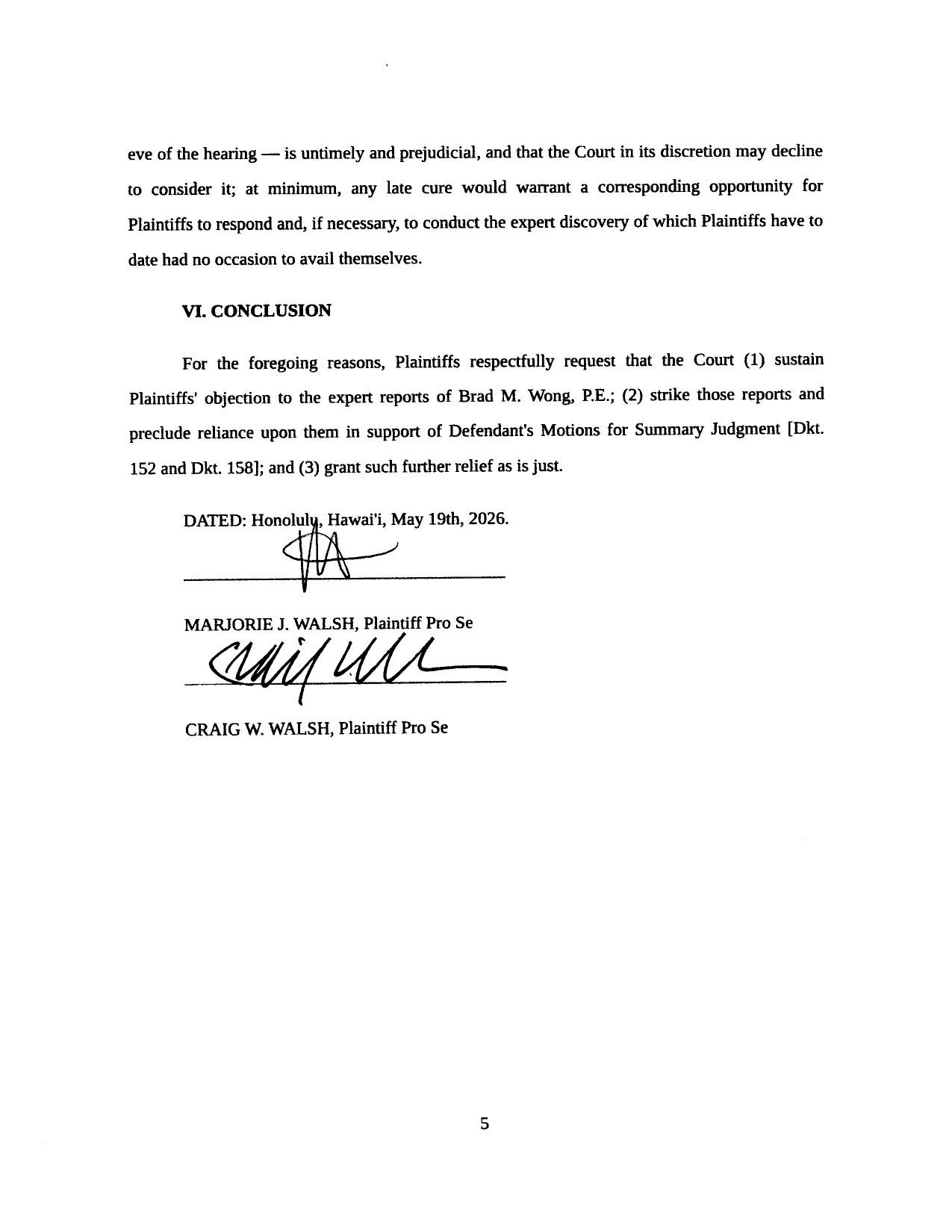
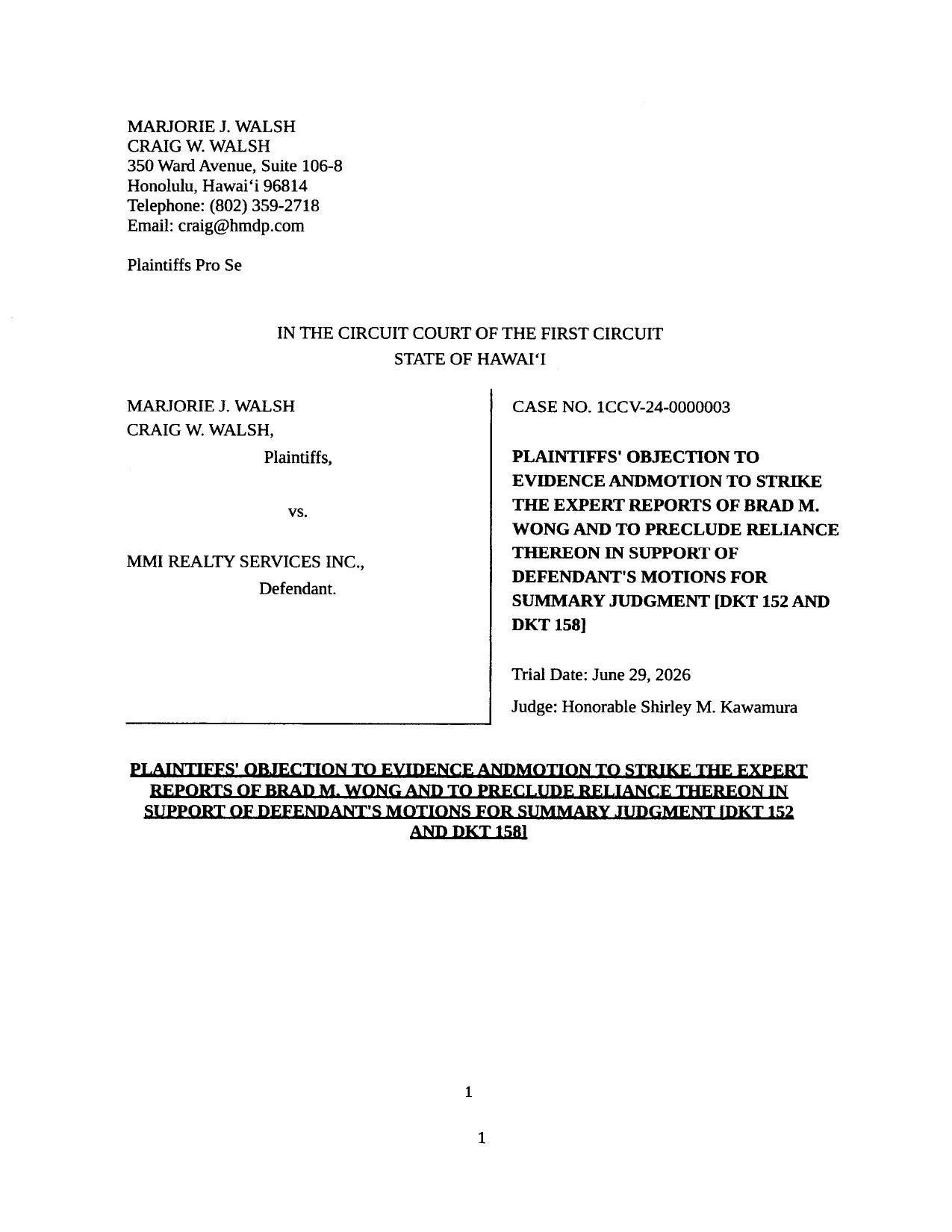
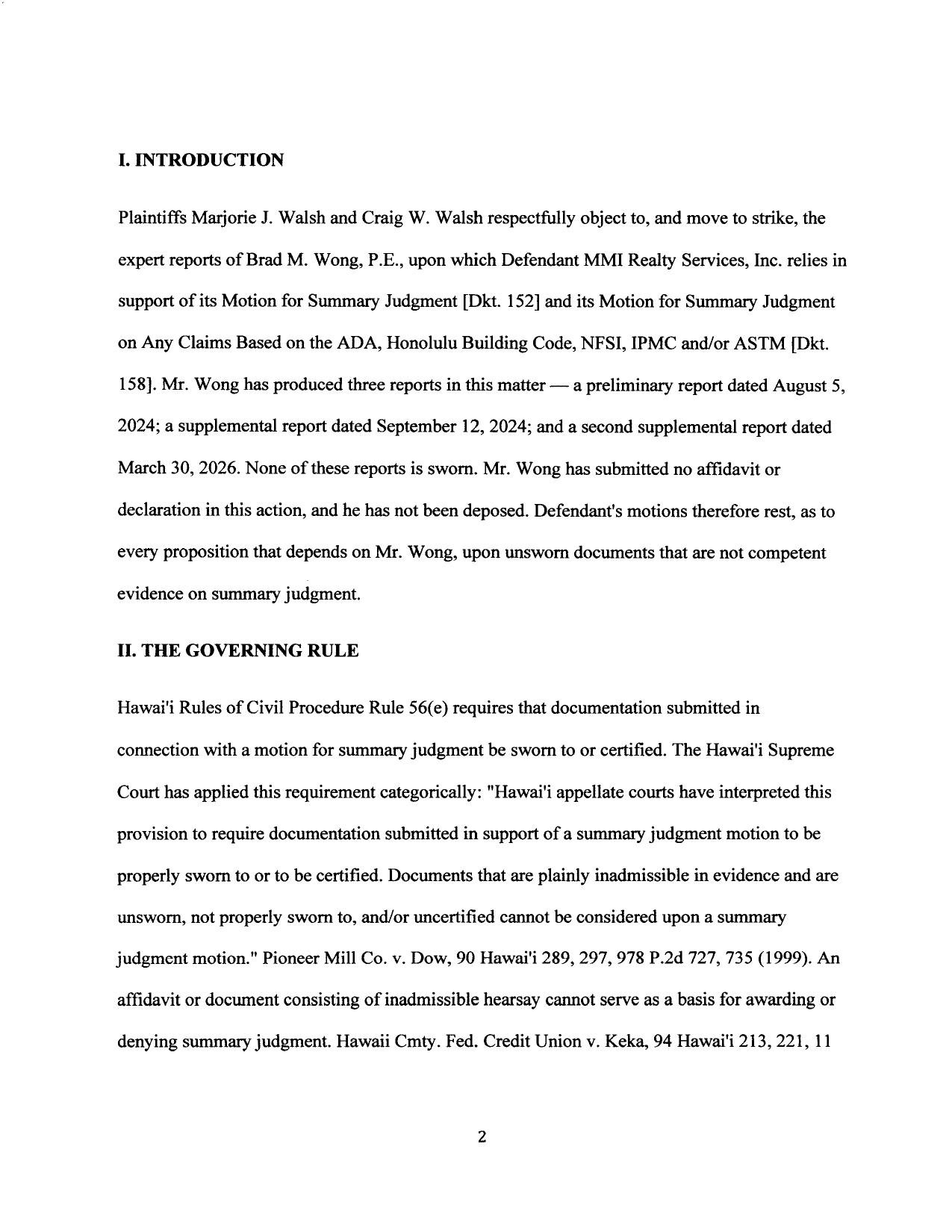
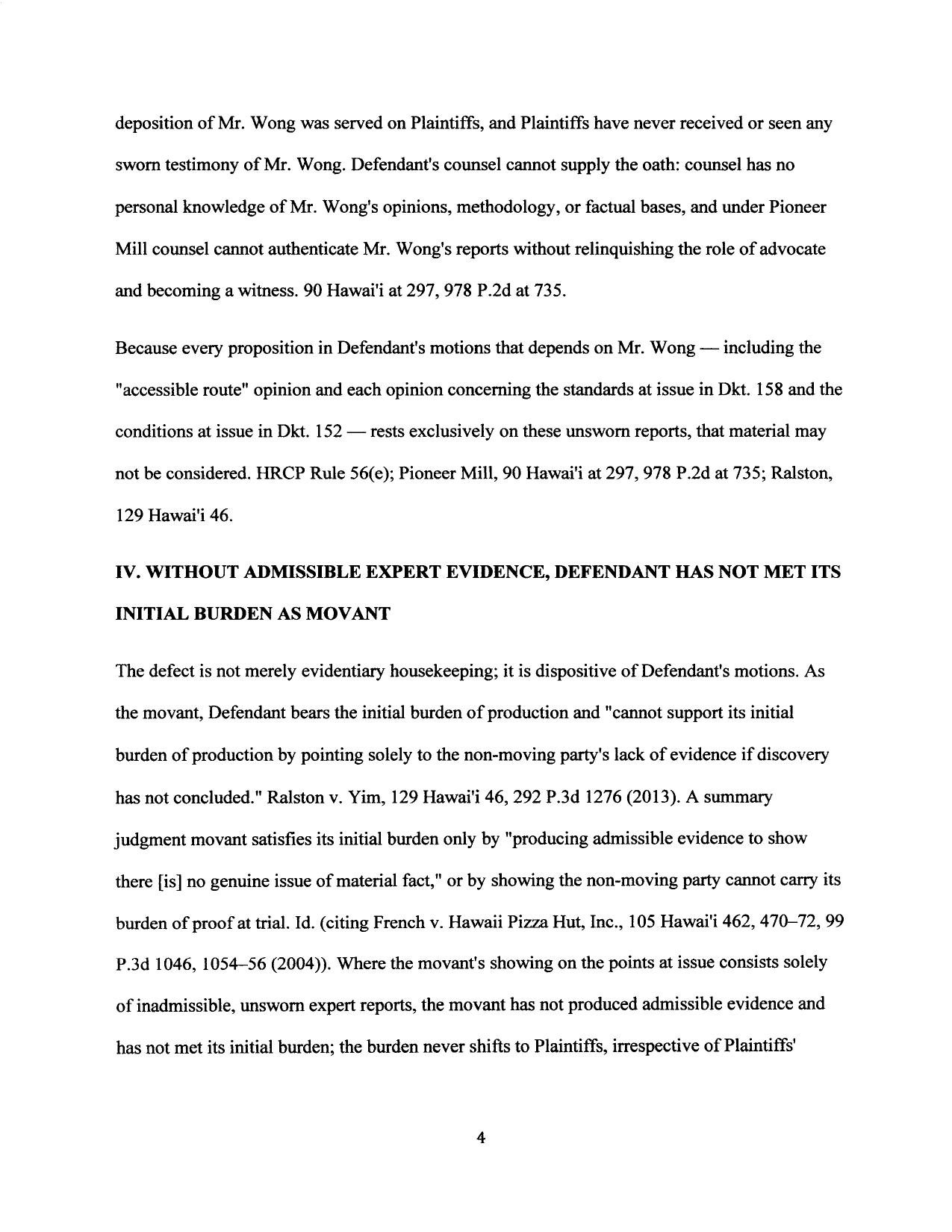
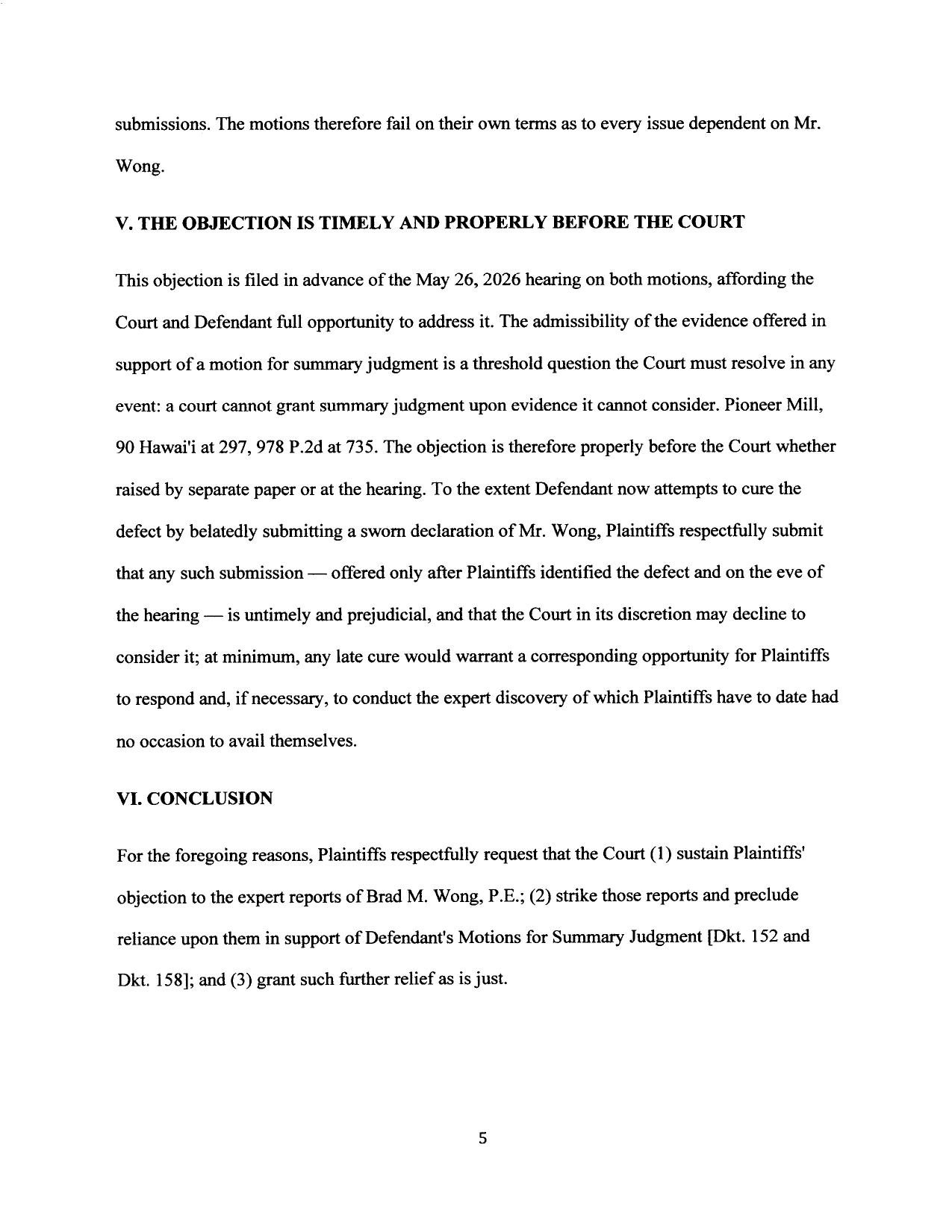
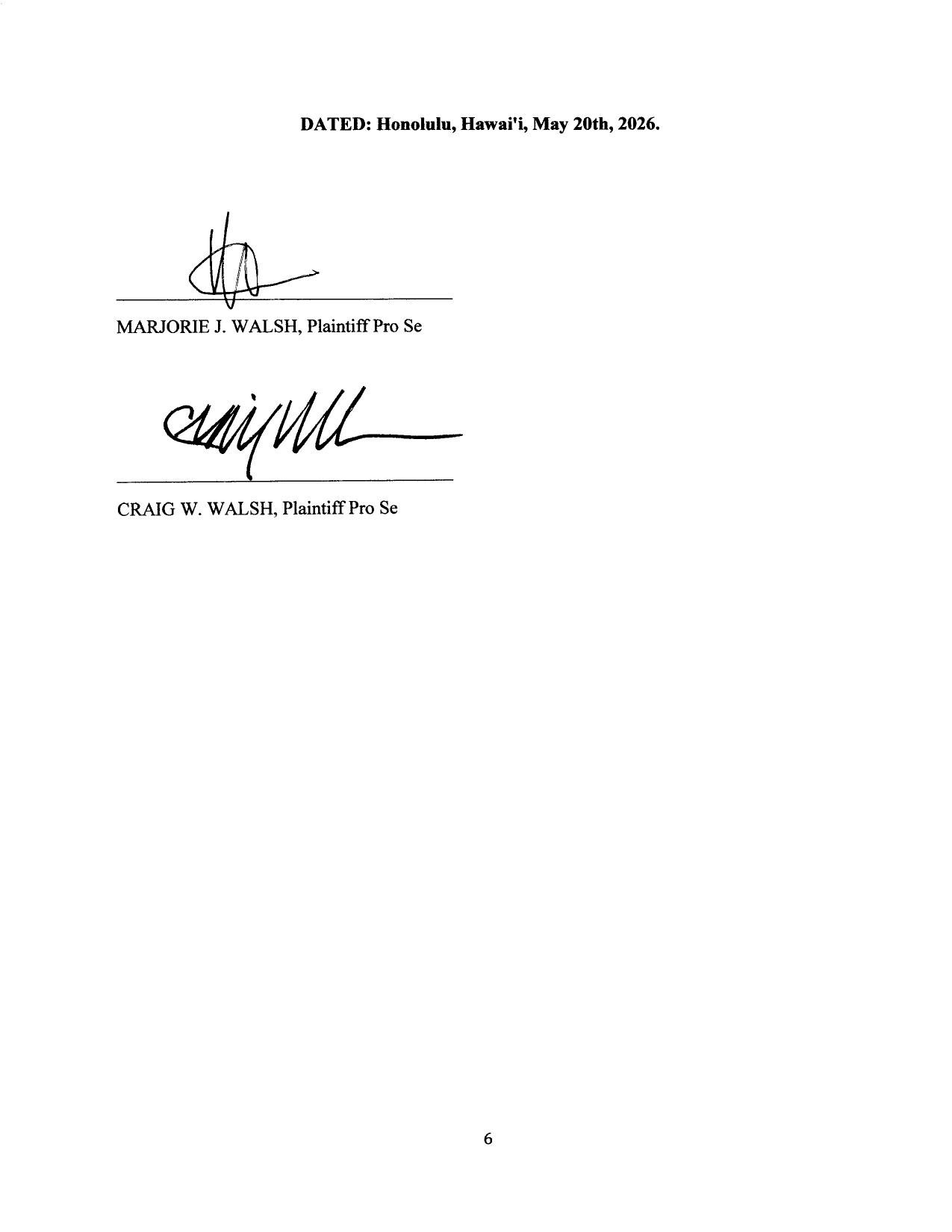
On 19 and 20 May the Walshes filed an objection to evidence and a motion to strike Mr. Wong’s reports. Their ground was simple: none of the three reports was sworn. Mr. Wong had filed no affidavit and no declaration. He had not been deposed — no notice of his deposition had ever been served on them, and they had never seen any sworn testimony from him.
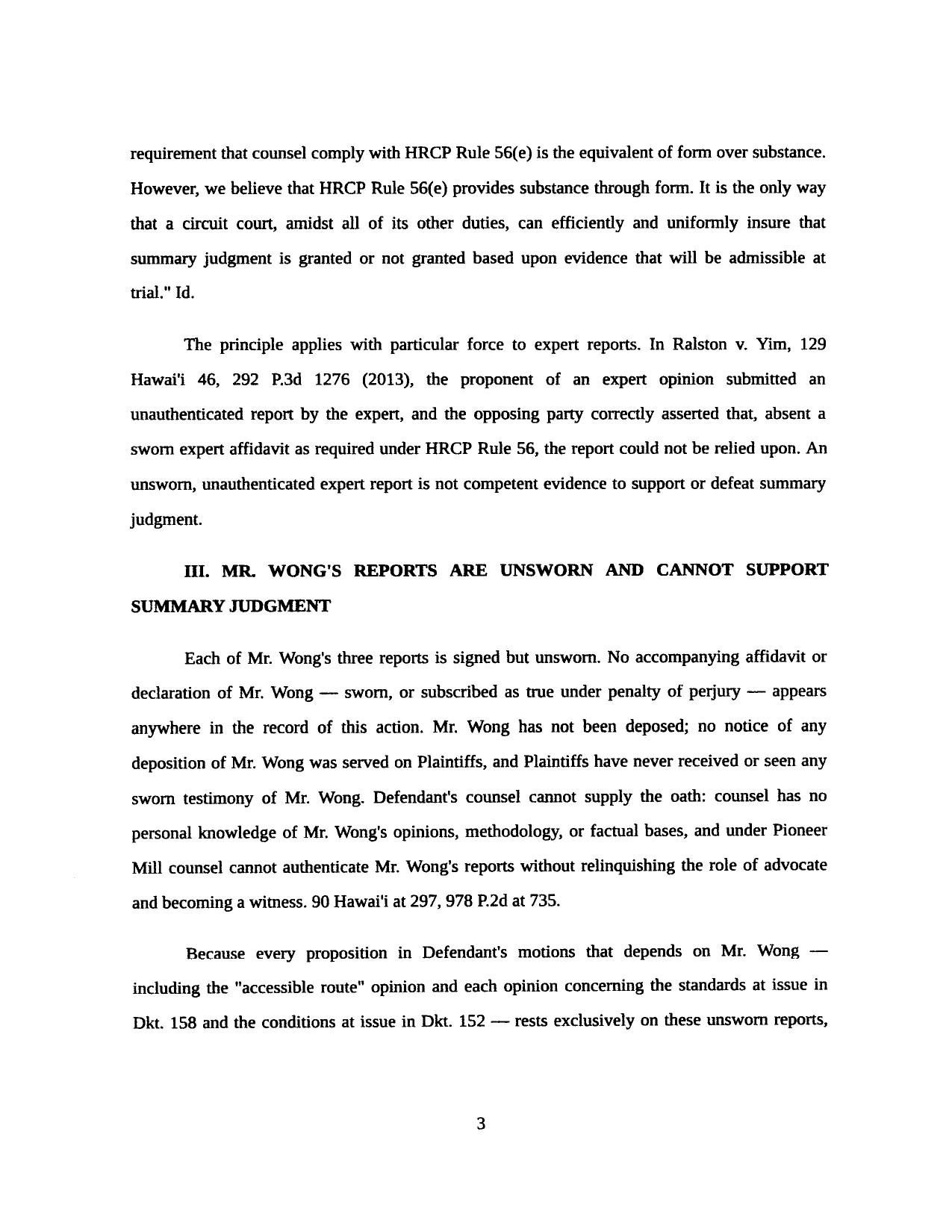
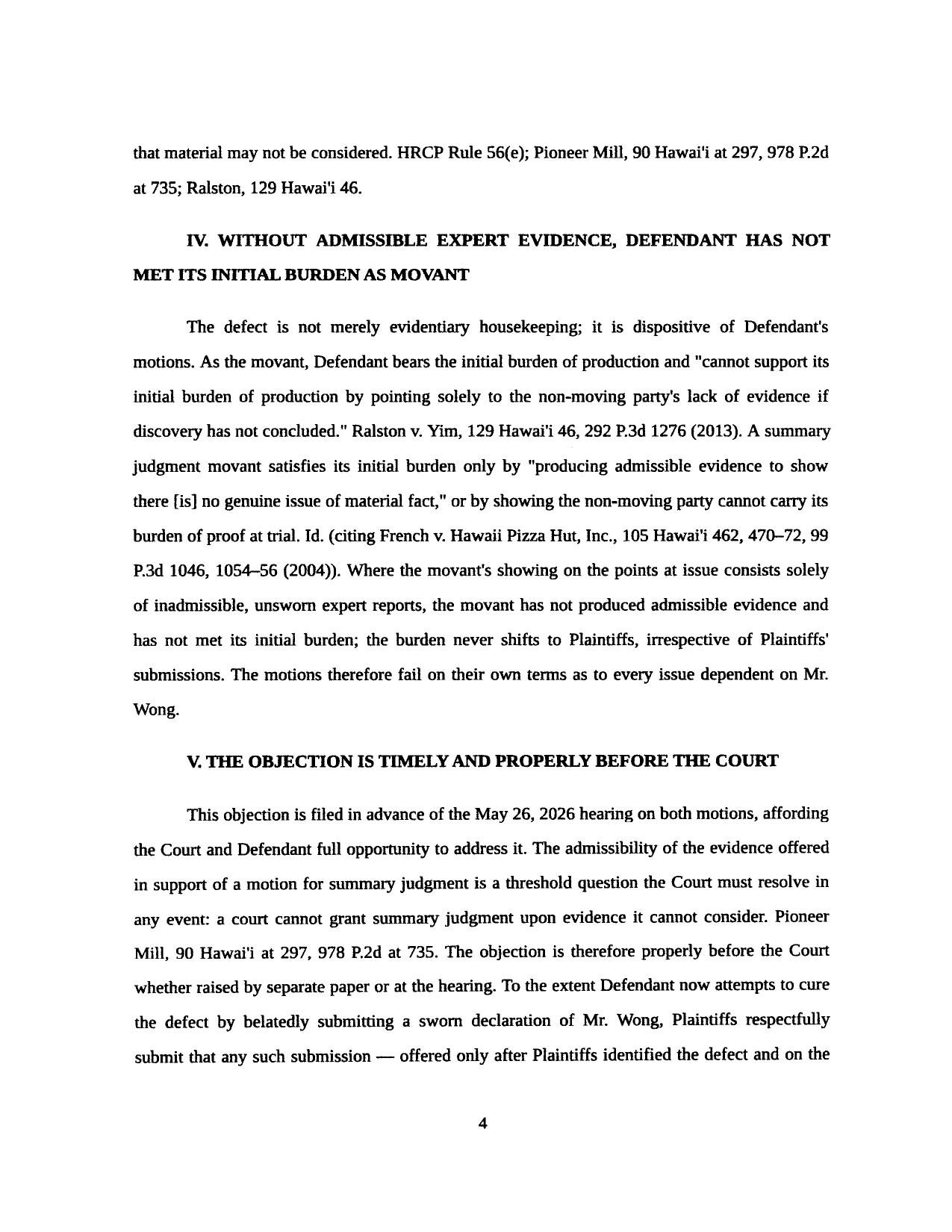
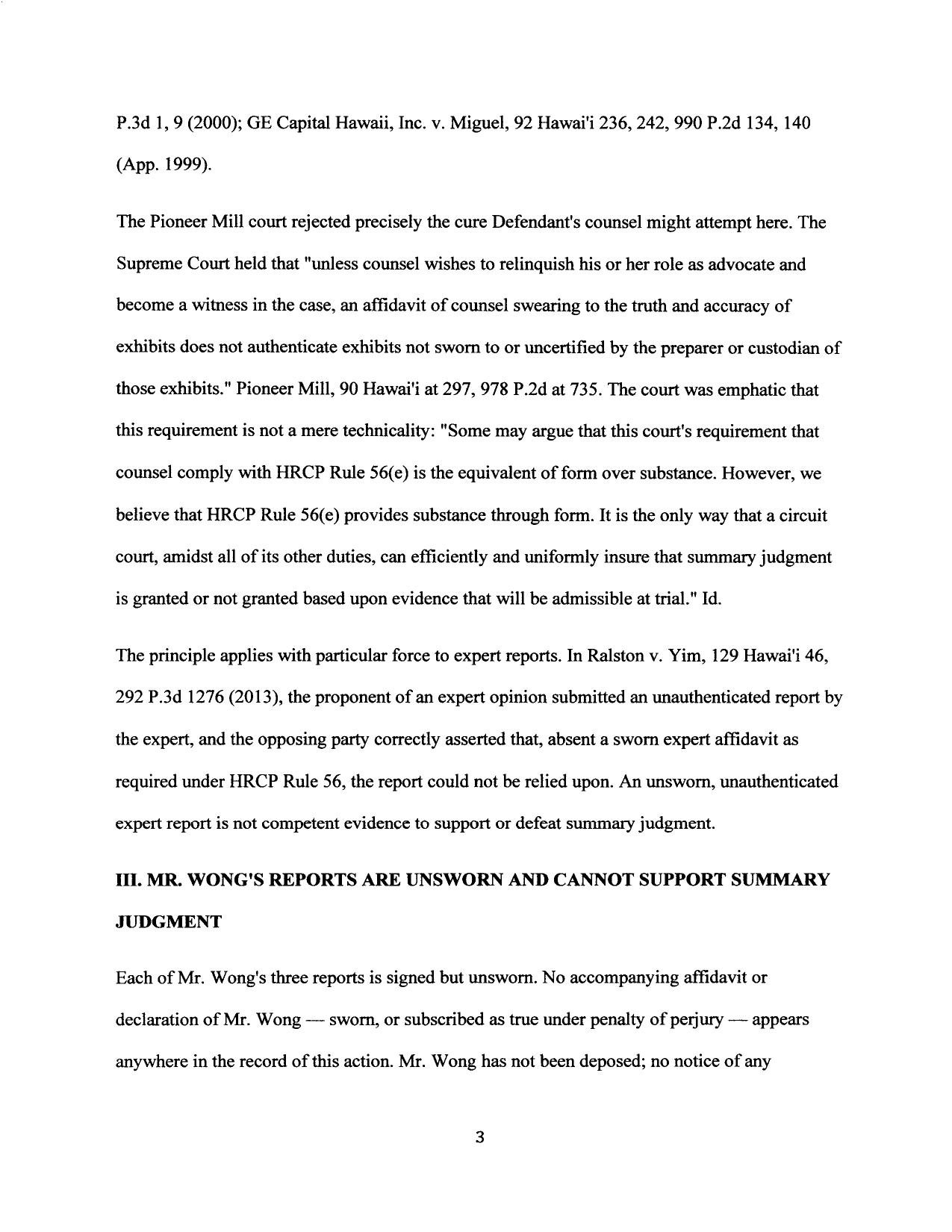
Rule 56(e) of the Hawai‘i Rules of Civil Procedure requires material submitted on summary judgment to be sworn or certified. Pioneer Mill Co. v. Dow, 90 Hawai‘i 289 (1999): documents that are unsworn, not properly sworn to, and/or uncertified cannot be considered upon a summary judgment motion. And, from the same case, on the objection that this is mere form:
we believe that HRCP Rule 56(e) provides substance through form. It is the only way that a circuit court, amidst all of its other duties, can efficiently and uniformly insure that summary judgment is granted or not granted based upon evidence that will be admissible at trial.
In Ralston v. Yim, 129 Hawai‘i 46 (2013), an unauthenticated expert report was held insufficient for exactly this reason.
So the position on 20 May was that every proposition in the defendant’s motions which depended on Mr. Wong depended on documents that were not competent evidence.
On 21 May the defendant filed its reply. Attached to it were two declarations of Brad M. Wong, signed.
The Court set the Walshes’ motion to strike down for its own hearing. After granting summary judgment, it cancelled that hearing by memorandum order on the docket — a note in the file rather than a document. The objection to Mr. Wong’s reports was never argued.
Both motions were heard together on Tuesday 26 May 2026 at nine in the morning, in person before Judge Kawamura. The Walshes appeared pro se. Mr. Kaya appeared for MMI. Trial had been set for 29 June — the trial the Walshes had put themselves at risk on costs and fees to obtain, when they appealed the arbitration award a year earlier.
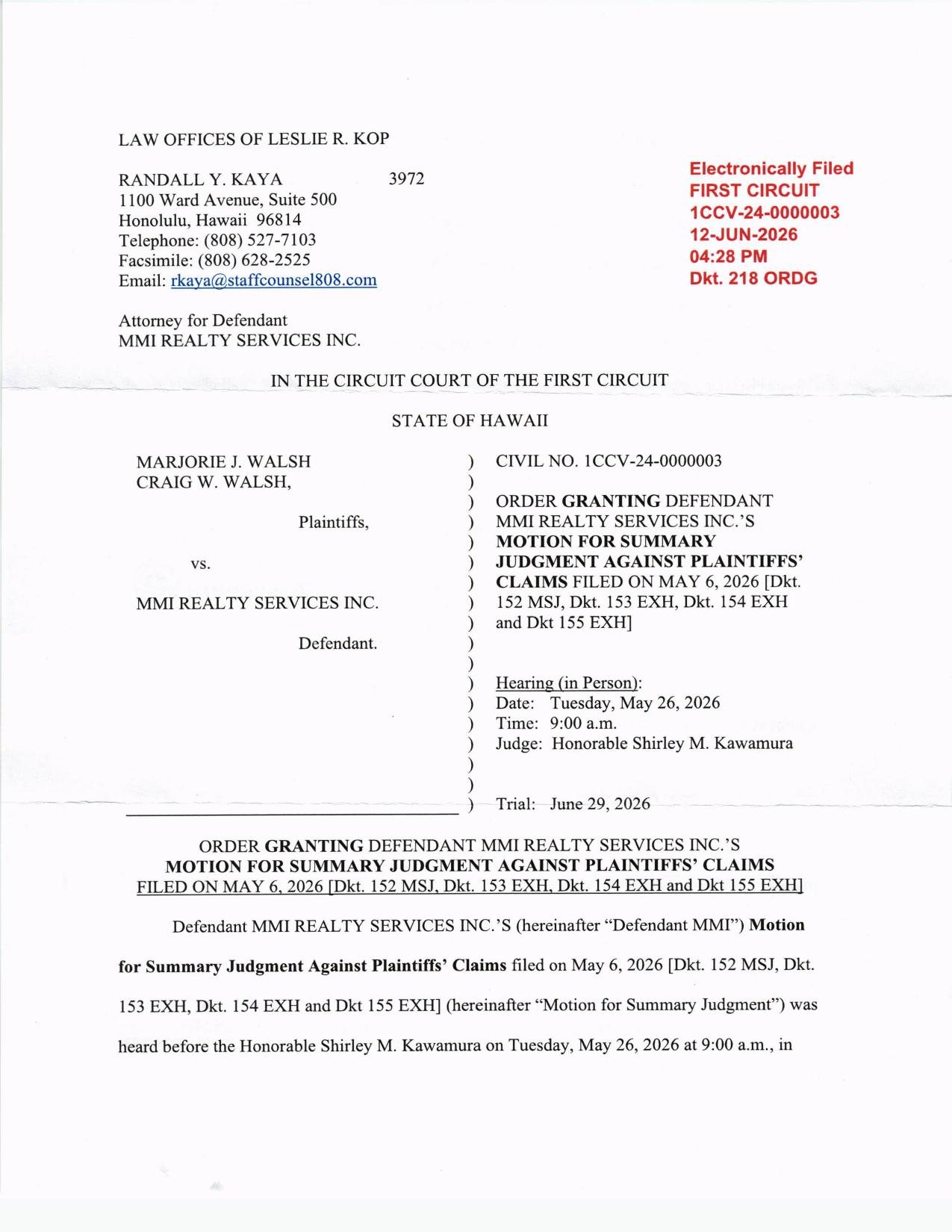
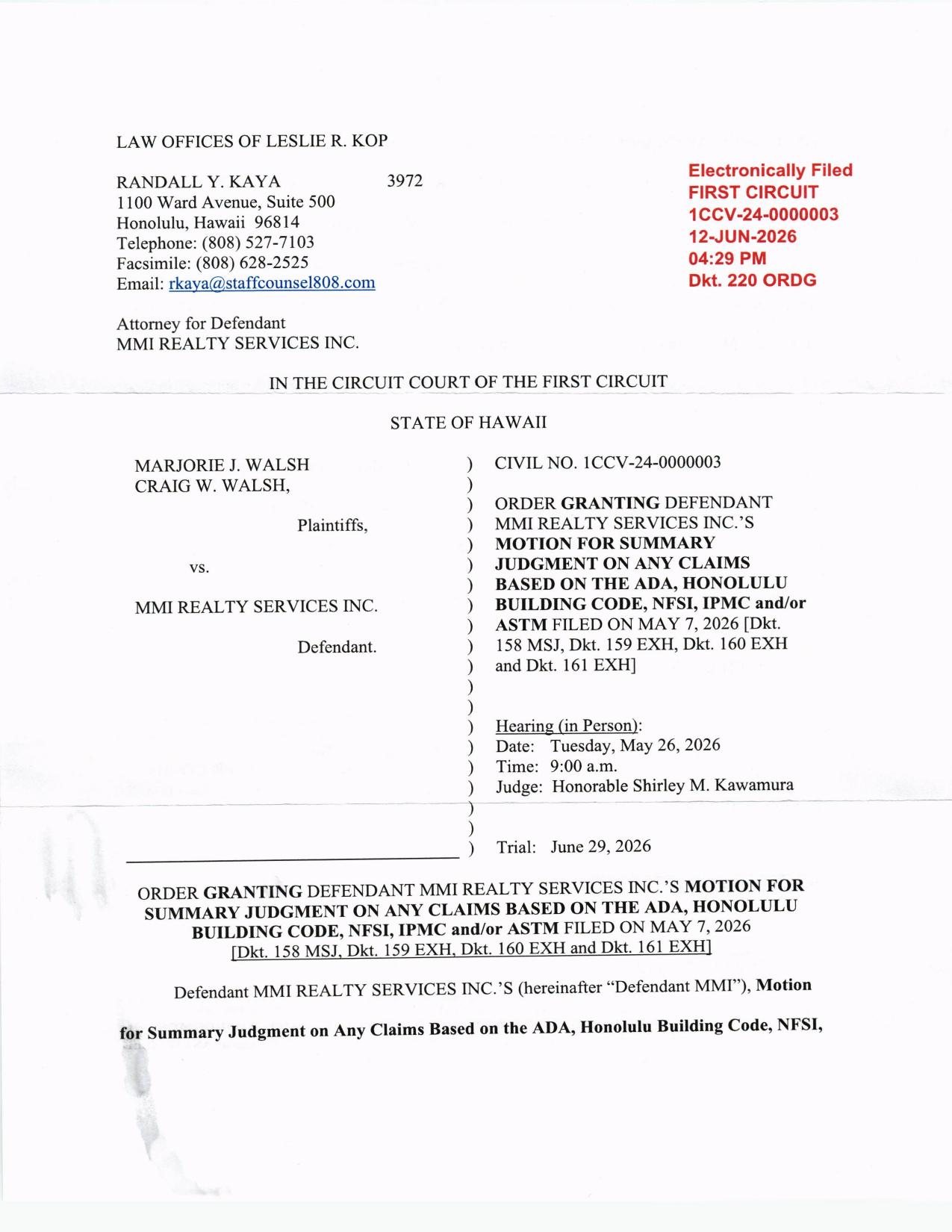
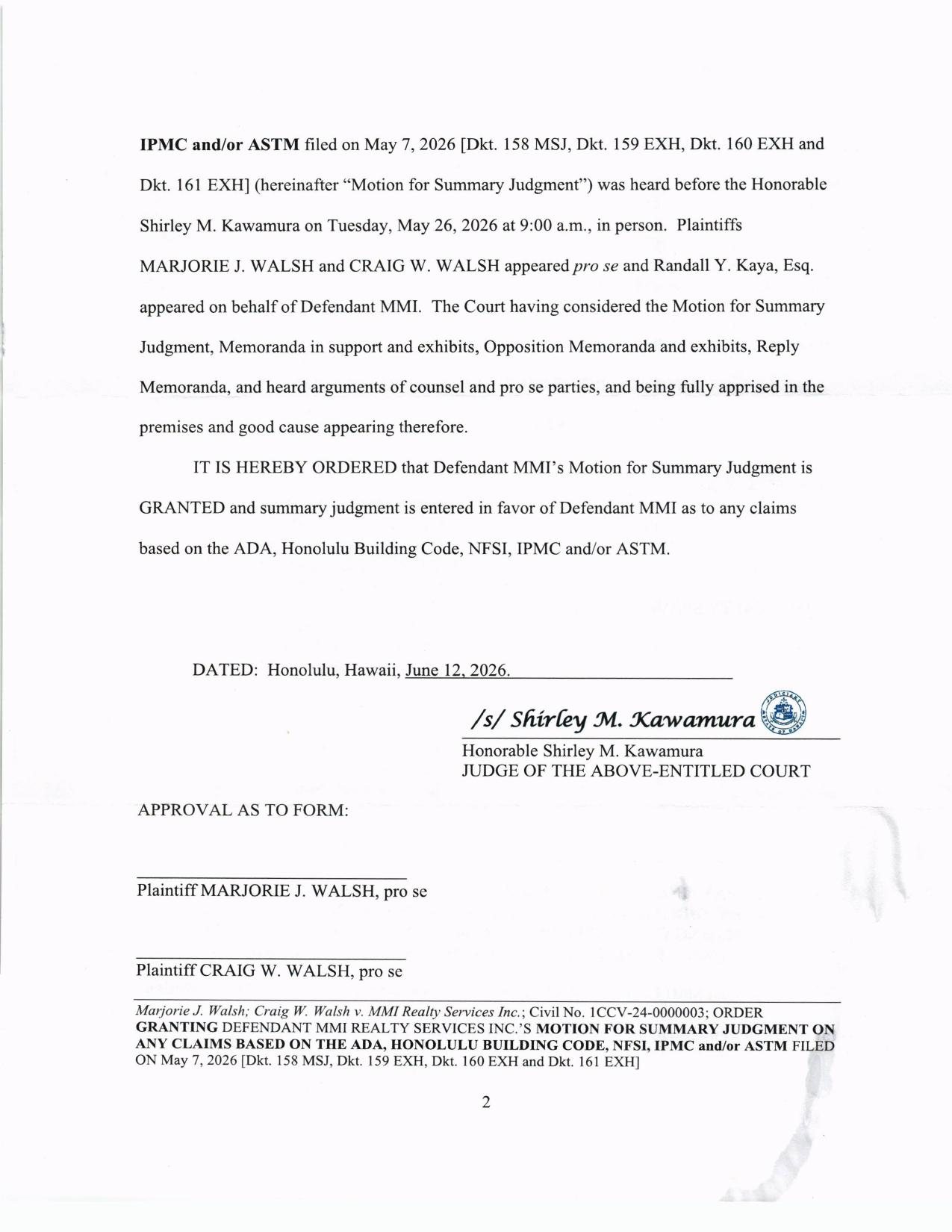
Both motions were granted.
The written orders, drafted by Mr. Kaya and sent to the Walshes for approval as to form on 28 May, say only what such orders say:
The Court having considered the Motion for Summary Judgment, Memoranda in Support and exhibits, Opposition Memoranda and exhibits, Reply Memoranda, and heard arguments of counsel and pro se parties, and being fully apprised in the premises and good cause appearing therefore.
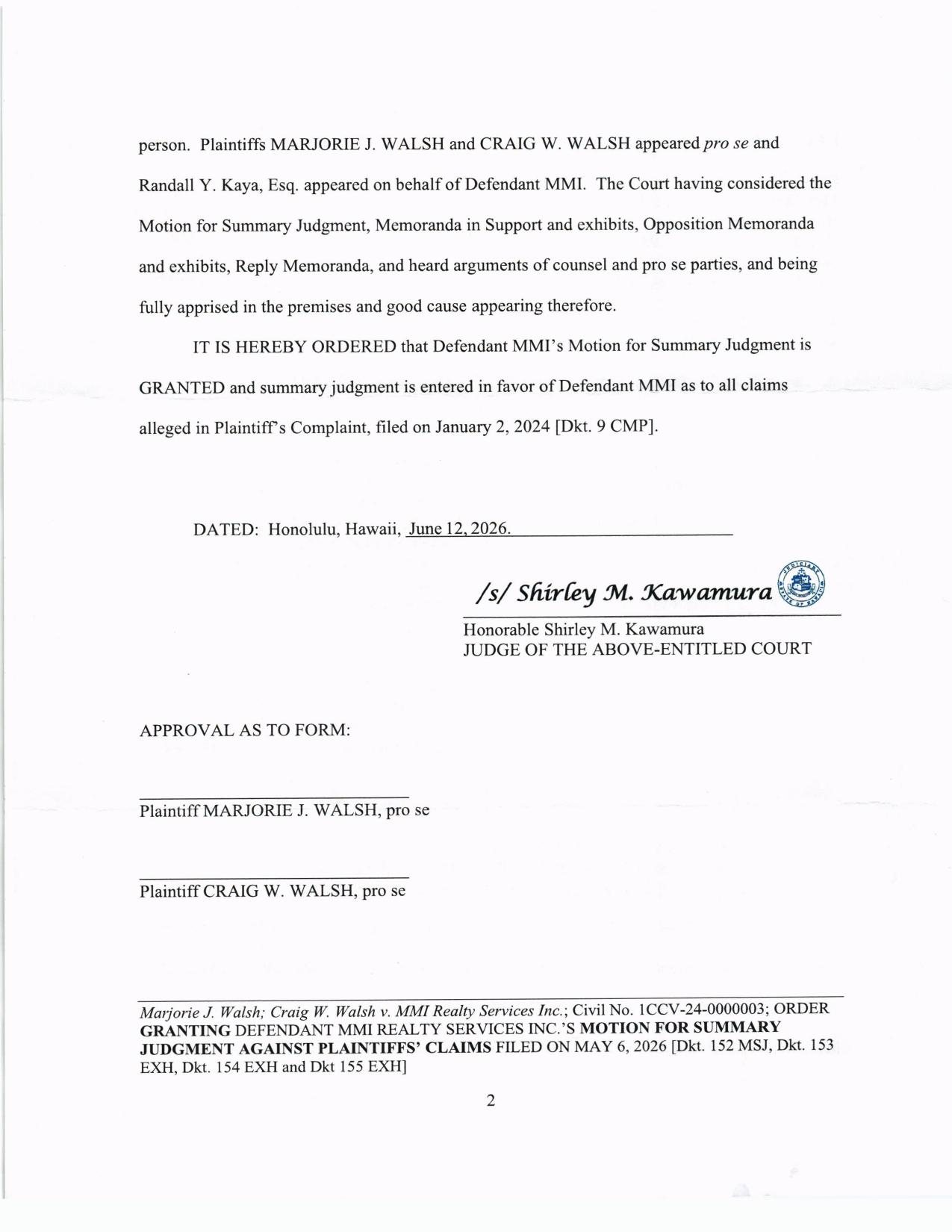
IT IS HEREBY ORDERED that Defendant MMI’s Motion … is GRANTED and summary judgment is entered in favor of Defendant MMI as to all claims alleged in Plaintiff’s Complaint.
There is no reasoning in them. Whatever the Court said, it said from the bench.
There was no trial, and Brad Wong was never cross-examined by anyone.
XVII. The end of it
Seven days after the hearing, on 2 June 2026, Mr. Kaya wrote.
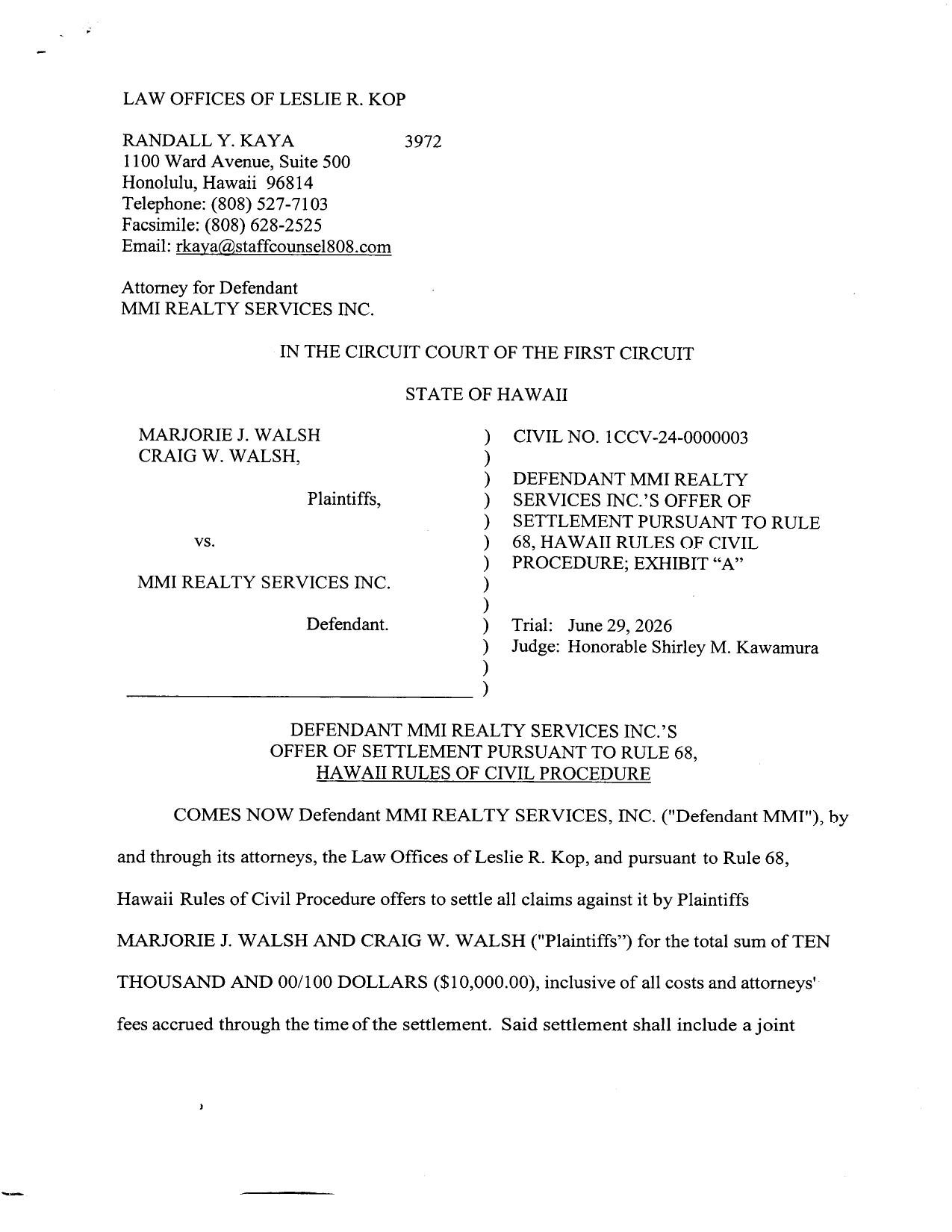
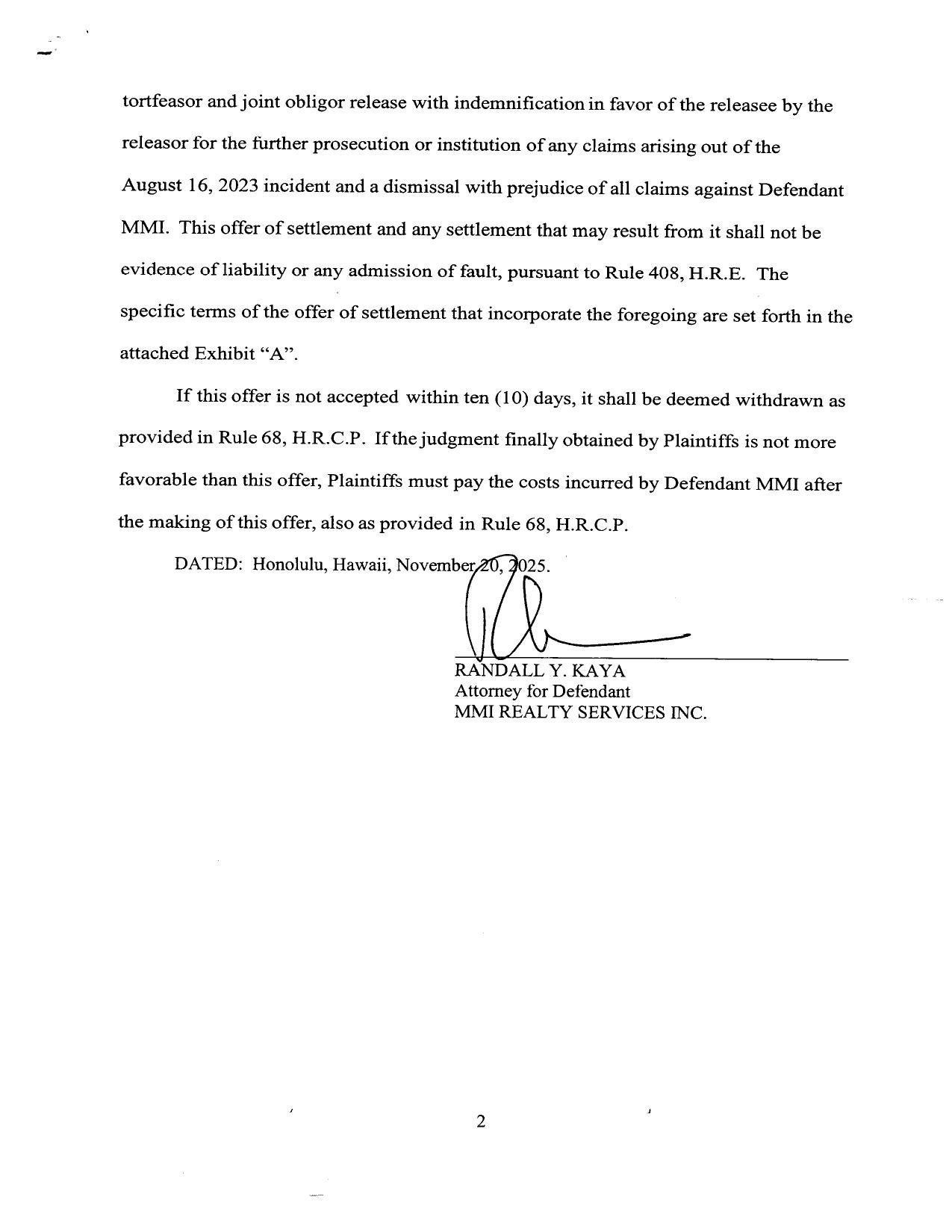
MMI had prevailed on both motions. Before that it had prevailed in arbitration, and the Walshes had appealed. After that appeal, MMI had made an offer of settlement under Rule 68 — the $10,000 offer of 20 November 2025 — which they had not accepted, and which had expired. On those grounds, the letter said, MMI was entitled to its costs and fees.
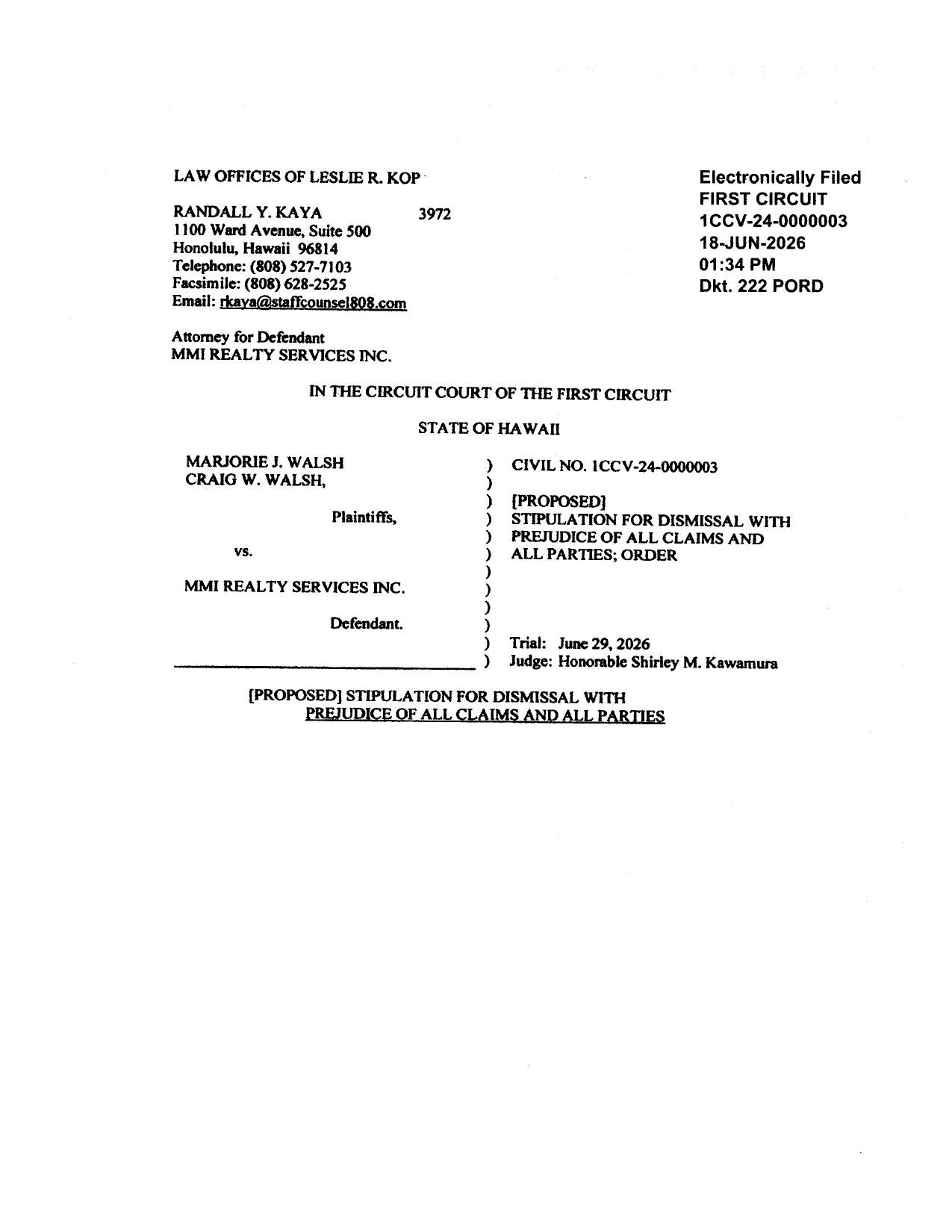
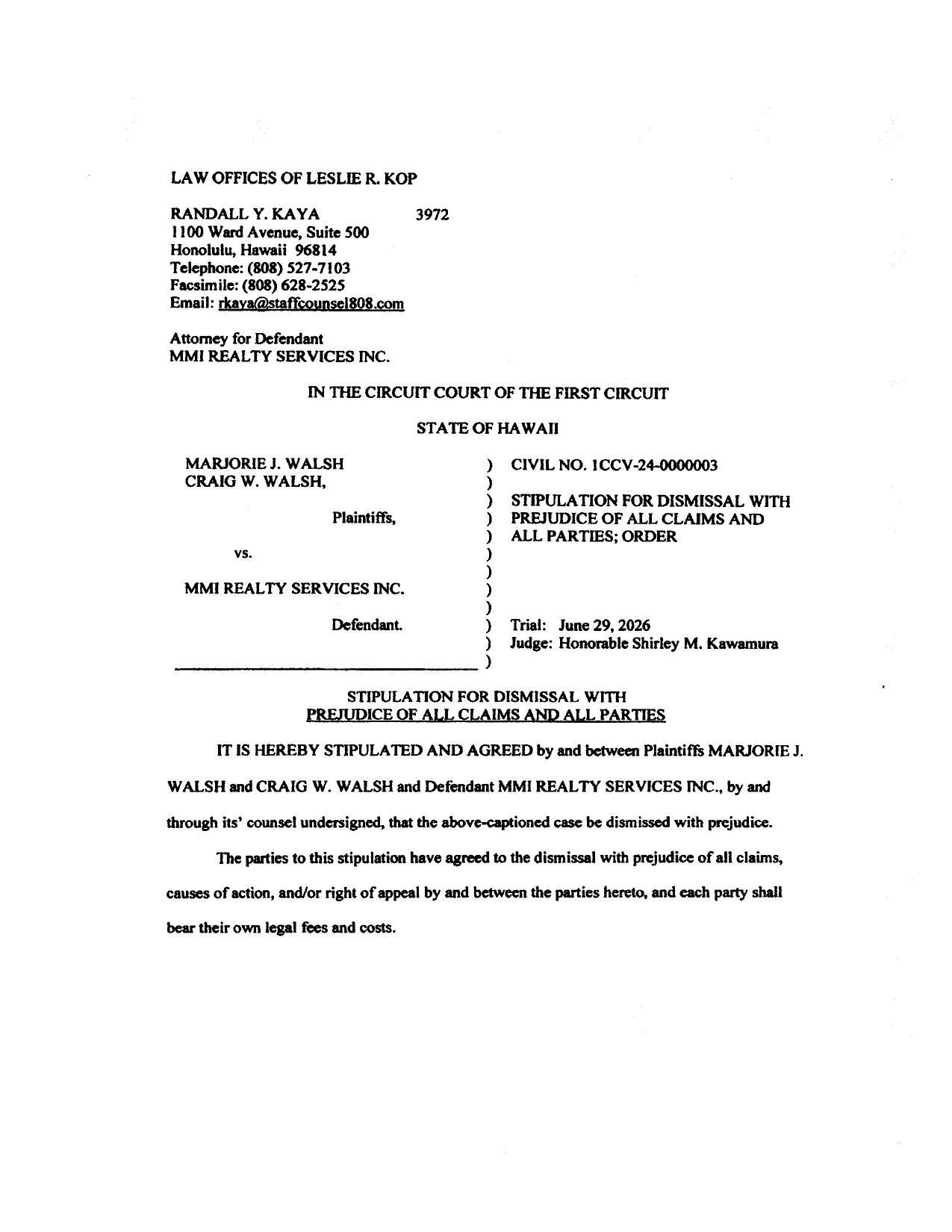
He was preparing a motion for taxation of costs and fees. Before filing it, he had been authorised to offer a stipulation dismissing the case with prejudice, each side bearing its own costs. The Walshes had until 8 June.
And then the figure:
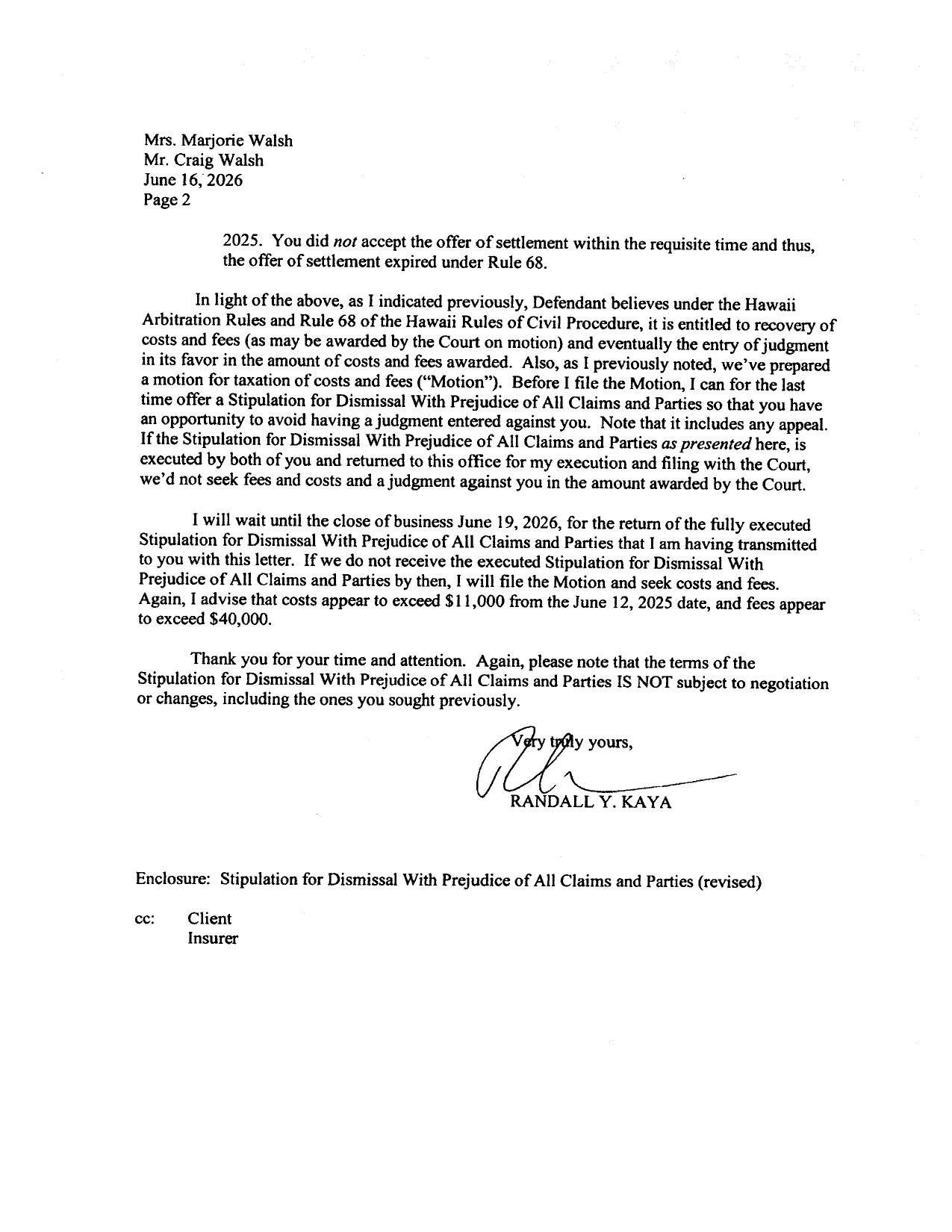
Preliminarily, I’d advise that costs appear to exceed $11,000 from the June 12, 2025 date, and fees appear to exceed $40,000.
Fifty-one thousand dollars, against two retired people who had filed the case on a poverty waiver of a $515 fee.
They signed it the next day, 3 June.
But they asked for one thing in return: that the orders granting summary judgment not be entered, because of their precedential effect. A dismissal by agreement leaves nothing behind. Two entered orders stand on the record.
Mr. Kaya refused, and said the request was objectionable and had never been offered. On learning he would not agree, the Walshes e-filed a stipulation without his signature. He objected. The Court struck it.
On 12 June 2026 the two orders were signed by Judge Kawamura and filed as docket items 218 and 220.
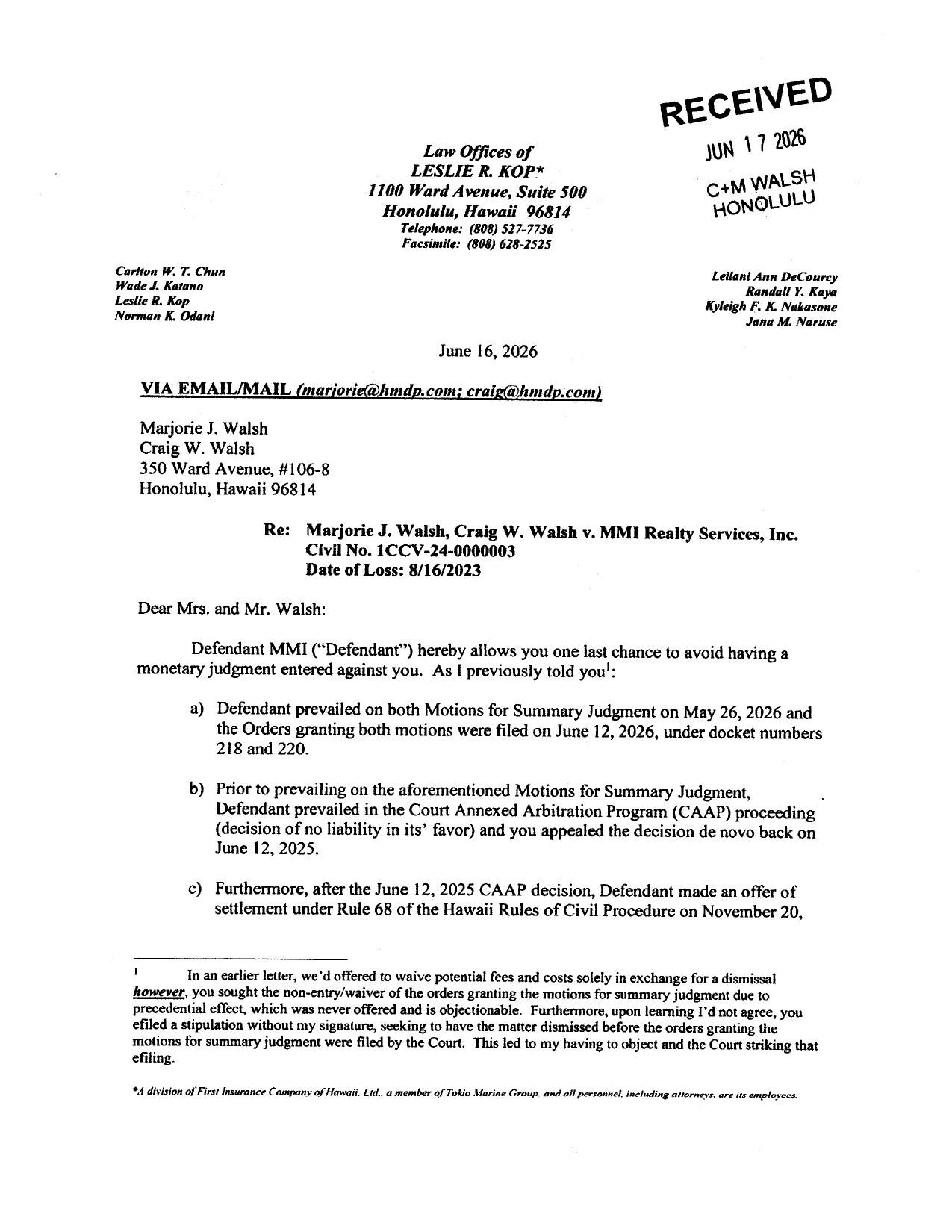
Four days later Mr. Kaya wrote again:
Defendant MMI hereby allows you one last chance to avoid having a monetary judgment entered against you.
The terms had changed. This time the stipulation waived all claims, causes of action, and/or right of appeal. He noted the point himself: Note that it includes any appeal. The deadline was the close of business on 19 June. The figures were repeated: costs over $11,000, fees over $40,000.
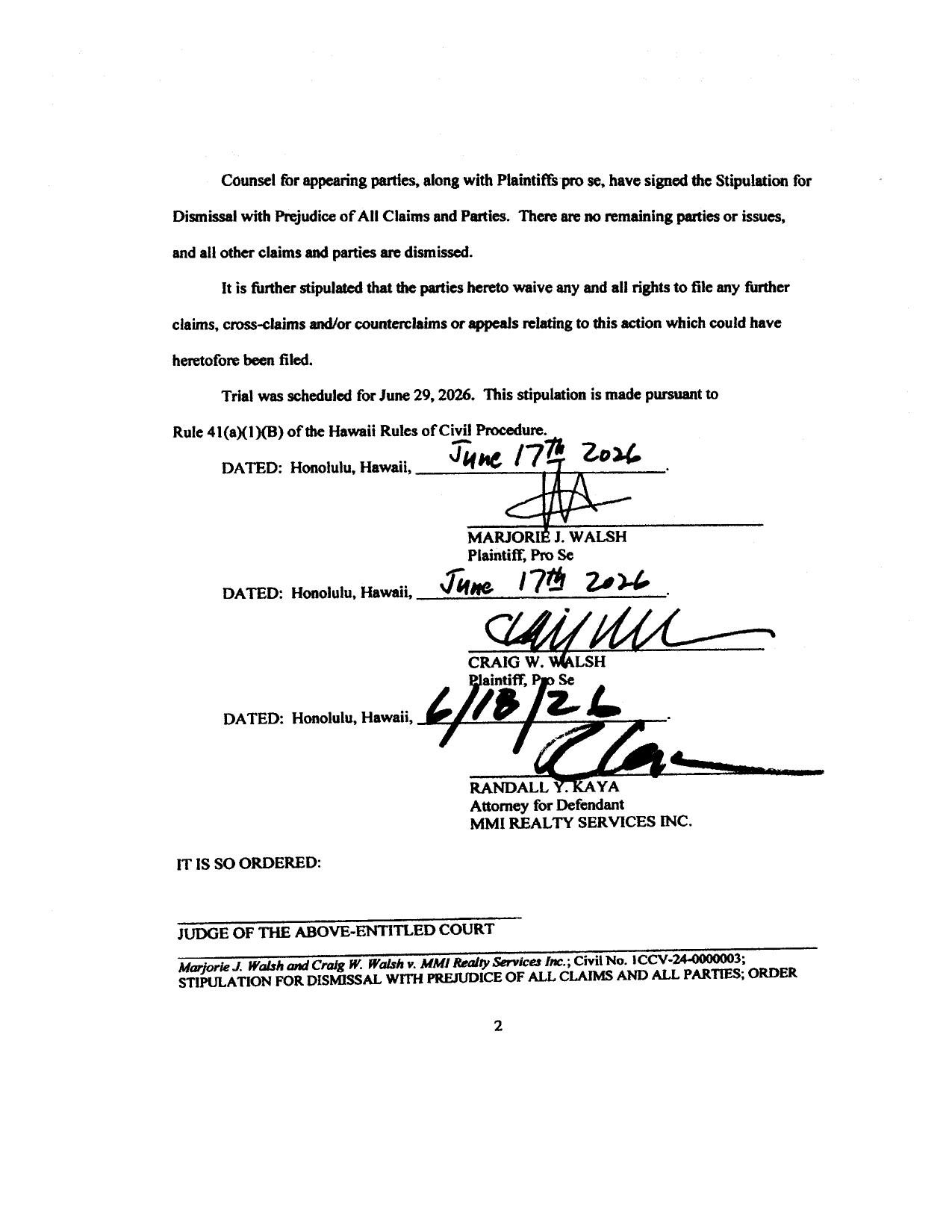
The Walshes signed on 17 June 2026.
They believed the judge had erred and were prepared to appeal. They gave up the appeal, and the claim for costs and fees went away with it.
What they were not asked to give up was anything else. No confidentiality clause. No non-disparagement. No restriction of any kind on what could afterwards be said, written or published about the case.
That is why this file is public, and why none of it has been redacted.
XVIII. Why this is here
The argument that ended this case was that nobody else had ever fallen there.
Two hundred and eighty-eight feet away, eleven years earlier, Mary Jo Romano fell in the same parking lot and broke a bone in her foot. Her case was defended by the same insurer’s lawyers. An expert in that case recorded that a Chili’s employee said others had tripped and fallen in the same general area. The lawyer who represented Chili’s was appointed arbitrator in this one.
There is no register of these things. There is no way for one injured shopper to learn of another. And, as the General Manager’s own testimony established, there was no system inside the mall for gathering that information either — no inspections of its own, no aggregated incident reports, no ADA consultant since 2017, and nothing on the capital list for a drain that, to her knowledge, had nothing wrong with it.
If you have fallen at Kahala Mall, or been injured on that property, this file exists so that the next person does not have to prove a negative alone.
The documents quoted here are reproduced on the pages that follow. Nothing in them has been redacted. The plaintiffs’ names, address and telephone number appear as they appear in the public court record, available through the State of Hawai‘i eCourtKokua system. Not published: Marjorie Walsh’s medical records; the defendant’s insurance policy; the defendant’s contracts with its maintenance and security contractors; and procedural material such as certificates of service and postal receipts.
If you have fallen at Kahala Mall
The argument that ended this case was that nobody else had ever fallen there. If you have been injured on that property, we would like to hear from you — leave a comment below. The next person should not have to prove a negative alone.