There Wasn’t a Problem
Craig W. Walsh and Marjorie J. Walsh v. Malvern Hills District Council & others · Claim No. HC09C00986, High Court of Justice, Chancery Division · 2008–2012 · the story, with the documents behind it
How one neighbour, one councillor and two councils spent four years investigating a dog kennel — and never found anything
On the morning of 10 January 2008, fourteen people came up a gravel track in Powick, Worcestershire, and went into a house whose owners were forty miles away.
Nine officers of two councils, two private computer forensics contractors, an RSPCA inspector and a couple of policemen. They had a warrant sworn out before a magistrate twelve days earlier. Among them were Malvern Hills District Council’s streets scene manager and its car parks officer.
Craig Walsh had broken his back some years before and was classified as totally disabled. He walked with a stick, was in more or less constant pain and seldom left the house; his wife Marjorie ran the business. That morning the two of them had driven a dog home to its owner in Somerset — a job normally done by Marjorie alone, or by a member of staff — and had gone on to Bath for the day. It was the first time in a long while that both of them had been off the property. Their solicitor would later note the coincidence drily.
Six people went into the house. They searched the rooms, went through the papers on Craig’s desk, imaged his hard drive, took papers off the kitchen table, searched the bedrooms and searched the attic, leaving the hatch ajar behind them. They shut the Walshes’ bull terrier, Tapa, in a back bedroom and left him there all day. By the time the owners got home he was distressed and dehydrated.
They carried three things away: an invoice waiting to go to a dog’s owner; two pages of fake test data from an abandoned software trial; and seven pages out of a bin, which their own side would later describe as “soiled, stuck together and largely totally illegible.”
And a copy of everything on a disabled man’s computer.
Twenty-two months earlier, the officer who obtained that warrant had already investigated every complaint against the Walshes and put it in writing that there was nothing wrong.
I. “There wasn’t a problem”
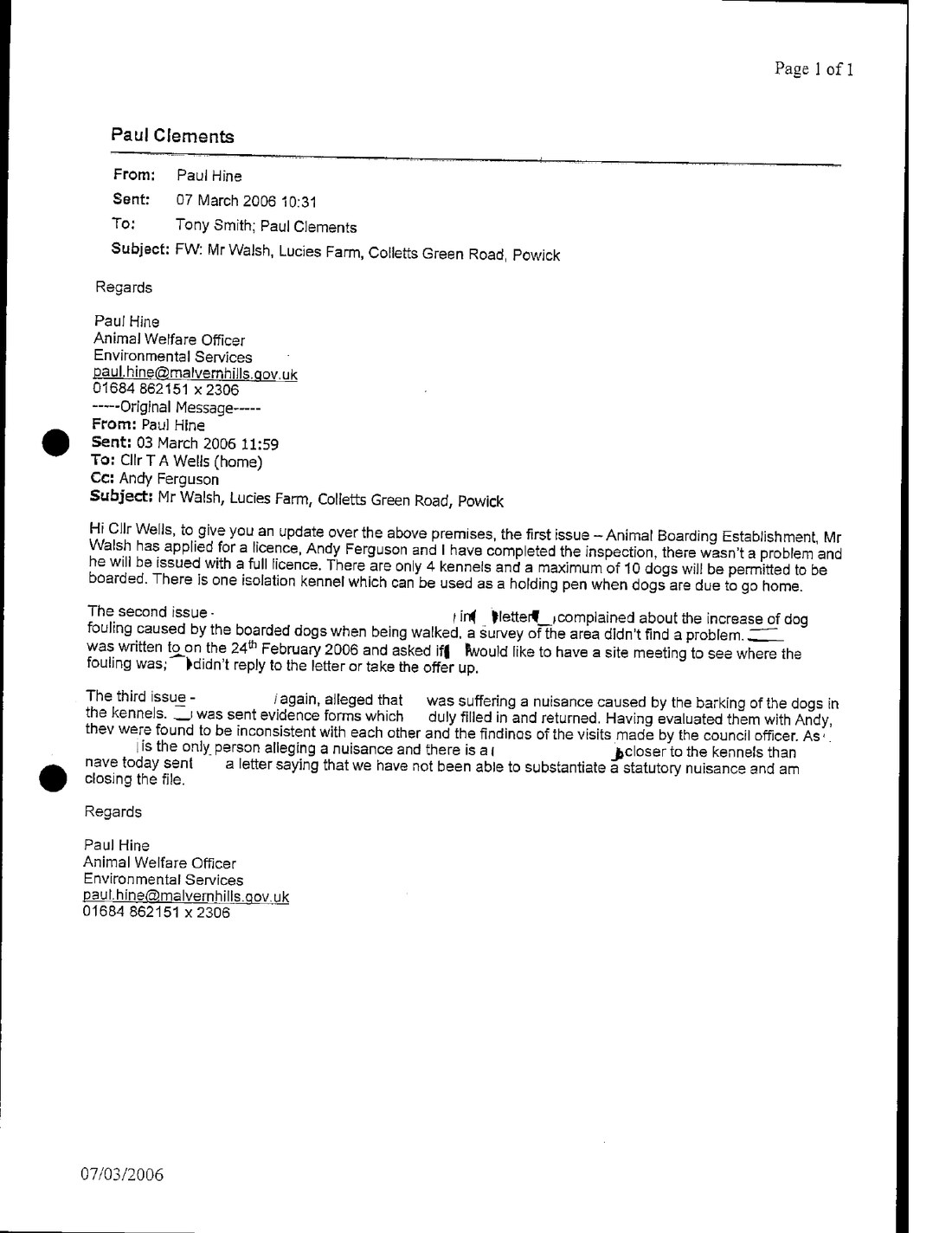
On 3 March 2006, Paul Hine, Animal Welfare Officer at Malvern Hills District Council, emailed a county councillor at his personal e-mail address about Mr Walsh of Lucies Farm.
On the boarding licence: “Andy Ferguson and I have completed the inspection, there wasn’t a problem and he will be issued with a full licence.”
On dog fouling: “a survey of the area didn’t find a problem.” The complainant had been offered a site meeting to show the officers where it was, and “didn’t reply to the letter or take the offer up.”
And on noise, which would consume the next four years:
“was sent evidence forms which duly filled in and returned. Having evaluated them with Andy, they were found to be inconsistent with each other and the findings of the visits made by the council officer. As is the only person alleging a nuisance and there is a closer to the kennels than, have today sent a letter saying that we have not been able to substantiate a statutory nuisance and am closing the file.”
The names are redacted in the copy the council later disclosed. The findings are not: she was the only person complaining, her own evidence contradicted itself, and a household nearer the kennels than hers was saying nothing at all.
The file was closed. Then it was opened again.
II. Whitecroft
Craig and Marjorie Walsh bought Whitecroft, at 23 Colletts Green Road, in 1989. They had built Transax PLC, a cheque-guarantee business in Birmingham and the leader in its sector, and sold it to Equifax.
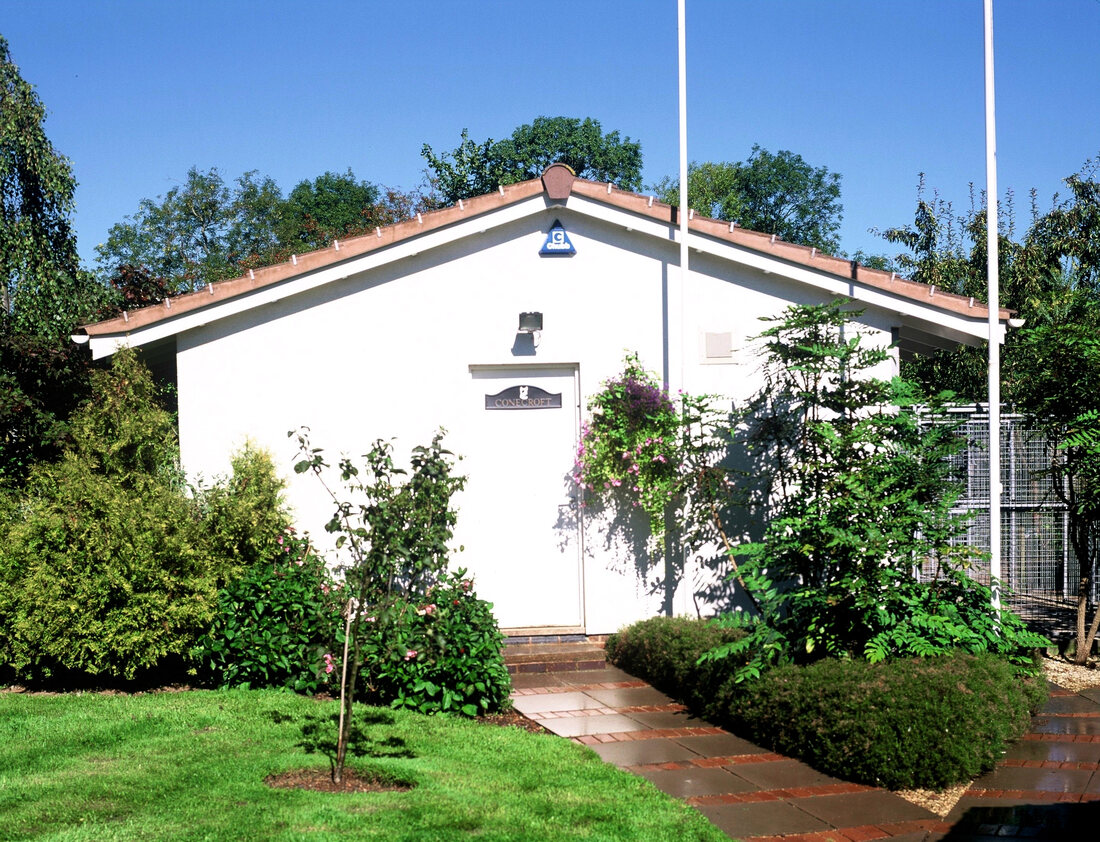
Some of the money went on a kennel for their own dogs, because the Walshes travelled constantly and hated leaving them. They did not buy a prefabricated kennel. They commissioned Gates Hafen Cochrane of Boulder, Colorado — a practice that designed veterinary buildings and very little else — who supplied the ideas, among them reinforced concrete cubbies with individually adjustable underfloor heating. Work in England needed a British architect, so Robert Lett, of Lett + Sweetland in Worcester, turned those ideas into a building that would stand up in Worcestershire. In 1997 Spicers (Builders) Ltd built it under a contract for £31,446. Five hundred square feet. Double-skin masonry, tiled roof, concrete floors, double glazing throughout, glass blocks along the east wall so the dogs got the morning sun. One of the things the architects had been asked to think about was the minimisation of noise.
When it was built, the Walshes had no plans to use it commercially. Their business was Lucies Farm Limited, which raised pedigree Highland cattle, Aberdeen Angus, Berkshire and Tamworth pigs, wild boar, chickens and ducks — producing Kobe-style beef, Kurobuta pork and eggs, with farm hands to look after the animals. It was an agricultural business, and the kennel was where their own dogs slept.
When the Walshes went to Hawaii for four years the dogs stayed behind in the kennel and the house stood empty, and the neighbours grew used to their being away.
When they came home the dogs moved indoors and the kennel stood idle. Craig thought about turning it into a home cinema. Then he had what he calls the silly thought — that other people might like their dogs spoiled too, and that the more it cost, the more exclusive it would feel.
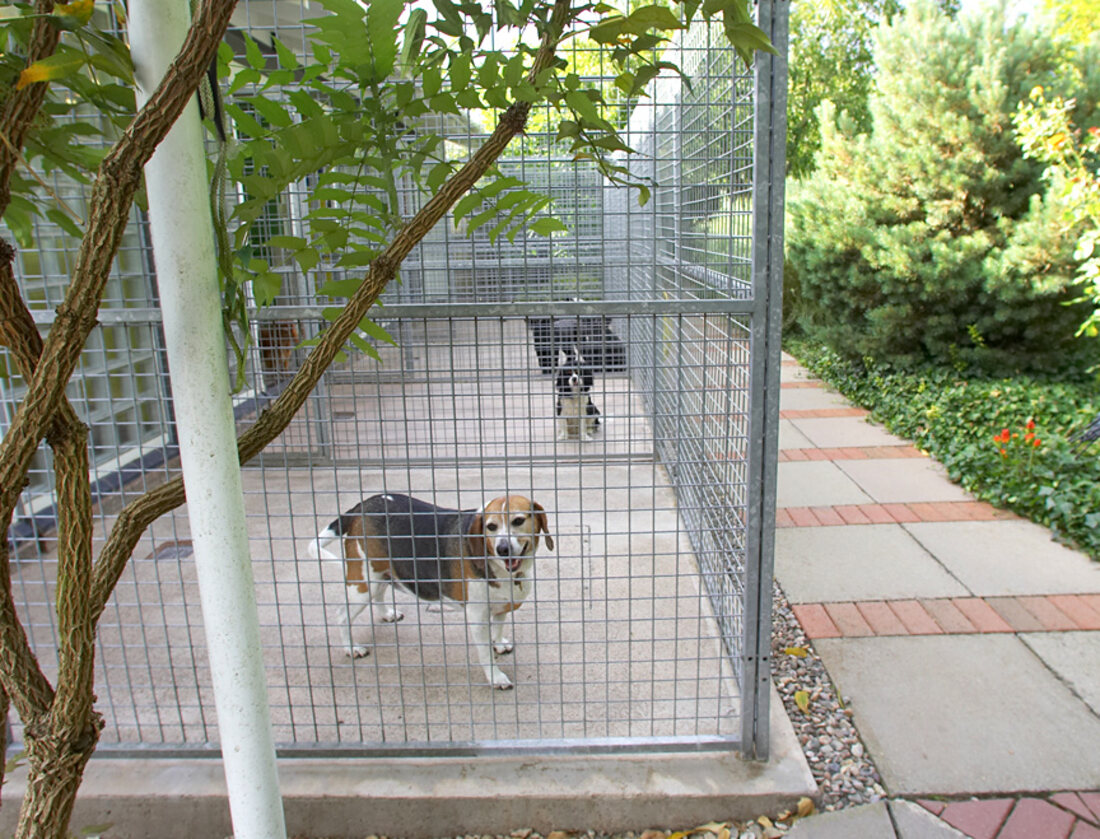
In the late summer of 2004, Lucies Farm opened as a dog hotel. Four suites, later six, and Sony pan-tilt-zoom cameras clients could operate from anywhere in the world — good enough, at full zoom, to fill the screen with a dog’s eye. One client boarded his two black Labradors and then chose a Caribbean cruise because the ship had a business centre from which he could watch them; when the ship’s internet failed he made the cruise line fly an engineer out from Miami. By the last season a suite cost £50 a night for one dog and £65 for two.
The clientele were, in Craig’s description, “wealthy people, for the most part, but not wealthy enough to build their own kennel block.” Every dog was exercised three hours a day, most of them driven to the woodland the Walshes owned. “They would run and run,” Craig says. “Tired dogs don’t bark.”
None of what follows ever stopped any of this. The hotel went on being a hotel throughout — and at one point Channel 5’s national evening news came out to Worcestershire, and its reporter booked his own dog in for the night.
Two facts matter, because the councils never grasped either.
Marjorie ran it. The Walshes’ pleaded case put it beyond doubt: “The business is run by and under the direction of Mrs Walsh, who rises at 6.00 am and finishes, most days, at about 10.00 pm.” Her office was in the tack room of the stable, kept deliberately out of the house. Craig “has virtually nothing to do with the running of the business. He cannot.”
And the records were not in the house. They were not on any computer at Lucies Farm. The booking system was RezEasy — hotel software, not kennel software — and it ran on a managed server in Newark, Delaware. Nothing was installed on the farm. The machine in the stable tack room was an HP thin client — no hard disk in it at all, a keyboard and a screen pointed at Delaware — twenty yards from where the search party would one day be standing. It had been an ordinary workstation once. It stopped being one when the farm hands kept filling it with pornography, and Craig’s answer was to take the disk out of the building. The farm’s email was archived daily to data centres in Vancouver and Toronto, and the Walshes were registered as data controllers, registration Z1289187, on a registration that declared on its face that data went to the United States.
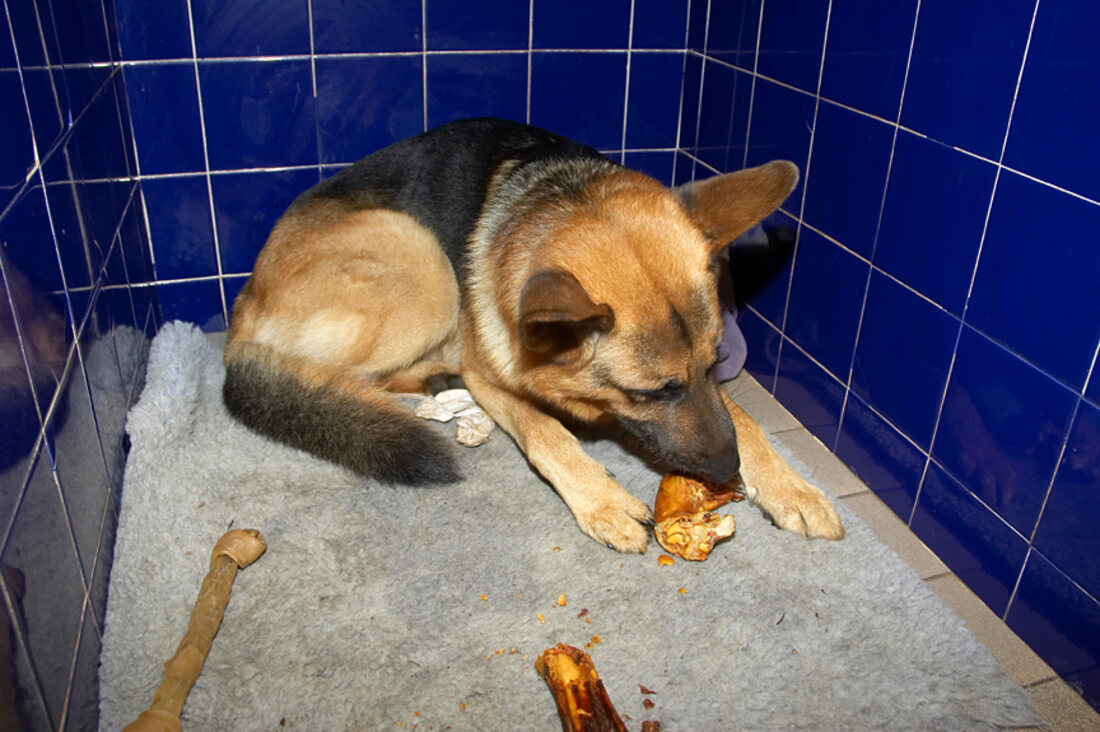
Every night at about half past eight, Marjorie did the cookie run: round the suites, a biscuit each, the doors to the outside runs shut. After that the dogs were inside a sealed building until morning.
III. The Cider Mill
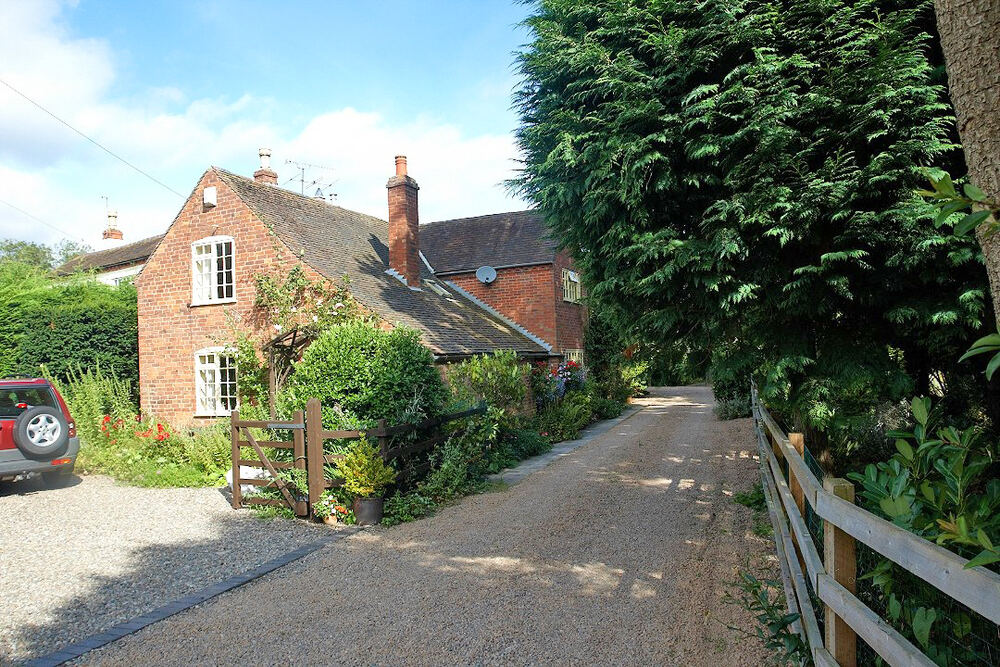
The Cider Mill stood next door, its front door opening onto the gravel track. Harry and Patricia Godwin had lived there since 1986, three years longer than the Walshes had been at Whitecroft.
The track belonged to the Walshes. Establishing that had not been simple: there were no deeds saying who owned it, and Christopher Jessel of Farrer & Co, the author of the standard textbook on the law of the manor, had to construct the title out of the waste of the manor, document by document, until the Land Registry accepted it.
It is also a registered public footpath. The Walshes owned the soil; the public had a right of way over it to pass and repass, and no right to park on it, or to loiter on it, or to use it for anything but passage.
The Walshes never disputed the right to pass and repass. Andy Ferguson of the council once told Craig he could have a picnic on the track if he wanted to. Craig suggested he put that to the council’s legal department. He never had a picnic.
It began over a parking space.
Where the track widens, past the grassy patch with the oak tree, the Godwins parked two cars. The Walshes were perfectly happy about it. Then dog hotel clients and delivery vans began stopping in what she had come to regard as her space, and she was not happy at all. The Walshes started asking visitors not to park there — to buzz the gate instead and drive down to the house.
She appears never to have understood that she had no right to park there in the first place. At one point her solicitor sent the conveyancing documents to the Walshes’ solicitors to prove the right. They proved no such thing. What she had was what every walker on that footpath had, which was to pass and repass, and Craig by then had said the phrase so often it was tattooed on his brain.
The grassy patch with the oak had once been a pond, filled in — they think — in the 1950s, when Whitecroft was built. It belonged to the Walshes, and the Godwins had made a garden on it: pretty, planted, and on the far side of the track from their own front door. The Walshes offered to lease it to them for £1 a year, on an undertaking that they would raise any problem about the kennel directly with the Walshes before going to the council.
It was a good offer. A long lease on that garden would have added considerably to the value of their house.
They refused it. About a week before their solicitors’ letter arrived, they removed their chimney-pot planters themselves. Then they dug up their own front lawn to park on, and took more lawn on the other side of the house for a garage so small they had trouble opening the car door once the car was in it.
Harry Godwin was a retired cattle feed salesman, and did not seem an unreasonable man. He was a good deal older than his wife, and doted on her. When Craig walked a dog past in the evenings he would often find Harry standing in the small garden with a cigarette or a cigar, because he was not allowed to smoke indoors. When the garage was finished, Harry showed him, with great pride, the little office he had built at the back of it — slightly bigger than a telephone box — so that he had somewhere to smoke when it rained.
Anything for a quiet life.
What the £1 lease had asked for was the one thing she would never do, which was to come and say what was wrong. In four years she almost never did. She telephoned the council, and Andy Ferguson or somebody like him would appear at the gate without an appointment.
The exception, when it came, was not an improvement. On the evening of Saturday 14 June 2008, at half past nine, she rang the Walshes’ intercom repeatedly — a buzzer that rang on every telephone on the property, in most rooms of the house, in the stable, in the kennel and in the house across the road — and when Craig answered, screamed through it:
“When are you going to do something about that demented dog barking?”
There was no barking. Craig picked up a video camera and walked out into his own front and rear gardens, and filmed what was there. Part way through he checks his watch and says the time: twenty-five to ten. The solicitor’s letter, written more than a year later, puts her call at half past nine.
Crickets, and traffic somewhere a long way off.
He put it on YouTube six weeks later, on 26 July 2008 — eight months before any proceedings were issued, and more than a year before the letter that dated the call. The timestamp is not his.
The rest of it is set out in a letter the Walshes’ solicitor wrote to the Godwins on 28 August 2009.
On 27 January 2008, seventeen days after the raid, Mrs Godwin stopped an employee on the track to tell her that the Walshes had “been raided”, were “in trouble with the police”, and that she “should be careful.”
On 3 March 2008, of the dogs at the fence: “Can you keep those dogs away from this fence, it’s a bloody nuisance.” Mr Godwin, in the employee’s words, “wielded” a garden fork “in an aggressive manner” and said that if the dogs came near it again there would not be any dogs left, because he would “bash them over the head.” Later the same day Mrs Godwin stopped her on the track: “you’re just a glorified dog walker, when you find out you are working for a pair of crooks, you won’t be so proud of what you do.”
On 30 July 2008, both Godwins shouted down a meeting Craig was holding on his own track with the principal surveyor of Central Networks, who had to leave.
And in between, a pattern: Mrs Godwin following the Walshes at a distance whenever they walked on their own land, and coming out of her front door to tell Marjorie to keep the noise down in front of departing clients. When a DHL driver came daily to collect meat orders, she told him he was not allowed to bring his van down the track. He believed her, and carried the parcels up on foot, until Marjorie saw him and asked why.
The Walshes paid, out of their own pocket, to put the overhead electricity cables along the track underground, because storms kept bringing them down. Trish Godwin, Craig says, believed they were doing it to cut off her electricity.
IV. The councillor
The complaints did not only go to the council. They went to Councillor T A “Tom” Wells, who sat both as a Malvern Hills district councillor for the ward covering Powick and as a Worcestershire county councillor for the same division. He was also the Walshes’ own councillor; Craig copied him in on things.
There were votes in it, if a man were counting. Two at the Cider Mill, and more from every neighbour she could press into signing something. On the other side, so far as anyone knew, an American who could not vote and his wife.
The first surviving trace of how it worked is an internal email of 13 September 2005 from Andy Ferguson, Environment Team Manager at Malvern Hills, headed “Unlicensed Dog Boarding Kennels.” It contains the sentence that explains the next four years:
“One of the [complainants] who up until now has been declining to complete evidence for us regarding an allegation of noise nuisance has now approached Cllr. Tom Wells who phoned me this morning.“
A statutory nuisance case runs on evidence forms. She would not fill them in. Having not filled them in, she went to the councillor, and the councillor telephoned the Environment Team Manager the same morning.
Ferguson’s instruction at the foot of that email: “Please could you advise re. any action you may take and also communicate this to Tom Wells? Paul, please keep planning and T.W. advised re. our actions.”
A councillor placed on the standing distribution list of an enforcement investigation into a constituent.
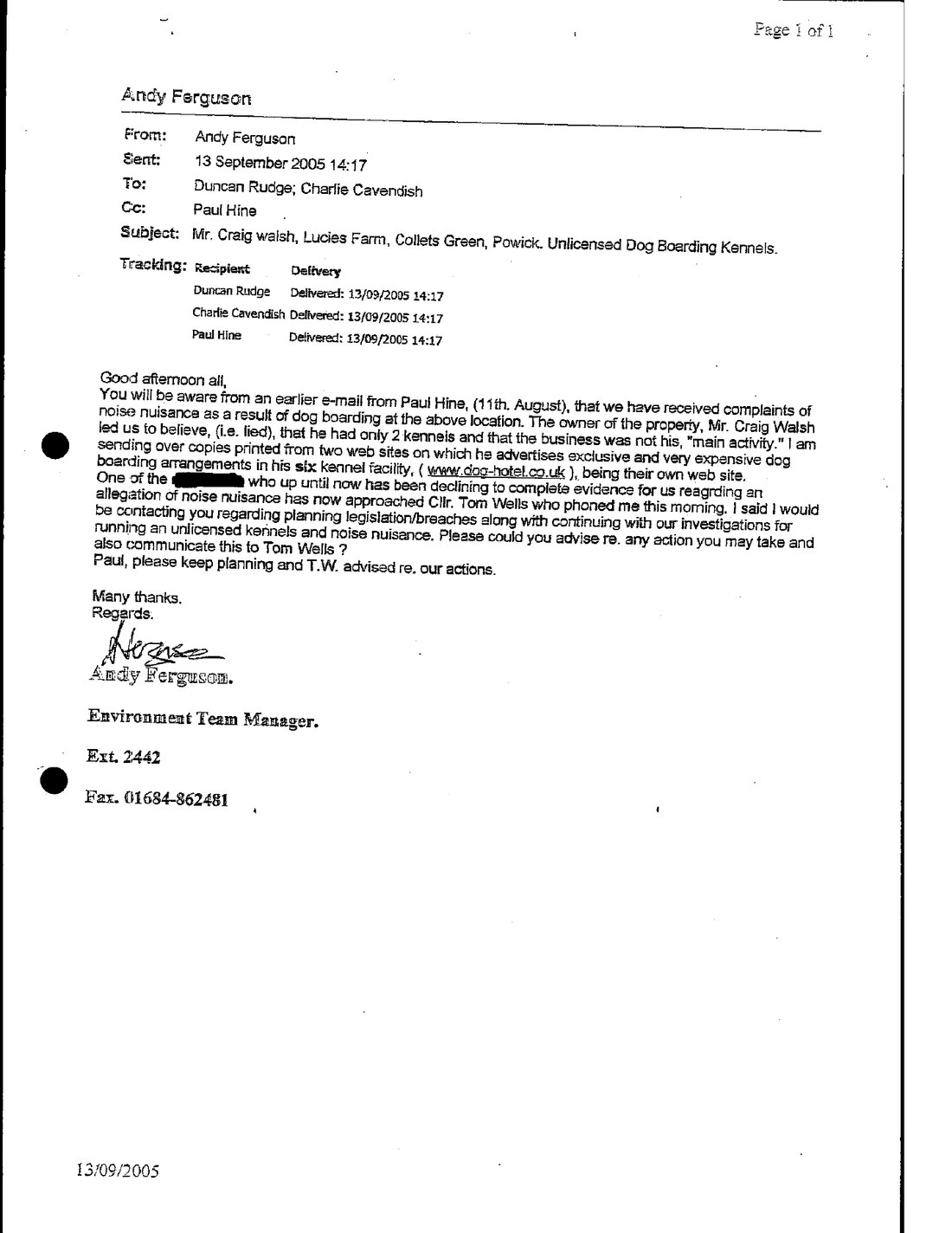
The same email contains two other things. Of Craig, whom no officer had yet found to be doing anything wrong, Ferguson writes that he “led us to believe, (i.e. lied), that he had only 2 kennels and that the business was not his ‘main activity.'” The parenthesis is his.
It was not a lie. It was an interpretation Craig had put to the council in writing, and which the council — having taken it to its own legal department — had confirmed in writing was correct.
On 9 August 2004 at 08:42, Paul Hine had written to Craig about the Animal Boarding Establishments Act 1963: “under section 5 of the Act headed interpretation, sub sec 1A of the Act stating that a licence is not required if the animal boarding activity is not the main activity of the premises, then from the information you have given to me, you are not required to be licensed under the Act.” He had put it to the council’s legal department before answering. Craig replied at 09:13 the same morning: “The dog kennels, if we do them, would only be a minimal activity of Lucies Farm Ltd.”
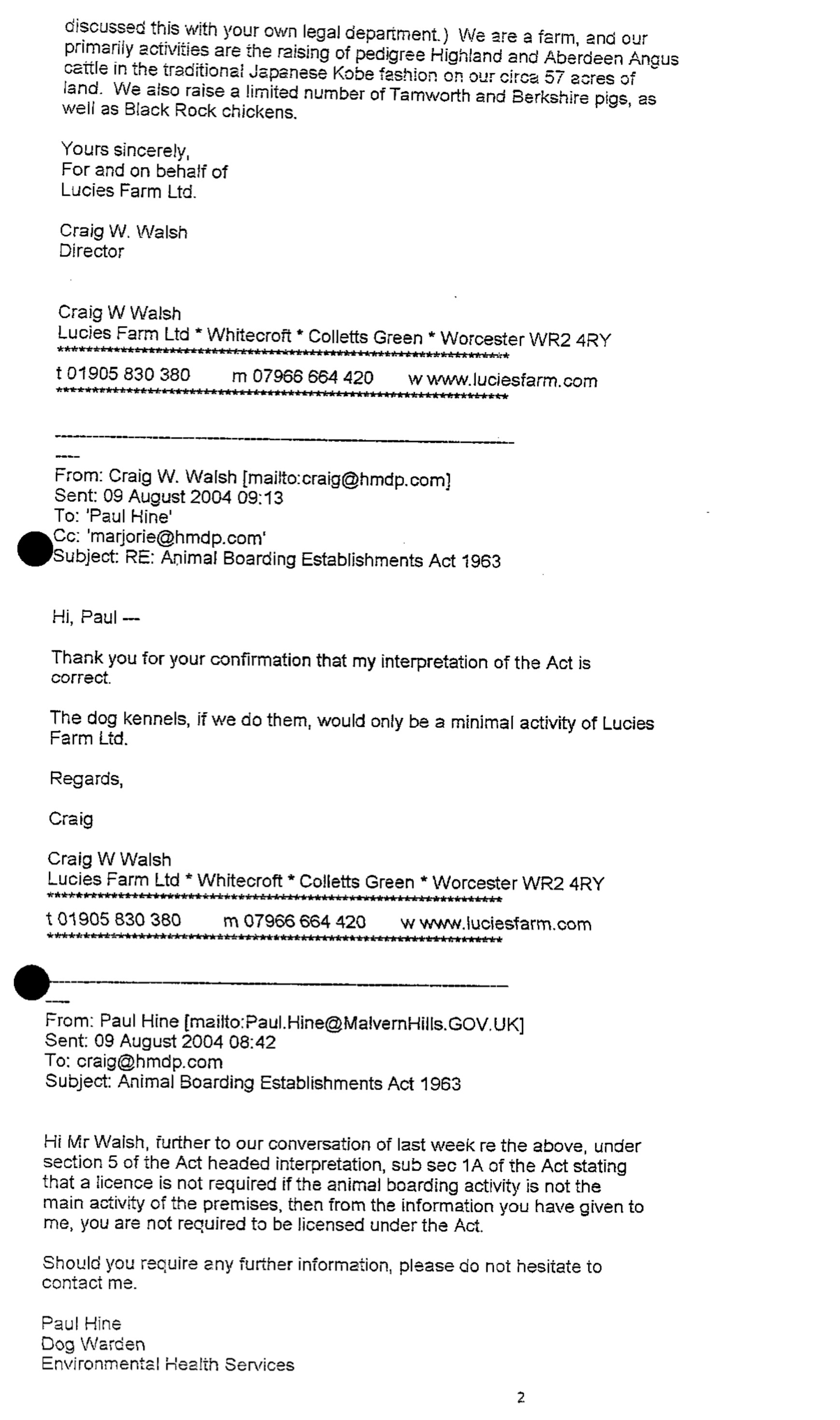
Thirteen months later Ferguson wrote “(i.e. lied)” about a man repeating the council’s own position back to them.
It changed ten weeks after that. On 29 November 2005, Hine wrote again:
“This section of the Act has now been clarified and is aimed at situations for example like veterinary surgeries where the fact that they keep some animals overnight is incidental to running the practice, it’s not the main purpose of the business. So where you are in business of running a farm, the boarding of dogs is not in connection with that business, therefore a licence is required for the boarding of animals.”
The Act asks whether boarding is the main activity. That is a question of size, and on fifty-seven acres with a pedigree herd the answer was not close. The clarified version asks whether boarding is in connection with the main activity, which no farm can satisfy, because boarding other people’s dogs is not farming. The same legal department confirmed both readings, fifteen months apart.
The council’s own later account of it records “a prolonged exchange of letters and e-mails before a final agreement to issue the license.” Then Andy Ferguson and Paul Hine came out and inspected, and there wasn’t a problem.
And he describes the premises as “his six kennel facility” — the emphasis Ferguson’s own. Two and a half years later, Paul Hine would tell a magistrates’ court there were four, and build a case on it.
Then there was the planning permission, and this is where it becomes farcical.
The council believed the kennel had been granted permission subject to a condition forbidding commercial activity. It had an approved permit to prove it, and sent Craig a copy. His own copy carried no such condition. He and Marjorie went up to inspect the files with their own copy in hand, and discovered there were two.
What had happened was this. The kennel had been built under an approved permit. In 1997, while the work was going on, a question arose about the height of the roof above ground level — the building sits near a stream, and where exactly the ground was could be argued over an inch or two. Robert Lett proposed amending the permit, which would have taken a short exchange of letters. The council required a new application instead, and issued a fresh permit, which cancelled out the earlier one. Lett dealt with all of it himself and saw no reason to mention it to the Walshes. And when the new permit was typed, the condition was simply left out of it. Nobody decided to remove the ban on commercial activity. They forgot to type it in — and the old permit, which carried it, no longer existed.
There had always been a kennel on that spot. Before the new building there was a shed of the sort you buy at a garden centre, with concrete slabs laid round it for runs, where the Walshes’ own dogs slept. The 1997 permission was to replace it with something better, and nobody involved thought it a commercial matter. Andy Ferguson, commenting on the application on 6 February 1997, wrote: “In view of the fact that this application relates to the replacement of existing kennel accommodation and do not relate to any commercial activity, I have no adverse comment.”
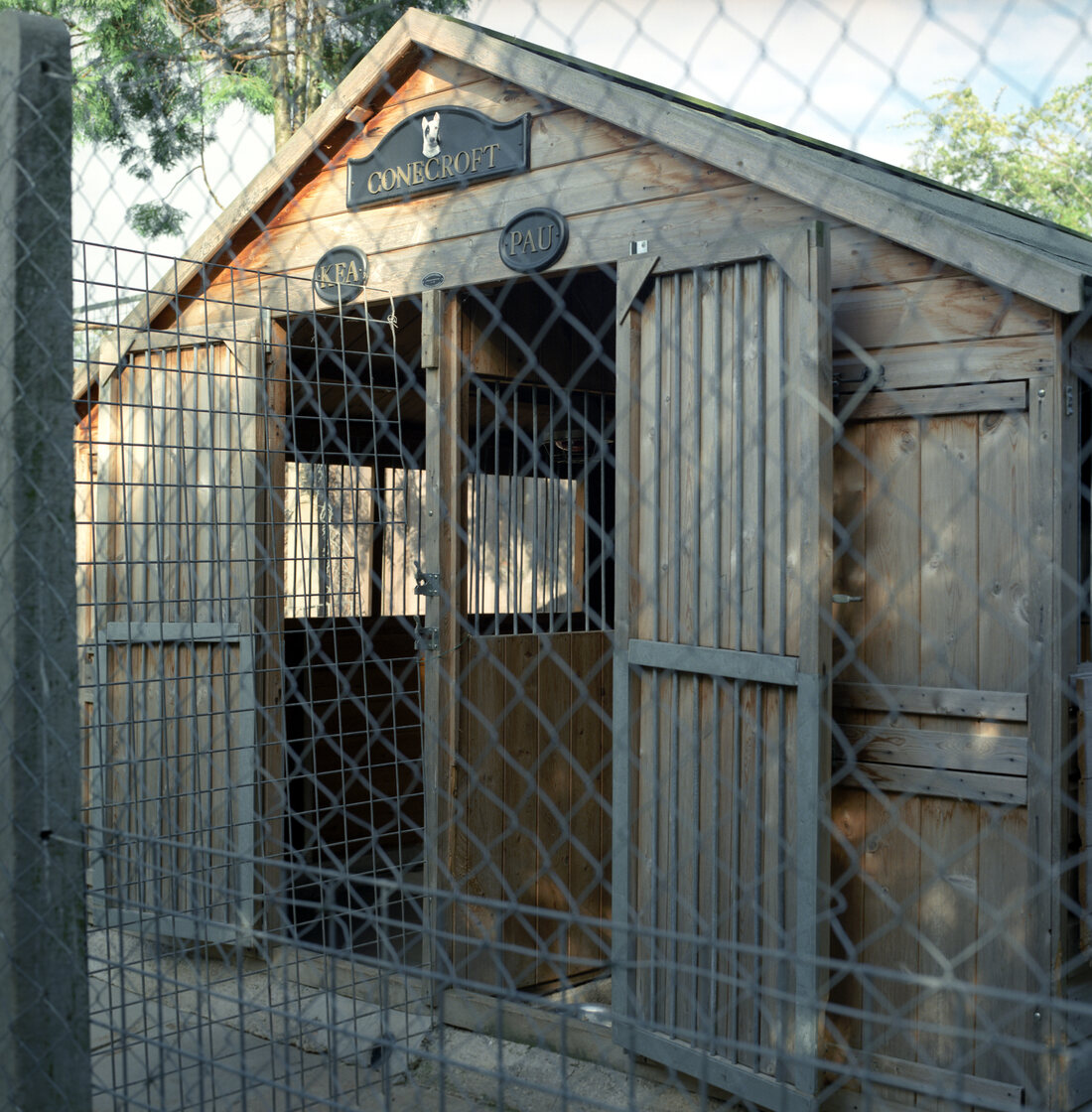
So when Trish Godwin and Tom Wells demanded to know how the council could permit a commercial kennel when the permission forbade it, they were asking a perfectly fair question from a document that no longer existed. And the Walshes, looking at a different piece of paper, could not understand what the fuss was about.
On 8 May 2006, Wells wrote to David Murray, Malvern Hills’ Head of Development Control, on County Council notepaper. Planning had by then formed the view — supported by its own Head of Legal Services — that there was nothing to enforce against.
“I am both surprised and disappointed by the Planning Department’s point of view… I am surprised that the Head of Legal Services fails to support that interpretation. Local residents continue to suffer nuisance from barking dogs… I suspect they may seek an independent review by the Local Government Ombudsman.“
The Head of Legal Services was right, and knew exactly why. The restriction the councillor was relying on had been destroyed by his own council, in correspondence about a roof.
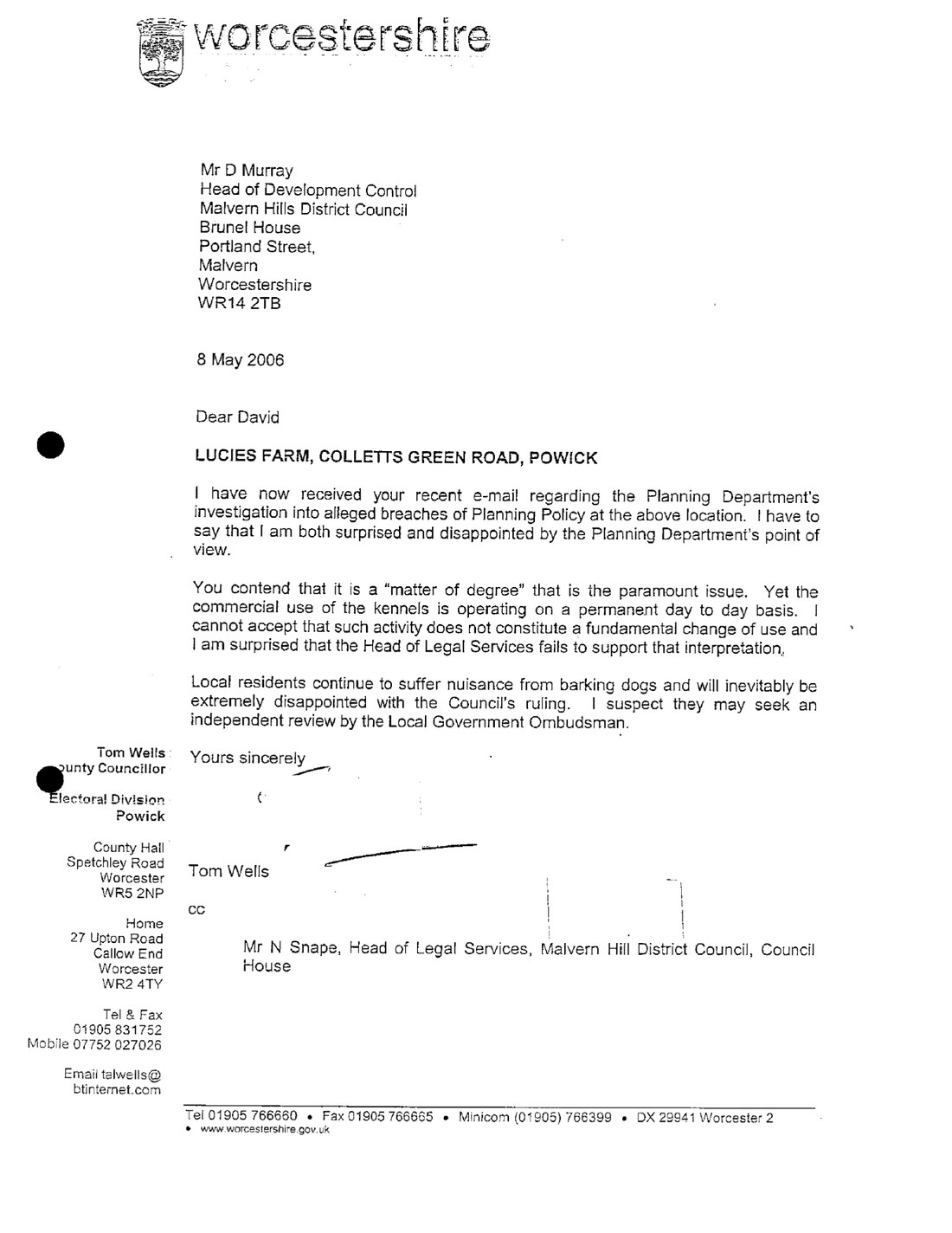
Two months later, Murray wrote to Ferguson:
“Following the meeting with Cllr Wells last week, we need to consider the form of additional noise monitoring to be undertaken in respect of Lucies Farm… I think it would also be beneficial to have a tally sheet brought together of all the visits that [Ferguson] and the Dog Warden have made over the last year, so that we can include this in a response to the Ombudsman.”
Read that twice, because it answers the question the Walshes could never answer for themselves: why nobody ever stopped.
The meeting with the councillor generates the surveillance. And in the same breath, a tally of past visits is assembled as the council’s defence to the Ombudsman. From that moment the visits were not an investigation. They were a record of diligence — and an authority that has begun counting its own visits as evidence of its own diligence cannot afford to stop making them.
Craig once asked the officers whether there would ever come a point at which they visited, found nothing again, and concluded that Mrs Godwin was simply a complainer. They told him that point would never come, because they had no policy for dealing with persistent complainants.
That was true. Four years later, asked by the Ombudsman, Malvern Hills confirmed it in writing: “There is not a formal Council policy on dealing with persistent complaints.”
Wells could have brokered a peace in an afternoon. Craig met him once, over tea, and found him wishy-washy. In September 2007 he carried a further complaint to the County Council instead, about somebody reporting that they had been chased by a bull on footpath PW 611.
There was no bull. There were Highland cattle, and the animal was a cow.
V. A month inside the Cider Mill
In August 2006, under the Regulation of Investigatory Powers Act, Malvern Hills District Council installed directed surveillance equipment inside the Godwins’ house and left it there for the whole month. August is the busiest month of a boarding kennel’s year. The Walshes were not told.
On 12 September, Ferguson emailed Craig:
“I do know that the monitoring at the Godwins is complete with very little barking or evidence of any problems at all related to Lucies Farm — you will be pleased to hear.“
The same email carries something else. Ferguson had met David Murray, who “is under some criticism for making decisions/comments on the need, (or lack of any need), for planning controls to be applied to your site.”
An officer being criticised inside the council for finding that nothing needed enforcing.
The operation was formally cancelled. The authorising officer, Ivor Pumfrey, recorded the reason in writing: very little barking had been recorded and they “were able to prove that no statutory nuisance was being caused from the premises.”
Two days after Ferguson’s email, Patricia Godwin complained to the Local Government Ombudsman. In January 2007 the Ombudsman did not uphold it — and told her, in terms, that the removal of the commercial restriction from the planning permission had not been maladministration by the council.
That was January 2007. It ran for three more years.
And a pattern had by then established itself which never afterwards varied. Every time they looked and found nothing, the conclusion was never that there was nothing there. It was that they had not yet monitored enough.
VI. What they were offered
The Walshes kept trying to have the thing measured, at their own expense.
In August 2006, while the council’s equipment was still in the Cider Mill, Craig obtained a hire agreement for a Class 1 sound level meter and put it to Ferguson:
“Only readings from a Class 1 meter can be admitted in Court… sound measurement — over an entire week, and during our busy time of year — is the best way to quantify the ‘problem,’ rather than dealing only with anecdotal, emotional measurements. But before I incur an expense of £245.00 plus VAT, I’d like to be sure that you and your colleagues think this exercise would be helpful.”
He also offered to install a permanent Class 1 monitor at his own expense, at a spot of the council’s choosing, and leave it there.
The answer came back that it would not be necessary.
They took the cameras instead. Craig gave the council a username and password for the two webcams, one of them in the kennel with stereo sound. Ferguson was careful, in writing, about what he intended to do with the access: “My interest in the web cam with audio facility is not for purposes of measuring or collecting data in any way.”
In 2007 Craig paid a programmer to build the council a system of its own — a password-protected register showing occupancy day by day back to 2004, which “you (or your colleagues) will be able to log into from the comfort of your offices at any time.” By June it was finished and he was about to send them the login.
And in March 2009 he wrote to Malcolm Robinson, an environmental health officer newly on the file, describing the building the council had by then spent three years investigating:
“It was designed by a firm of architects in the States who only designs kennels, and one of the things they considered was the minimisation of noise. The building is double-wall brick construction. The windows are double glazed… One thing we could do would be to drop the interior ceiling, but we were expressly prevented from doing so by your colleagues in the planning department.“
The most effective acoustic improvement available in that building was a dropped ceiling. The Walshes had proposed one. Planning had refused it, on the ground that the building was agricultural.
One arm of the council forbade the remedy because the building was a farm building. Another pursued it as a commercial noise nuisance. In four years there is no sign that either mentioned it to the other.
VII. The warrant
It was not about the number of dogs.
On 28 December 2007 Paul Hine attended Worcester Magistrates’ Court and obtained a warrant under section 9 of the Animal Welfare Act 2006, on the strength of an RSPCA inspector’s report that the Walshes were keeping wild boar, and a statement from a former employee, dismissed some weeks earlier and then in dispute with the Walshes over that dismissal, alleging poor care of the animals. Magistrate M V Eastwood granted it.
The animal welfare allegations came to nothing almost at once, and no proceedings of any kind ever followed from them. Within four months the case had become one about the number of dogs in the kennels; and underneath that, as it had been from the start, it was about barking.
An application for a warrant is heard with only one side in the room. Nobody appears for the householder, because the householder is not told. The magistrate is the whole of the protection they have.
Malvern Hills would later plead that Hine “made and kept a detailed note of his submissions” to the court, and that the information was presented “in writing… and orally by Mr Hine.”
In November 2009 the Walshes’ solicitor wrote to the Clerk to the Justices at Worcester. His letter records what the Clerk who had been sitting that day told them:
“The Clerk stated that Mr Hine presented no information orally whatsoever — simply the written information, on the basis of which Magistrate Eastwood signed the warrant.”
There is no transcript. Applications of this kind are not recorded and no stenographer sits in on them, which is precisely why the note mattered. The document the council produced was described in the same letter as “Mr Hine’s preparatory note for the application” — a note written before, relied upon as a record of what was said during.
Counsel asked the council to state when the note was made; whether Hine “used the note when making his submissions” or “made the note during or after the hearing as a record of what he said”; and to produce the original.
The answers never came.
VIII. Fourteen people
They mustered in the middle of The Greenway, the housing estate across the road, and put on their hi-vis vests. A car parks officer. A streets scene manager. A street scene warden. Two policemen. An RSPCA inspector. Two computer forensics contractors from a PO box in Wolverhampton. Fourteen in all, braced for Craig and Marjorie Walsh.
On the property they found a twenty-five-year-old Latvian.
Malvern Hills would later plead that its people had been “invited onto the claimants’ premises by a servant or agent with apparent authority.” That was him — a farm hand, alone, facing fourteen people at the gate, two of them police officers, with a warrant. Counsel asked the council to name him, to mark on a plan the exact spot where the invitation was said to have been given, to say who had spoken to him beforehand and what they had said, whether anybody had shown him the warrant, whether anybody had told him they had power to enter, and what words he had actually used.
None of it was ever answered.
When the Walshes got home from Bath, they found the warrant on the doorstep. You leave a copy in a prominent place when there is nobody there to hand it to.
Nobody has ever explained what the car parks officer was for.
The two contractors were Phillip Hatton and Andrew Turner, of a company then less than three years old. Hatton’s own witness statement records the geography. Two computers in the office, one in the stables, one in an upstairs bedroom, four storage devices. He and Turner set up in “an adjacent conservatory.” They pulled the drive out of the office machine, previewed it with EnCase, and copied “all Outlook files, all Microsoft Word and Excel documents and data folders for Sage and Quicken accounts.” They photographed the screens as they worked — twenty-nine photographs, timestamped and hashed. They left at 13:10.
Four things about that morning have never been explained either.
They searched the wrong building. The business ran from the tack room of the stable; the house was a dwelling and no relief was claimed on any part of it. They went into the house.
They searched the wrong person’s room. Hatton’s log lists Office, Stables and Bedroom. Marjorie’s den — the room holding everything about the kennel that was not in RezEasy — appears nowhere in the forensic record.
They came for something that was not there. RezEasy was not installed on any machine at Lucies Farm; it ran in Delaware. No amount of imaging could produce a booking from a hard drive in that house, because there were none on them. The two ways to reach the data were to log in or to ask. Hatton’s own statement records that the staff present knew nothing of the computers “other than the system located in the stables” — he knew which machine the workers could open. It had no disk to image. He imaged the house instead.
And he could not get into the accounts. His log reads: “Quicken + Sage are PW protected.” His statement explains why he went no further: “I felt it was however unlikely that Sage would have been used to manage kennel occupancy.”
Nobody had suggested it managed occupancy. It billed it — and every stay raised a VAT invoice, reported to HM Revenue and Customs every quarter. The one application on that machine that recorded every booking, was audited and had already been declared to the Revenue, was the one he declined to open, on a feeling, without asking anyone for the password.
Every booking at Lucies Farm in fact left a trail in seven places, two of them in an offsite email archive in Canada within seconds of the reservation being made. Sixteen years later Craig retrieved the last two bookings the business ever took, from Honolulu, in about a minute.
Instead there was a mirror image of a disabled man’s computer, containing his medical correspondence, his personal finances, his privileged letters to his solicitors, his family photographs, and a spreadsheet listing his wife’s jewellery.
And one more line in Hatton’s statement, three sentences after the one about Sage:
“I was shown an Apple laptop which had been recovered from another part of the farm. This system was not examined.“
IX. Test Dog
What Hatton found on the office machine, he knew was worthless. He wrote it down at the time.
At 11:33 he opened a program called Kennel Connection 5.0 and noted: “only — some customer data — test dogs in Dec? Printed.”
Kennel Connection was demonstration software the Walshes had been given to evaluate and never used. It ran on one computer and could not take bookings online, which was the entire reason they used RezEasy instead. It contained none of their business.
He printed it anyway. The print-out became exhibit PH-1, headed “10/01/2008 — Lucies Farm Ltd — RUN AT A GLANCE”, and it survives. It shows twelve runs across the week of 23 to 29 December 2007. In the whole of that week there is one dog, called Ringo, in Suite 3.
And on the Friday and the Saturday, in the run marked CONSERV, two entries reading “Test Dog.”
The document seized and produced as evidence that the Walshes were over-filling their kennels has the words Test Dog printed on its face, and the examiner’s own note records that he noticed.
X. Arithmetic
The case for over-occupancy was built four months later, at a desk, by Paul Hine — not from the booking system but from Craig’s Outlook calendar, taken off the machine Hatton’s log labels “Craig-new.” The diary of the man who, on the Walshes’ pleaded case, had virtually nothing to do with running the business.
He counted the reminder list.
“I don’t know why there were things in Outlook,” Craig says. “Probably so reminders would pop up. I used, and she used, RezEasy as the definitive, most up-to-date reservation picture.” Bookings arrived by email at all hours; the diary held what someone had been told and had thought to note down, between the lameness in Priscilla and the meat for the cold store.
Hine’s reasoning ran as follows. The licence permitted ten dogs at any one time, and only dogs from the same household might share a kennel. From which:
“If 4 clients each have one dog, then a total of 4 dogs are permitted. At any one time no more than 4 clients are permitted as there are only 4 suites available.“
The logic is sound. The premise is not — and the document that contradicts it is one Hine himself exhibits. Describing the renewal application, he writes that on it “question 2 was answered 4 suites and question 10 answered 2 suites in stable block.”
Six suites, declared to the council on the form the officer produces in evidence, three paragraphs after he tells the court there were four. Andy Ferguson had called it a six kennel facility in 2005.
Then the numbers. His worked example is 1 January 2007 — New Year’s Day, the highest-turnover day in a boarding kennel’s year, when everybody collects their dog. His own list shows three separate collections spread across it. He concludes:
“in total during the day there were 13 dogs on the premises, 11 clients, 3 dogs were checked out, none were checked in, meaning that there were, at any one time, 8 clients with 9 dogs.“
Nine dogs. The licence permitted ten.
His schedule for the rest of the year runs: 2 January, 6 dogs. 5 January, 6 dogs. 6 January, 6 dogs. 19 January, 8 dogs. 27 January, 6 dogs. 28 January, 6 dogs.
Not one figure approaches ten. Every client figure fits inside six suites.
To prove that a kennel was over-full, a council officer counted the private diary of the owner who did not run it, on New Year’s Day, and arrived at a number below the licensed limit — measured against a client cap he had derived from a suite count his own exhibit contradicted.
The reservation system he did not look at is named nine times in the councils’ files. Every one of those mentions is Craig, writing to them, explaining what it was and offering them a login.
XI. Letters to the customers
On 12 August 2008, Tracey Blanchard of Worcestershire County Council’s Trading Standards Service began writing to the Walshes’ clients.
“I am contacting clients I know have previously used the kennels. From records, I believe that your German Shepherd, Enoch boarded at the kennels from 30 August 2006 to 10 September 2006.“
The dog’s name, its breed, and the precise dates that household had been away from home — taken off the seized computer and posted out with a questionnaire.
Blanchard described her source: “This is how I have obtained the customer database for Lucies Farm… Information examined has been limited to the customer contact list.”
There was no customer database and no contact list. There was a man’s diary, and somebody had made one out of it.
The answers did not go as expected. Pam Dorsett returned hers on 14 August. Asked what had attracted her: “personal attention, cleanliness + understanding of dogs. I appreciated the absence of dog noise + the contented guests.” Asked what she paid: “This is between me + Lucies Farm.” And in the comments box:
“I am horrified that you send these forms to Lucies clients. You must surely be guilty of destroying a business with this crass, heavy footed behaviour.“
She posted the Walshes a copy, with a note: “enclosed a copy of my reply to the puffed up little pricks in the council offices. See you with Sam in October.”
Another client’s form came back endorsed in her husband’s hand, in capitals: “AN EXCELLENT ESTABLISHMENT.” He was a city councillor himself, and he wrote separately threatening to prosecute the county council under the Data Protection Act, having noticed what nobody at Worcestershire had:
“as you have obtained details about the dates we put our dog into the kennels concerned you will be aware of the time of the year when we are away from our home.”
The council had compiled, and posted out, a schedule of when its own citizens’ houses would be empty.
Three weeks later, on 4 September 2008, the same service wrote to the same list: enquiries complete, no further action, “absolutely no reason why you should not continue to use the facilities of Lucies Farm”, and “all data containing personal records will now be destroyed.”
The information had indeed been extremely useful. It consisted of signed statements from the kennel’s customers saying the place was excellent, the dogs were happy, there was no noise, and the investigation was a disgrace.
The last sentence of that letter was not true.
XII. The data
Hatton had driven the copies home to Wolverhampton and kept them for at least eight months. He was not registered as a data controller. Craig checked the register, then telephoned the Information Commissioner’s Office, who confirmed it.
Hatton’s answer was that he did not need to be, being merely a processor. As to why he had taken material with no connection to a kennel licence:
“In any event in this era of proceeds of crime investigations personal data of many kinds may be relevant to the case.“
There was no proceeds of crime investigation. There was a complaint about a dog kennel.
When the council eventually returned the drive, it was marked “Copy.” On being challenged, the Walshes were told Hatton still held two more.
On 13 January 2010 the Information Commissioner issued its assessment. Worcestershire had explained that it operated to Hatton’s standard terms and conditions “but that no contract exists“ between them.
That was fatal. Because he was a processor and the council the controller, the Act required a written contract. There wasn’t one.
“In light of this it is my assessment that it is unlikely that the council has complied with the DPA in this case.“
Asked why it was keeping the material at all, Worcestershire told the Commissioner it was doing so under the limitation period for civil proceedings, “in the event that a civil case is brought against them.”
They were keeping a disabled man’s medical correspondence as their defensive file in the litigation about their having taken it.
XIII. Not a suitable person
Seven weeks after the raid, Malvern Hills moved to close the business down.
It had before it applications for a Dangerous Wild Animals licence and for renewal of the boarding licence. In March 2008 it refused both, and said why:
“following the execution of the warrant to enter your premises… the evidence obtained from that visit… it has been decided to refuse both applications on the grounds that you are not a suitable person to hold such licences.”
And: “trading and bookings must cease forthwith and in any case by Tuesday 25 March 2008.”
The letter carries the council’s own strapline down the side: Committed to Excellence — Rated ‘Excellent’ by the Audit Commission.
The Walshes fought it, and thirteen months later the same council licensed them again.
Licence 09/00272/DWAB was issued on 17 April 2009 over the signature of M. Robinson of the Environment Section — the officer to whom Craig had written a month earlier about the dropped ceiling. His inspection findings, in full, were that there was chewing and scratching on the kennel doors, which Craig had already said he intended to replace, and that in kennel 1 there appeared to be “some minor damage to a mortar joint in the block work.”
In December 2007 the animals at Lucies Farm were the subject of a warrant sworn under the Animal Welfare Act. In April 2009 the same council inspected the same premises and wrote down: some dogs have chewed the doors, and there is a bit of loose mortar.
Either the raid produced nothing capable of supporting the refusal, or the refusal was wrong.
By the following year Malvern Hills could not do the inspecting at all. The file had moved out of environmental health and into the hands of Nigel Snape, the council’s Head of Legal and Governance, and the vet who came was Hamish Wilson of Townsend Veterinary Practice in Bromsgrove, who — as Snape put it — “carries out similar inspections on behalf of another local authority.” Craig’s recollection is that the last renewal was handled by a neighbouring council altogether.
The reason was not complicated. Malvern Hills had nobody left to send whom the Walshes had not sued.
XIV. Eighteen visits
The noise complaints did not stop when the litigation started. They intensified.
Between May and August 2009, officers of Malvern Hills visited Colletts Green eighteen times. Their own record: the 5th, 6th, 11th, 26th, 29th, 30th and 31st of May; the 1st and 20th of June, on both of which they “observed no barking”; the 24th, 25th, 27th and 30th of July; the 1st, 3rd, 6th, 7th and 10th of August.
On one of those eighteen occasions an officer recorded prolonged barking at “potential nuisance levels.” On the other seventeen he did not.
They were not always at the gate. That summer Craig wrote to an acoustic consultant:
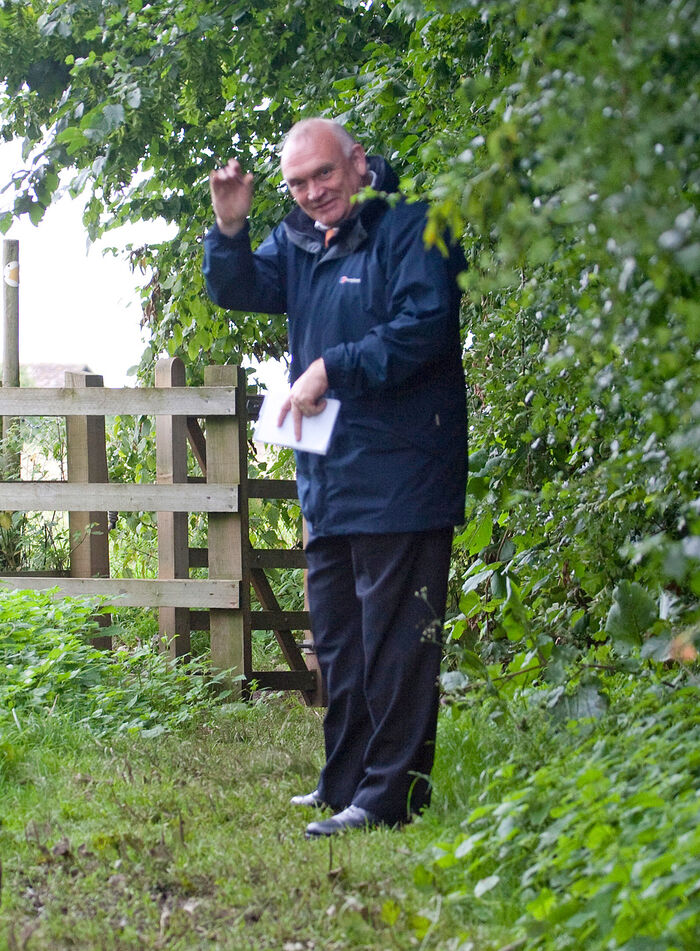
“We had Andy Ferguson prowling around again this afternoon — attached is a photo from one of our surveillance cameras. Our colleagues spotted him in the bushes, and once he realised he was rumbled he headed off further down on the footpath and must have doubled back to his car.”
The farm staff took the dogs out several times a day and had begun coming back laughing: the council men were in the hedge again.
His notebook survives as well — dozens of pages of it, photocopied into the council’s own disclosure. This is the entry for Monday 10 August 2009, two days before what happened next.
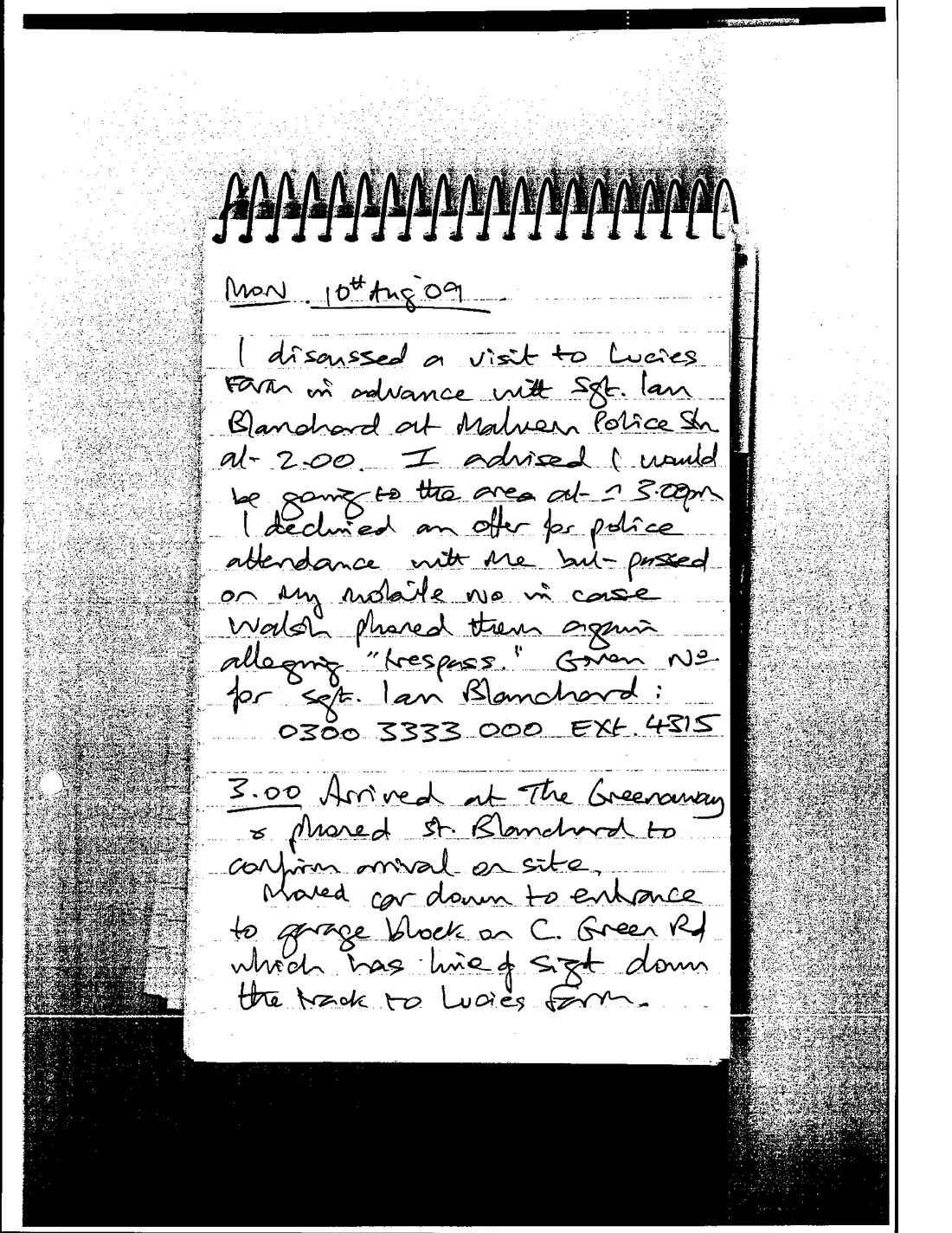
He had parked at The Greenway, where the fourteen had formed up nineteen months before.
It was that summer the Walshes stopped being polite about it. Craig had spent four years going round his own house with a can of WD-40, oiling the hinges so the doors would not squeak. He stopped. “This is crazy. I don’t want to live like that.” Marjorie had counselled restraint throughout; when she said she had had enough too, it ended.
Contractors arrived to prepare for a six-foot wall on the Walshes’ own land, hard against the Cider Mill. Craig had no intention whatever of building it. The men were his usual fencing contractors and they went along with the whole kabuki: surveyors’ tools, and a great many little coloured flags on thin metal sticks, planted with enormous care along the boundary over the course of a day.
“The measuring for the wall only works,” Craig says, “if they think you are going to do it.”
By the time Slade wrote to the Godwins in August, the bluff had been engineered down to the product name — a two-metre acoustic barrier, four inches thick, with gaps in front of their driveway and door to preserve their rights of way, and perspex apertures so as not to reduce their light. And with it, “a Class 1 noise monitor on their land, but on your side of the boundary, so that noise levels can be monitored constantly.”
The third such offer in three years.
A camera went up in a tree, pointed not at her window but down the track the Walshes owned. And a dog-waste bag dispenser appeared on the track with a bin beneath it, emptied daily by the farm staff — Craig having gone to some trouble to source the same dispenser and the same bags the council used in its own dog parks. There were many places it could have gone. It went opposite her kitchen window.
“I think more than anything the webcam spooked her.”
Then, on Wednesday 12 August 2009, the Worcester News gave over half its front page to a photograph of a heavy-set man in a white shirt and red tie, standing in long grass among the leaves with a camera raised to his eye.
“THEY’RE SPYING ON ME.”
“CAMERA: The council officer snapped by farmer Craig Walsh carrying out surveillance of his property because of complaints.” The story described “a council snooper spying on a disabled farmer in Malvern — because of complaints about barking dogs”, and recorded that the officer had been found “peering in through bushes on two occasions last week”, from a public footpath running through the Walshes’ own land.
“I found him literally peeking through our conifer hedge. I found it chilling and quite Orwellian… How many people would like this little bureaucrat hiding in their back hedge with his camera and pad?”
Malvern Hills District Council’s statement to the paper, in full:
“There has been a long history of enforcement problems at Mr Walsh’s property. Mr Walsh has previously complained about the actions of Malvern Hills and Worcestershire councils and their officers… None of these have been upheld by the council’s standards committee or by the local government ombudsman. Mr Walsh is currently pursuing claims against the council through the courts… Under these circumstances, it is inappropriate to make any further comments.”

The photograph the paper ran came out of a short burst, and the camera wrote the times into the files. They are still there.
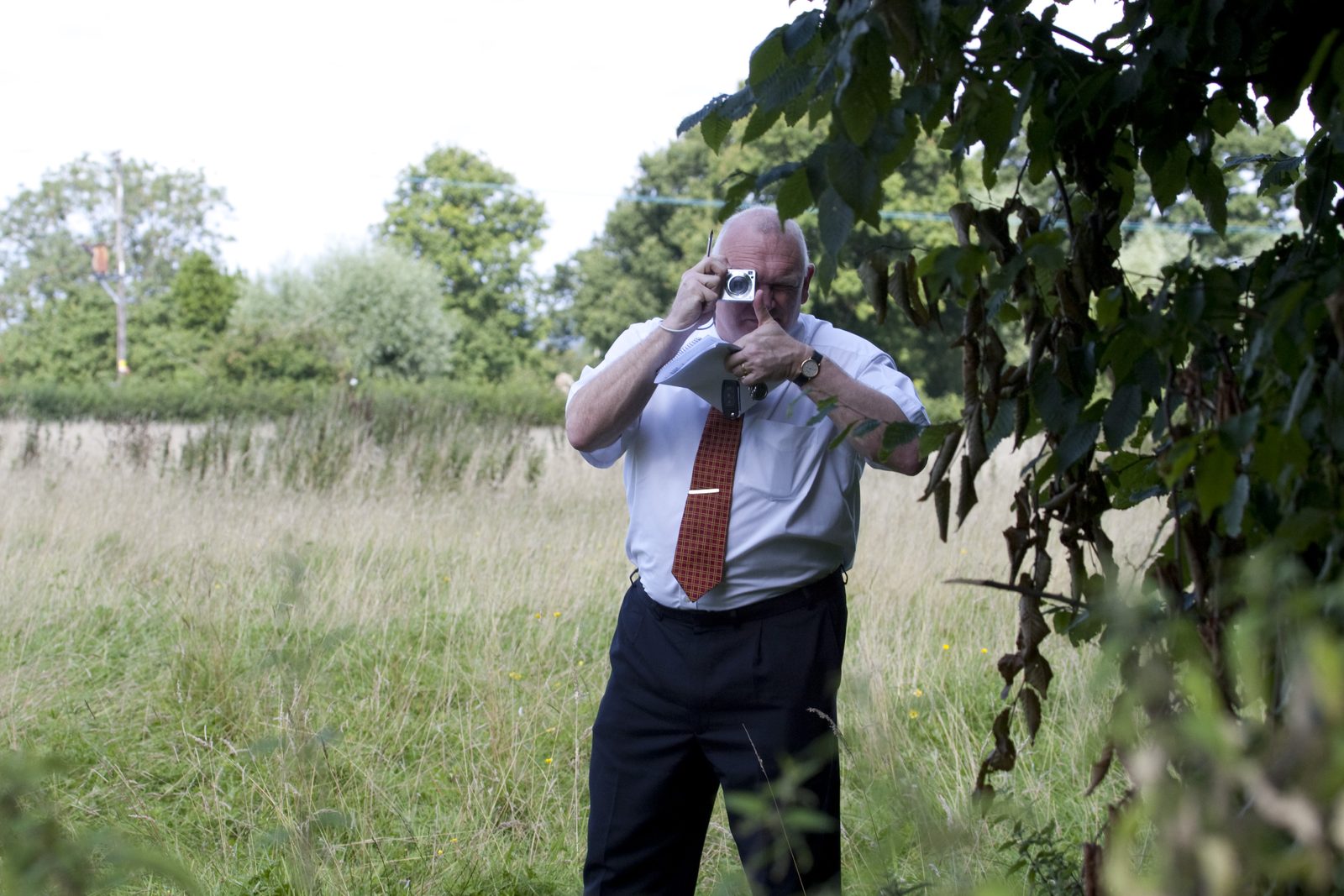
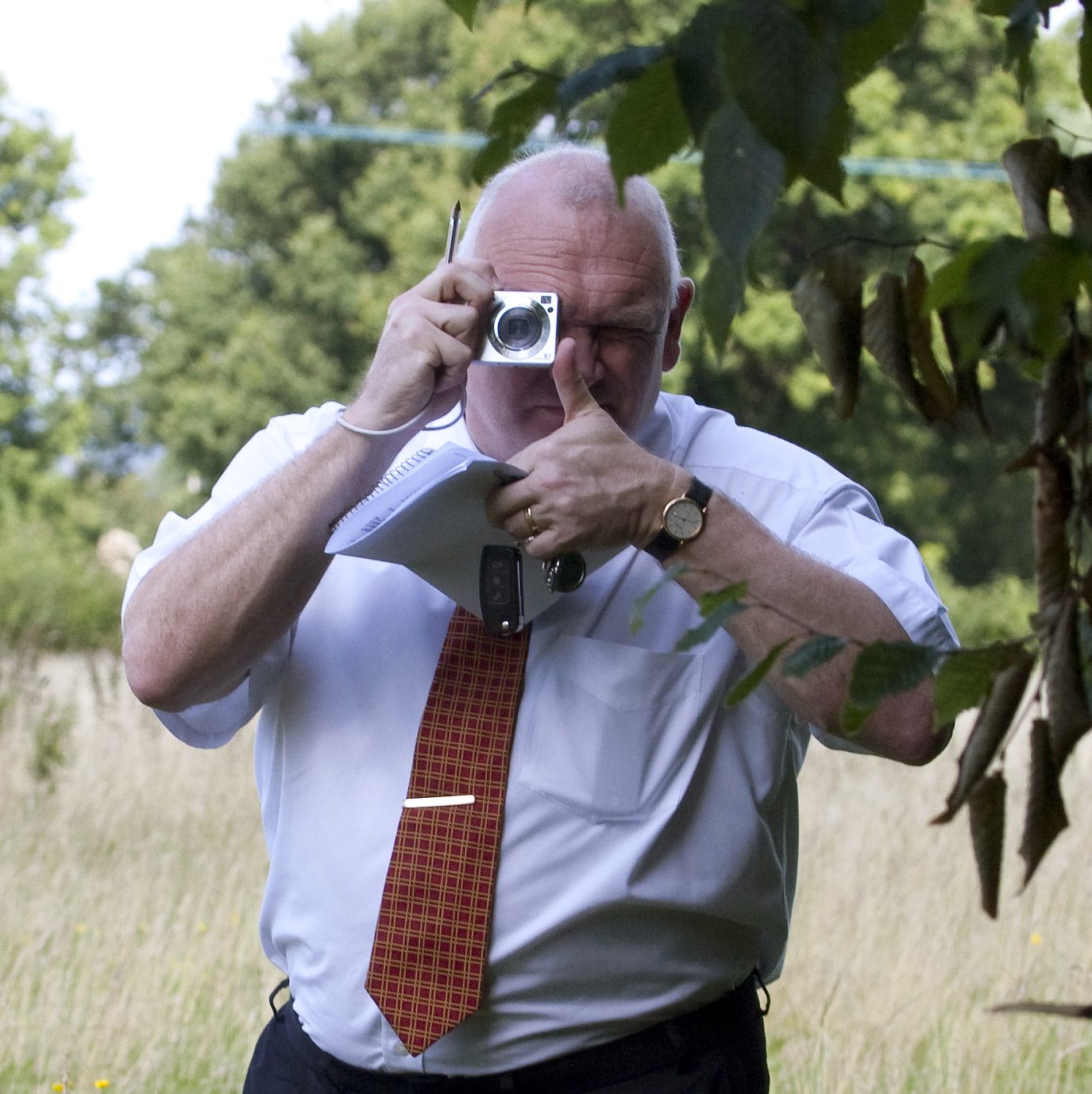
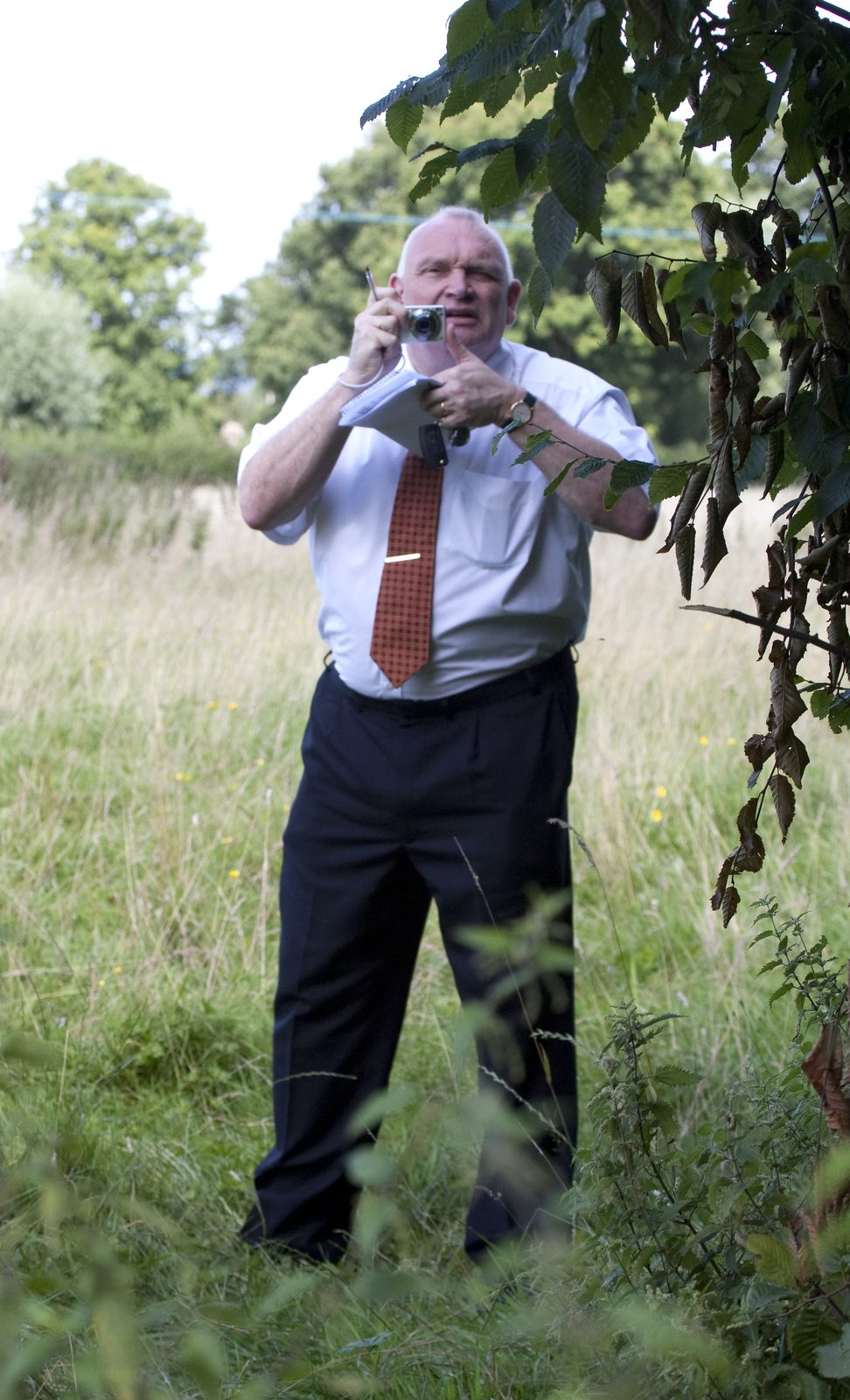
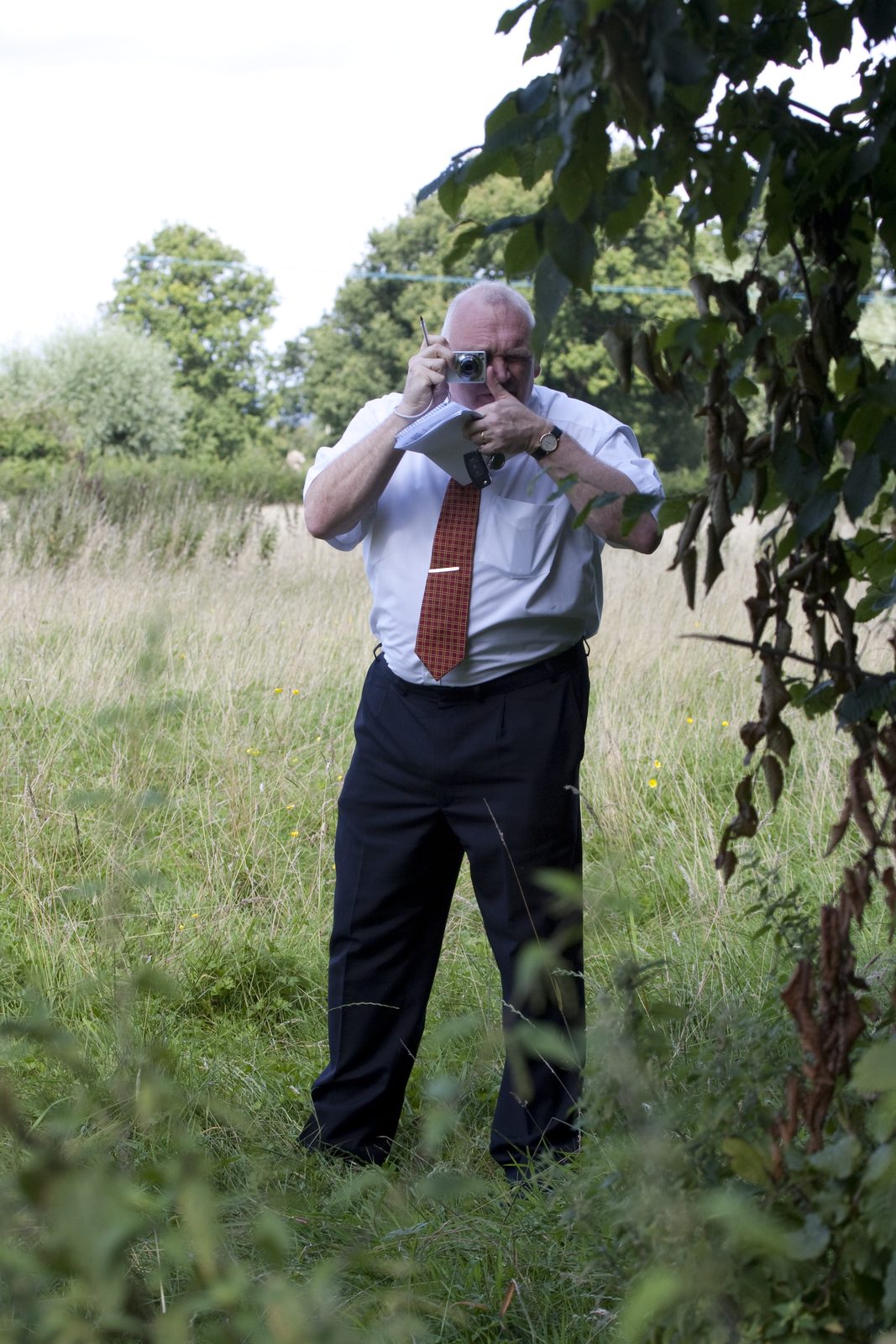
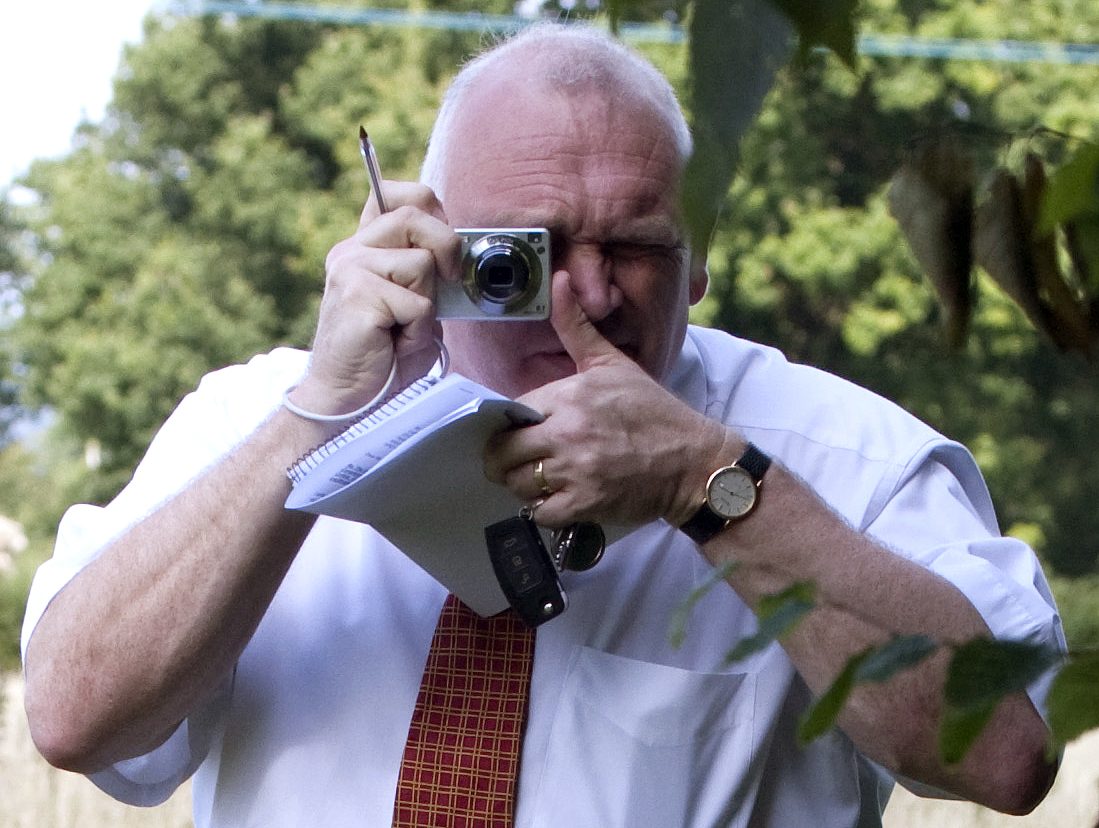
Six frames, timed by the camera that took them. One on Thursday 6 August 2009 at 15:53:30; five on Friday 7 August between 14:43:15 and 14:43:23 — eight seconds. The Worcester News, the following Wednesday, reported that the officer had been found peering through bushes “on two occasions last week.” Camera and pad, in both hands, on both days.
Photographed in a hedge, and the answer was the complainant’s record of complaining.
It did not stay in the newspaper.
XV. Biggleswade
Three weeks after that front page, the Local Government Ombudsman wrote to Malvern Hills’ Chief Executive.
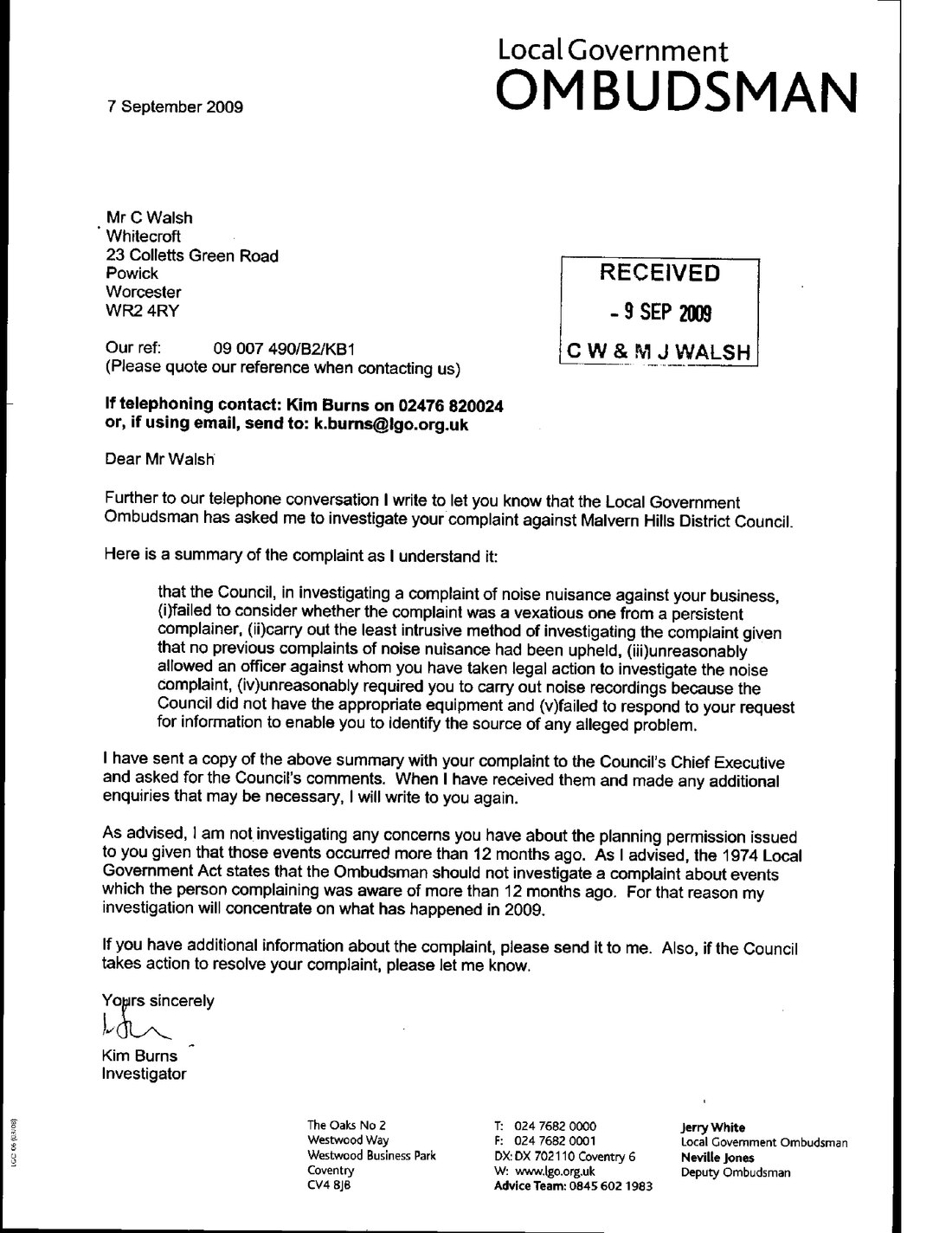
Craig had complained, and on 7 September 2009 Kim Burns of the Ombudsman’s office set out what she had been asked to investigate: that the council, in pursuing a noise complaint against his business, had
“(i) failed to consider whether the complaint was a vexatious one from a persistent complainer, (ii) [failed to] carry out the least intrusive method of investigating the complaint given that no previous complaints of noise nuisance had been upheld, (iii) unreasonably allowed an officer against whom you have taken legal action to investigate the noise complaint, (iv) unreasonably required you to carry out noise recordings because the Council did not have the appropriate equipment, and (v) failed to respond to your request for information to enable you to identify the source of any alleged problem.”
Three weeks after that, Malvern Hills did the thing it had been asked to do in 2006. It hired an acoustician.
Spectrum Acoustic Consultants came from Biggleswade. Their man arrived on 1 October, set up a Norsonic Type 140 — a Type 1 meter, the kind the Walshes had been told was unnecessary — and left it running for seven days, sampling every second, calibrated before and after, set to capture audio whenever a noise event broke 60 decibels so the source could be identified. He was on site through the day, back at ten past ten at night, and back again at eleven minutes past midnight.
The council chose where the meter went, and it did not go at the nearest house: at the closest property “the instrumentation being clearly visible… the risk of modified behaviour would have increased.” Three years on, the method was still concealment.
“The measured noise levels show the area to be very quiet. Comparison with the National Noise Incidence Study suggests that the noise exposure of residents in this location is in the quietest 5-10% of the country.”
Across seven days and 604,800 one-second measurements, thirty-three seconds contained a noise above 60 decibels that could be identified as a dog. Nothing at all was logged on two of the days.
“Dog-bark events exceeding LAFmax 60 dB were infrequent, and none occurred during the night.”
He could not attribute them with confidence in any case — “it can not be guaranteed that the dog bark was from Lucies Farm itself” — and against the loudest sequence of the week he wrote in his own table: “Barking very clear ~ perhaps dog being walked on road or footpath?“
On what he actually heard, standing in the lane:
“dog barking could be heard from time to time, but was often masked by other noises, such as cars, aircraft, domestic activity (lawnmowers), agricultural activity (tractors etc) and birdsong and other animal noises (ducks, cockerel etc)… The dog barking that I observed was, in my view, characteristic of the rural environment.”
And on the eighteen visits:
“MHDC have investigated the complaints repeatedly, and on just one visit out of at least eighteen visits, witnessed a potential Statutory Nuisance… I do not consider their investigation justifies [an abatement notice].”
Then, having been paid to review the council’s own work, he told it that it had been going at the wrong time of day: “All officer visits were during the afternoon… It may have perhaps been beneficial for the officer to have visited at different times of the day.”
Which mattered more than it sounds. The guideline he was working to applies at night. Short noisy events in the afternoon are not, in the standard’s terms, important. For four years the council had been listening at the only time of day when the measurement could not have told it anything.
The report reached Malvern Hills on 17 November 2009. The council wrote to Mrs Godwin to say there would be no further investigation unless conditions materially changed, and that if she wanted to take it further she must engage her own acoustic consultant and bring private proceedings.
She went quiet.
“I was mad at myself for not taking the offensive — politely — earlier,” Craig says. “She was just a neurotic bully. Bullies often back down.”
XVI. Eleven thousand pounds
Proceedings had been issued on 31 March 2009 in the High Court, Chancery Division. The pleadings were settled by George Laurence QC; the solicitor was Richard Slade.
There were thirteen defendants: the two councils, and eleven people — five officers of Malvern Hills, four of Worcestershire, and the two contractors. Fourteen came up the track. Eleven of them were sued.
The defence did not hold together. Malvern Hills pleaded that Hatton and Turner were engaged by Worcestershire and “not connected contractually or otherwise” to it — while the cover of Hatton’s own report reads “Submitter: Malvern Hills District Council.” Hatton and Turner pleaded that they had acted for “Malvern Hills District Council and/or Worcestershire County Council”, being unable to say which, and sued both for a contribution.
The Walshes’ own solicitor put the case in one sentence, in his paper for the mediation:
“The Malvern Hills District Council appears to have allowed itself to be sucked into the neighbourhood dispute against Mr and Mrs Walsh’s interests. It had no business allowing that to happen — but that it has happened is clear. Nothing else can explain the extraordinary events which occurred on 10 January 2008.“
Mediation was fixed for 20 January 2010. Slade required Hine and Ferguson to attend in person, with named decision-makers from both councils. “To confirm, we have no intention of bringing counsel with us.”
The two of them and their solicitor, across a table from the officers.
They asked for apologies, for the data to be returned and deleted, and for £20,000. On 15 February Henry Bermingham for Malvern Hills went through the draft line by line. Against the acknowledgement: “Not agreed, there will be no admission of liability.“ On the money: “We are instructed to go NO further than £6k… Trespass damages would be less than £1k.“
The Tomlin Order was dated 30 March 2010. Malvern Hills paid £6,000, Worcestershire £5,000, both “without any admission of liability.” Both paid the Walshes’ costs, and both paid £10,750 each to Hatton and Turner on the contribution claim — the contractors brought in to search the house recovering their costs from the authorities that sent them.
The councils paid the Walshes £11,000 in damages, £21,500 to the two contractors, and the Walshes’ costs, which stood at £96,000 plus VAT before the assessment began. What they paid their own three firms of solicitors has never been published. The Walshes’ estimate of the whole affair is £350,000.
The kennel that started it had cost £34,000 to build.
Malvern Hills had legal expenses insurance. Worcestershire did not, and none of it had been budgeted for, and the county council asked whether it might pay in instalments.
Which meant asking Craig Walsh whether he would accept payment in instalments.
The cheques came one at a time over the following months. “When each check arrived,” he says, “I remember thinking how much more useful this money would have been for Worcestershire if it had been used to fund education — school improvements, teachers’ salaries — or even infrastructure.”
There was no apology. There never was one.
And after that it stopped. Whatever else the settlement did, it ended the thing: no more visits, no more monitoring, no more officers on the footpath.
XVII. Afterwards
The kennel went on taking bookings through the settlement and into the summer. The last dogs went home in early September 2010, and the sale of Whitecroft completed on 24 September. By then Richard Slade and Associates was growing and the Walshes were spending more and more of their time on it; it was simply time to scale down the physical business of a farm. They sold it and moved to Vermont.
Worcestershire Regulatory Services was created in 2010, the year the case settled: Worcestershire’s Trading Standards merged with the environmental health and licensing teams of all six district councils, Malvern Hills included, and hosted by Bromsgrove. Both of the bodies that came up the track in January 2008 ceased to exist as separate units within the year. Most of the officers involved, Craig believes, were made redundant.
Phill Hatton Forensic Computing Ltd — company number 05416004, incorporated in April 2005, and so less than three years old on the morning of the raid — was renamed Arcanum Digital Forensics Ltd in January 2017 and dissolved in September 2024. Phillip Hatton is described today as Senior Digital Forensics Practitioner at Arcanum, whose corporate vehicle is Arcanum Information Security Limited, registered at the same address in Caerphilly. It is an NCSC-assured consultancy working in critical national infrastructure and defence, and it writes publicly about its pursuit of ISO/IEC 17025 — the international standard governing the competence of testing and calibration laboratories.
“While I will probably never wear a white lab coat,” Hatton notes, “I do feel much more like a forensic scientist now.”

Councillor Tom Wells is still in public life. He sits as an independent Worcestershire county councillor for the division that includes Powick, and has held the county cabinet portfolio for Highways and Transport — which covers public rights of way.
And on 10 May 2022, having previously been Deputy Leader, Councillor Wells was elected Leader of Malvern Hills District Council — the authority that obtained the warrant. He was re-elected at the annual council meeting of 23 May 2023. “It is an honour and privilege,” he said on taking it, “to have been asked by fellow councillors to be their Council Leader.”
As the Walshes drove away from Whitecroft for the last time, Harry Godwin stood outside his house and gave them the finger.
For years afterwards they sent the Godwins postcards from wherever they happened to be. “Having a great time, hope you are both well.” “It’s lovely here, you should see it.”
They thought the Godwins would be glad to know they were enjoying themselves.
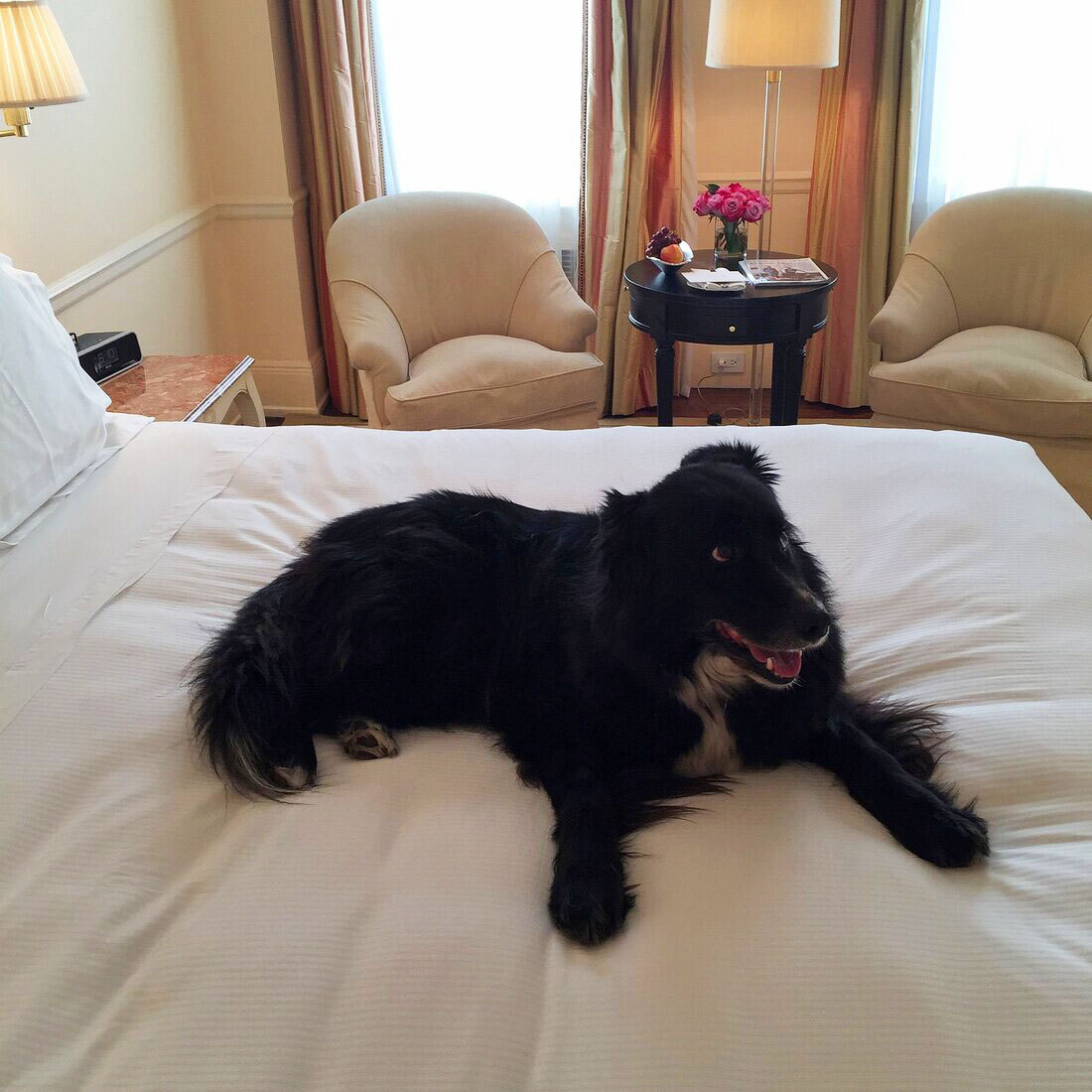
There was a dog called Barney.
He had been found as a stray on a beach in Ireland and came to Lucies Farm as a paying guest, boarding for the best part of a year while his owner and her husband built a house in the west of the country. When it became clear he would not be going with them and would need a home, Marjorie said they would take him. The next day there arrived a very large bottle of champagne, the biggest box of chocolates Craig had ever seen, and a flower arrangement in a vase three feet high. Honestly.
He was a border collie. He went with them to Vermont, and Craig trained him as a diabetes alert dog. With Mana, their bull terrier, he came on every road trip: forty-nine states, and at least four crossings of the continent. In 2016 he moved to Hawai’i and discovered the beaches.
From a beach in Ireland to Frette linen at the Carlyle.
He liked fountains and ornamental pools, because they had carp in them, and he would watch the fish for hours — thinking, Craig believes, about how to herd them.
And at every dog park he ever visited he did the same three things. He walked the perimeter and checked all the fences, like a Council official. Then he visited every human present, one at a time. And then he went and stood at the gate, to let everybody know that his work was done and they could go home.
A note on sources
Every document quoted here was disclosed to Craig and Marjorie Walsh by Malvern Hills District Council and Worcestershire County Council under the Freedom of Information Act, or was filed in proceedings to which the Walshes were parties, or is their own correspondence.
Public officials are named where they acted in their public functions, and are quoted from their own documents. Customers of the kennel are not named, except for those who chose to put their names to the matter themselves by writing to Trading Standards about it.
In September 2008 Worcestershire County Council assured a hundred or so dog owners that all data containing their personal records would now be destroyed. In 2009 it told the Information Commissioner it was keeping that data for six years, in case it got sued.
Worcestershire kept the records it had promised to destroy. The Walshes kept the records Worcestershire was obliged to hand over.
Every fact in this account comes from their own paperwork.
The kennel, as it was
The Lucies Farm dog hotel website and its sister site, Ritz Canine, are preserved exactly as they stood, at dog-hotel.co.uk/archive and dog-hotel.co.uk/ritz-canine. They are archives. The kennel closed in 2010 and cannot take bookings.